
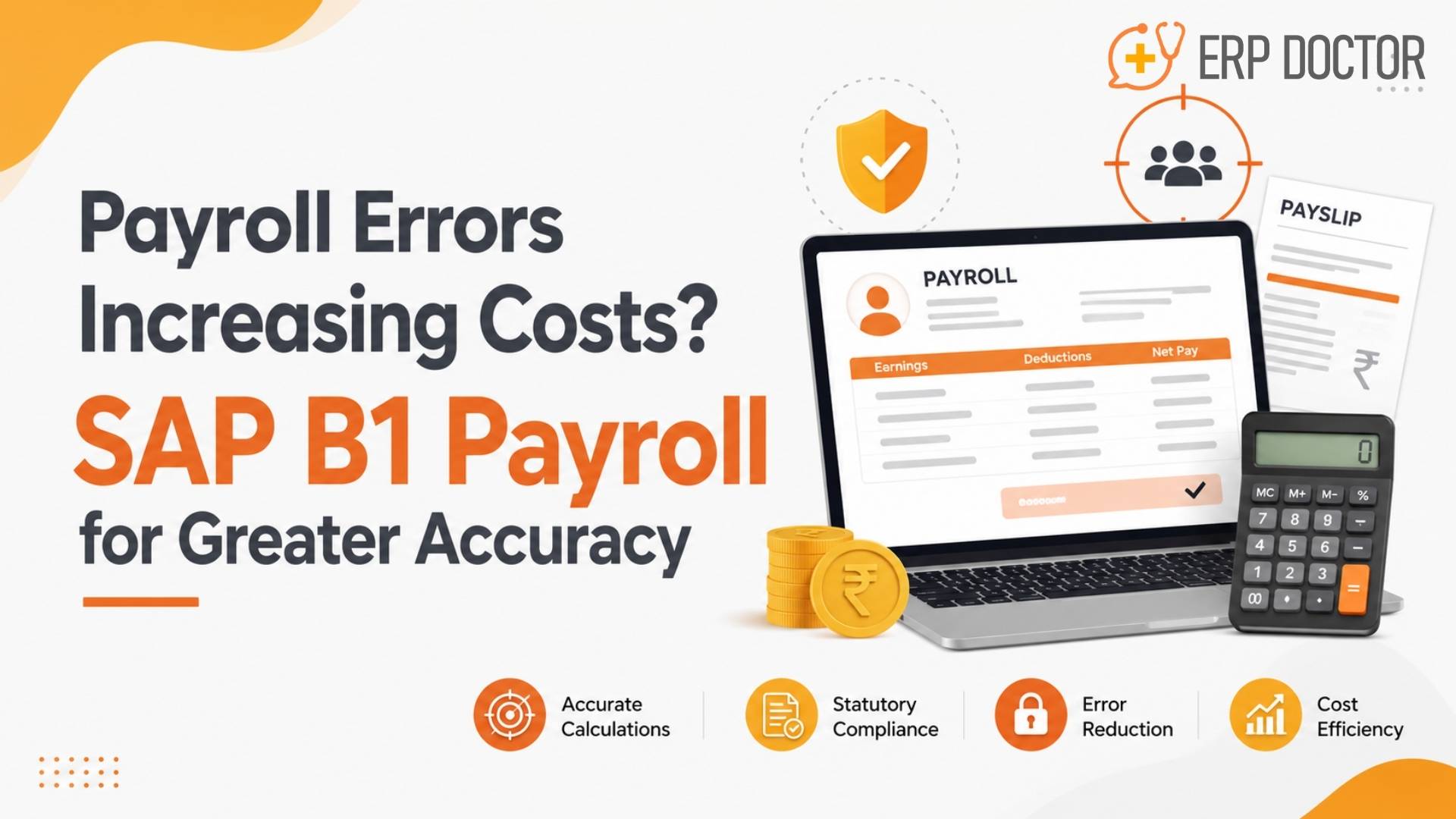
Payroll Errors Increasing Costs? SAP B1 Payroll for Greater Accuracy
SAP Business One Payroll Automation for Faster Processing and Compliance
Payroll is one of the few business processes where even a minor error can trigger financial losses, compliance penalties, employee dissatisfaction, and unnecessary administrative effort. As organizations grow, spreadsheets and disconnected payroll systems struggle to keep pace with changing regulations, workforce complexity, and increasing transaction volumes. SAP B1 Payroll helps businesses automate payroll management, improve calculation accuracy, strengthen compliance, and provide finance teams with complete visibility into payroll operations. Instead of manually validating data across multiple systems, organizations can standardize payroll workflows and reduce costly processing errors.
Whether you’re a CEO looking to improve operational efficiency or a CFO focused on financial accuracy, modernizing payroll with SAP Business One creates measurable business value beyond salary processing.
Why Payroll Errors Continue to Increase as Businesses Grow
Payroll complexity naturally increases as organizations expand. More employees, multiple locations, varying compensation structures, statutory deductions, reimbursements, overtime calculations, and changing tax regulations all introduce additional risk.
Common causes of payroll errors include:
- Manual data entry
- Spreadsheet-based calculations
- Duplicate employee records
- Incorrect attendance integration
- Delayed approval workflows
- Compliance updates not reflected in payroll
- Lack of centralized payroll reporting
These issues rarely remain isolated within HR. Payroll inaccuracies directly affect finance, employee trust, compliance reporting, and cash flow forecasting.
For growing businesses, payroll should operate as a controlled business process—not as a monthly firefighting exercise.
How SAP B1 Payroll Improves Payroll Accuracy
SAP B1 Payroll centralizes payroll calculations within an integrated ERP environment. Instead of relying on disconnected applications, payroll information flows consistently across finance, HR, attendance, and reporting functions.
This integrated approach significantly reduces manual intervention while improving consistency and audit readiness.
Key capabilities include:
- Automated salary calculations
- Leave and attendance integration
- Overtime computation
- Statutory deduction automation
- Loan and advance management
- Reimbursement processing
- Automated payslip generation
- Payroll journal posting
- Employee master synchronization
By reducing manual calculations, businesses minimize payroll discrepancies before they reach employees.
SAP B1 Payroll Management for Better Business Control
Payroll is no longer just an HR function. Executive leadership increasingly expects payroll data to support workforce planning, budgeting, profitability analysis, and compliance reporting.
Effective SAP B1 payroll management provides:
Real-Time Financial Visibility
Payroll expenses automatically integrate with finance, allowing leadership teams to monitor labor costs more accurately.
Standardized Payroll Operations
Every payroll cycle follows predefined approval workflows, reducing dependency on individual employees.
Better Audit Readiness
Payroll history, approvals, revisions, and reports remain centrally available for audits and statutory reviews.
Improved Employee Confidence
Accurate payroll builds employee trust while reducing HR support requests related to salary discrepancies.
Automating SAP B1 Payroll Management Processes
Manual payroll workflows consume valuable administrative time. Automation enables payroll teams to focus on verification rather than repetitive calculations.
Modern SAP B1 payroll management processes typically automate:
- Attendance imports
- Salary revisions
- Variable pay calculations
- Bonus computation
- Leave adjustments
- Tax deductions
- PF, ESI, PT calculations
- Payroll approvals
- Payslip distribution
- Financial posting
This significantly shortens payroll cycles while improving overall operational consistency.
If your payroll process still depends heavily on spreadsheets or manual reconciliation, a payroll assessment can quickly identify automation opportunities before they become compliance risks.
Payroll System Challenges That Affect Business Performance
Many organizations continue using standalone payroll applications that lack ERP integration.
This creates multiple business challenges:
| Traditional Payroll System | SAP B1 Payroll |
| Manual data movement | Automated integration |
| Duplicate employee records | Single source of truth |
| Delayed financial posting | Real-time accounting |
| Limited reporting | Executive dashboards |
| High reconciliation effort | Automated validation |
| Higher compliance risk | Standardized controls |
Disconnected systems often create hidden operational costs that extend beyond payroll itself.
Finance teams spend additional hours reconciling payroll journals.
HR spends more time correcting salary issues.
Management lacks reliable workforce cost reporting.
Payroll Error Prevention Checklist Every Business Should Follow
Payroll accuracy depends on standardized governance—not just software.
A practical Payroll Error Prevention Checklist should include:
Employee Data Validation
Ensure master records remain current before every payroll cycle.
Attendance Verification
Validate attendance imports before salary calculations begin.
Salary Change Controls
Approve salary revisions before payroll processing.
Compliance Updates
Confirm statutory rules reflect current government regulations.
Exception Reporting
Review unusual payroll values before final approval.
Approval Workflow
Implement multi-level approvals for payroll release.
Financial Reconciliation
Match payroll journals with finance records after processing.
Audit Trail Review
Maintain complete payroll documentation for statutory compliance.
Organizations following structured payroll governance experience significantly fewer payroll disputes and compliance issues.
Why Integrated Payroll Delivers Greater ROI
Payroll automation generates value well beyond HR efficiency.
Business leaders typically experience measurable improvements across several operational areas:
Lower Administrative Costs
Reduced manual processing decreases payroll administration effort.
Faster Payroll Cycles
Automation shortens payroll preparation and approval timelines.
Reduced Compliance Risk
Standardized calculations minimize regulatory exposure.
Improved Financial Reporting
Integrated payroll data enhances budgeting and workforce planning.
Better Decision Making
Leadership gains real-time visibility into labor costs.
For organizations evaluating digital transformation initiatives, payroll automation often delivers one of the fastest operational returns because it impacts every monthly payroll cycle.
A short SAP B1 Payroll consultation can help identify where automation delivers the highest ROI based on your existing payroll processes and ERP landscape.
SAP Business One Payroll Module for Scalable Growth
As organizations expand, payroll complexity grows faster than many businesses anticipate.
The SAP Business One payroll module provides the scalability required to support:
- Growing workforce sizes
- Multiple departments
- Branch operations
- Shift-based employees
- Variable compensation structures
- Compliance across locations
- Finance integration
- Executive reporting
Instead of continually adding manual workarounds, businesses establish a payroll foundation capable of supporting long-term growth.
Business Outcomes That Matter to Executive Leadership
For CEOs, CFOs, CIOs, and Operations Leaders, payroll modernization is ultimately a business decision—not merely an HR upgrade.
A well-implemented SAP B1 Payroll solution delivers outcomes that directly support executive priorities:
- Lower payroll processing costs
- Reduced compliance exposure
- Faster month-end financial close
- Higher payroll accuracy
- Greater operational visibility
- Improved employee confidence
- Better workforce cost management
- Stronger governance and audit readiness
Organizations that modernize payroll gain not only efficiency but also greater confidence in one of their most critical business processes.
Conclusion
Payroll errors are expensive because they affect finances, compliance, employee satisfaction, and business credibility simultaneously. As organizations grow, manual payroll processes become increasingly difficult to manage without introducing unnecessary risk.
SAP B1 Payroll enables businesses to automate payroll management, improve processing accuracy, strengthen compliance, and provide leadership with real-time financial visibility. For companies seeking sustainable operational efficiency, payroll modernization is an investment that continues to deliver value every payroll cycle.
Frequently Asked Questions
1. How does SAP B1 Payroll reduce payroll processing errors?
SAP B1 Payroll automates calculations, integrates attendance and employee master data, and applies standardized payroll rules. This minimizes manual intervention and significantly reduces calculation and data-entry errors.
2. Can SAP B1 Payroll integrate with attendance systems?
Yes. SAP B1 Payroll can integrate attendance and leave management systems so working hours, overtime, shifts, and leave balances automatically flow into payroll calculations, reducing manual reconciliation.
3. Is SAP B1 Payroll suitable for growing SMEs?
Absolutely. It is designed to scale with business growth by supporting larger workforces, multiple departments, and increasingly complex payroll structures without relying on spreadsheets or disconnected applications.
4. How does SAP B1 Payroll improve compliance?
The system automates statutory calculations, maintains payroll audit trails, standardizes approval workflows, and supports accurate reporting, helping organizations stay aligned with applicable payroll regulations.
5. What reports are available in SAP Business One payroll module?
Organizations can generate payroll summaries, employee earnings reports, deduction reports, statutory reports, department-wise payroll costs, reimbursement reports, overtime analysis, and payroll journals for finance.
6. Can SAP B1 Payroll support multiple salary structures?
Yes. Businesses can configure different salary components, allowances, deductions, incentives, overtime policies, and reimbursement rules for various employee categories while maintaining centralized payroll management.
7. How does SAP B1 Payroll benefit finance teams?
Payroll data integrates directly with financial accounting, reducing manual journal entries, improving cost allocation, simplifying reconciliation, and providing more accurate labor cost reporting for budgeting and forecasting.
8. What is the biggest advantage of integrated payroll over standalone payroll software?
Integrated payroll eliminates duplicate data entry and ensures payroll information automatically updates finance and reporting systems. This improves accuracy, saves time, and creates a single source of truth across the organization.
9. How long does payroll automation implementation typically take?
Implementation timelines depend on workforce size, payroll complexity, compliance requirements, integrations, and existing ERP readiness. Most projects begin with process mapping and payroll configuration before testing and deployment.
10. When should a company consider upgrading to SAP B1 Payroll?
Organizations should evaluate SAP B1 Payroll when payroll processing becomes increasingly manual, compliance risks grow, reporting lacks visibility, payroll errors become frequent, or business expansion makes existing payroll systems difficult to manage.
Schedule a personalized SAP B1 Payroll demo and discover how payroll automation can reduce costs, improve compliance, and support scalable business growth.