
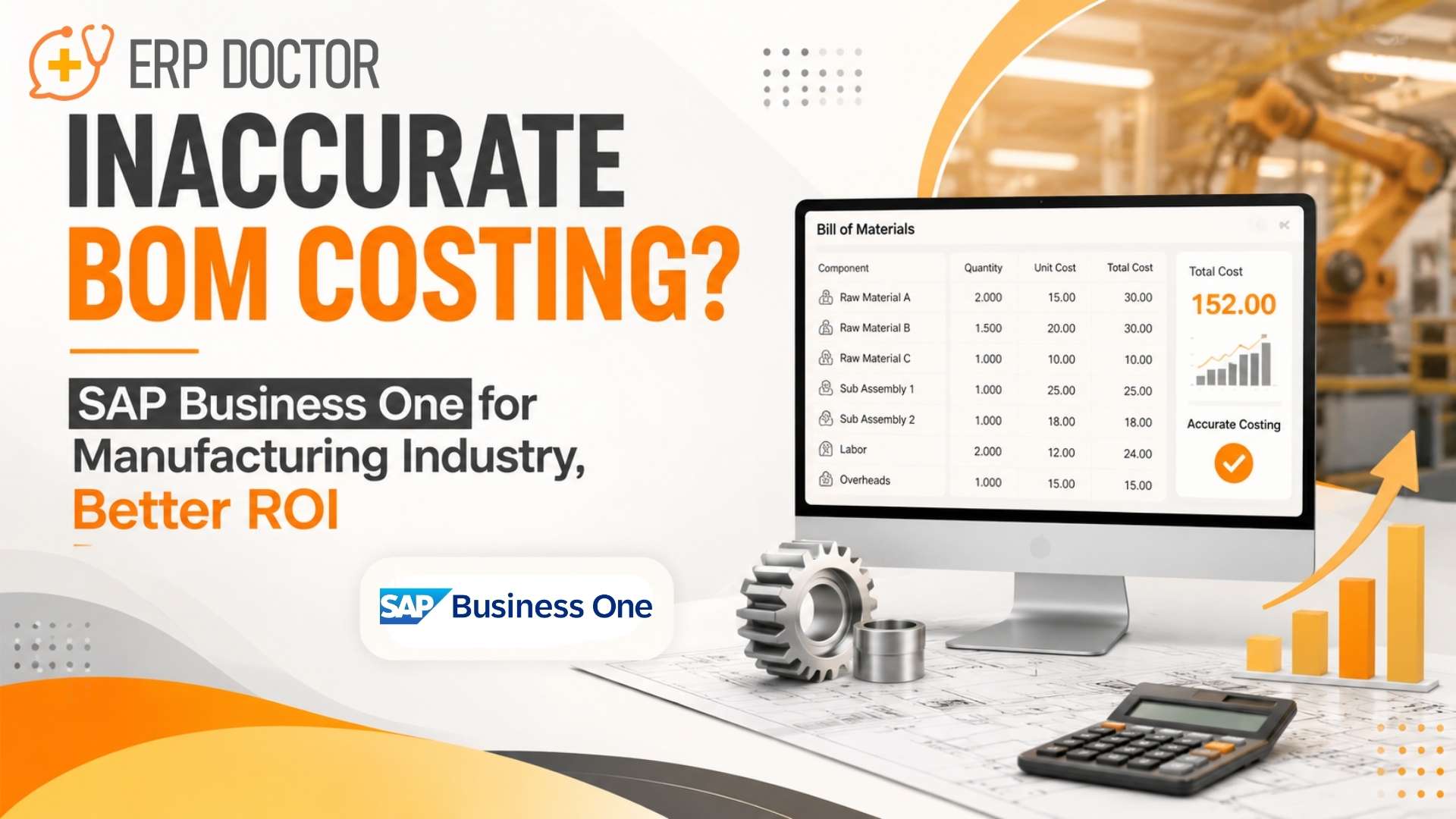
Inaccurate BOM Costing? SAP Business One for Manufacturing Industry, Better ROI
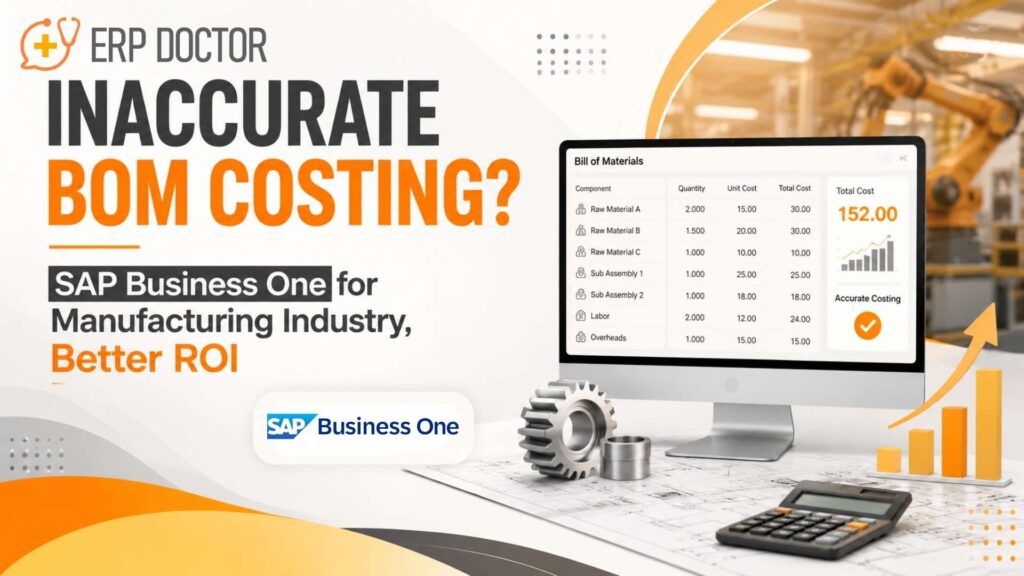
SAP Business One for Manufacturing Industry, Accurate BOM Costing, Protected Margins
For many manufacturers, shrinking margins are not caused by declining sales—they result from inaccurate product costing. When the Bill of Materials (BoM) is outdated, raw material costs fluctuate, or production data is disconnected, every quotation, production order, and financial report becomes less reliable.
SAP Business One for Manufacturing Industry helps manufacturers eliminate these blind spots by connecting inventory, procurement, production, finance, and costing into a single Enterprise Resource Planning (ERP) platform. The result is accurate manufacturing costs, healthier margins, and better executive decisions.
Why BOM Costing Errors Quietly Reduce Manufacturing Profitability
Most manufacturing organizations believe they understand their product costs. In reality, many rely on spreadsheets, manual updates, or disconnected systems that no longer reflect actual production expenses.
Even small costing inaccuracies multiply across hundreds or thousands of production orders.
Common causes include:
- Outdated Bills of Materials
- Incorrect labor allocation
- Material price fluctuations
- Scrap not reflected in production costs
- Multiple BOM versions with poor revision control
- Manual production planning
- Inventory valuation mismatches
- Delayed purchase price updates
These issues eventually create:
- Products priced below actual cost
- Reduced gross margins
- Inventory valuation errors
- Poor profitability reporting
- Incorrect budgeting
- Executive decisions based on inaccurate numbers
For Manufacturing SMEs in India, these hidden losses often remain unnoticed until profitability begins declining despite stable revenue.
How SAP Business One for Manufacturing Industry Improves Cost Accuracy
SAP Business One for Manufacturing Industry creates a single source of truth for manufacturing operations. Instead of relying on isolated spreadsheets, every department works from synchronized operational and financial data.
The platform continuously aligns procurement, inventory, production, finance, and costing so product costs remain current throughout the manufacturing lifecycle.
Core capabilities include:
- Centralized Bill of Materials (BoM) management
- Multi-level BOM structures
- Production order management
- Real-time inventory valuation
- Material issue tracking
- Labor and resource costing
- Purchasing integration
- Financial integration
Unlike fragmented software, SAP Business One (SAP B1) connects operational events directly with financial outcomes.
Real-Time Bill of Materials Management Without Manual Rework
An accurate Bill of Materials (BoM) is the foundation of reliable manufacturing costing. When engineering changes, supplier costs, or component substitutions are not updated immediately, product profitability becomes distorted.
SAP Business One for Manufacturing Businesses maintains structured BOM records while supporting engineering revisions and controlled updates.
Manufacturers gain visibility into:
- Raw materials
- Semi-finished goods
- Finished products
- Alternate components
- Version-controlled BOMs
- Cost roll-ups
- Material consumption
As production data changes, costing updates automatically instead of requiring manual spreadsheet reconciliation.
Preventing Margin Leakage Across Procurement and Production
Manufacturing margins rarely disappear because of one major mistake. They erode through hundreds of small inefficiencies across purchasing, inventory, and production.
SAP Business One Solves Manufacturing Challenges by connecting every operational transaction.
Examples include:
- Purchase price increases immediately reflected in production costing
- Material shortages identified before production begins
- Excess inventory highlighted for corrective action
- Scrap monitored by production order
- Production variances tracked automatically
- Inventory consumption recorded in real time
This visibility enables operations leaders to correct problems before they become financial losses.
Executive Insight: A manufacturing process review often identifies hidden costing inaccuracies before they affect annual profitability. A structured ERP assessment can reveal opportunities that are difficult to detect using spreadsheets alone.
Better Production Decisions Through Real-Time Manufacturing Visibility
Executives cannot improve profitability using yesterday’s production information. Accurate decisions require current operational data.
SAP B1 Manufacturing Solution provides dashboards that combine manufacturing performance with financial metrics.
Decision-makers can monitor:
- Production status
- Work order progress
- Inventory availability
- Material consumption
- Production variances
- Product profitability
- Purchase commitments
- Financial performance
Instead of waiting for month-end reports, leadership teams gain immediate visibility into operational performance.
Why Manufacturing SMEs in India Choose SAP Business One
Growing manufacturers often outgrow accounting software long before they realize it. As production complexity increases, manual processes begin limiting scalability.
SAP Business One for Manufacturing SMEs provides enterprise-grade manufacturing capabilities without the complexity associated with large ERP platforms.
It is particularly suitable for businesses that require:
- Multi-location inventory
- Production planning
- Cost control
- Batch management
- Procurement integration
- Financial reporting
- Manufacturing analytics
- Business scalability
Many Manufacturing SMEs in India adopt the platform as they expand operations, product lines, or manufacturing facilities.
SAP Business One Implementation Considerations
Successful ERP projects begin with process alignment rather than software installation.
A structured SAP Business One Implementation typically includes:
Business Process Assessment
Identify current manufacturing bottlenecks, costing issues, and reporting gaps.
Manufacturing Process Mapping
Align production workflows with ERP functionality.
Master Data Preparation
Clean Bills of Materials, inventory records, vendor information, and item masters.
User Training
Ensure production, procurement, finance, and warehouse teams follow standardized processes.
Go-Live Support
Validate costing accuracy, inventory balances, and production transactions before full deployment.
Organizations that invest time in implementation planning generally achieve faster adoption and more accurate manufacturing reporting.
Planning Tip: Before evaluating ERP options, consider conducting a manufacturing process and BOM accuracy assessment. It helps define implementation priorities and reduces project risk.
Understanding SAP Business One Cost in India
ERP investment should be evaluated based on business outcomes rather than software price alone.
SAP Business One Cost in India depends on several factors, including:
- Number of users
- Deployment model
- Manufacturing complexity
- Required modules
- Customizations
- Third-party integrations
- Implementation scope
- Support requirements
Similarly, SAP B1 pricing varies according to licensing and project requirements.
Rather than focusing solely on initial investment, manufacturers should compare:
- Margin improvement
- Inventory optimization
- Production efficiency
- Reduced manual work
- Better financial reporting
- Lower operational risk
For most growing manufacturers, these long-term benefits outweigh the implementation investment.
Protecting ROI with SAP Business One for Manufacturing Industry
For CEOs, COOs, CIOs, and Operations Heads, manufacturing profitability depends on cost visibility as much as production efficiency. SAP Business One for Manufacturing Industry helps organizations reduce uncertainty by ensuring every production decision is supported by accurate operational and financial data.
Key business outcomes include:
- Higher BOM costing accuracy
- Reduced margin leakage
- Better pricing decisions
- Improved inventory control
- Faster production planning
- Greater financial visibility
- Stronger operational governance
- Scalable manufacturing growth
Instead of reacting to profitability issues after month-end, leadership teams gain the visibility needed to protect margins continuously.
Conclusion
Manufacturing profitability depends on knowing the true cost of every product. Inaccurate Bills of Materials, disconnected systems, and manual costing processes gradually erode margins without obvious warning signs.
SAP Business One for Manufacturing Industry brings manufacturing, procurement, inventory, finance, and costing together in a unified ERP platform, enabling manufacturers to improve accuracy, reduce operational risk, and make faster, data-driven decisions.
Frequently Asked Questions
1. How does SAP Business One improve BOM costing accuracy?
SAP Business One automatically links Bills of Materials with purchasing, inventory, and production data. This ensures material costs, labor, and production variances are reflected in product costing without relying on manual spreadsheet updates.
2. Can SAP Business One manage multi-level Bills of Materials?
Yes. The system supports multi-level Bill of Materials (BoM) structures, allowing manufacturers to manage complex assemblies, subassemblies, and finished products while maintaining costing accuracy.
3. Is SAP Business One suitable for small and mid-sized manufacturers?
Yes. SAP Business One for Manufacturing SMEs is designed specifically for growing manufacturers that need integrated production, inventory, procurement, finance, and reporting without the complexity of large enterprise ERP systems.
4. How does SAP Business One reduce margin leakage?
It provides real-time visibility into procurement costs, inventory movements, production variances, and material consumption. This enables manufacturers to identify and correct issues before they affect profitability.
5. Does SAP Business One support production planning?
Yes. The platform manages production orders, material availability, capacity planning, and inventory requirements, helping manufacturers improve scheduling and reduce production delays.
6. What industries benefit most from SAP Business One for Manufacturing Industry?
It is widely used across automotive components, industrial equipment, engineering products, plastics, electronics, pharmaceuticals, food processing, chemicals, and fabricated metal manufacturing.
7. How long does a typical SAP Business One implementation take?
Implementation timelines depend on business complexity, manufacturing processes, integrations, and data quality. Many manufacturing SMEs complete implementation within a few months when project planning is well structured.
8. How is SAP Business One Cost in India determined?
The overall cost depends on user licenses, deployment choice, implementation scope, manufacturing requirements, integrations, and ongoing support. A detailed assessment is usually required for accurate budgeting.
9. What reports help executives monitor manufacturing profitability?
Executives can access dashboards covering production costs, inventory valuation, product profitability, procurement spending, work order status, production variances, and financial performance from a unified ERP database.
10. How should manufacturers evaluate SAP B1 pricing?
Instead of comparing license costs alone, evaluate the expected return through improved costing accuracy, inventory optimization, faster production planning, lower manual effort, reduced waste, and stronger operational visibility. These factors provide a more meaningful measure of long-term value.
Schedule a personalized SAP Business One manufacturing consultation and discover how accurate BOM costing can strengthen ROI across your entire operation.