
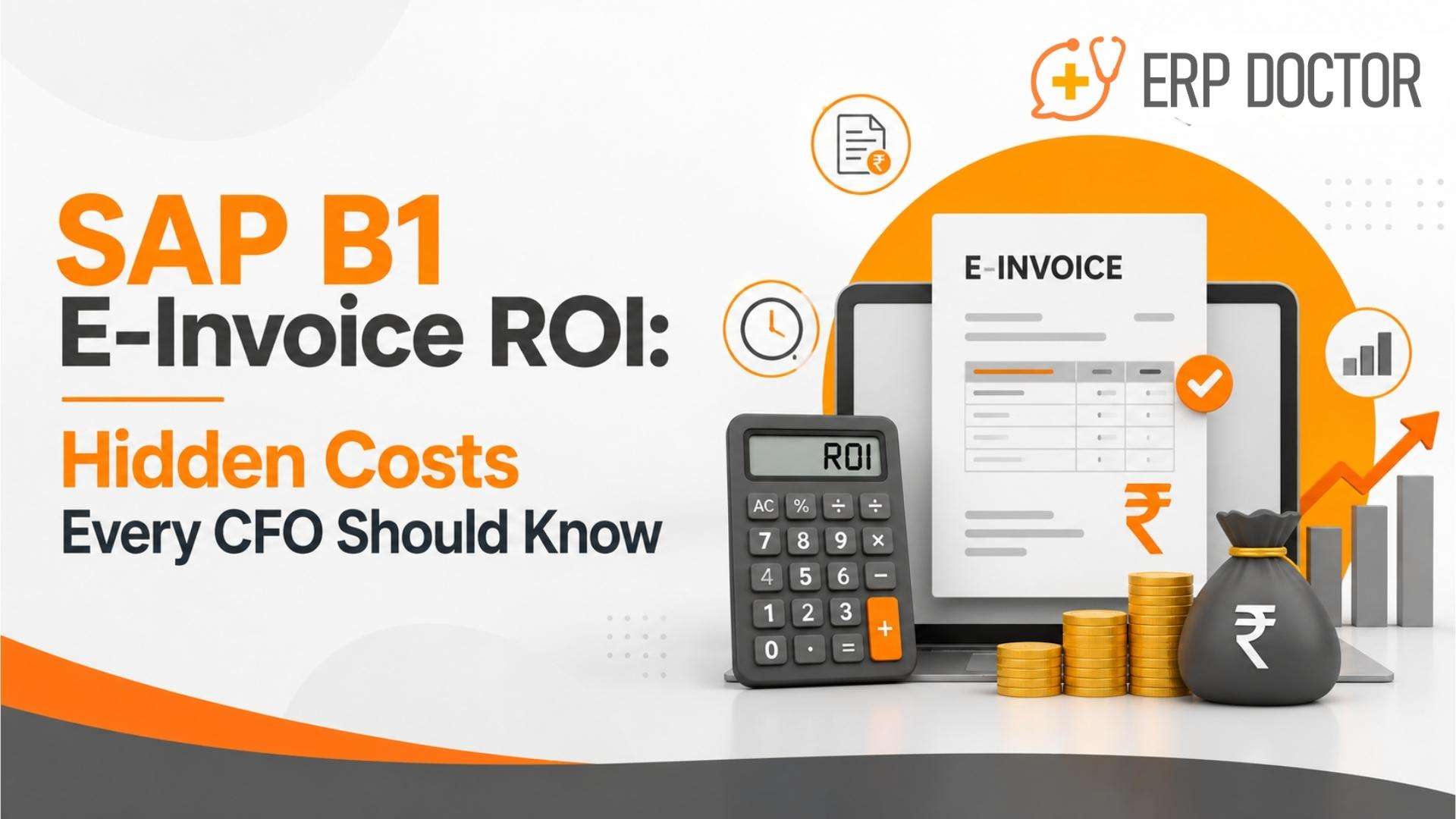
SAP B1 E-Invoice ROI: Hidden Costs Every CFO Should Know
SAP B1 E-Invoice Reducing Compliance Expenses and Accelerating Invoice Cycles
Every CFO focuses on reducing operational costs, improving cash flow, and ensuring regulatory compliance. Yet one critical financial process often escapes attention—invoice processing. While many organizations measure the visible costs of invoicing, they frequently overlook the hidden expenses caused by manual work, delayed approvals, compliance risks, invoice corrections, and inefficient financial operations.
These hidden costs quietly reduce profitability, consume finance team resources, and delay business growth.
This is where SAP B1 E-Invoice ROI becomes a strategic business advantage. Rather than viewing GST e-invoicing as a regulatory requirement, forward-looking organizations use SAP Business One E-Invoice to automate invoicing, improve financial accuracy, accelerate collections, and strengthen compliance. The result is measurable returns through lower operating costs, faster invoice processing, and improved finance productivity.
For CFOs, finance leaders, and ERP decision-makers, investing in electronic invoice automation is no longer simply about compliance—it is about building a more efficient finance function.
Hidden Costs That Reduce Financial Performance
Many organizations assume invoicing is a routine back-office activity. In reality, inefficient invoice management creates financial losses across multiple business functions.
Manual Invoice Processing Increases Operational Costs
Manual invoice preparation often requires multiple employees to validate data, create invoices, verify GST information, upload documents, and resolve exceptions.
These repetitive activities consume valuable finance resources that could instead focus on financial planning, forecasting, and business analysis.
Common challenges include:
– Manual data entry
– Duplicate invoice creation
– Approval delays
– Human errors
– Repetitive validation
Over time, these inefficiencies significantly increase administrative expenses.
GST Compliance Risks Lead to Unexpected Costs
GST regulations continue to evolve, requiring businesses to maintain accurate invoice data, timely reporting, and proper document validation.
Manual processes increase the likelihood of:
– Incorrect GST information
– Missing mandatory invoice fields
– IRN generation failures
– Compliance violations
– Regulatory penalties
Every correction requires additional finance effort while increasing audit exposure.
Invoice Errors Create Expensive Rework
Even minor invoice mistakes can create major downstream consequences.
Incorrect customer details, pricing discrepancies, tax calculation errors, or missing information often require invoices to be cancelled, recreated, and resubmitted.
The hidden costs include:
– Extra staff hours
– Customer dissatisfaction
– Delayed revenue recognition
– Slower payment cycles
– Reduced finance productivity
Delayed Customer Payments Affect Cash Flow
Invoices that reach customers late are typically paid late.
When finance teams manually prepare invoices or wait for approvals, billing cycles become longer.
Longer billing cycles result in:
– Increased Days Sales Outstanding (DSO)
– Delayed collections
– Reduced working capital
– Lower cash availability
– Greater financing requirements
For growing businesses, cash flow delays can directly impact expansion plans.
Administrative Overhead Continues to Grow
As businesses scale, invoice volumes increase rapidly.
Without automation, organizations often respond by hiring more finance personnel instead of improving processes.
This increases:
– Payroll costs
– Training expenses
– Process complexity
– Management overhead
Automation allows businesses to grow invoice volumes without proportionally increasing finance headcount.
Audit Preparation Consumes Valuable Time
Preparing for GST audits often involves gathering invoices from multiple systems, validating records, checking compliance documentation, and resolving inconsistencies.
Finance teams frequently spend days—or even weeks—preparing reports that could otherwise be generated automatically.
Lost Productivity Across Finance Teams
When experienced finance professionals spend most of their time correcting invoices or handling manual paperwork, they contribute less to strategic business initiatives.
Instead of delivering financial insights, they become occupied with repetitive operational work.
The long-term opportunity cost is substantial.
How SAP B1 E-Invoice ROI Improves Financial Performance
The greatest value of SAP B1 E-Invoice ROI lies in eliminating these hidden operational costs while improving overall finance performance.
Automated Invoice Generation
With SAP Business One E-Invoice, invoices are generated directly from business transactions, minimizing manual intervention.
Benefits include:
– Faster invoice creation
– Standardized formats
– Reduced manual work
– Improved consistency
– Better operational efficiency
Faster IRN and QR Code Processing
Electronic invoice automation accelerates GST compliance by supporting rapid IRN generation and QR code processing within the invoicing workflow.
Instead of manually managing compliance activities, businesses can streamline invoice validation while reducing processing delays.
This leads to:
– Faster invoice approvals
– Improved customer delivery
– Reduced compliance effort
– Better operational accuracy
Lower Compliance Costs
Automation minimizes compliance-related expenses by reducing manual validation, repetitive corrections, and regulatory risks.
Organizations benefit from:
– Reduced GST errors
– Lower compliance overhead
– Simplified reporting
– Consistent invoice accuracy
– Better audit readiness
Improved Invoice Accuracy
Automated invoice creation significantly reduces human errors.
Standardized business rules ensure that customer information, tax calculations, pricing, and invoice data remain accurate throughout the process.
Higher invoice accuracy leads to:
– Fewer disputes
– Faster approvals
– Reduced rework
– Higher customer confidence
Faster Billing Cycles
Automation shortens the time between order completion and invoice delivery.
Quicker billing allows organizations to:
– Accelerate revenue recognition
– Improve payment collections
– Strengthen working capital
– Increase financial agility
Even small reductions in invoice processing time can create measurable financial gains across thousands of invoices.
Better Cash Flow
Faster invoices typically translate into faster payments.
Improved invoice accuracy also reduces payment disputes that delay collections.
For CFOs, this means:
– Stronger cash flow
– Lower financing costs
– Improved liquidity
– Better financial planning
Increased Finance Team Productivity
Automation frees finance professionals from repetitive administrative work.
Instead, teams can focus on:
– Financial analysis
– Budget planning
– Business forecasting
– Cost optimization
– Strategic decision-making
Higher-value work produces stronger business outcomes than manual invoice processing.
Business Benefits Beyond Compliance
Although GST compliance is essential, the broader business advantages often generate even greater long-term returns.
Better Financial Visibility
Automated invoice processing provides finance leaders with faster access to transaction data, enabling quicker reporting and more informed decision-making.
Real-time visibility supports:
– Revenue monitoring
– Cash flow analysis
– Outstanding receivables
– Compliance tracking
– Financial forecasting
Real-Time Reporting
Modern finance departments require immediate access to operational insights.
Integrated invoice automation allows management to review financial performance without waiting for manual reconciliations.
This improves planning accuracy while supporting faster executive decisions.
Improved Customer Experience
Customers appreciate receiving accurate invoices quickly.
Electronic invoice automation reduces delays, eliminates correction requests, and improves billing consistency.
A better billing experience contributes to:
– Faster customer payments
– Stronger business relationships
– Higher customer satisfaction
– Reduced payment disputes
Stronger Internal Controls
Standardized workflows improve governance across finance operations.
Organizations benefit from:
– Approval transparency
– Controlled invoice processing
– Better audit trails
– Reduced fraud exposure
– Higher process consistency
Reduced Operational Risk
Manual finance processes expose organizations to avoidable business risks.
Automation helps reduce:
– Human error
– Compliance failures
– Data inconsistencies
– Revenue leakage
– Operational disruptions
Scalable Finance Operations
Growing businesses require finance processes that expand efficiently.
Invoice Processing Automation enables organizations to handle increasing invoice volumes without continuously expanding finance teams.
This scalability directly supports sustainable business growth.
Why Choose Emerging Alliance
Choosing the right implementation partner is just as important as selecting the right ERP solution.
Emerging Alliance combines deep SAP Business One expertise with practical finance transformation experience to help organizations maximize the return on their e-invoicing investment.
Our capabilities include:
– SAP Business One implementation expertise
– SAP Business One E-Invoice integration
– GST compliance consulting
– End-to-end project deployment
– Process optimization
– Finance automation best practices
– User training and knowledge transfer
– Ongoing support and continuous optimization
Rather than delivering only software implementation, Emerging Alliance works closely with finance leaders to simplify compliance, reduce operational costs, and improve long-term business performance.
Conclusion
Many organizations evaluate e-invoicing only from a compliance perspective. However, the real business opportunity lies in the measurable operational improvements it delivers.
By reducing manual processing, improving GST compliance, accelerating billing cycles, increasing invoice accuracy, and strengthening financial visibility, SAP B1 E-Invoice ROI extends far beyond regulatory requirements. It helps finance teams lower hidden costs, improve productivity, enhance cash flow, and support sustainable business growth.
For CFOs seeking greater efficiency and measurable financial returns, SAP Business One E-Invoice is a strategic investment rather than a compliance expense.
If your organization is still relying on manual invoice processing, now is the ideal time to modernize your finance operations and unlock greater ROI.
Frequently Asked Questions
1. How does SAP B1 E-Invoice ROI differ from simply meeting GST compliance requirements?
GST compliance helps businesses satisfy regulatory obligations, while SAP B1 E-Invoice ROI focuses on measurable business outcomes such as lower processing costs, faster invoice cycles, improved cash flow, fewer invoice errors, and higher finance team productivity.
2. What hidden costs can SAP Business One E-Invoice eliminate?
SAP Business One E-Invoice helps reduce expenses associated with manual data entry, invoice corrections, delayed approvals, GST compliance issues, audit preparation, administrative overhead, payment delays, and finance resource inefficiencies.
3. How does SAP Business One E-Invoice improve cash flow?
By automating invoice generation, improving invoice accuracy, and accelerating invoice delivery, businesses can shorten billing cycles, reduce payment disputes, improve collections, and lower Days Sales Outstanding (DSO).
4. Is SAP Business One E-Invoice suitable for manufacturing and distribution companies?
Yes. Manufacturing, distribution, retail, pharmaceutical, and trading companies with high invoice volumes benefit significantly from automated invoice processing, improved compliance, and scalable finance operations within SAP Business One.
5. Why should businesses work with Emerging Alliance for SAP Business One E-Invoice implementation?
Emerging Alliance combines SAP Business One implementation expertise, GST compliance knowledge, finance process optimization, end-to-end deployment, user training, and ongoing support to help organizations achieve faster implementation and maximize long-term ROI.
Schedule Your Free SAP B1 E-Invoice Consultation
Hidden invoicing costs can quietly reduce profitability, slow cash flow, and increase compliance risks. Emerging Alliance helps businesses transform these challenges into measurable financial gains through SAP Business One E-Invoice solutions tailored to their operational needs.
Book a FREE SAP B1 E-Invoice Consultation with Emerging Alliance to:
– Assess your current invoicing process
– Identify hidden compliance and operational costs
– Estimate your potential ROI from invoice automation
– Develop a roadmap for GST-compliant finance transformation
– See a personalized SAP Business One E-Invoice demonstration
Talk to our SAP Business One experts today and discover how intelligent invoice automation can improve efficiency, reduce costs, and accelerate business growth.