
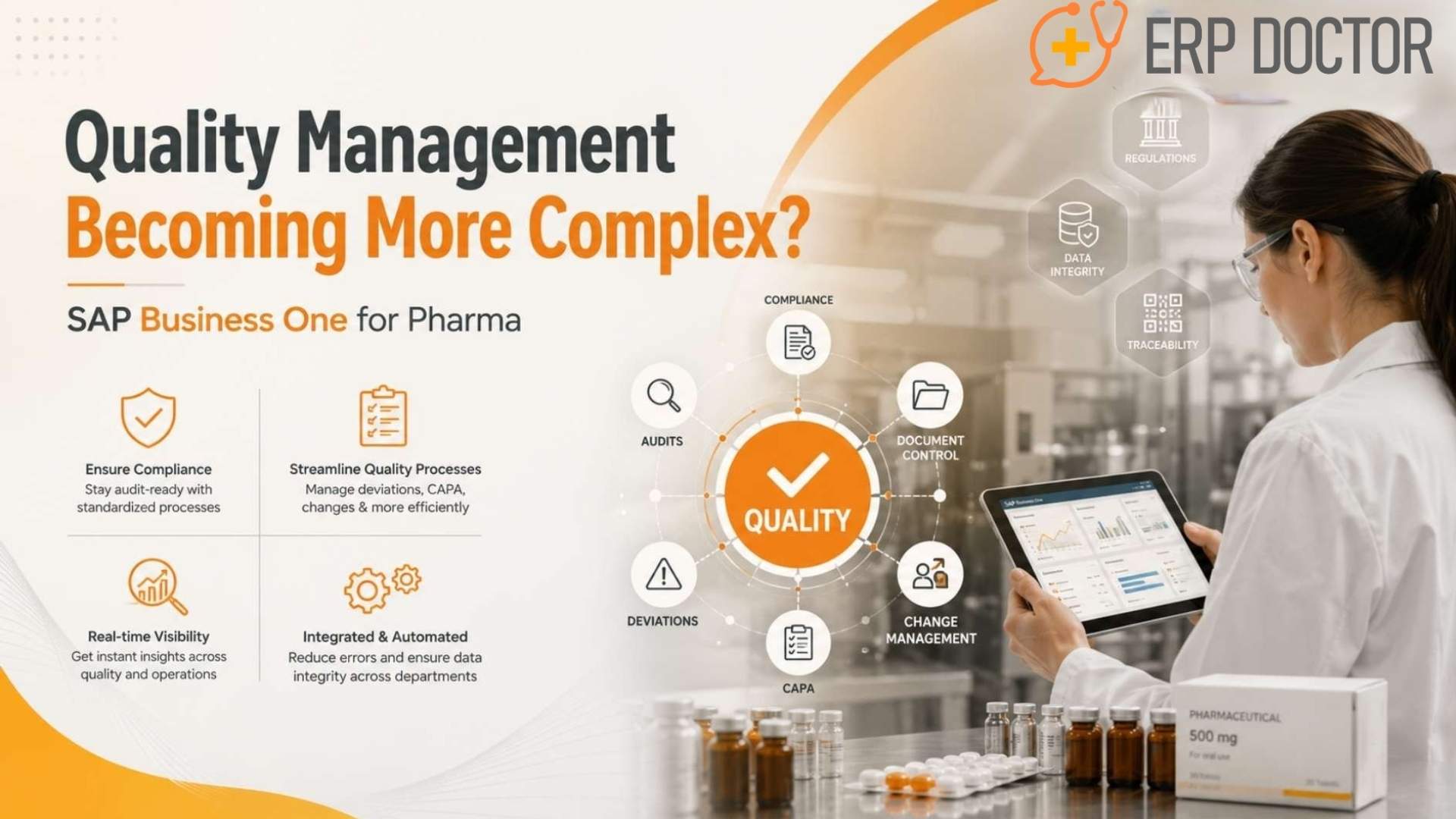
Quality Management Becoming More Complex? SAP Business One for Pharma
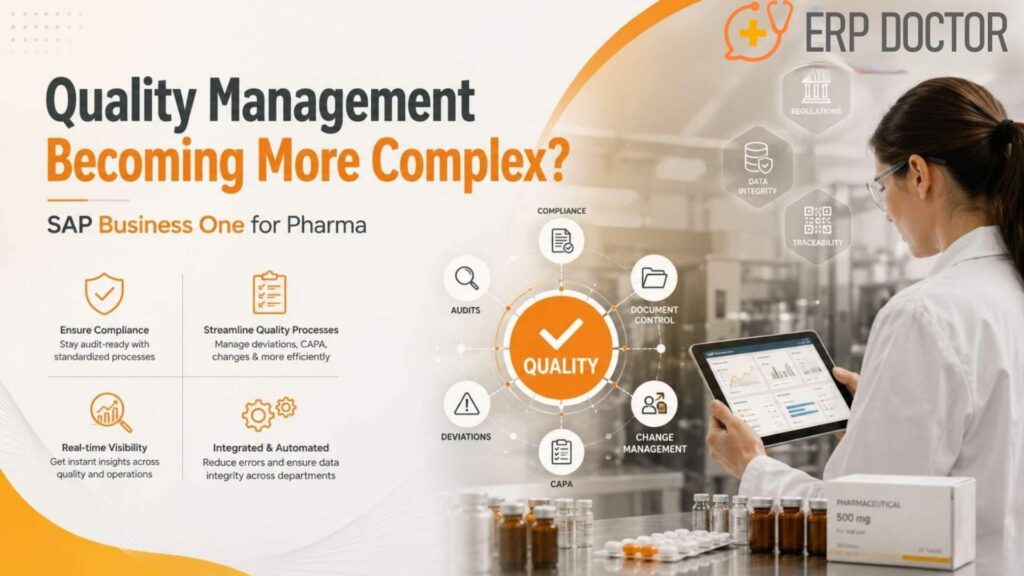
SAP Business One for Pharma for End-to-End Quality Management
Quality failures in pharmaceutical manufacturing rarely happen because of a single mistake. They usually result from disconnected quality processes, delayed visibility, inconsistent documentation, and limited traceability across procurement, production, warehousing, and distribution. SAP Business One for Pharma addresses these challenges by integrating quality management into everyday operations instead of treating it as a separate function. From incoming raw material inspection to finished goods release, the ERP provides real-time visibility, standardized workflows, and complete batch traceability that help pharmaceutical companies improve compliance while maintaining operational efficiency.
For CEOs, COOs, CIOs, and Operations Heads, quality management is no longer just a regulatory responsibility—it directly influences profitability, customer trust, production efficiency, and long-term business growth.
Why Quality Management Has Become a Strategic Business Challenge
Quality management today extends far beyond laboratory testing. Pharmaceutical companies must ensure that every material, process, employee action, and product movement complies with internal standards and regulatory requirements.
Common operational challenges include:
- Manual quality inspections causing production delays
- Inconsistent batch documentation
- Difficulty tracking deviations across departments
- Limited visibility into supplier quality performance
- Slow CAPA execution
- Delayed product release due to disconnected approval workflows
- Compliance risks during regulatory inspections
These issues increase operational costs while exposing organizations to recalls, rejected batches, customer complaints, and regulatory penalties.
A modern SAP Business One for pharma industry implementation helps standardize these processes within a single ERP environment.
How SAP Business One for Pharma Strengthens End-to-End Quality Management
Quality management becomes more effective when every operational function shares the same real-time information. Instead of relying on spreadsheets or disconnected applications, quality teams work directly within business processes.
With SAP Business One for Pharma, organizations can manage quality across:
Raw Material Inspection
Incoming materials can be inspected against predefined quality parameters before entering production.
This helps:
- Prevent non-conforming inventory
- Improve supplier accountability
- Reduce production interruptions
- Maintain consistent material quality
Production Quality Control
Quality checks can be embedded throughout manufacturing rather than performed only after production completes.
Benefits include:
- Real-time production monitoring
- Process validation checkpoints
- Immediate deviation reporting
- Reduced batch failures
Batch Traceability
Complete traceability is essential for pharmaceutical manufacturers.
The system allows organizations to:
- Track every batch from supplier to customer
- Trace raw materials used in finished goods
- Perform faster root-cause analysis
- Simplify product recall management
Finished Goods Release
Quality approval workflows become standardized before products enter inventory or distribution.
This improves:
- Release accuracy
- Documentation consistency
- Compliance confidence
- Customer satisfaction
Many organizations begin with a quality process assessment before ERP modernization. A structured review often reveals hidden process gaps that affect compliance, productivity, and profitability long before they become visible in audits.
Business Processes That Improve with SAP Business One Pharma Software
Quality management performs best when integrated with every operational function.
SAP Business One Pharma Software connects quality processes with:
Procurement
Supplier performance, inspection results, rejected materials, and purchasing decisions remain connected.
Inventory Management
Quality status travels with inventory across every warehouse movement.
Manufacturing
Production orders automatically reflect quality checkpoints, approvals, and inspection outcomes.
Warehouse Operations
Released, quarantined, and rejected inventory remain clearly separated.
Distribution
Only approved products move into customer deliveries, reducing shipment risks.
This integrated approach is one of the primary advantages of modern pharma-specific ERP software.
Compliance Becomes Easier with Centralized Data
Regulatory compliance depends heavily on documentation accuracy and traceability.
Instead of preparing manually for inspections, organizations maintain audit-ready information continuously.
With SAP B1 Quality Management Pharma, businesses gain:
- Digital quality records
- Batch genealogy
- Electronic approvals
- Complete audit trails
- Controlled documentation
- Faster inspection preparation
- Better deviation tracking
This reduces the administrative burden while strengthening compliance readiness.
Why Disconnected Systems Create Hidden Quality Risks
Many pharmaceutical manufacturers continue using separate applications for production, inventory, laboratory activities, procurement, and finance.
The result is fragmented information.
Disconnected systems often create:
- Duplicate quality records
- Version control issues
- Delayed approvals
- Manual reconciliation
- Limited operational visibility
- Higher compliance risks
An integrated SAP B1 pharma solution eliminates many of these inefficiencies by creating one trusted source of operational data.
Choosing the Right SAP Business One Partner Matters
ERP software alone does not guarantee better quality management. Success depends heavily on implementation strategy and industry expertise.
An experienced SAP Business One Partner understands:
- Pharmaceutical manufacturing workflows
- Validation requirements
- Batch-controlled production
- Regulatory expectations
- Master data governance
- User adoption planning
A successful SAP B1 pharma implementation focuses equally on technology, process redesign, and operational adoption.
If your organization is evaluating ERP modernization, a quality readiness workshop can identify which process improvements deliver the fastest operational impact before implementation begins.
Understanding SAP B1 Pharma Cost Beyond Software Licensing
Many executives evaluate ERP projects based only on software investment.
However, SAP B1 Pharma Cost should be measured against the long-term business value created through improved quality management.
Potential returns include:
- Lower batch rejection costs
- Reduced compliance risks
- Faster product release
- Improved production utilization
- Lower documentation effort
- Better inventory accuracy
- Reduced recall exposure
- Faster management reporting
The true cost of poor quality often exceeds the investment required for ERP modernization.
How SAP Business One for Pharma Delivers Measurable Business Outcomes
For executive leadership, ERP success is measured by business performance rather than software functionality.
SAP Business One for Pharma supports measurable improvements across the organization by enabling:
- Faster quality decision-making
- Better operational visibility
- Stronger regulatory compliance
- Lower quality-related costs
- Reduced production delays
- Improved inventory accuracy
- Faster audit preparation
- Better executive reporting
- Higher customer confidence
- Scalable operations for future growth
Organizations that integrate quality management into core ERP processes position themselves to grow without increasing operational complexity.
Conclusion
Quality management is no longer an isolated quality department responsibility—it has become a business-wide capability that influences compliance, profitability, customer satisfaction, and long-term growth.
SAP Business One for Pharma brings quality processes, manufacturing, inventory, procurement, and compliance together within a unified ERP platform. The result is greater operational control, stronger traceability, improved decision-making, and reduced business risk across the pharmaceutical value chain.
Frequently Asked Questions
1. How does SAP Business One for Pharma improve quality management?
It integrates quality processes with procurement, inventory, manufacturing, and distribution, allowing quality checks to occur throughout the product lifecycle. This reduces manual intervention and improves compliance consistency.
2. Can SAP Business One for Pharma support batch traceability?
Yes. The solution provides complete batch and serial number traceability from raw material procurement through manufacturing and customer delivery. This simplifies investigations, recalls, and regulatory reporting.
3. Is SAP Business One suitable for growing pharmaceutical manufacturers?
Yes. It is designed for small and mid-sized pharmaceutical companies seeking enterprise-grade process control without the complexity of large ERP platforms. The system scales as operations expand.
4. What should organizations consider before SAP B1 pharma implementation?
Companies should assess process maturity, master data quality, compliance requirements, reporting needs, and user adoption plans. A structured implementation roadmap significantly reduces project risk.
5. How does SAP B1 Quality Management Pharma help during regulatory inspections?
The solution maintains centralized records, audit trails, electronic approvals, and batch histories. This enables organizations to retrieve documentation quickly and demonstrate compliance with greater confidence.
6. Can SAP Business One integrate quality management with inventory control?
Yes. Inventory transactions reflect quality status in real time, ensuring quarantined or rejected materials cannot be released accidentally. This improves inventory accuracy and product integrity.
7. How is SAP B1 Pharma Cost typically evaluated?
Organizations should evaluate total business value rather than software licensing alone. Factors such as reduced batch failures, improved productivity, lower compliance risk, and faster product releases often deliver significant ROI.
8. Why is choosing the right SAP Business One Partner important?
An experienced implementation partner understands pharmaceutical regulations, manufacturing workflows, validation requirements, and quality processes. This industry expertise improves implementation success and accelerates business outcomes.
9. What differentiates SAP Business One Pharma Software from generic ERP solutions?
It supports pharmaceutical requirements such as batch traceability, controlled quality workflows, inventory management, regulatory documentation, and integrated manufacturing operations within a unified platform.
10. Which pharmaceutical companies benefit most from SAP Business One for Pharma?
Manufacturers facing quality inconsistencies, compliance challenges, limited traceability, manual documentation, or disconnected operational systems gain the greatest value. The solution is particularly effective for organizations preparing for growth while maintaining regulatory control.
Book a consultation with our experts and discover how SAP Business One for Pharma can strengthen quality management, improve compliance, and support sustainable business growth.