
SAP S/4HANA vs Oracle Fusion Cloud: The 2026 ERP Comparison Guide
Choosing between SAP S/4HANA and Oracle Fusion Cloud is rarely a simple software comparison.
For enterprise organizations, the decision can influence finance, manufacturing, procurement, supply chain operations, data architecture, integration strategy, reporting, AI adoption, IT operating models, and future scalability.
Both platforms provide comprehensive enterprise capabilities. However, they approach ERP architecture, cloud delivery, operational processes, extensibility, and transformation differently.
The Real Question Is Therefore Not Simply:
Which ERP has more features?
It Is:
Which ERP architecture, operating model, and functional depth best match the complexity and future direction of your business?
This SAP S/4HANA vs Oracle Fusion Cloud comparison examines the decision from the perspective of CIOs, CFOs, CTOs, transformation leaders, and enterprise ERP teams.
Quick Answer: SAP S/4HANA vs Oracle Fusion Cloud
SAP S/4HANA and Oracle Fusion Cloud are both enterprise ERP platforms designed to manage core processes such as finance, procurement, supply chain, projects, and enterprise operations.
The key distinction is generally the ecosystem and operating model around each platform:
- SAP S/4HANA is often evaluated by organizations with complex operational environments, particularly businesses with significant manufacturing, supply chain, asset, logistics, or existing SAP process landscapes.
- Oracle Fusion Cloud ERP is commonly evaluated by organizations seeking a cloud-native enterprise application suite with strong financial management, procurement, project management, risk management, and connected Oracle Cloud applications.
The right choice depends on factors including:
Neither platform should be selected based on a feature checklist alone.
The ERP should be evaluated against the processes that create the most operational and financial value for the organization.
SAP S/4HANA vs Oracle Fusion Cloud at a Glance
| Area | SAP S/4HANA | Oracle Fusion Cloud |
|---|---|---|
| ERP positioning | Enterprise ERP platform | Enterprise cloud applications suite |
| Deployment | Public Cloud, Private Cloud and related deployment models | Primarily SaaS cloud |
| Finance | Extensive enterprise financial management | Extensive cloud financial management |
| Manufacturing | Strong manufacturing and operational depth | Broad discrete and process manufacturing capabilities |
| Supply chain | Integrated SAP supply-chain ecosystem | Fusion Cloud SCM suite |
| Procurement | SAP ecosystem including procurement solutions | Integrated Oracle Procurement |
| Projects | Enterprise project capabilities | Strong project financial management capabilities |
| AI | SAP Business AI and Joule | Built-in AI, AI agents and agentic applications |
| Analytics | SAP analytics and data ecosystem | Oracle analytics ecosystem |
| Customization approach | Increasing focus on clean-core extensions | Configuration and cloud extensibility |
| Upgrade model | Depends on deployment model | SaaS release model |
| Best evaluation context | Operational complexity and SAP-centric environments | Cloud-suite transformation and Oracle-centric environments |
This table is only a starting point. ERP fit depends heavily on your industry, processes, architecture, and transformation objectives.
What Is SAP S/4HANA?
SAP S/4HANA is SAP’s enterprise ERP platform designed around the SAP HANA database and a unified enterprise data and process model.
It supports business functions including:
SAP also offers cloud deployment models, including SAP S/4HANA Cloud Public Edition and Private Edition.
For companies already running SAP ECC or other SAP products, S/4HANA may also form part of a broader SAP transformation strategy rather than an isolated ERP replacement.
SAP continues to expand AI capabilities through SAP Business AI and Joule. In 2026, SAP reported new Joule capabilities across finance, manufacturing, project management and other processes, including AI-assisted error resolution and production-order activities.
What Is Oracle Fusion Cloud ERP?
Oracle Fusion Cloud ERP is Oracle’s SaaS enterprise resource planning platform.
Its major capabilities include:
Oracle Fusion ERP also operates within the broader Oracle Fusion Cloud Applications portfolio, connecting areas such as human capital management and supply chain management.
Oracle Fusion Cloud SCM extends this environment across product development, planning, procurement, manufacturing, inventory, logistics and order management. Oracle describes the platform as a connected cloud suite with built-in AI and agentic applications.
Oracle continues to expand AI functionality within Fusion applications. Its 2026 ERP roadmap includes AI agents and agentic applications across financials, project management and risk functions.
SAP S/4HANA vs Oracle Fusion Cloud: Core Differences
The differences between these platforms become clearer when they are compared across the business areas that matter during an enterprise ERP selection.
1. ERP Architecture
SAP S/4HANA is built around SAP HANA and SAP’s enterprise process model.
Its architecture is particularly relevant for organizations managing interconnected processes across:
Manufacturing
Logistics
Materials
Procurement
Sales
Supply chain
Asset operations
SAP customers may also connect S/4HANA with a wider SAP landscape spanning analytics, procurement, human resources, planning, integration and industry applications.
Oracle Fusion Cloud takes a SaaS-first approach. Fusion ERP operates as part of Oracle’s unified cloud applications environment, allowing organizations to connect ERP with Oracle applications across HCM, SCM, EPM and other business areas.
ERP Decision Question:
Ask: Do we need ERP to operate at the center of a deeply integrated operational landscape, or are we prioritizing a standardized SaaS application model across enterprise functions?
That question can reveal more than comparing hundreds of individual features.
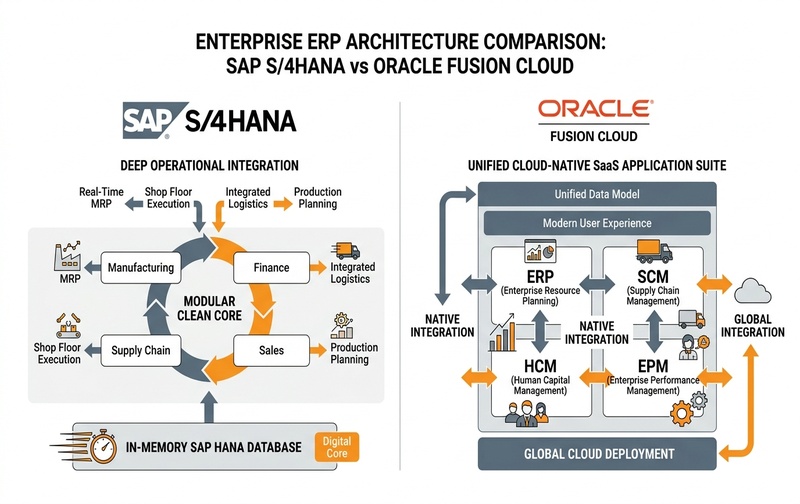
Enterprise ERP architecture comparison highlighting SAP S/4HANA’s modular clean core with deep operational integration versus Oracle Fusion Cloud’s unified SaaS application suite.
2. Financial Management
Finance is central to both SAP S/4HANA and Oracle Fusion Cloud ERP.
SAP S/4HANA Finance
SAP S/4HANA supports core financial areas including:
- General ledger
- Accounts payable
- Accounts receivable
- Asset accounting
- Financial close
- Management accounting
- Profitability analysis
- Treasury-related processes
- Group reporting
- Financial planning integration
One important architectural concept is the integration of financial and operational transactions. For organizations with complex manufacturing, logistics or product costing environments, this connection can be especially important.
Oracle Fusion Cloud Financials
Oracle Fusion Cloud Financials supports:
- General ledger
- Payables
- Receivables
- Cash management
- Fixed assets
- Expenses
- Revenue management
- Collections
- Accounting automation
- Financial reporting
Oracle is also expanding AI agents across financial workflows. Current Oracle documentation lists AI capabilities around areas such as cash processing, capital expenditure, billing and financial analysis.
Finance Selection Consideration
Finance leaders should evaluate:
Multi-country operations
Intercompany transactions
Consolidation
Revenue recognition
Cost accounting
Product costing
Financial close
Treasury requirements
Audit controls
Local statutory requirements
The strongest finance platform is the one that aligns with the organization’s operating model—not simply the one with the longest feature list.
3. Manufacturing
Manufacturing requirements can significantly influence an Oracle Fusion vs SAP S/4HANA decision.
SAP S/4HANA Manufacturing
SAP supports manufacturing processes including:
- Production planning
- Material requirements planning
- Production orders
- Manufacturing execution
- Product costing
- Capacity planning
- Quality processes
- Batch-related processes
- Inventory integration
- Procurement integration
SAP has historically served organizations with complex manufacturing and supply-chain operations.
Its 2026 cloud releases are also introducing additional AI-assisted manufacturing capabilities. SAP has documented Joule-assisted production-order functionality and manufacturing AI capabilities in current S/4HANA Cloud releases.
Oracle Fusion Cloud Manufacturing
Oracle Fusion Cloud Manufacturing supports both discrete and process manufacturing. Oracle documentation identifies capabilities including:
- Discrete manufacturing
- Process manufacturing
- Mixed-mode production
- Contract manufacturing
- Outsourced manufacturing
- Project-specific manufacturing
- Work-order execution
Oracle also expanded process-manufacturing functionality in 2026 around formulas, recipes, materials and batch execution.
Manufacturing Selection Consideration
Manufacturers should test the platforms against actual scenarios such as:
Production variants
Batch manufacturing
Recipe management
Material substitution
Quality management
Production costing
Make-to-stock
Make-to-order
Engineer-to-order
Capacity constraints
Subcontracting
Traceability
Generic ERP demonstrations rarely expose these differences sufficiently.
Use your actual production scenarios during ERP evaluation.
4. Supply Chain Management
Modern ERP selection increasingly extends beyond finance into end-to-end supply-chain orchestration.
SAP Ecosystem Process Orchestration
SAP can support processes spanning:
➔
Procurement
➔
Inventory
➔
Production
➔
Fulfillment
➔
Finance
Depending on the organization’s architecture, additional SAP supply-chain applications may complement S/4HANA. This can be valuable where operational transactions must connect tightly to finance and profitability.
Oracle Ecosystem: Fusion Cloud SCM
Oracle Fusion Cloud SCM covers:
Supply planning
Procurement
Manufacturing
Inventory
Order management
Logistics
Maintenance
Supply-chain analytics
Oracle’s 26C release introduced further AI and automation capabilities across planning, manufacturing, pricing, orders, compliance and logistics.
Key Supply Chain Decision Criteria
Do not compare supply-chain modules only by name.
Compare how effectively each platform supports:
Inventory visibility
Demand volatility
Production constraints
Supplier collaboration
Warehouse operations
Transportation
Product lifecycle complexity
Global fulfillment
5. AI and Automation
AI has become an important differentiator in the SAP vs Oracle ERP discussion.
However, enterprise buyers should distinguish between marketing terminology and actual process-level use cases.
SAP Business AI and Joule
Joule is SAP’s AI copilot integrated across SAP cloud applications. SAP describes Joule as supporting informational, navigational and transactional activities using natural language.
By 2026, SAP had expanded Joule and specialized agent capabilities across multiple business processes, including:
- Finance
- Manufacturing
- Procurement
- Project processes
- Order management
- Data-related workflows
SAP reported more than 30 specialized agents and more than 2,500 Joule skills in its Q1 2026 Business AI update.
Oracle AI
Oracle is embedding AI directly into Fusion applications. Oracle’s current documentation lists AI agents and agentic applications across functions including:
- Financials
- Cash management
- Project management
- Risk management
- Supply chain
- Manufacturing
Oracle’s 2026 SCM releases also expanded agentic applications designed to combine information, recommendations and guided operational actions.
AI Evaluation Framework
Instead of asking: Which ERP has more AI?
Ask:
- Which AI use cases are generally available?
- Which require additional licenses?
- Which work with our existing processes?
- Which use cases deliver measurable productivity improvement?
- How is business data governed?
- How are AI actions audited?
- Can AI interact across systems?
- What human approvals remain necessary?
- How are custom workflows supported?
ERP AI should be evaluated based on business outcomes, governance and process integration.
6. User Experience
Both vendors continue to invest in modern user experiences.
SAP users typically interact with business processes through SAP Fiori-based experiences. Oracle continues to expand its Redwood user experience across Fusion applications.
User experience should be assessed by role rather than general visual preference. Test real workflows for:
Accountant
Procurement manager
Plant manager
Production planner
Warehouse user
Sales operations
Project manager
IT administrator
A visually attractive interface does not automatically mean fewer process steps.
Measure: Clicks + decisions + handoffs + exceptions + manual intervention.
7. Cloud Strategy
Cloud strategy represents one of the more significant architectural considerations.
SAP S/4HANA
Organizations may evaluate different SAP S/4HANA deployment approaches depending on business requirements and transformation strategy.
Cloud choices can provide different levels of:
- Standardization
- Flexibility
- Infrastructure responsibility
- Extension options
- Upgrade control
This flexibility can be valuable, but it can also make architecture decisions more complex.
Oracle Fusion Cloud
Oracle Fusion Cloud Applications follow a SaaS model.
This provides organizations with a standardized cloud release structure and reduces responsibility for managing traditional ERP infrastructure.
The trade-off is that organizations must align more closely with the SaaS operating model.
Decision Question:
Determine whether your organization values:
Greater deployment flexibility or Greater SaaS standardization.
That decision can materially narrow the ERP shortlist.
8. Customization vs Standardization
Legacy ERP environments often accumulate years of custom code. That creates:
Testing requirements
Maintenance costs
Integration dependencies
Technical debt
Both SAP and Oracle increasingly encourage customers to avoid unnecessary modification of the core platform.
For SAP, the concept of maintaining a clean core has become increasingly important.
For Oracle Fusion Cloud, customers operate within a SaaS application framework where configuration and extension mechanisms replace many traditional forms of ERP customization.
During selection, categorize every proposed customization:
Only the first three normally justify serious consideration.
Many ERP customizations exist because: “That is how we have always done it.”
ERP transformation is an opportunity to challenge that assumption.
9. Integration
Modern ERP rarely operates alone. Typical enterprise landscapes include:
MES
WMS
E-commerce
Banking systems
Tax platforms
Payroll
Data warehouses
Business intelligence
Supplier platforms
Customer portals
Industry applications
Integration evaluation should therefore include:
Do not count integrations. Assess their business criticality and complexity.
10. Data and Analytics
ERP data supports both operational execution and management decision-making.
Evaluate both platforms against requirements for:
A major ERP transformation should establish a clear data architecture before implementation.
Moving poor-quality master data into a new ERP rarely solves the original problem.
11. Implementation Complexity
Neither SAP S/4HANA nor Oracle Fusion Cloud should be considered a simple enterprise implementation.
Complexity depends on variables including:
Countries
Users
Plants
Warehouses
Business processes
Integrations
Legacy systems
Customizations
Data volume
Localization
Regulatory requirements
SAP Implementation Complexity
SAP programs can become particularly complex where companies are:
- Migrating from SAP ECC
- Consolidating multiple SAP instances
- Transforming custom processes
- Redesigning global templates
- Integrating complex manufacturing environments
Oracle Implementation Complexity
Oracle Fusion programs can also become complex when organizations are:
- Replacing multiple ERP systems
- Standardizing global finance
- Migrating historical data
- Transforming enterprise processes
- Integrating non-Oracle operational applications
ERP implementation complexity comes primarily from the business, not the software installation.
12. SAP S/4HANA vs Oracle Fusion Cloud Cost
There is no reliable universal answer to: Which costs less—SAP S/4HANA or Oracle Fusion Cloud?
Enterprise ERP costs depend on much more than subscription pricing.
A proper total-cost-of-ownership model should include:
Software Costs
- ERP licenses/subscriptions
- Additional modules
- User categories
- AI capabilities
- Analytics
- Integration platforms
Implementation Costs
- Consulting
- Configuration
- Data migration
- Integration
- Development
- Testing
- Training
- Change management
Operating Costs
- Support
- Internal ERP teams
- Integration maintenance
- Release testing
- Security
- Data management
- Enhancement programs
Transformation Costs
Do not overlook:
- Process redesign
- Organizational change
- Temporary productivity impact
- Data cleansing
- Historical-system retirement
- Parallel operations
The lowest initial ERP quotation may not produce the lowest five- or ten-year TCO.
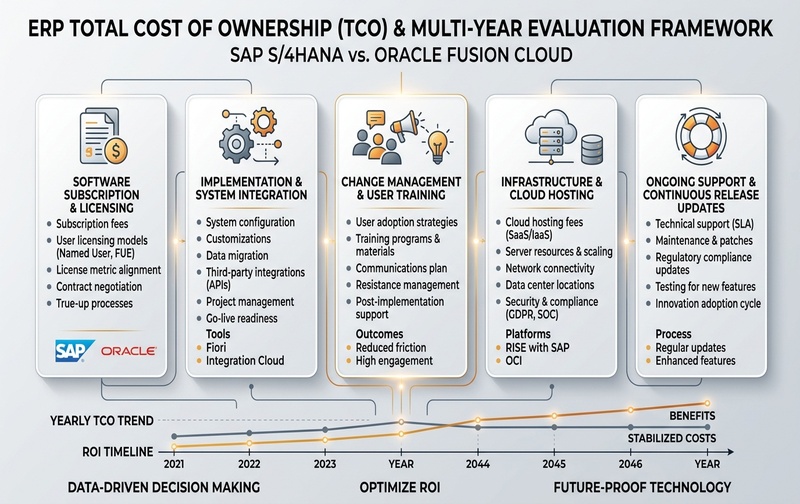
Enterprise ERP Total Cost of Ownership (TCO) framework illustrating multi-year software licensing, implementation, change management, hosting, and continuous support costs.
13. Migration Considerations
Migration strategy can materially change the business case.
Existing SAP Organizations
Companies operating SAP ECC may need to evaluate:
- Current customizations
- Existing SAP skills
- Interfaces
- Historical data
- Business-process redesign
- S/4HANA migration options
- Existing SAP investments
Moving to Oracle would normally represent a broader platform change rather than a technical ERP upgrade.
Existing Oracle Organizations
Organizations already invested in Oracle technology may evaluate how Fusion applications fit their existing:
- Databases
- Cloud infrastructure
- Enterprise applications
- Reporting architecture
- Integration environment
- Internal skill base
Greenfield Organizations
Organizations without significant legacy ERP constraints have greater freedom.
They should prioritize: future process architecture over historical technology decisions.
14. Industry Fit
Industry requirements often matter more than generic ERP functionality.
Manufacturing
Assess:
Planning, Production, Quality, Costing, Maintenance, Traceability
Consumer Products
Assess:
Demand planning, Product lifecycle, Supply-chain visibility, Pricing, Distribution
Pharmaceuticals & Life Sciences
Assess:
Batch control, Traceability, Quality processes, Documentation, Regulatory requirements
EPC & Project Businesses
Assess:
Project structures, Procurement, Cost control, Revenue, Resource planning, Project profitability
Services
Assess:
Project accounting, Resource management, Revenue recognition, Billing, Profitability
The correct comparison therefore becomes:
SAP S/4HANA vs Oracle Fusion Cloud for our industry and operating model.
Not merely SAP versus Oracle.
SAP S/4HANA May Fit When
SAP S/4HANA deserves deeper evaluation where an organization has:
- Significant existing SAP investments
- Complex manufacturing operations
- Integrated production and finance requirements
- Complex material flows
- Asset-intensive operations
- Sophisticated product costing
- Large-scale global operations
- Extensive SAP domain expertise
- A broader SAP transformation strategy
These are evaluation signals rather than automatic selection rules.
Oracle Fusion Cloud May Fit When
Oracle Fusion Cloud deserves deeper evaluation where an organization prioritizes:
- SaaS-first enterprise applications
- Cloud financial transformation
- Integrated Oracle applications
- Project-centric financial management
- Standardized cloud operations
- Frequent SaaS innovation
- Oracle-centered technology architecture
Again, these are evaluation criteria rather than universal recommendations.
SAP S/4HANA vs Oracle Fusion Cloud Decision Framework
Use five dimensions during selection:
1. Business fit
Can the ERP support your most critical end-to-end processes?
2. Industry fit
Can it handle your industry’s operational complexity without excessive customization?
3. Technology fit
Does it align with your cloud, integration, data and security architecture?
4. Transformation fit
Can your organization realistically implement and adopt the operating model?
5. Economic fit
Does the long-term business case justify the total investment?
Score the platforms using evidence from workshops, prototypes and business scenarios—not generic sales demonstrations.
Common ERP Selection Mistakes
Selecting by feature count
Both products contain thousands of functions. Feature quantity is not business fit.
Comparing only license prices
Implementation and operating costs can materially change TCO.
Recreating every legacy process
This transfers old complexity into a new platform.
Ignoring data quality
Poor master data can undermine even a technically successful implementation.
Ignoring integration complexity
ERP value depends on the wider application landscape.
Selecting ERP without business ownership
ERP transformation cannot remain an IT-only initiative. Finance, supply chain, manufacturing, procurement, sales and executive leadership must participate.
Final ERP Selection Perspective
The SAP S/4HANA vs Oracle Fusion Cloud decision should not begin with software demonstrations. It should begin with your operating model.
Operating Model Decision Flow:
➔
Process requirements
➔
Industry complexity
➔
Data architecture
➔
Integration requirements
➔
ERP capabilities
➔
Economics
Only then compare platforms.
Both SAP and Oracle are investing heavily in cloud ERP, automation and AI. Oracle’s Fusion Cloud ERP business continued to grow in fiscal 2026, while both vendors released substantial AI and operational enhancements during 2026.
That makes vendor selection increasingly less about whether a platform can run basic enterprise processes.
The differentiator is whether the ERP can support the specific complexity, architecture and transformation model of your organization.
Frequently Asked Questions
Planning an ERP Selection or Transformation?
Choosing between SAP S/4HANA, Oracle Fusion Cloud or another enterprise ERP requires more than a software feature comparison.
ERPDoctor helps businesses understand their current ERP landscape, process complexity, integration requirements, technology architecture and transformation priorities before moving forward with an ERP roadmap.
Want to see how the right ERP approach could fit your business? Book an ERP Demo.