
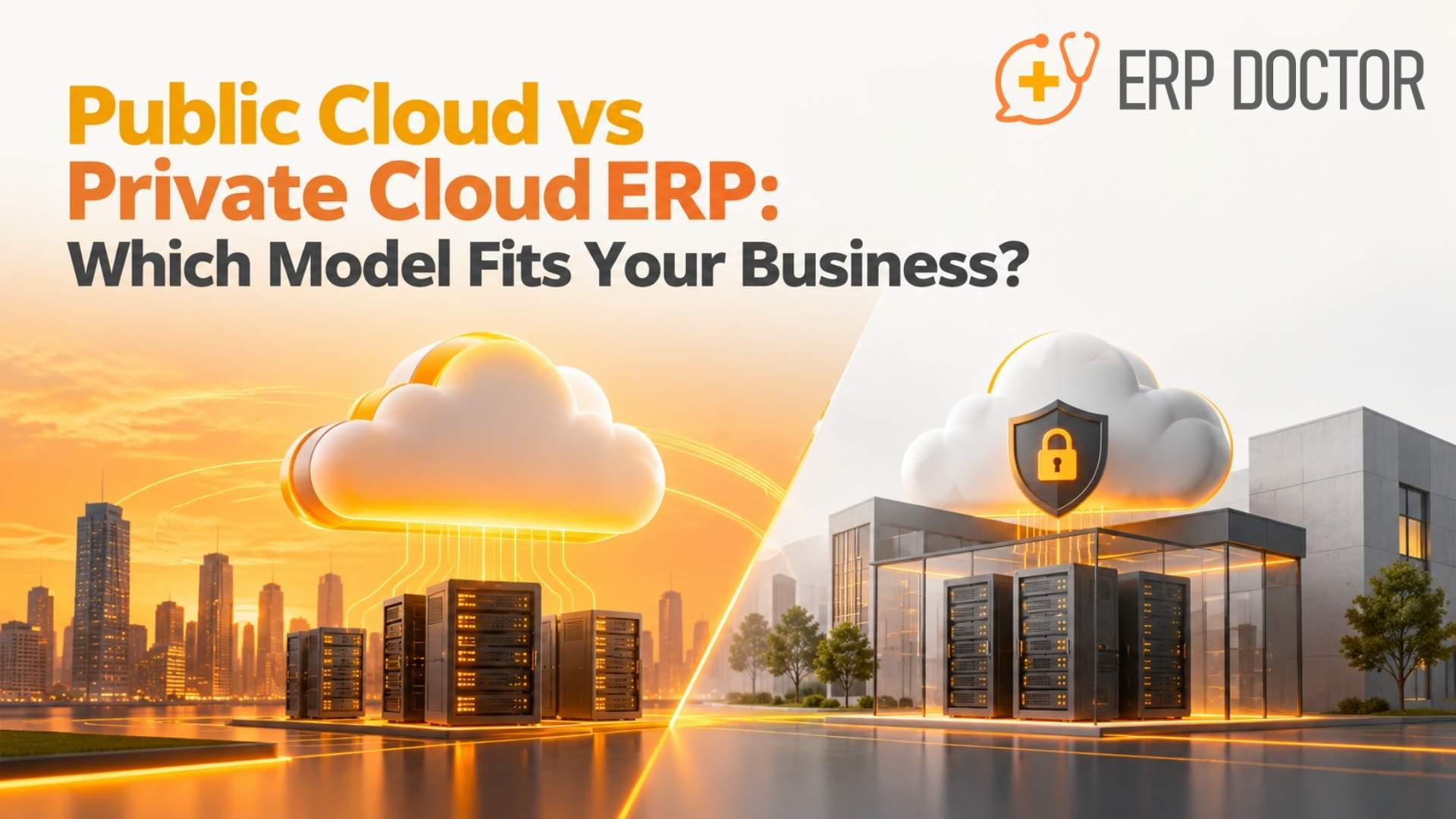
Public Cloud vs Private Cloud ERP: Which Model Fits Your Business?
Quick Answer: Public Cloud vs Private Cloud ERP
Public Cloud ERP typically provides a standardized, vendor-managed environment designed for faster deployment, scalability and lower infrastructure management. Private Cloud ERP provides a dedicated environment with greater flexibility for complex processes, integrations, customization and specific compliance requirements.
For businesses prioritizing standardization, rapid implementation and reduced IT administration, Public Cloud ERP can be a strong fit. Organizations with complex legacy environments, extensive integrations, regulatory requirements or significant customization may find Private Cloud ERP more suitable.
The right decision should be based on business processes, ERP complexity, security requirements, total cost of ownership and transformation objectives — not cloud terminology alone.
Why the Public vs Private Cloud ERP Decision Matters
Moving ERP to the cloud is no longer simply an infrastructure decision.
For many organizations, the deployment model influences:
how much the ERP can be customized
how frequently upgrades are introduced
how integrations are managed
where operational responsibility sits
how quickly the platform can scale
how compliance requirements are handled
the long-term cost of operating the ERP environment
A model that works well for a fast-growing company implementing a new ERP may not suit an enterprise migrating a highly customized legacy system.
That is why the real question is not:
“Is Public Cloud better than Private Cloud?”
The better question is:
“Which deployment model aligns with our processes, risk profile, IT architecture and growth strategy?”
Public Cloud vs Private Cloud ERP at a Glance
SAP, for example, describes its Public Cloud ERP as a SaaS offering built around standardized processes, while its Private Cloud ERP uses a single-tenant managed-cloud model with greater extensibility and deployment flexibility.
What Is Public Cloud ERP?
Public Cloud ERP is an enterprise resource planning system delivered through a cloud environment in which the provider manages much of the underlying infrastructure, application lifecycle, maintenance and platform operations.
Public Cloud ERP solutions are commonly based on a multi-tenant SaaS architecture, where multiple customers use standardized software services while their data remains logically separated.
The objective is generally to provide:
rapid deployment
standardized best-practice processes
automatic innovation
scalable infrastructure
lower infrastructure administration
predictable subscription-based operating costs
SAP Cloud ERP Public, for instance, is delivered as a SaaS solution with standardized processes and provider-managed lifecycle activities.
Public Cloud ERP typically works well when:
- the business is implementing ERP for the first time
- management wants process standardization
- legacy customization is limited
- rapid deployment is important
- internal IT infrastructure resources are limited
- regular cloud innovation is desirable
- the organization is comfortable adapting processes to ERP best practices
What Is Private Cloud ERP?
Private Cloud ERP runs in a dedicated cloud environment designed for a specific organization.
Unlike typical multi-tenant SaaS, private-cloud environments generally provide greater control over configuration, extensibility, integrations and operational architecture.
Private Cloud ERP is particularly relevant to organizations moving from complex on-premise ERP environments where significant investments have already been made in:
custom workflows
industry-specific processes
third-party integrations
add-ons
regulatory configurations
historical ERP architecture
SAP describes its Cloud ERP Private offering as a single-tenant managed cloud service that can run through SAP or supported hyperscaler infrastructure.
Private Cloud ERP typically becomes relevant when:
- ERP processes are highly customized
- the organization has complex integrations
- regulatory requirements are significant
- existing ERP investments need to be retained
- business processes cannot easily be standardized
- migration is based on an existing enterprise ERP environment
- greater upgrade control is required
Public Cloud ERP vs Private Cloud ERP: Key Differences
The decision should be evaluated across several business and technical dimensions.
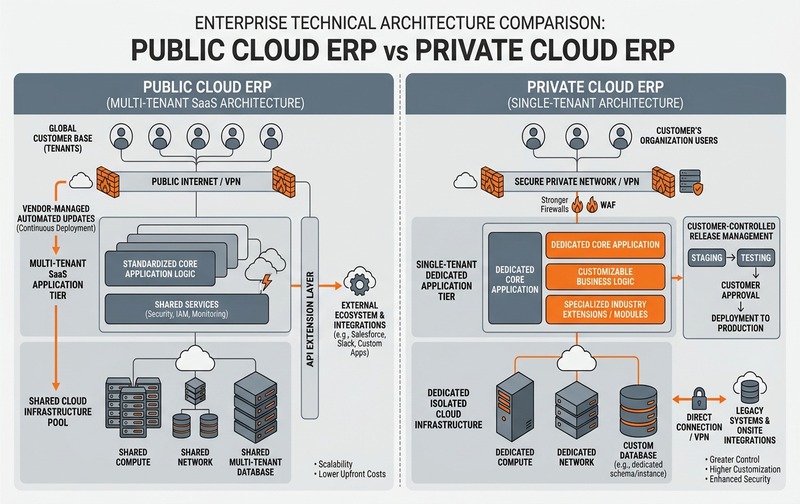
Enterprise architecture diagram comparing Public Cloud multi-tenant SaaS architecture with shared infrastructure and automated updates against Private Cloud single-tenant architecture with dedicated infrastructure and customer-controlled releases.
1. Architecture and Tenancy
One of the clearest differences is infrastructure architecture.
Public Cloud ERP
Public-cloud SaaS environments generally use a standardized platform serving multiple customers.
The provider manages:
- infrastructure
- application operations
- maintenance
- platform security
- upgrades
- availability
This architecture creates operational efficiencies because customers share a standardized delivery model.
Private Cloud ERP
Private Cloud ERP commonly uses a dedicated or single-tenant environment.
This provides greater isolation and often more flexibility regarding:
- configuration
- integration architecture
- infrastructure requirements
- upgrade scheduling
- specialized business processes
For complex organizations, that flexibility can be important.
2. Implementation Speed
Implementation speed is often one of the strongest Public Cloud ERP advantages.
Because Public Cloud solutions emphasize predefined processes and standardized configurations, companies may spend less time designing extensive custom ERP architecture.
That can reduce:
- implementation complexity
- infrastructure preparation
- technical customization
- system administration requirements
Private Cloud implementation can require more architectural planning because organizations frequently use it to accommodate existing business complexity.
Decision question
Are you willing to redesign processes around ERP best practices, or must the ERP accommodate existing processes?
Organizations prepared for process standardization often have a stronger Public Cloud case.
Organizations that must preserve complex processes may require Private Cloud.
3. ERP Customization
Customization is one of the most important differences between Public and Private Cloud ERP.
Public Cloud
Modern Public Cloud ERP emphasizes: configuration and extensibility rather than modification of the ERP core.
Organizations typically adapt requirements through:
configuration
APIs
supported extensions
cloud platforms
side-by-side applications
This reduces technical debt and makes future upgrades easier.
Clean-Core Extensibility Flow:
➔
APIs & Supported Extensions
➔
Side-by-Side Cloud Apps
➔
Seamless Upgrades
Private Cloud
Private Cloud typically offers greater flexibility for organizations that need to accommodate:
- existing enhancements
- complex industry processes
- partner add-ons
- specialized integrations
- historical ERP configurations
However, greater customization does not automatically mean better ERP architecture.
Every customization should answer:
Does this create competitive advantage, or are we preserving an outdated process simply because it exists?
Modern ERP transformation increasingly emphasizes clean-core principles, even in flexible private-cloud environments. SAP defines clean core around keeping processes, extensions, data and integrations standardized enough to preserve upgradeability and operational efficiency.
4. Public vs Private Cloud ERP Cost
Cost comparisons should go beyond subscription pricing.
Organizations should calculate Total Cost of Ownership (TCO).
A proper ERP cloud TCO analysis should include:
Implementation
consulting, configuration, data migration, testing, training, change management
Infrastructure
servers, storage, databases, backup environments, disaster recovery, monitoring
ERP operations
administration, security management, system monitoring, patching, technical support
Customization
development, testing, upgrade remediation, maintenance
Integration
middleware, APIs, external applications, custom interfaces
Upgrade costs
regression testing, remediation, business validation, custom-code adjustments
Public Cloud ERP can reduce infrastructure ownership and technical administration because the provider handles more of the operating model.
Private Cloud may carry greater operating complexity but can deliver value when replacing existing customization would create excessive transformation cost or operational risk.
Key takeaway
Do not compare ERP deployment models only on annual subscription price. Compare three-to-five-year TCO.
5. Security
A common misconception is:
Private Cloud ERP is secure and Public Cloud ERP is insecure.
That is too simplistic.
Security depends on:
architecture
identity management
encryption
access controls
monitoring
configuration
vulnerability management
backup strategy
provider controls
governance
Large cloud ERP providers operate extensive security programs.
Private Cloud can, however, provide additional isolation or deployment flexibility for organizations with specific cybersecurity or governance requirements.
SAP notes that both its Public and Private Cloud offerings use established security approaches, while some highly regulated organizations may prefer Private Cloud because of requirements around data residency, customization and specialized compliance.
The security conversation therefore should not be:
Which cloud is secure?
It should be:
Which architecture meets our organization’s specific security and risk requirements?
6. Compliance and Data Residency
Compliance requirements can become a deciding factor for industries such as:
pharmaceuticals
healthcare
financial services
government
aerospace
utilities
energy
defense
highly regulated manufacturing
Questions to evaluate include:
- Where will ERP data physically reside?
- Which regulations apply?
- Who controls administrative access?
- Which certifications does the provider maintain?
- What audit evidence is available?
- How is data encrypted?
- How are backups managed?
- What happens during disaster recovery?
- Are specific geographic hosting requirements involved?
Public Cloud ERP may already satisfy many standardized regulatory requirements.
Private Cloud becomes more relevant when the organization needs specialized architecture, additional isolation or specific operational controls.
7. Upgrade Management
ERP upgrades affect:
- business processes
- integrations
- extensions
- reporting
- custom developments
- user training
Public Cloud ERP
Updates are generally introduced according to the provider’s product lifecycle.
This has an advantage:
Businesses gain access to innovation without running large infrastructure upgrade projects.
The trade-off is that organizations have less freedom to postpone platform evolution indefinitely.
Private Cloud ERP
Private Cloud often provides greater flexibility around when certain updates are implemented.
That can help businesses with complex integration and testing requirements.
SAP’s own guidance highlights the distinction: Public Cloud releases are managed as part of the SaaS lifecycle, while Private Cloud provides greater customer involvement in update implementation.
8. Integration Complexity
Most enterprise ERP systems do not operate independently.
They connect with systems such as:
CRM
warehouse management
manufacturing execution systems
e-commerce
banking
payroll
HR
procurement platforms
business intelligence
third-party logistics
supplier portals
industry applications
Public Cloud ERP increasingly supports integration through standardized APIs and cloud integration platforms.
This works well when the organization’s application architecture is modern and standardized.
Private Cloud may provide greater flexibility where companies have:
- extensive legacy interfaces
- custom middleware
- industry-specific integrations
- tightly coupled applications
- long-standing ERP dependencies
Before selecting a deployment model, build an ERP integration dependency map.
9. Scalability
Both Public and Private Cloud ERP can provide significant scalability.
However, they achieve it through different operating models.
Public Cloud typically provides straightforward cloud scaling through standardized provider-managed infrastructure.
Private Cloud can also scale effectively, but the environment may require greater planning depending on architecture and service model.
The bigger question is not only:
Can the infrastructure scale?
It is:
Can the ERP operating model scale as the business adds companies, locations, users, transactions and acquisitions?
Public Cloud ERP: Advantages and Limitations
Advantages
Faster deployment
Standardized processes can reduce implementation complexity.
Lower infrastructure management
The vendor handles much of the technical operating model.
Continuous innovation
New functionality can enter the environment through regular cloud releases.
Easier scalability
Capacity can expand without traditional infrastructure projects.
Reduced technical debt
Cloud extensibility models encourage organizations to avoid unnecessary core modifications.
Limitations
Less customization freedom
Highly specialized legacy processes may require redesign.
Upgrade schedules are less flexible
Customers must operate within the vendor’s release model.
Standardization requires change
Departments may need to adopt different processes rather than reproducing old workflows.
Private Cloud ERP: Advantages and Limitations
Advantages
Greater flexibility
Private Cloud can better accommodate complex ERP environments.
Stronger support for existing ERP investments
Organizations may retain more of their existing processes, integrations and extensions.
Greater operational control
Companies often have more flexibility regarding architecture and lifecycle decisions.
Suitable for complex migrations
Private Cloud is commonly considered for organizations converting mature enterprise ERP environments.
Limitations
Greater complexity
Flexibility can increase implementation and administration requirements.
Higher potential TCO
Dedicated environments and complex customization may increase long-term operating costs.
Risk of preserving unnecessary legacy complexity
Private Cloud should not become an excuse to migrate every historical ERP customization unchanged.
When Should You Choose Public Cloud ERP?
Public Cloud ERP should receive serious consideration when the organization:
is implementing a new ERP
wants rapid deployment
wants standardized business processes
has limited ERP customization
wants lower infrastructure administration
wants continuous cloud innovation
is prepared to redesign outdated processes
prefers a SaaS operating model
Example
A growing manufacturing company operating across several locations may currently rely on disconnected systems and spreadsheets.
Rather than rebuilding those fragmented processes inside a new ERP, the company could use Public Cloud ERP as an opportunity to adopt standardized processes across:
finance
procurement
inventory
sales
production
reporting
In this case, standardization itself becomes part of the transformation.
When Should You Choose Private Cloud ERP?
Private Cloud ERP may be better suited when the company:
already operates a complex enterprise ERP
has extensive customizations
depends on specialized industry functionality
has significant third-party integrations
operates in highly regulated markets
needs specific data-location requirements
cannot immediately redesign core processes
requires greater control over system lifecycle decisions
SAP specifically positions its Private Cloud ERP as relevant to customers requiring the flexibility and geographical reach associated with complex S/4HANA environments.
What About Hybrid ERP?
Public and Private Cloud are not always the only choices.
Large businesses can operate hybrid landscapes combining:
cloud ERP
private ERP environments
on-premise applications
SaaS platforms
industry systems
cloud integration services
Hybrid ERP Landscape Integration Topology:
➔
Private ERP Environments
➔
On-Premise Applications
➔
SaaS & Cloud Services
For example, an organization may operate ERP centrally while connecting:
- CRM through SaaS
- manufacturing systems locally
- analytics through cloud platforms
- specialist regulatory applications separately
Hybrid architecture can reduce migration risk, but it also creates integration and governance complexity.
The objective should therefore be:
intentional hybrid architecture — not permanent application fragmentation.
Public vs Private Cloud ERP by Business Scenario
This matrix should only be used as an initial guide.
Actual ERP architecture should be validated against business and technical requirements.
Public Cloud vs Private Cloud ERP: A Decision Framework for Executives
A practical ERP evaluation can be structured around six areas.
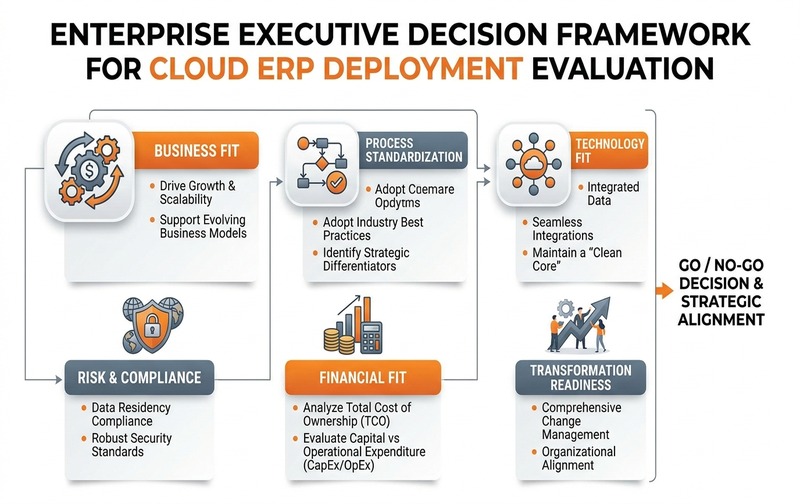
Comprehensive enterprise decision framework showing the 6 strategic pillars for Cloud ERP evaluation: Business Fit, Process Standardization, Technology Fit, Risk and Compliance, Financial Fit, and Transformation Readiness.
Six Evaluation Areas:
➔
2. Process Standardization
➔
3. Technology Fit
➔
4. Risk and Compliance
➔
5. Financial Fit
➔
6. Transformation Readiness
1. Business Fit
Determine whether the ERP can support:
- current processes
- future growth
- acquisitions
- international expansion
- new business models
2. Process Standardization
Identify which processes can adopt best practices and which genuinely differentiate the business.
3. Technology Fit
Assess:
- ERP architecture
- integrations
- custom code
- data volumes
- reporting
- extensions
4. Risk and Compliance
Evaluate:
- data residency
- cybersecurity
- auditability
- business continuity
- disaster recovery
- regulatory requirements
5. Financial Fit
Calculate:
- implementation cost
- operating cost
- infrastructure cost
- support
- upgrade cost
- five-year TCO
6. Transformation Readiness
Finally ask:
Is the organization prepared to change?
Public Cloud transformation often requires stronger process standardization.
Private Cloud may accommodate more existing complexity, but the organization should still eliminate unnecessary legacy processes.
The Biggest ERP Cloud Mistake: Choosing Technology Before Understanding the Business
ERP selection frequently starts with vendor demonstrations.
That reverses the decision process.
Before comparing cloud products, organizations should document:
business problems
critical processes
integration dependencies
regulatory requirements
existing customization
future growth plans
transformation objectives
Only then should Public Cloud, Private Cloud and Hybrid options be evaluated.
Otherwise, businesses risk choosing an ERP architecture based on features rather than operational fit.
How ERPDoctor Can Help with Cloud ERP Evaluation
Choosing between Public and Private Cloud ERP affects far more than infrastructure.
It influences:
- business processes
- ERP architecture
- implementation complexity
- customization
- integration strategy
- compliance
- operating costs
- future upgrades
ERPDoctor can help organizations evaluate ERP options from a business-first perspective before committing to a platform or deployment model.
The evaluation can include:
current ERP landscape assessment
process-fit analysis
customization review
integration assessment
cloud deployment comparison
ERP vendor evaluation
implementation-risk review
TCO comparison
transformation roadmap
Final Takeaway
There is no universal winner in the Public Cloud vs Private Cloud ERP debate.
Public Cloud ERP provides a compelling model for organizations prioritizing:
standardization, speed, scalability and reduced infrastructure management.
Private Cloud ERP provides a stronger fit where businesses require:
greater flexibility, complex integration, legacy ERP continuity or specialized compliance controls.
The most important decision is not where the ERP runs.
It is whether the selected architecture supports the company’s processes, growth strategy, risk profile and long-term transformation objectives.
Before committing to either model, evaluate the complete ERP landscape—including processes, integrations, customization, compliance requirements and five-year TCO.
Need help deciding between Public Cloud, Private Cloud or Hybrid ERP? Get an independent ERP assessment before making the investment.
Frequently Asked Questions
Evaluate Your Cloud ERP Deployment Options
Discuss your public, private or hybrid cloud ERP requirements with an expert.
Book a demo to explore the right deployment approach for your business, integrations and growth plans.