
ERP for Pharmaceutical Manufacturing: Selection, Features & Implementation Guide
Quick Answer
ERP for pharmaceutical manufacturing connects production, inventory, procurement, finance, supply chain and related business processes within a centralized system. For pharmaceutical manufacturers, the right ERP should support batch and lot management, production planning, inventory and expiry tracking, traceability, production costing, quality-related workflows, reporting and integrations.
Choosing an ERP for pharmaceutical manufacturing should go beyond comparing feature lists. Manufacturers need to evaluate how well the system fits their production processes, product complexity, inventory requirements, data structure, integrations, reporting needs and future growth plans.
A suitable pharmaceutical ERP can help replace disconnected spreadsheets and systems with a more centralized operating model. However, the exact capabilities available depend on the ERP platform, configuration, industry extensions and integrations used during implementation.
AI can further support pharmaceutical manufacturing through areas such as forecasting, analytics, anomaly detection and planning assistance. AI should be evaluated as part of the overall ERP architecture rather than treated as a substitute for core manufacturing, inventory and financial processes.
The most important ERP selection criteria include manufacturing functionality, batch and inventory management, traceability, integration capability, scalability, reporting, implementation approach, support and total cost of ownership.
For pharmaceutical manufacturers, the right ERP is ultimately the system that fits the organization’s operational requirements and can support those processes reliably as the business evolves.
What Is ERP for Pharmaceutical Manufacturing?
ERP for pharmaceutical manufacturing is an enterprise resource planning system used to connect core business and manufacturing processes within a centralized platform.
Unlike a basic accounting or inventory application, a manufacturing-focused ERP can bring together processes such as:
For pharmaceutical manufacturers, ERP selection also needs to consider the operational complexity associated with raw materials, formulations, production batches, inventory expiry, traceability and multiple stages of manufacturing.
The objective is not simply to introduce another software system. It is to create a connected information flow across processes that may otherwise operate in separate applications, spreadsheets or manual workflows.
For example, procurement needs visibility into material requirements, production needs accurate inventory information, warehouse teams need batch and expiry visibility, finance needs production and purchasing data, and management needs consolidated reporting.
An ERP can connect these processes so that information created in one part of the business can support decisions elsewhere.
Why Pharmaceutical Manufacturers Need Industry-Fit ERP
Pharmaceutical manufacturing involves operational requirements that can make generic ERP selection insufficient.
A manufacturer may manage multiple raw materials, formulations, production stages, warehouses, finished products and distribution channels. At the same time, management needs visibility into inventory, production costs, purchasing commitments and sales performance.
Common operational challenges include:
These challenges do not automatically mean that an organization needs a new ERP. The first step should be to document the current processes and identify where the existing system is creating operational limitations.
A pharmaceutical ERP evaluation should then determine whether the prospective platform can address those requirements through standard functionality, configuration, customization or integration.
Essential ERP Capabilities for Pharmaceutical Manufacturing
The capabilities required from a pharmaceutical manufacturing ERP will vary by organization. However, several functional areas should be evaluated during the selection process.
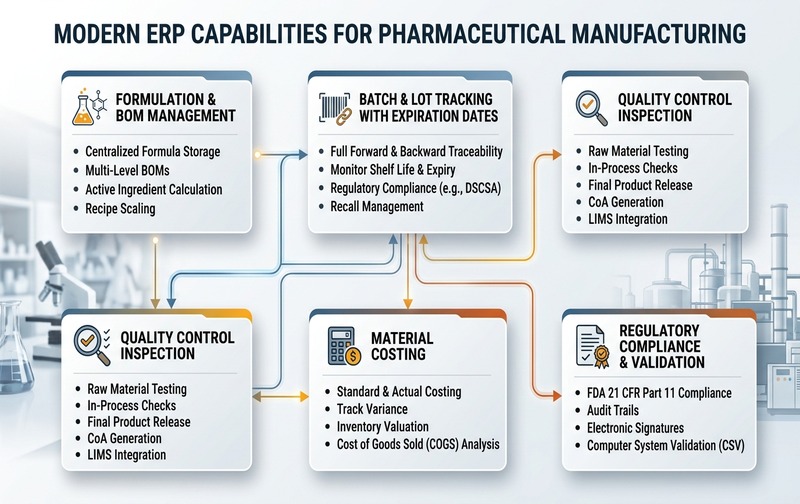
Figure 1: High-level architectural overview of core pharmaceutical manufacturing ERP modules and data flows.
Batch and Lot Management
Batch and lot management is important when materials and finished products need to be identified and tracked according to production or inventory batches.
The ERP evaluation should consider whether the system can support the organization’s requirements for:
- Batch identification
- Lot tracking
- Material consumption
- Finished-goods tracking
- Inventory movements
- Batch-related reporting
- Traceability across relevant processes
The exact level of traceability required will depend on the manufacturer’s products, processes and operating environment.
Bill of Materials and Formulation Management
Pharmaceutical manufacturing often depends on defined material structures and formulations.
The ERP should allow manufacturers to evaluate how bills of materials, production versions, formulations or related product structures are maintained.
Important questions include:
- How are material requirements defined?
- How are revisions managed?
- How are alternative materials handled?
- How are production quantities calculated?
- How are changes communicated to production?
- How does the system record actual material consumption?
The objective is to ensure that product and production data remain consistent across planning, procurement and manufacturing.
Production Planning and Scheduling
Production planning connects customer requirements, inventory availability, material requirements and manufacturing capacity.
An ERP evaluation should examine how the system supports:
- Production orders
- Material requirements
- Production scheduling
- Work-in-progress visibility
- Resource planning
- Material availability
- Production status reporting
Manufacturers should test these processes using their own production scenarios rather than relying exclusively on generic software demonstrations.
Inventory and Expiry Management
Pharmaceutical manufacturers often need detailed inventory visibility across raw materials, packaging materials, work in progress and finished goods.
The ERP should be evaluated for its ability to support:
- Batch and lot inventory
- Expiry information
- Warehouse locations
- Stock transfers
- Material consumption
- Inventory adjustments
- Stock availability
- Inventory reporting
The important question is not simply whether an ERP has an inventory module. It is whether the inventory model matches the manufacturer’s actual warehouse and production processes.
Procurement and Supplier Management
Procurement is closely connected to manufacturing because material availability can directly affect production planning.
ERP evaluation should consider how purchasing processes connect with:
- Material requirements
- Purchase orders
- Supplier records
- Goods receipts
- Inventory
- Purchase costs
- Accounts payable
Centralized procurement information can also give management better visibility into purchasing commitments and supplier activity.
Production Costing
Manufacturers need to understand the cost associated with producing their products.
Depending on the ERP architecture, production costing can incorporate areas such as:
- Raw-material costs
- Packaging costs
- Production-related expenses
- Inventory movements
- Work in progress
- Finished-goods costs
Costing models vary by ERP and implementation. Manufacturers should therefore validate the exact costing methodology during the evaluation stage instead of assuming that every system calculates costs in the same way.
Quality-Related Workflows
Quality processes are an important part of pharmaceutical manufacturing operations.
The ERP should be assessed for how it can support the organization’s quality-related workflows and whether integration with dedicated quality or laboratory systems is required.
Potential areas for evaluation include:
- Quality checks
- Material inspection workflows
- Non-conformance processes
- Quality status
- Documentation
- Laboratory or quality-system integration
ERP should not automatically be described as a complete replacement for specialized quality systems. In some environments, integration may be the more appropriate architecture.
How ERP Supports Pharmaceutical Batch Manufacturing
A pharmaceutical manufacturing ERP can connect the flow of information across a batch production process.
A simplified workflow may look like:
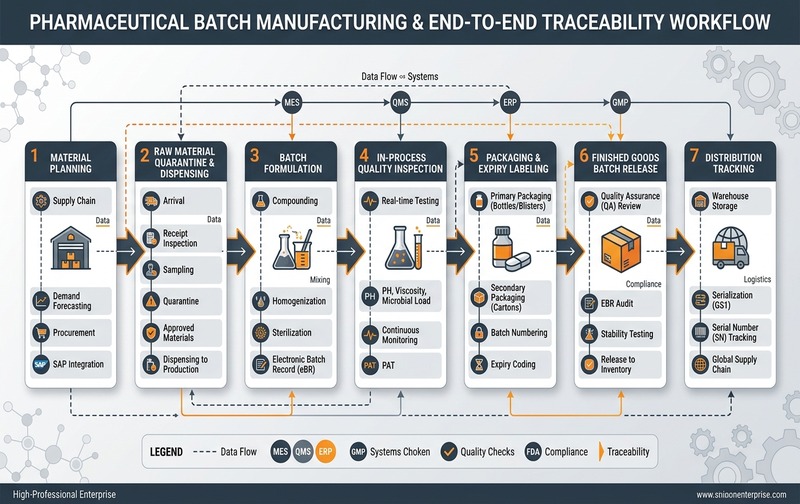
Figure 2: Complete lifecycle traceability across pharmaceutical batch manufacturing stages and connected enterprise applications.
The value of an integrated workflow is the ability to maintain connected information between these stages.
For example, production planning depends on material availability. Material availability depends on purchasing and inventory records. Finished-goods availability depends on production completion and inventory updates.
When these processes operate independently, employees may need to reconcile information manually.
An ERP can provide a common system for these transactions, subject to the platform’s capabilities and implementation design.
Pharmaceutical Inventory and Traceability
Inventory visibility becomes more complex when a manufacturer handles multiple materials, batches, warehouses and finished products.
A pharmaceutical ERP should therefore be evaluated based on how easily users can answer questions such as:
What materials are currently available?
Which batch or lot does the material belong to?
Where is the inventory located?
What quantities have been consumed?
Which finished products are associated with a particular production process?
What inventory is approaching expiry?
What stock is available for production or distribution?
Traceability should be assessed against the organization’s actual operational requirements.
Rather than assuming that every ERP provides the same level of traceability, manufacturers should demonstrate representative scenarios during the vendor evaluation.
ERP Integration Requirements for Pharmaceutical Manufacturers
An ERP rarely operates completely alone.
Depending on the organization, the ERP may need to exchange information with systems used for:
- Laboratory operations
- Quality management
- Warehouse management
- CRM
- E-commerce
- Banking and payment processing
- Tax and e-invoicing
- Business intelligence
- Manufacturing equipment
- Customer or distributor portals
Integration requirements should be identified before selecting the ERP.
For example, if a manufacturer already operates a specialized laboratory or quality platform, replacing it may not be necessary. The better approach could be integrating the existing system with the ERP.
This is why ERP selection should include an integration architecture review, not just a feature comparison.
AI in Pharmaceutical Manufacturing ERP
AI is becoming increasingly relevant to ERP and manufacturing technology, but its value depends on the quality of the underlying business data and the specific use case.
Potential AI-supported applications include:
- Demand forecasting
- Inventory forecasting
- Production planning assistance
- Anomaly detection
- Operational analytics
- Predictive insights
- Automated analysis of business data
- Management reporting assistance
However, manufacturers should avoid evaluating AI as a standalone feature.
A more useful evaluation asks:
What business decision can AI improve, what data does it require, and how is the resulting insight incorporated into the operational workflow?
For example, an AI-powered forecasting capability is only useful if the organization has sufficiently reliable historical and operational data to support the intended analysis.
AI functionality can also differ substantially between ERP platforms. Some capabilities may be native, while others may depend on additional services, integrations or extensions.
Therefore, manufacturers should validate the exact AI functionality available in the proposed solution rather than relying on broad “AI-powered ERP” claims.
Pharmaceutical ERP Requirements to Evaluate Before Selection
Before comparing ERP vendors, pharmaceutical manufacturers should document their requirements.
The evaluation should cover at least six areas.
Manufacturing Requirements
Document:
- Production processes
- Batch structure
- Formulations
- Production stages
- Material consumption
- Production planning
- Costing requirements
Inventory Requirements
Evaluate:
- Warehouses
- Batch and lot management
- Expiry tracking
- Stock transfers
- Material availability
- Inventory reporting
Business Requirements
Consider:
- Procurement
- Sales
- Finance
- Distribution
- Customer management
- Management reporting
Integration Requirements
Identify every system that needs to exchange data with the ERP.
This should include existing software as well as planned future systems.
Reporting Requirements
Management should identify the reports required for:
- Production
- Inventory
- Procurement
- Sales
- Finance
- Costs
- Management performance
Scalability Requirements
The ERP should be evaluated against expected changes in:
- Users
- Products
- Production volume
- Warehouses
- Business locations
- Transactions
- Reporting requirements
The goal is to evaluate whether the platform can support the organization’s expected operating model rather than only its current size.
How to Compare ERP Solutions for Pharmaceutical Manufacturing
Comparing ERP systems only by the number of features can produce misleading results.
A better approach is to compare each platform against the organization’s actual business requirements.
| Evaluation Area | What to Examine |
|---|---|
| Manufacturing | Production, BOM, formulations and planning |
| Batch Management | Batch, lot and production traceability |
| Inventory | Stock, expiry, warehouses and material availability |
| Procurement | Suppliers, purchasing and material requirements |
| Costing | Production and inventory costing requirements |
| Quality | Quality workflows and required integrations |
| Integration | APIs, third-party systems and data exchange |
| Reporting | Operational and management visibility |
| Scalability | Users, products, locations and transaction growth |
| Implementation | Configuration, customization and migration |
| Support | Training, support and post-go-live services |
| Total Cost | Software, implementation, integrations and ongoing costs |
This approach allows decision-makers to evaluate ERP systems based on business fit rather than marketing terminology.
Standard ERP Functionality vs Configuration vs Customization
One of the most important questions during ERP selection is how a requirement will actually be delivered.
A requirement may be addressed through:
Standard functionality: The capability already exists in the ERP.
Configuration: Existing functionality is adjusted to match the organization’s process.
Customization: Additional development is required because standard functionality does not meet the requirement.
Integration: Another system provides the capability and exchanges data with the ERP.
These approaches have different implications for cost, maintenance, upgrades and implementation complexity.
A strong ERP evaluation should identify the proposed approach for each critical requirement before implementation begins.
ERP Implementation Considerations for Pharmaceutical Manufacturers
Selecting the ERP is only one part of the transformation.
Implementation planning should cover:
Process Mapping
Document current workflows and identify which processes should remain, change or be standardized.
Master Data
Review:
- Product data
- Material data
- Supplier records
- Customer records
- Warehouse data
- Bills of materials
- Pricing
- Opening balances
Poor master data can create operational problems even when the ERP itself is technically capable.
Data Migration
Determine which historical and operational information needs to move into the new system.
Migration should be planned, tested and validated before production cutover.
Integration
Identify integration dependencies early rather than treating them as a final implementation task.
User Training
Users should understand not only which buttons to click but also how the new processes affect their daily responsibilities.
Testing
Test representative business scenarios before go-live.
For pharmaceutical manufacturing, these should include realistic production, inventory, procurement and batch-related workflows.
Post-Go-Live Support
The implementation plan should include support after deployment, including issue resolution, user assistance, system optimization and future enhancements.
Common Pharmaceutical ERP Selection Mistakes
Choosing Based Only on Features
A long feature list does not guarantee business fit.
Ignoring Existing Systems
An ERP may need to integrate with systems that the organization intends to retain.
Treating Customization as the Default
Custom development can sometimes be appropriate, but standard functionality and configuration should be evaluated first.
Evaluating Only the Software License
The total investment can also include implementation, migration, integrations, training, support and future enhancements.
Demonstrating Generic Workflows
A generic product demo may not show how the ERP handles the organization’s actual manufacturing processes.
Ignoring Master Data
Poor data preparation can undermine an otherwise successful ERP implementation.
Focusing Only on Current Requirements
The ERP should also be evaluated against expected business growth, additional locations, new products and increasing transaction volumes.
When Should a Pharmaceutical Manufacturer Reconsider Its Existing ERP?
A company may need to reassess its ERP when its existing systems no longer support its operating model effectively.
Potential warning signs include:
- Heavy dependence on spreadsheets
- Multiple disconnected applications
- Limited production visibility
- Difficult batch-level information retrieval
- Manual inventory reconciliation
- Slow management reporting
- Limited integration between business systems
- Increasing difficulty supporting new products or locations
- Growing customization requirements
- Operational processes that require repeated manual data entry
These signals do not automatically mean that replacing the ERP is the correct decision.
The organization should first determine whether the problem can be addressed through process improvements, configuration, integration, upgrades or targeted extensions.
How to Choose the Right ERP for Pharmaceutical Manufacturing
The ERP selection process should follow a structured evaluation.
Step 1: Document current processes
Map production, inventory, procurement, quality-related workflows, sales, finance and reporting.
Step 2: Identify operational gaps
Determine where the current environment creates manual work, delays, duplicate data or limited visibility.
Step 3: Define ERP requirements
Separate mandatory requirements from desirable capabilities.
Step 4: Evaluate the technology architecture
Review deployment, integration, data, scalability and extensibility requirements.
Step 5: Test real business scenarios
Ask vendors to demonstrate actual workflows rather than generic features.
Step 6: Evaluate implementation requirements
Understand migration, configuration, customization, integration and training requirements.
Step 7: Review the total investment
Consider software, implementation, integration, support, training and future enhancement costs.
Step 8: Define the post-go-live model
Clarify support, upgrades, maintenance and future optimization before signing the implementation agreement.
This process gives decision-makers a clearer basis for comparing ERP options.
Is ERP Enough for Pharmaceutical Manufacturing?
ERP can provide the central business and manufacturing foundation for many pharmaceutical organizations, but it may not replace every specialized system.
Depending on the organization’s processes, an ERP may need to work alongside:
- Laboratory systems
- Quality systems
- Warehouse platforms
- Manufacturing equipment
- Business intelligence tools
- CRM platforms
- Specialized regulatory or operational applications
The appropriate architecture depends on the manufacturer’s requirements.
The goal should therefore be connected systems and reliable information flow, rather than forcing every business function into a single application regardless of suitability.
Frequently Asked Questions
What is the best ERP for pharmaceutical manufacturing?
The appropriate ERP depends on the manufacturer’s production processes, batch requirements, inventory structure, integrations, reporting needs, scalability requirements and implementation model. Rather than selecting an ERP solely by its feature count, manufacturers should evaluate how each platform performs against their actual business requirements.
What features should pharmaceutical manufacturing ERP software include?
Important areas to evaluate include production planning, batch and lot management, inventory and expiry tracking, bills of materials, procurement, warehouse management, production costing, financial management, reporting, integrations and relevant quality-related workflows.
How does ERP support pharmaceutical batch manufacturing?
ERP can connect material planning, procurement, inventory, production orders, material consumption, batch-related information, finished-goods inventory and distribution processes. The exact level of batch functionality depends on the ERP platform and implementation.
Can ERP manage pharmaceutical inventory and expiry?
Many ERP platforms provide inventory capabilities that can be configured to manage batch, lot, warehouse and expiry-related information. Manufacturers should verify the exact workflows required for their operations during product evaluation.
Does pharmaceutical ERP include quality management?
Some ERP platforms provide quality-related functionality, while others integrate with dedicated quality or laboratory systems. The appropriate approach depends on the organization’s requirements and existing technology environment.
Can AI be used with pharmaceutical manufacturing ERP?
AI can support use cases such as forecasting, analytics, anomaly detection and planning assistance. The available capabilities depend on the ERP platform, data architecture and additional technologies or integrations used.
How should pharmaceutical manufacturers compare ERP software?
Manufacturers should compare ERP solutions against documented requirements covering manufacturing, batch management, inventory, procurement, costing, quality-related workflows, integrations, reporting, scalability, implementation and total cost of ownership.
What should manufacturers consider before implementing ERP?
Manufacturers should assess business processes, master data, migration requirements, integrations, user roles, training, testing, customization, implementation resources and post-go-live support before beginning an ERP implementation.
Evaluate ERP for Pharmaceutical Manufacturing
Choosing an ERP for pharmaceutical manufacturing requires alignment between production processes, batch management, inventory, compliance requirements, integrations and business growth.
Emerging Alliance can help you evaluate ERP requirements across selection, implementation, customization, integration, cloud deployment, migration and ongoing support.
Discuss your pharmaceutical manufacturing ERP requirements with our team and explore an ERP approach aligned with your processes and growth plans.