
ERP for Pharma Industry: The Manufacturing Control & Compliance Selection Guide
Pharmaceutical manufacturers rarely outgrow their businesses. They outgrow the systems holding those businesses together.
Production may be managed in one application, quality records in another, inventory in spreadsheets, procurement through emails, and financial reporting in an accounting system. The arrangement can work when operations are smaller. As manufacturing volumes, SKUs, batches, warehouses, regulatory requirements, and locations increase, however, disconnected processes begin creating operational risk.
That is where evaluating an ERP for pharma industry operations becomes a strategic decision rather than a simple software purchase.
A pharmaceutical ERP should create an integrated operational foundation connecting procurement, inventory, production, quality, costing, finance, sales, batch information, and management reporting. More importantly, the right system must fit the manufacturer’s regulatory environment, operational complexity, growth plans, validation requirements, and total cost of ownership.
This guide explains how pharmaceutical manufacturers can evaluate ERP systems, identify essential capabilities, compare different ERP categories, estimate implementation considerations, and determine which approach fits their business.
Quick Answer: What Is ERP for the Pharma Industry?
ERP for the pharma industry is an integrated business management system designed to connect pharmaceutical manufacturing, inventory, procurement, quality, batch traceability, costing, sales, finance, and compliance-related processes within a controlled operating environment.
Unlike generic accounting or inventory software, pharmaceutical ERP requirements frequently include batch and lot traceability, expiry management, quality status controls, production documentation, material genealogy, auditability, controlled approvals, and integration with specialized laboratory, manufacturing, serialization, or regulatory systems.
The best ERP is therefore not simply the platform with the most features. It is the system that provides the right balance of pharmaceutical process control, compliance support, scalability, usability, integration capability, implementation effort, and total cost of ownership.
Why Pharmaceutical Manufacturers Outgrow Basic Business Systems
The need for ERP often becomes visible through operational symptoms rather than an explicit technology problem.
A finance team may struggle to determine the actual cost of producing a batch. Warehouse teams may manually track expiry dates. Quality departments may depend heavily on spreadsheets and disconnected documents. Procurement teams may lack visibility into material requirements. Production planners may discover shortages only after schedules have been committed.
Each department may still be functioning, but the organization lacks a reliable operational view across departments.
This creates several common problems across pharmaceutical operations:
Inventory Mismatches: Inventory records in the system do not match physical stock availability in the warehouse.
Delayed Scheduling: Production scheduling decisions are made based on stale or delayed operational data.
Invisible Quality Status: Inspection or quarantine holds are not immediately visible to warehouse or dispatch teams.
Manual Batch Consolidation: Batch records and material genealogy require extensive manual cross-referencing.
Reporting Vulnerabilities: Management reporting depends on spreadsheet manipulation rather than live transactional data.
The issue becomes more serious as the company expands.
More production does not merely create more transactions. It creates more dependencies between materials, batches, quality decisions, warehouses, customers, suppliers, financial controls, and regulatory records.
A pharmaceutical ERP should reduce these dependencies on manual coordination.
ERP for Pharma Manufacturing: The Business Problems It Should Solve
The purpose of an ERP implementation is not to digitize existing inefficiencies.
It is to establish better control over how information moves through the pharmaceutical manufacturing lifecycle.
For example, consider a raw material received from a supplier.
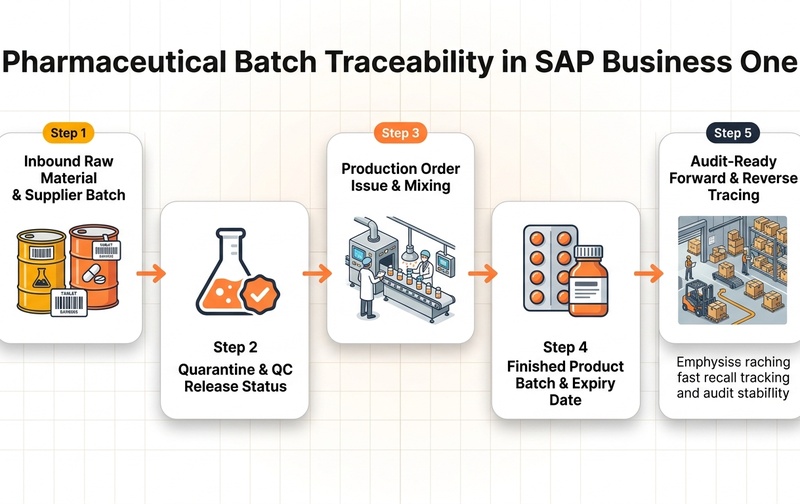
The ERP environment should help identify the supplier, purchase order, received quantity, lot or batch information, warehouse location, inspection or quality status, material availability, eventual consumption in production, resulting finished-goods batch, costing impact, and downstream customer transaction.
End-to-End Pharmaceutical Lifecycle Flow:
➔
Batch Receipt & Quarantine
➔
QC Inspection & Release
➔
Production Consumption
➔
Finished Batch Creation
➔
Costing Impact
➔
Customer Distribution
Without integrated systems, parts of that history may exist across several applications and spreadsheets.
With an appropriately designed ERP architecture, management can obtain much stronger transaction visibility and traceability.
That distinction is fundamental when comparing systems.
Core ERP Requirements for Pharmaceutical Manufacturing
A pharmaceutical company should evaluate ERP functionality around actual operating workflows rather than generic feature checklists.
Batch and Lot Traceability
Batch traceability is one of the most important requirements in pharmaceutical manufacturing.
The ERP should make it possible to identify the movement of batch-controlled materials through procurement, warehouse operations, manufacturing, finished goods, sales, and related transactions.
Management should be able to investigate questions such as:
- Which supplier lot was consumed?
- Which production order used the material?
- Which finished batches resulted from that production?
- Where are those batches currently stored?
- Which customers received a particular batch?
The ability to trace information efficiently becomes particularly important during quality investigations, customer complaints, internal reviews, and recall-related scenarios.
Expiry and Shelf-Life Control
Pharmaceutical inventory does not simply have a quantity and monetary value. It also has shelf-life implications.
ERP evaluation should therefore consider expiry-date visibility, remaining shelf life, inventory aging, batch allocation rules, warehouse practices such as FEFO (First Expired, First Out) where appropriate, and alerts or reports that help prevent inventory from becoming unusable.
Better expiry visibility can reduce avoidable write-offs while improving inventory planning.
Quality Management Integration
Quality control should not operate as an isolated administrative function.
ERP workflows should help ensure that material status and quality decisions are reflected in operational processes.
Depending on the selected system and architecture, this may involve inspection workflows, quality status, approvals, holds, release controls, non-conformance processes, or integration with a laboratory information management system (LIMS).
The critical question is not whether the ERP has a button labelled “Quality.”
The question is whether the proposed solution can enforce the organization’s actual quality workflow without creating uncontrolled workarounds.
Production Planning and Manufacturing Control
Pharmaceutical manufacturers require visibility across materials, formulations or bills of materials, manufacturing orders, production quantities, material consumption, yields, variances, and finished output.
More complex organizations may also need capabilities around routings, production stages, capacity planning, subcontracting, co-products, by-products, process manufacturing, or integration with manufacturing execution systems (MES).
The required depth depends heavily on manufacturing complexity.
An SME pharmaceutical manufacturer and a multi-site global pharmaceutical organization should not be expected to choose the same ERP architecture simply because both operate in the same industry.
Material Requirements and Procurement Planning
Procurement teams should be able to make decisions based on expected demand, production plans, current inventory, open purchase orders, lead times, minimum levels, and other planning parameters.
Without integrated planning, procurement often becomes reactive. That can increase both shortages and excess inventory.
The ERP should therefore help convert manufacturing requirements into clearer material planning decisions.
Product Costing and Margin Visibility
Pharmaceutical companies need more than revenue reporting. Management must understand what products actually cost to manufacture.
Raw materials, packaging, labor, overhead, subcontracting, production losses, yield differences, and other manufacturing variables can influence profitability.
The required costing methodology differs by business, but an ERP evaluation should determine whether management can obtain meaningful product, batch, production-order, and margin information without relying on extensive offline calculations.
Inventory and Warehouse Visibility
Management should be able to see inventory by warehouse, item, batch, status, and other relevant dimensions.
This becomes particularly valuable when a manufacturer operates multiple warehouses, plants, distribution locations, or legal entities.
An ERP should reduce situations in which inventory technically exists in the system but cannot confidently be used because its batch status, quality status, location, or expiry position is unclear.
Auditability and Controlled Access
Pharmaceutical operations often require stronger information governance than ordinary trading businesses.
User authorization, approval structures, change visibility, transaction history, electronic records, data integrity, and system validation therefore need to be considered during ERP design.
U.S. FDA 21 CFR Part 11
Applies to certain electronic records and electronic signatures maintained under FDA predicate rules. Key guidance focuses on system validation, secure audit trails, record retention, and electronic signatures.
EU GMP Annex 11
EudraLex Volume 4 Annex 11 addresses computerized systems used in GMP-regulated activities, specifying that applications should be validated and IT infrastructure qualified.
Indian GMP Schedule M (CDSCO 2024)
CDSCO’s 2024 circular references the revised Schedule M notified in December 2023, directing pharmaceutical manufacturers to perform systematic gap analyses against applicable computerized system requirements.
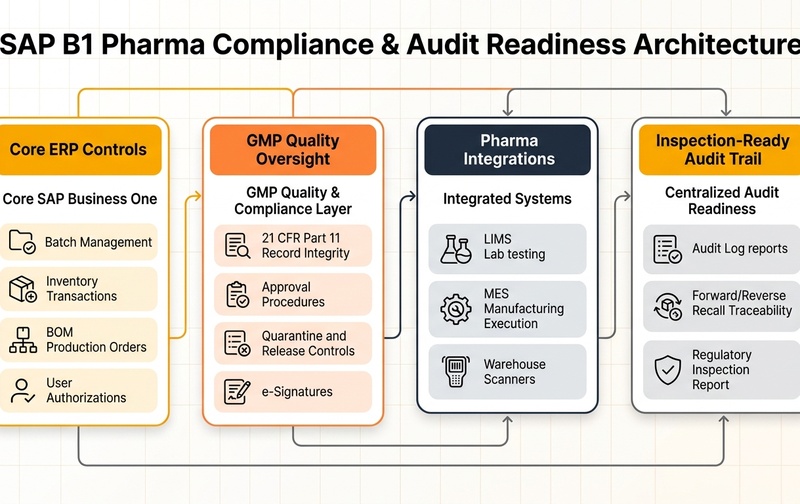
ERP software alone does not make a pharmaceutical manufacturer compliant. Compliance depends on the configured system, validated processes, controls, procedures, documentation, infrastructure, user behavior, and applicable regulatory requirements.
Generic ERP vs Pharmaceutical ERP: What Is the Difference?
The distinction is not always as simple as “generic” versus “pharma-specific.”
Many major ERP platforms can support pharmaceutical companies when appropriately designed, configured, validated, extended, and integrated.
The more useful question is:
How much pharmaceutical functionality does the business require from the core ERP, and how much should come from specialized applications or extensions?
A smaller pharmaceutical manufacturer may prefer an ERP that covers finance, procurement, inventory, production, batch management, sales, and reporting with selected industry extensions.
A larger enterprise may require a broader architecture involving ERP, laboratory systems, MES, warehouse systems, serialization platforms, product lifecycle management, regulatory systems, advanced planning, and analytics.
The selection should follow operational complexity—not software popularity.
ERP Selection by Pharmaceutical Business Complexity
A growing pharmaceutical company can use business complexity as an initial filter.
| Business Situation | Typical ERP Requirement |
|---|---|
| Small manufacturer moving away from spreadsheets/basic accounting | Integrated finance, purchasing, inventory, batch control, production and basic quality processes |
| Growing manufacturer with multiple product lines | Stronger planning, costing, approvals, warehouse control, traceability and reporting |
| Multi-location pharmaceutical company | Multi-site inventory, standardized processes, consolidation, stronger governance and scalable integrations |
| Export-focused manufacturer | Strong traceability, documentation controls, system validation considerations and market-specific regulatory support |
| Highly regulated or complex enterprise | Enterprise ERP combined with specialized quality, laboratory, manufacturing, serialization and regulatory systems |
This framework prevents companies from buying either too little capability or unnecessary enterprise complexity.
Comparing ERP Options for Pharmaceutical Manufacturers
There is no universal “best pharma ERP.”
Platforms such as SAP Business One, SAP S/4HANA, Microsoft Dynamics 365, Oracle NetSuite, Odoo, Infor, Oracle Fusion Cloud ERP, and other industry solutions serve different organizational profiles.
A useful comparison therefore starts with business fit.
SAP Business One
SAP Business One is commonly evaluated by small and midsized organizations requiring integrated finance, sales, purchasing, inventory, production, batch management, and operational reporting.
For pharmaceutical companies, the implementation design and industry-specific extensions may be particularly important where deeper quality, manufacturing, compliance, or process-industry requirements exist.
Its suitability should be assessed against transaction volume, production complexity, required add-ons, integration requirements, localization, reporting expectations, and future growth.
SAP S/4HANA
SAP S/4HANA is generally considered by larger or more operationally complex organizations requiring extensive enterprise capabilities, multi-company operations, sophisticated supply chains, manufacturing integration, financial control, and broader enterprise architecture.
It offers substantially more enterprise depth but also requires a different level of transformation planning, implementation governance, investment, and organizational readiness.
Microsoft Dynamics 365
Dynamics 365 can be relevant for organizations already invested heavily in the Microsoft ecosystem or seeking integrated ERP and business applications.
Pharmaceutical fit should be evaluated based on the specific Dynamics applications proposed, manufacturing requirements, quality processes, partner capabilities, industry extensions, validation approach, and integration architecture.
Oracle NetSuite
NetSuite is frequently evaluated by growing organizations looking for cloud ERP capabilities across finance, inventory, order management, procurement, and multi-entity operations.
Manufacturing depth, quality requirements, industry-specific processes, integrations, localization, and compliance architecture should be examined carefully against pharmaceutical requirements.
Odoo
Odoo’s modular architecture can appeal to organizations seeking flexibility across manufacturing, inventory, procurement, CRM, accounting, quality, maintenance, and related workflows.
Its flexibility makes implementation governance particularly important. Pharmaceutical manufacturers should determine what can be managed through standard modules, configuration, customization, third-party applications, and validated controls.
The correct comparison is therefore not:
SAP vs Odoo vs Microsoft vs Oracle—which brand is best?
It is:
Which architecture can support our required processes with acceptable complexity, compliance risk, implementation effort, scalability, and total cost?
Pharma ERP Cost: What Actually Determines the Investment?
The price of pharmaceutical ERP cannot be accurately judged from software licenses alone.
Total investment generally includes several components:
Software and Subscription Costs
The licensing model may depend on users, applications, modules, infrastructure, deployment model, transaction volumes, or other commercial metrics.
Cloud systems frequently use subscription models, while other environments may involve combinations of subscriptions, infrastructure, maintenance, or partner services.
Implementation Services
Implementation effort depends heavily on business complexity.
A single-site organization with relatively standardized processes requires a different program from a multi-site pharmaceutical company requiring significant migration, integrations, validation documentation, custom workflows, and process harmonization.
Customization and Extensions
Every requested customization should have a business justification.
Heavy customization can increase implementation cost and create long-term maintenance challenges.
A stronger approach is usually: standardize where possible, configure where necessary, extend where justified.
Data Migration
Master data quality can significantly affect implementation effort.
Items, suppliers, customers, bills of materials, batch information, inventory balances, pricing, open transactions, financial structures, and other records may require cleansing and validation before migration.
Poor data moved into a new ERP simply creates better-organized poor data.
Integrations
LIMS, MES, serialization systems, warehouse systems, CRM platforms, e-commerce applications, banking systems, tax platforms, and other applications can materially affect project scope.
Integration requirements should therefore be identified before commercial estimates are finalized.
Validation and Compliance Activities
Where computerized-system validation or related regulated controls are required, those activities need to be planned into the implementation rather than treated as a final-stage documentation exercise.
Regulatory applicability should be determined with qualified internal or external compliance professionals.
Common Pharma ERP Selection Mistakes
A pharmaceutical ERP project can struggle before implementation even begins if the wrong evaluation process is used.
One common mistake is selecting ERP based primarily on brand recognition.
Another is asking vendors whether their systems “support pharma” without defining what that phrase means operationally.
Manufacturers should instead demonstrate their actual scenarios:
Ask the vendor or implementation partner to demonstrate:
- How the proposed system handles a batch-controlled raw material from procurement through inspection, production, finished-goods creation, warehouse movement, sale, and traceability.
- Show a batch nearing expiry and how allocation rules behave.
- Show a rejected lot and quarantine quarantine enforcement.
- Show a production yield variance and scrap tracking.
- Show a quality hold applied during production or warehouse storage.
- Show a simulated customer complaint requiring complete upward and downward traceability.
- Show management how actual product and batch cost is determined.
These scenarios reveal far more than a generic product demonstration.
ERP Implementation Partner Selection for Pharmaceutical Companies
ERP capability is only one side of project success.
Implementation quality matters equally.
A technically capable ERP platform can still produce a weak business outcome when processes are poorly designed, master data is unreliable, requirements are misunderstood, users are inadequately trained, or excessive customization is introduced.
A pharmaceutical manufacturer should therefore evaluate the implementation partner’s understanding of both ERP technology and operational processes.
The partner should be capable of discussing production, warehouses, costing, batches, procurement, quality workflows, integrations, reporting, data migration, security, and implementation governance—not only software screens.
For regulated processes, responsibilities around validation and compliance documentation should also be explicitly defined.
Building the Business Case for Pharma ERP
The business case should connect ERP investment with measurable operational problems.
For example, management might evaluate:
- Inventory write-offs caused by expiry;
- Production delays caused by material shortages;
- Hours spent reconciling reports;
- Manual effort during batch traceability investigations;
- Excess inventory caused by poor planning visibility;
- Financial closing delays;
- Manual approval bottlenecks;
- Costing inaccuracies;
- Duplicate data entry;
- Operational risk created by uncontrolled spreadsheets.
ERP value becomes easier to evaluate when these problems are quantified before implementation.
Instead of asking whether ERP will “improve efficiency,” ask:
▪ How many hours are currently spent reconciling inventory every month?
▪ What value of inventory is written off because expiry risks are identified late?
▪ How long does a batch traceability investigation currently take?
▪ How quickly can management determine actual product margin?
▪ How many transactions require duplicate manual entry?
Those answers create the baseline for an ERP business case.
When Is a Pharmaceutical Manufacturer Ready for ERP?
A company may be ready for ERP when its existing systems are restricting operational control or growth.
Typical warning signs include increasingly complex spreadsheets, inconsistent information between departments, weak batch visibility, excessive manual reconciliation, slow production planning, poor costing visibility, fragmented quality information, duplicate data entry, difficult multi-location reporting, and dependence on a small number of employees who understand how disconnected processes fit together.
However, software readiness is not enough.
Organizations also need management sponsorship, process owners, realistic data-cleanup plans, implementation resources, user participation, clear governance, and willingness to standardize processes.
ERP transformation fails when a company expects software to make unresolved operating decisions on its behalf.
Frequently Asked Questions About ERP for Pharma Industry
Planning an ERP Evaluation for Your Pharmaceutical Business?
Before comparing ERP licenses or scheduling generic product demonstrations, start with your manufacturing processes, compliance requirements, system gaps, integration needs, and growth plans.
Book a Pharma ERP Demo to determine which ERP architecture fits your manufacturing operation before committing to a platform.