
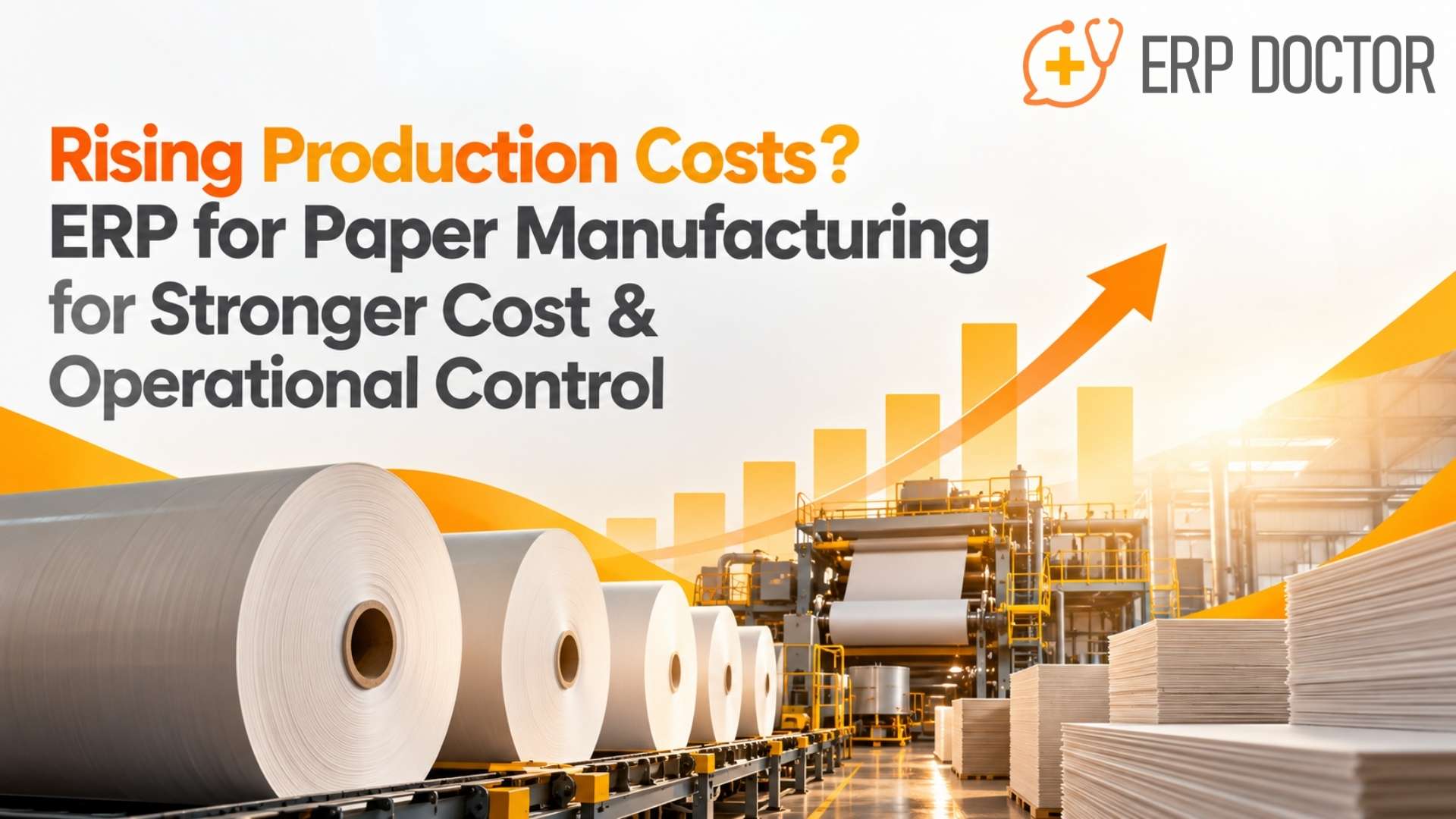
Rising Production Costs? ERP for Paper Manufacturing for Stronger Cost & Operational Control
Quick Answer
ERP for paper manufacturing connects production, inventory, procurement, costing, quality and finance in one system. It gives paper manufacturers better visibility into material consumption, production variances, waste, inventory levels and actual manufacturing costs, helping management move from fragmented cost reporting toward stronger operational and cost control.
Rising Production Costs Are Exposing Operational Gaps in Paper Manufacturing
Paper manufacturing operates under continuous cost pressure. Raw materials, energy, chemicals, packaging materials, labour, transportation and inventory carrying costs can all influence the final cost of production.
The challenge is not simply that individual costs are increasing. The bigger issue is that many manufacturers do not have enough visibility into where those costs are occurring, why production costs are changing, and how operational decisions are affecting margins.
When production data, inventory records, procurement information and financial transactions are maintained across disconnected systems, management may receive cost information only after the operational problem has already occurred.
For example, higher material consumption may be visible in financial reports, but the production team may not immediately know whether the variance came from:
Excess material consumption
Production losses
Incorrect production planning
Inventory discrepancies
Quality-related rejection
Supplier variation
Process inefficiencies
Excessive waste or scrap
This creates a gap between cost reporting and cost control.
An ERP system designed for manufacturing can help close that gap by connecting operational transactions with inventory, production, purchasing and financial data.
ERP for Paper Manufacturing and the Cost Control Challenge
Paper manufacturers need more than a system that records financial transactions. Cost control depends on how effectively the business connects operational activity with financial outcomes.
A production decision can affect material consumption. Material consumption affects inventory. Inventory movements affect valuation. Production variances affect manufacturing costs. Procurement decisions affect purchase costs. Quality issues can create additional waste or rework.
When these activities are disconnected, identifying the financial impact of an operational issue becomes difficult.
A paper manufacturing ERP can create a connected information flow:
➔
➔
➔
➔
➔
➔
➔
This connection allows management to evaluate production performance using current operational data rather than relying entirely on manually consolidated reports.
Where Paper Manufacturing Loses Cost Visibility
Rising costs are often symptoms of several operational gaps rather than a single problem.
Raw Material Consumption Gaps
Paper production depends heavily on raw materials and other production inputs. Variations in material quality, consumption and purchasing costs can significantly affect production economics. If material issues and consumption are recorded manually or across disconnected systems, it becomes harder to compare planned consumption with actual usage. An ERP system can connect material requirements, inventory movements and production consumption, giving management a clearer view of material usage and variances.
Inventory Visibility Gaps
Excess inventory increases carrying costs, while insufficient inventory can interrupt production schedules. Paper manufacturers may also need visibility across different forms of stock, including raw materials, work-in-progress, finished products, rolls, sheets, rejected material and waste. Without reliable inventory visibility, procurement and production teams may make decisions using incomplete information. ERP-based inventory management can provide a centralized view of stock movements, availability and consumption across relevant locations and processes.
Production Planning Gaps
Production planning becomes more difficult when sales requirements, material availability, inventory levels and production capacity are not connected. Last-minute changes can result in:
A manufacturing ERP can connect production planning with inventory and demand information, helping teams make more coordinated production decisions.
Costing Gaps
A standard production cost does not always reflect actual manufacturing conditions. Changes in material prices, consumption, labour, overheads, production quantities and waste can create differences between expected and actual costs. Without timely variance analysis, management may identify margin pressure only after financial results have been finalized.
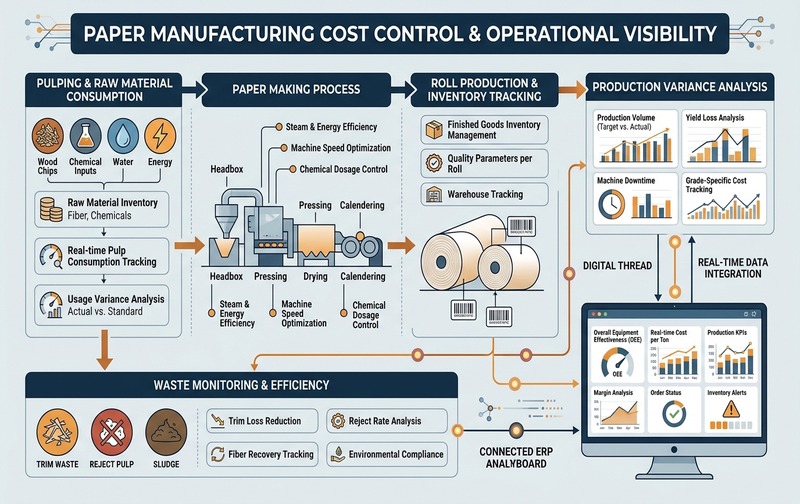
Figure 1: Resolving operational cost visibility gaps across paper pulping, roll inventory, production variances, and waste tracking.
How ERP for Paper Manufacturing Connects Operations and Cost Control
The value of ERP is not simply having more data. It is connecting data generated by different business processes.
For paper manufacturers, an integrated ERP workflow can connect:
➔
➔
➔
➔
➔
➔
➔
Each transaction contributes to a broader view of operational and financial performance.
For example, when materials are purchased, the system can capture purchase information and inventory movement. When materials are issued for production, consumption is recorded. Production output can then be compared against expected quantities, while associated costs can flow into financial reporting.
This creates a more traceable relationship between operational activity and manufacturing cost.
ERP Inventory Management for Paper Manufacturing
Inventory management is one of the most important areas for controlling production costs.
Paper manufacturers need to balance material availability against inventory carrying costs. Too much stock ties up working capital, while too little stock can disrupt production.
An ERP system can help provide visibility into:
Real-time stock of pulp, fibers, chemicals and additives.
Automated tracking of inbound shipments and production dispatches.
Bin, aisle, and location transfers across mill facilities.
Live stock visibility across pulping, pressing, drying and winding.
Reel, roll and sheet inventory categorized by grade and GSM.
Accurate valuation methods reflecting true acquisition and processing costs.
Automated reorder triggers based on actual mill consumption rates.
Monitoring slow-moving paper stocks, degraded rolls, and obsolete lots.
Immediate recording of actual batch and run material usage.
Controlled audit adjustments with full justification and approval trails.
This information allows purchasing, production, warehouse and finance teams to work from a common data set.
The objective is not simply to maintain accurate stock records. It is to improve the quality and timing of inventory decisions.
Paper Production Planning and Operational Control
Production planning directly influences manufacturing efficiency and cost.
When production schedules are prepared without considering actual material availability, existing inventory, production capacity and demand requirements, manufacturers may experience avoidable operational disruptions.
ERP-based production planning can connect production requirements with inventory and procurement information.
This can help manufacturers coordinate:
Aligned with demand
Calculated from BOMs
Optimized machine runs
Live stage tracking
Rolls & sheet yield
Standard vs actual
Target achievement
Early discrepancy detection
Better coordination can reduce the dependence on spreadsheets and manually consolidated production information.
More importantly, it gives management a clearer picture of how production activity is affecting cost and operational performance.
Manufacturing Cost Management Through ERP
Cost management requires visibility into both expected and actual production performance.
ERP can help manufacturers compare planned costs against actual costs and investigate significant variances.
| Cost Area | Planned View | Actual View | Management Insight |
|---|---|---|---|
| Raw materials | Expected consumption | Actual consumption | Material variance |
| Labour | Planned labour cost | Actual labour cost | Labour variance |
| Overheads | Allocated cost | Actual cost | Overhead variance |
| Production output | Planned quantity | Actual quantity | Production variance |
| Waste | Expected loss | Actual loss | Yield variance |
This comparison can help management identify where production performance is moving away from expectations.
Instead of asking only, “What did production cost?”, management can investigate, “Why did production cost change?” That distinction is critical for effective cost control.
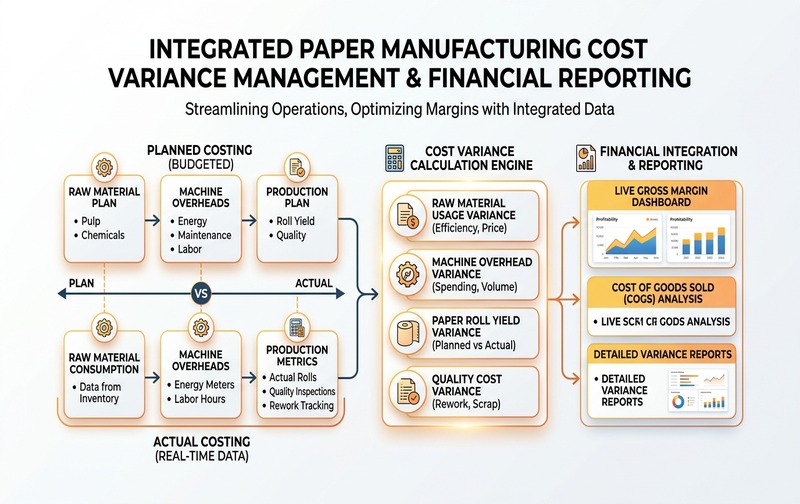
Figure 2: End-to-end paper manufacturing cost variance calculation engine connecting planned budgeting with actual floor metrics and live gross margins.
Waste, Yield and Production Variance Control
Waste and yield directly affect manufacturing economics.
Even relatively small production losses can become significant when they occur repeatedly across large production volumes.
Paper manufacturers may need to monitor differences between planned and actual output, material consumption and production losses.
ERP can support this analysis by connecting production transactions with material consumption and output records.
Management can then identify recurring variances rather than treating every production loss as an isolated event.
Better visibility can support decisions around:
The objective is not simply to record waste. It is to make waste visible as a cost-control issue.
Procurement and Supplier Cost Control in Paper Manufacturing
Procurement decisions have a direct impact on manufacturing costs.
Differences in supplier pricing, purchase quantities, delivery performance and material quality can affect both production costs and operational continuity.
An integrated ERP system can connect purchasing activity with inventory and production requirements.
This helps procurement teams evaluate:
Track price fluctuations across pulp, chemicals, and energy contracts.
Evaluate vendors on delivery adherence, quality consistency, and lead times.
Align procurement volumes directly with actual paper mill production orders.
Analyze long-term cost trends and supplier price movement patterns.
Prevent duplicate orders by cross-referencing on-hand and in-transit stock.
Maintain tight control over pending supplier commitments and delivery dates.
Forecast future material requirements based on operational consumption data.
Connecting procurement with production requirements can also reduce unnecessary purchases and improve purchasing decisions based on actual operational demand.
Quality Control and Production Cost Variance
Quality problems can create costs beyond the initial production transaction.
Rejected material, rework, additional processing, customer complaints and returns can all influence operational profitability.
When quality information is disconnected from production and inventory records, it becomes harder to determine the financial impact of quality issues.
An ERP environment can connect quality-related information with production and inventory processes.
This can help manufacturers identify relationships between:
➔
➔
➔
➔
➔
Such traceability is particularly valuable when management needs to investigate recurring quality-related production costs.
Financial Integration for Paper Manufacturing Cost Visibility
Financial reporting should not operate as an isolated function.
When production, purchasing, inventory and sales information is integrated with finance, management can gain a more connected view of business performance.
For paper manufacturers, this can support visibility into:
Accurate real-time valuation of pulp, reels, sheets, and WIP.
Landed cost tracking across raw materials, chemicals, and energy.
True cost of goods manufactured per ton and reel grade.
Direct revenue recognition linked to dispatched shipments.
Accurate margin tracking across paper grades and customer contracts.
Immediate identification of usage, yield, and price discrepancies.
Aging receivables tracking and automated customer credit control.
Coordinated supplier payment schedules aligned with cash flow.
Predictive cash management connecting operations and capital.
Item-level margin analysis revealing true contribution margins.
The benefit is a shorter path between an operational event and its financial impact.
For example, a change in material consumption should not remain only within the production department. Its effect on inventory and manufacturing cost should also be visible to the relevant financial and management teams.
Cost Visibility and Management Reporting With Paper Manufacturing ERP
Management decisions depend on the quality and timeliness of reporting.
Manual spreadsheets can still play a role in analysis, but relying on multiple disconnected spreadsheets creates challenges around data accuracy, version control and reporting speed.
ERP can centralize operational information and support management reporting across functions.
Depending on the ERP platform and implementation, management may be able to monitor:
Machine output, tonnage, and run efficiencies.
Real-time stock of raw pulp, WIP, and finished rolls.
Actual vs standard chemical and fiber usage.
Direct material acquisition prices and landed expenses.
Quantified material, labor, and overhead differences.
Trim loss, broke pulp recycling, and grade yield rates.
Order volumes, fulfillment rates, and customer delivery.
Net contribution margin by paper grade and reel specification.
Balance sheet, P&L, and operational working capital metrics.
The goal is not to generate more reports.
The goal is to provide the right information early enough for management to act.
What to Evaluate in ERP Software for Paper Manufacturing
Choosing an ERP for a paper manufacturing business requires more than comparing feature lists.
The system should align with the company’s actual production model, inventory structure, costing requirements, reporting needs and future growth plans.
Manufacturing and Production Management
Evaluate whether the ERP can support the company’s production workflows, production planning, material requirements, work-in-progress and production reporting.
Inventory and Warehouse Management
Check whether the system can provide reliable visibility into raw materials, production inventory, finished goods, stock movements and valuation.
Costing and Variance Management
The ERP should support meaningful analysis of planned versus actual production costs and provide visibility into significant variances.
Procurement and Supplier Management
Procurement functionality should connect purchasing requirements with inventory and production demand rather than operating independently.
Quality and Production Control
Consider whether quality processes can be connected with production, inventory and relevant traceability requirements.
Financial Integration
Production and inventory transactions should flow into financial processes without requiring excessive manual reconciliation.
Reporting and Operational Analytics
Management should be able to access relevant operational and financial information without depending entirely on manually prepared spreadsheets.
Integration and Scalability
The ERP should be capable of integrating with existing applications and supporting the company’s future operational requirements.
The right solution is therefore not necessarily the ERP with the longest feature list. It is the platform that provides the strongest fit between the manufacturer’s operational requirements and the level of control management needs.
ERP Implementation Priorities for Paper Manufacturers
Selecting ERP software is only one part of the transformation.
Implementation quality can determine whether the system actually improves operational visibility.
Before implementation, manufacturers should clearly define:
Map mill machine operations from pulping to sheeting and packing.
Standardize warehouse receipt, batch assignment, and storage methods.
Determine automated vs manual backflushing and issuance triggers.
Establish standard, weighted average, or actual cost calculation rules.
Define PO approval tiers, quotation comparison, and supplier terms.
Incorporate mandatory inspection checkpoints and rejection parameters.
Automate general ledger postings from shop floor transactions.
Define executive dashboards, daily run sheets, and variance reports.
Connect mill DCS/SCADA, weighbridges, and third-party tools.
Cleanse and validate customer, supplier, BOM, and opening stock records.
The implementation should focus on business processes rather than simply reproducing existing manual processes inside a new software system.
Where necessary, ERP configuration, integration or customization should be evaluated based on actual business requirements.
When ERP Becomes a Strategic Priority for Paper Manufacturing
ERP becomes increasingly relevant when operational complexity starts affecting management control.
Typical indicators include:
These conditions indicate that the issue may no longer be simply a reporting problem.
It may be an underlying process and information-management problem.
From Cost Reporting to Cost Control With ERP
For paper manufacturers, the objective of ERP should extend beyond digital record-keeping.
The stronger objective is to create a connected operating environment where production, inventory, procurement, quality and finance contribute to a common view of business performance.
When management can identify material consumption, production variance, waste, inventory movement and actual cost more clearly, it becomes easier to investigate the causes behind rising production costs.
That is where ERP moves from being a reporting system to becoming a management-control platform.
For manufacturers evaluating ERP investment, the key question is not simply whether the software has the required features.
It is whether the system can provide the visibility, process integration and cost control required to support better operational decisions.
Conclusion
Rising production costs can put significant pressure on paper manufacturing margins, but the solution is not always simply to reduce individual expenses.
Manufacturers need visibility into the operational factors driving those expenses.
ERP for paper manufacturing can connect inventory, production, procurement, costing, quality and finance to create a more consistent view of operational and financial performance.
With the right implementation approach, manufacturers can move from fragmented reporting toward stronger control over material consumption, production variance, waste, inventory and manufacturing costs.
For businesses considering ERP investment, the next step should be to evaluate the current operational gaps, identify where cost visibility is being lost, and determine how an ERP platform can align with the company’s manufacturing processes.
Frequently Asked Questions
What is ERP for paper manufacturing?
ERP for paper manufacturing is an integrated business management system that connects production, inventory, procurement, costing, quality and finance. It helps manufacturers centralize operational data and improve visibility into production performance, material consumption, inventory and manufacturing costs.
How does ERP help control paper manufacturing costs?
ERP can connect production transactions with inventory, procurement and financial information. This allows manufacturers to compare planned and actual costs, monitor material consumption, identify production variances and improve visibility into waste, inventory and other cost drivers.
How does ERP improve inventory management in paper manufacturing?
ERP provides centralized visibility into inventory receipts, issues, transfers, consumption, work-in-progress and finished goods. This can help manufacturers improve stock accuracy, reduce unnecessary inventory and coordinate purchasing with production requirements.
Can ERP help reduce material waste in paper manufacturing?
ERP can help track planned versus actual material consumption and production output. By making consumption and production variances more visible, manufacturers can identify recurring waste, yield issues and process inefficiencies that may contribute to higher production costs.
How does ERP improve production planning for paper manufacturers?
ERP can connect production requirements with inventory availability, material requirements and procurement information. This gives production teams better visibility when planning manufacturing activities and can reduce disruptions caused by disconnected production and inventory information.
What should paper manufacturers evaluate before choosing ERP software?
Manufacturers should evaluate production management, inventory, costing, procurement, quality, financial integration, reporting, scalability and integration capabilities. The ERP should also fit the company’s actual manufacturing workflows rather than being selected solely on the number of available features.
Is ERP suitable for small and mid-sized paper manufacturers?
ERP can be suitable for small and mid-sized manufacturers when the solution is appropriately scoped to their operational complexity, budget and growth requirements. The focus should be on solving critical process and visibility gaps without introducing unnecessary complexity.
How can a paper manufacturer determine whether ERP is worth the investment?
A manufacturer can assess the business impact of current inventory discrepancies, manual reporting, production variances, material waste, delayed financial visibility and disconnected processes. Comparing these operational costs with the expected value of improved process integration and management visibility can support the ERP investment decision.
Evaluate ERP for Stronger Paper Manufacturing Cost & Operational Control
If your paper manufacturing business is facing rising production costs, inventory visibility gaps, material consumption issues, production variances or limited costing visibility, evaluate how an ERP platform can align with your existing manufacturing processes.
Identify where configuration, integration or customization may be required and determine whether an ERP-driven approach can provide stronger operational and cost control.
Request an ERP Demo