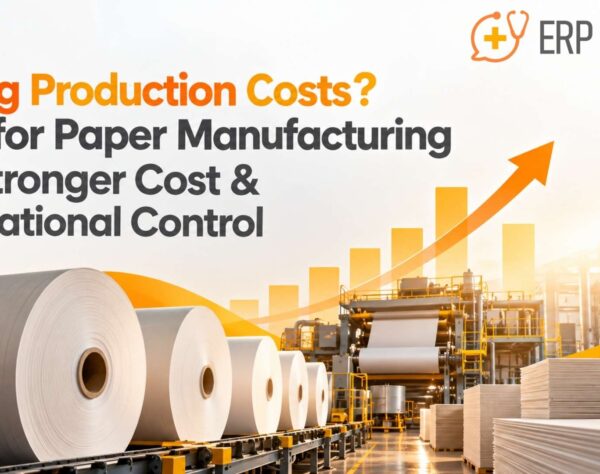

ERP for Paper Manufacturing: Closing the Gaps Between Inventory, Production & Cost Management
Quick Answer
ERP for paper manufacturing connects inventory, production, procurement, quality, costing, sales, warehouse and finance in one integrated system. For paper manufacturers, this is important because materials and finished products often need to be managed across different grades, GSM, reel sizes, weights, batches, warehouses and production stages.
A paper manufacturing ERP can connect customer demand with production planning, material availability with procurement, production output with inventory, and manufacturing activity with actual costs. This helps reduce information gaps between departments that otherwise rely on spreadsheets, disconnected systems or manual reconciliation.
The most important ERP capabilities for paper manufacturers include raw-material inventory management, production planning, reel and roll tracking, wastage monitoring, quality management, costing, warehouse control, procurement, sales-order management and financial integration.
However, selecting an ERP should not be based only on a feature checklist. Manufacturers should evaluate how well the system fits their actual production processes, inventory structure, product specifications, reporting requirements, integrations and future growth plans.
Why Paper Manufacturing Needs an Industry-Focused ERP Approach
Paper manufacturing involves more than purchasing materials, producing paper and selling finished products.
A typical operation may involve raw materials, pulp, recycled materials, chemicals, production processes, intermediate stock, reels, rolls, sheets, warehouses, quality checks, customer specifications and multiple units of measurement.
The same product may need to be identified by characteristics such as:
GSM
Basis weight density
Paper Grade
Kraft, duplex, virgin, coated
Width
Deckle / slit reel width
Length
Linear run meter measurement
Weight
Gross, tare and net kg/tonnes
Reel or Roll Number
Unique piece serialization
Batch
Furnish run identification
Production Date
Shift and date timestamp
Warehouse Location
Bay, row and bin position
Quality Status
QC approved, quarantine, hold
At the same time, management needs answers to broader business questions:
Do we have enough raw materials for the planned production?
Which finished products are available?
Which stock is slow-moving?
How much material was consumed for a production order?
What quantity was produced?
How much was wasted?
What is the actual production cost?
Which customer orders require additional production?
Are inventory and financial records aligned?
A generic inventory system may record quantities, but paper manufacturers often need a connected view of material, production, product specification, cost and order information.
That is where ERP becomes more relevant.
Where Inventory Gaps Occur in Paper Manufacturing
Inventory discrepancies can develop at several points between procurement and dispatch.
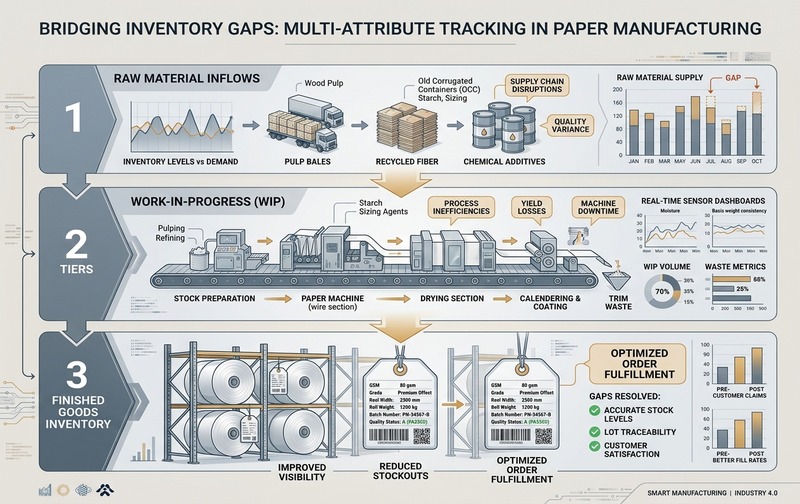
Enterprise infographic illustrating paper manufacturing inventory gaps across raw materials, work-in-progress, and finished reel inventory with multi-attribute GSM, grade, width, and batch tracking.
Raw-Material Inventory
Paper manufacturers may manage pulp, recycled fibre, wastepaper, chemicals, additives, packaging materials and other production inputs.
An ERP system can connect purchasing and inventory transactions so teams can monitor:
This gives purchasing and production teams a common view of material availability.
Work-in-Progress Inventory
WIP becomes difficult to control when production transactions and inventory transactions are maintained separately.
An integrated ERP can associate production orders with material issues, consumption, output and inventory updates.
The basic relationship becomes:
➔
➔
➔
➔
This creates greater traceability between what entered production and what came out of it.
Finished-Goods Inventory
Finished paper products may need to be managed according to specific characteristics rather than quantity alone.
Depending on the operation, the ERP may need to track:
This becomes particularly important when customer orders require specific product specifications.
| Inventory Stage | Common Operational Gaps | Critical Tracking Parameters | Connected ERP Control Mechanism |
|---|---|---|---|
| Raw Materials | Stockouts discovered during run setup; unrecorded moisture losses; unaligned PO receipt dates. | Pulp grade, moisture %, chemical purity, bale weight, supplier lot #. | Real-time PO matching, QA gatekeeping, auto reorder triggers linked to MPS schedules. |
| Work-in-Progress (WIP) | Untracked slurry batches, hidden slitter losses, unrecorded chemical dosing changes. | Furnish formulation, machine speed, wire losses, drying steam usage, trim weight. | Backflush / shop-floor issue against production orders with real-time stage scrap recording. |
| Finished Goods | Bulk tonnage hides missing GSMs/widths; shipping uninspected reels; stock aging unnoticed. | Serialized reel barcode, caliper, burst factor, exact reel width, warehouse bin location. | Multi-attribute reel master linked to sales order reservation and dispatch verification scanning. |
How ERP Connects Inventory With Paper Production
The central advantage of an integrated ERP is the connection between operational processes.
A typical workflow can be represented as:
➔
➔
➔
➔
➔
➔
➔
➔
➔
➔
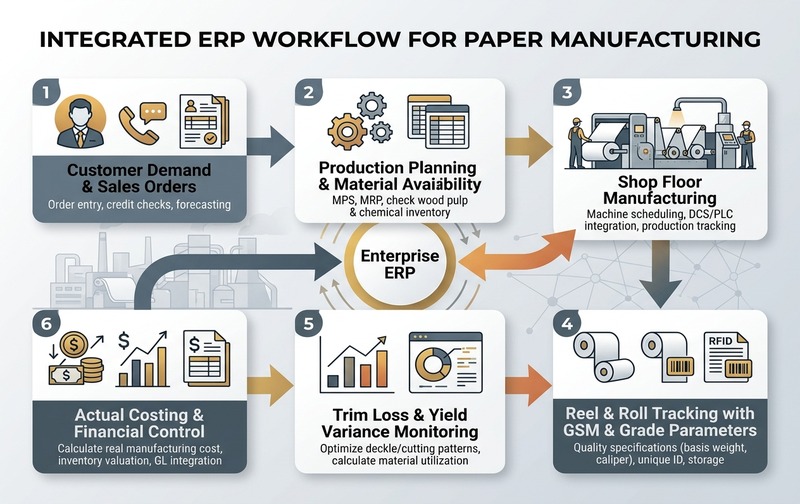
Comprehensive workflow diagram showing connected paper manufacturing processes from customer demand and production planning through shop floor manufacturing, reel tracking, yield variance, and actual costing.
Instead of treating each step as a separate activity, ERP connects the transactions.
For example, if a customer requires a particular GSM and grade and the required finished stock is unavailable, sales and production teams can identify the requirement and plan accordingly.
Similarly, if production planning shows that a required raw material is insufficient, procurement can act based on the production requirement rather than discovering the shortage later.
This connection between demand, inventory and production is one of the most important areas to evaluate when selecting an ERP for paper manufacturing.
Reel, Roll, GSM and Grade Tracking
Paper inventory can become difficult to manage when finished products have multiple specifications.
A quantity-based inventory record may not provide enough operational information.
For example, knowing that a warehouse contains 50 tonnes of paper does not necessarily answer:
How much is available in each GSM?
Which grades are available?
What reel widths are in stock?
Which reels are allocated to customer orders?
Which stock has passed quality inspection?
Where is each reel located?
Which production batch created the stock?
An ERP designed or configured for paper manufacturing should allow the business to structure inventory information according to its actual product and warehouse requirements.
This improves visibility for sales, production, warehouse and management teams.
Production Planning and Material Availability
Production planning depends on more than machine availability.
Manufacturers also need visibility into:
Exact GSM, slit dimensions & ship dates
Available unreserved warehouse rolls
Pulp furnish, chemicals & packaging
Machine hours, slitter & winder speeds
Queued jobs on deckle lines
Caliper, tensile & moisture parameters
Net marketable tonnage forecast
Standard bill of materials requirements
An integrated ERP can connect these data points.
The objective is not simply to create a production schedule. It is to make the production plan more closely connected to demand, materials, inventory and capacity.
This can help teams identify potential material shortages or production requirements earlier.
Managing Waste, Yield and Production Variance
Material utilisation is an important consideration in paper manufacturing.
Production can involve:
Pulp wash and start-up losses
Edge cuts along the deckle line
Slitter and sheet converter scrap
Reels failing burst or GSM tolerances
Repulping off-spec paper runs
Furnish-to-finished tonnage ratio
Cost and material volume deviations
ERP can provide a structured way to record planned consumption and actual consumption, planned output and actual output.
This allows management to compare:
➔
➔
➔
The value of this information depends on accurate production transactions and appropriately configured manufacturing processes.
ERP should therefore be evaluated not only for whether it records production, but also for whether it provides useful visibility into production variance and material utilisation.
Paper Manufacturing Costing and Cost Control
Inventory visibility alone does not provide a complete picture of manufacturing performance.
Management also needs to understand the cost associated with producing different products.
Depending on the manufacturing model, costing may involve:
Market rates for imported pulp & waste
Actual fiber and chemical dosing
Machine operators, slitter crews & QA
Asset depreciation & maintenance wear
Boiler coal, steam & electricity per tonne
Strapping, core plugs & protective film
Financial impact of trim and rejected reels
Plant administration & environmental compliance
Weighted average or standard cost basis
Unfavorable material and conversion delta
An ERP can connect these transactions to provide a more structured view of manufacturing costs.
For example, management may compare planned and actual production costs and investigate significant variances.
This helps move the conversation from:
“How much did we produce?”
to:
“What did it cost to produce it?”
and ultimately:
“Which products, orders or production activities require closer cost analysis?”
Quality Management and Paper Traceability
Quality requirements can affect whether finished inventory is available for sale or dispatch.
Depending on the manufacturing process, businesses may need to manage quality information associated with:
Connecting quality information with inventory makes it easier to distinguish usable stock from material that requires inspection, rework or other action.
Traceability should therefore be considered when evaluating an ERP for paper manufacturing.
Procurement and Production Should Work From the Same Data
Procurement teams need to understand what materials are required.
Production teams need to understand what materials are available.
Finance needs to understand what has been purchased and consumed.
When these processes operate independently, discrepancies can occur.
An integrated ERP connects:
➔
➔
➔
➔
➔
➔
This provides a stronger information flow between procurement, production, inventory and finance.
Warehouse Management for Paper Inventory
Warehouse operations become more complex when stock is stored across multiple locations or must be identified according to product characteristics.
An ERP can help structure warehouse information around:
Barcode or other identification methods can also be considered where they fit the operational requirements.
The important point is that warehouse processes should be designed around how the manufacturer physically handles its products.
Connecting Sales Orders With Production Requirements
Sales and production should not operate with separate versions of inventory availability.
When a customer order is entered, the business may need to determine:
An integrated ERP can bring these considerations closer together.
This is particularly valuable for manufacturers handling products with multiple grades, specifications and production requirements.
ERP Reporting for Paper Manufacturing Decision-Makers
ERP reporting should support both operational and management decisions.
Useful reports may include:
📦 Inventory Reports
- Stock by product
- Stock by grade
- Stock by GSM
- Inventory ageing
- Slow-moving stock
- Warehouse stock
- Inventory valuation
⚙️ Production Reports
- Production against plan
- Material consumption
- Production output
- Production variance
- Waste and rejection
- Yield analysis
- Machine or capacity utilisation
💰 Cost Reports
- Planned vs actual cost
- Material-cost variance
- Production cost
- Inventory valuation
- Product-level cost analysis
🚚 Sales and Dispatch Reports
- Open sales orders
- Available finished stock
- Pending production requirements
- Dispatch status
- Order fulfilment
The exact reports required will vary by business model, production process and management structure.
What Should You Evaluate Before Choosing ERP for Paper Manufacturing?
A paper manufacturer should evaluate ERP based on business processes rather than the number of features listed by a vendor.
Key evaluation areas include:
Can the ERP accommodate the company’s actual paper manufacturing workflows?
Can it manage the units, specifications, reels, rolls, grades, GSM and warehouse structures used by the business?
Can production orders, material consumption, output and variances be recorded consistently?
Can management obtain meaningful information about manufacturing costs and production variances?
Can quality checks and product status be connected with inventory?
Can operational and management reports be configured around the company’s actual requirements?
Can the ERP connect with finance, CRM, warehouse, weighing, barcode, e-commerce or other required systems?
Can the solution support additional warehouses, plants, users, products or business processes as the company grows?
What level of configuration, customisation, data migration, training and process redesign will be required?
What implementation and post-go-live support will be available?
| Evaluation Dimension | Key Evaluation Questions | Paper Manufacturing Importance |
|---|---|---|
| 1. Process & Inventory Fit | Does the system handle continuous papermaking, slitting, multi-attribute reels and dual units of measurement? | Prevents costly customizations and spreadsheet workarounds for GSM and deckle slitting. |
| 2. Production & Cost Control | Can the software capture actual fiber/chemical consumption, trim scrap and machine energy per order? | Ensures precise margin analysis per grade and eliminates delayed month-end costing surprises. |
| 3. Quality & Traceability | Is quality status gated across warehouse receipts, and can finished reels be traced backward to pulp lots? | Protects brand reputation by ensuring uninspected or off-spec reels cannot be dispatched. |
| 4. Scalability & Partner Support | Can the platform scale across multiple mills, weighing scale bridges, barcode scanners and future growth? | Protects long-term investment and ensures ongoing operational support as production expands. |
These questions provide a more useful basis for ERP evaluation than comparing feature lists alone.
ERP for Paper Manufacturing: Common Implementation Challenges
Selecting the software is only one part of an ERP project.
Paper manufacturers should also prepare for implementation considerations such as:
Poor master data can undermine an otherwise capable ERP.
For example, inconsistent item names, duplicate products or poorly defined units of measurement can create problems in inventory reporting and production transactions.
Implementation planning should therefore receive the same attention as software selection.
When Should a Paper Manufacturer Consider ERP?
ERP evaluation becomes particularly relevant when the business experiences problems such as:
Frequent inventory reconciliation
Limited visibility across warehouses
Production planning based heavily on spreadsheets
Difficulty tracking finished reels or rolls
Unclear production variances
Delayed costing information
Disconnected sales and production data
Manual reporting
Growing product or plant complexity
Multiple systems that do not share operational data
These issues do not automatically mean that ERP is the only solution. However, they are useful signals that the business should examine whether its current systems adequately support its operational requirements.
Conclusion
Paper manufacturing requires close coordination between inventory, production, procurement, quality, costing, warehouse operations and sales.
When these processes operate through disconnected spreadsheets and systems, management can struggle to obtain a consistent view of material availability, production requirements, finished stock and manufacturing costs.
An ERP approach can connect these processes and create a more structured flow of information from procurement and production through inventory, costing and customer fulfilment.
The right solution, however, depends on the manufacturer’s specific processes and requirements. ERP selection should therefore begin with an assessment of how the business currently manages raw materials, production, reels and rolls, quality, inventory, costing, warehouses, sales orders and reporting.
For paper manufacturers considering ERP, the objective should not simply be to replace spreadsheets. It should be to establish a connected operational system that gives decision-makers better visibility across the manufacturing cycle.
Frequently Asked Questions About ERP for Paper Manufacturing
See How ERP Can Connect Your Paper Manufacturing Operations
If disconnected inventory, production and cost data are making it difficult to manage your paper manufacturing operations, an ERP solution can help bring these processes into a connected workflow.
Book a demo to explore how ERP can help improve visibility across inventory, production and cost management for your paper manufacturing business.