
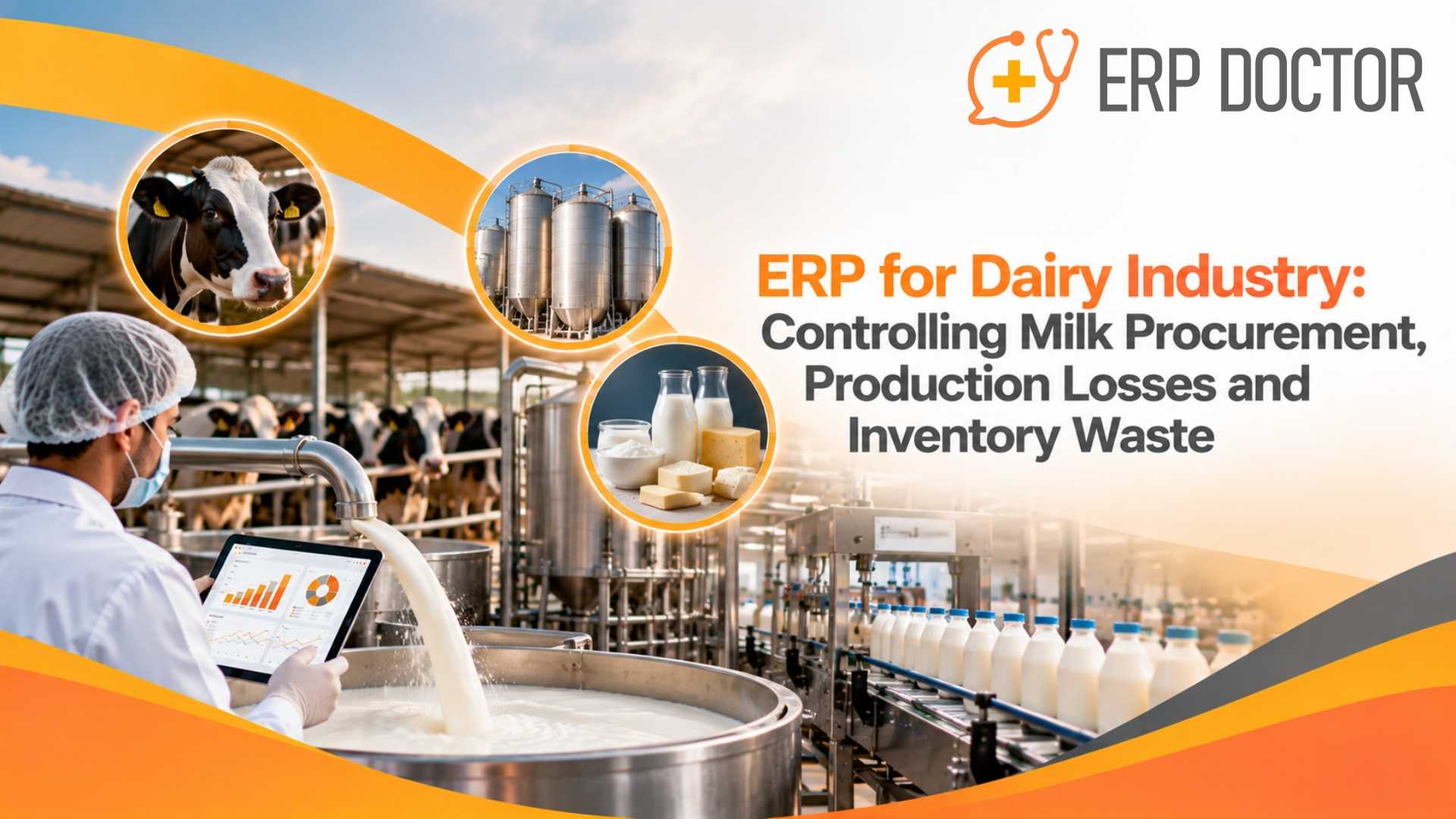
ERP for Dairy Industry: Controlling Milk Procurement, Production Losses and Inventory Waste
Quick Answer
ERP for the dairy industry connects milk procurement, quality testing, production, inventory, distribution and finance through integrated business processes. It helps dairy manufacturers identify procurement discrepancies, monitor production yield, improve batch traceability, reduce avoidable inventory waste and understand product-level costs through more consistent operational data.
By centralizing transaction data from collection centres, milk analysers, pasteurization lines, cold storage warehouses, and accounting ledgers, an integrated ERP environment eliminates siloed operational records and provides executive decision-makers with end-to-end operational visibility and real-time yield control.
Operational Challenges That Increase Losses Across Dairy Businesses
Dairy businesses operate with time-sensitive raw materials, strict quality requirements, variable production volumes and products with limited shelf lives. Managing these activities across milk collection centres, chilling facilities, processing plants, warehouses and distribution networks requires accurate information at every stage.
When these operations rely on disconnected applications, spreadsheets or manual records, management may struggle to understand where material losses occur and how operational variations affect profitability.
For example, procurement teams may record the quantity of milk received, production teams may maintain separate consumption records, and finance teams may receive cost information only after transactions have been processed. If these records are not connected, identifying the reason for a quantity or cost discrepancy becomes difficult.
The consequences can extend beyond production. Inconsistent procurement records may affect supplier payments, inaccurate material consumption can distort product costing, and delayed inventory updates can create shortages or excess stock.
For CEOs, COOs and CFOs, these are not simply operational inconveniences. They affect working capital, production planning, financial reporting and the ability to expand operations without losing control.
An integrated ERP environment can connect these processes and provide a more consistent operational record. However, the value depends on how accurately the system reflects the company’s actual procurement, manufacturing, inventory and financial workflows.
| Operational Area | Process Gap & Friction | Financial & Operational Impact | Required ERP Control |
|---|---|---|---|
| Milk Procurement & Collection | Manual entry errors, delayed updates, and differences between weighing records across collection points | Inconsistent procurement records, supplier payment disputes, and distorted raw material cost accounting | Structured procurement transactions by supplier, centre, date, and weighing equipment integration |
| Quality Testing & Grading | Testing data (Fat, SNF, temperature) recorded in standalone lab logs unlinked to procurement orders | Uncertainty in milk acceptance decisions, distorted quality-based payout formulas, and rejected quantity disputes | Test results recorded directly against procurement transactions with automated quality reconciliation |
| Processing & Yield Monitoring | Separate material consumption entries across chilling, standardisation, pasteurisation, and filling | Unexplained yield variations, unrecorded process losses, and delayed operational corrective actions | Connected production orders linking raw inputs, approved losses, by-products, and finished-goods receipts |
| Inventory & Cold Storage | Delayed stock updates, lack of batch-level visibility, and manual FIFO/FEFO stock rotation | Avoidable product expiry, inventory spoilage, unexpected stock shortages, and inflated working capital | Multi-location stock visibility by batch and expiry date with automated FEFO dispatch allocation rules |
| Packaging & Consumables | Packaging consumption (pouches, bottles, caps) tracked separately from production run records | Unexplained packaging scrap, line adjustment waste, and distorted unit-level product cost calculations | Integrated Bills of Materials (BOMs), material issue tracking, and packaging variance reporting |
| Sales & Cold-Chain Distribution | Disconnected sales orders, dispatch schedules, and standalone temperature monitoring logs | Promising unavailable stock, shipping near-expiry batches, dispatch delays, and product quality risks | Connected order-to-dispatch workflow with stock reservation and cold-chain exception tracking |
| Finance & Cost Control | Finance receives cost information only after transactions are manually compiled and reconciled | Delayed period-end close, inaccurate product profitability analysis, and reactive financial management | Automatic general ledger postings from operational transactions and structured product cost analysis |
Milk Procurement Discrepancies and Quality Control Gaps
Milk procurement is one of the most important control points in dairy manufacturing. The quantity and quality of raw milk received directly influence production planning, material availability and supplier payments.
Dairy businesses may collect milk from individual farmers, cooperatives, collection centres or third-party suppliers. Each source can involve different collection schedules, measurement procedures, quality parameters and payment arrangements.
When procurement information is maintained separately, discrepancies can arise between collected quantities, received quantities, tested quantities and accepted quantities.
Key Takeaway: Disconnected milk procurement data creates friction across collection points, laboratory grading, and vendor payouts. Establishing an integrated digital procurement workflow ensures every drop of milk received is accurately verified, graded, and accounted for in real time.
Inconsistent milk collection records
Manual entry errors, delayed updates and differences between weighing records can create uncertainty about the quantity received at each collection point.
An ERP system can maintain structured procurement transactions by supplier, collection centre, date and receiving location. When integrated with suitable weighing equipment, it can also capture measurement data more consistently.
This gives procurement and finance teams a common reference for reviewing received quantities, supplier transactions and purchase records.
Quality testing and supplier reconciliation
Milk quality can influence acceptance decisions, processing suitability and supplier payments. Depending on the business’s operating procedures, quality checks may include fat content, SNF (solids-not-fat), temperature and other applicable parameters.
An ERP solution can record test results against the corresponding procurement transaction when the required process and equipment integrations are configured.
This helps teams connect quality information with supplier records, accepted quantities and procurement decisions. It also supports more consistent review of rejected or adjusted quantities.
The system does not replace laboratory testing or quality assurance procedures. Instead, it helps preserve and connect the resulting records with business transactions.
Production Yield Variations Across Milk Processing Operations
Production yield is a critical measure of operational performance in dairy manufacturing. Differences between input quantities and finished-product output can influence material costs, production efficiency and profitability.
Milk processing may involve several stages, including chilling, standardisation, pasteurisation, homogenisation, fermentation, separation, filling and packaging. The exact process depends on the product being manufactured.
Each stage may have different material requirements, operating conditions and expected outputs. If production teams record these activities inconsistently, management may find it difficult to compare actual performance with planned production.
Monitoring input and output quantities
A dairy manufacturer needs to understand how much raw milk and other materials enter production, how much finished product is produced, and what quantities are recorded as process loss, by-product or rejected material.
An ERP system can connect production orders with material issues, consumption entries, finished-goods receipts and approved loss records.
For example, a production record may show that 10,000 litres of milk were issued to a processing order, while 9,800 litres were allocated to the planned output and 200 litres were recorded as process loss.
This is an illustrative reconciliation, not a standard industry yield. Actual results depend on product formulation, processing conditions, measurement methods and the manufacturer’s operating standards.
The important requirement is to record and investigate the difference rather than allowing unexplained variations to remain in separate production records.
Comparing planned and actual production
Production teams can use ERP records to compare planned quantities with actual material consumption and finished output.
Management can review variations by product, batch, plant, production line or reporting period, depending on the system configuration.
This supports more informed decisions about production planning, process review and material requirements.
ERP software cannot independently eliminate physical processing losses. It provides the information needed to identify variations, investigate their causes and strengthen operational controls.
| Value Chain Stage | Core Dairy Operational Activity | Key Loss & Variation Risk | Required ERP Control & Traceability |
|---|---|---|---|
| 1. Raw Milk Receiving | Tanker/can weighing, dock inspection, and initial temperature checking | Quantity discrepancies between dispatch and dock, unrecorded transit temperature abuse | Weighing system integration, receiving slip generation, and supplier transaction linking |
| 2. Quality Inspection & Chilling | Lab testing for Fat, SNF, acidity, adulterants, and transfer to chilling silos | Delayed test logging, sub-standard milk mixing, chilling delay spoilage | Milk analyser data capture, automated batch hold/release, and silo inventory tracking |
| 3. Processing & Standardisation | Separation, fat blending, pasteurisation, homogenisation, and fermentation | Recipe deviation, cream separation loss, unexplained volume shrink, equipment downtime | Standardized Bill of Materials (BOM), production order issue/receipt, mass-balance yield logging |
| 4. Packaging & Labeling | Filling milk pouches, bottles, cartons, capping, date coding, and crating | Overfill/underfill losses, damaged pouches, pouch film scrap, incorrect expiry dates | Packaging consumption tracking, finished batch generation with automated expiry calculation |
| 5. Cold Room & Warehouse | Finished-goods cold storage, batch staging, crate stacking, and rotation | Inventory spoilage, near-expiry batches overlooked, cold storage temperature excursions | FEFO-based stock allocation, batch expiry tracking, and warehouse transfer reconciliation |
| 6. Dispatch & Cold-Chain Delivery | Vehicle loading, insulated transport, delivery to distributors, retail, and institutions | Short shipments, transit spoilage, delayed delivery, disputed proof-of-delivery | Sales order picking validation, automated dispatch note & invoice generation, return tracking |
Inventory Spoilage and Expiry Risks in Dairy Manufacturing
Dairy inventory management involves more than recording stock quantities. Raw milk, ingredients, packaging materials, work-in-progress and finished products may have different storage requirements, shelf lives and handling procedures.
When stock records are updated late or maintained across multiple systems, businesses may face avoidable expiry, spoilage, excess inventory and stock shortages.
These issues can affect production continuity and increase working-capital requirements.
Raw material and finished-goods visibility
An ERP system can maintain inventory records across warehouses, processing locations and distribution facilities.
With suitable configuration, stock can be tracked by item, batch, location, quantity and relevant date information. This gives inventory and production teams a shared view of material availability.
For finished dairy products, batch and expiry information can support stock rotation and dispatch planning. Businesses can configure processes around FEFO (First Expired, First Out) where appropriate to their products and operating requirements.
Preventing avoidable expiry-related waste
Inventory visibility is useful only when transactions are recorded accurately and employees follow the defined procedures.
ERP workflows can support expiry-date monitoring, stock allocation, inventory transfers and exception reporting. Alerts and approval rules can be configured to identify stock approaching its expiry date or material requiring review.
Managers can then investigate slow-moving stock, adjust production plans and prioritise suitable inventory for dispatch.
These controls are particularly important for businesses operating multiple warehouses or distribution locations, where stock may be available in one facility but difficult to identify from another location’s records.
Packaging Material Waste and Production Cost Variations
Packaging is a significant part of dairy production planning. Bottles, pouches, cartons, caps, labels and other consumables must be available in the right quantities and specifications.
When packaging consumption is not connected to production records, businesses may find it difficult to explain differences between planned and actual usage.
For example, a production order may require a defined number of bottles and caps for a particular quantity of finished product. Actual consumption may vary because of rejected packaging, line adjustments, damaged materials or production changes.
An ERP system can connect bills of materials, production orders, material issues and inventory transactions. This provides a structured way to compare planned consumption with recorded usage.
Finance teams can also use the associated material and production records to review product costs.
Accurate product costing requires appropriate configuration of material costs, labour, overhead allocation, production quantities and other relevant cost components. If these inputs are incomplete or outdated, the resulting cost information may not represent actual manufacturing performance.
For CFOs, connecting production and finance records makes it easier to investigate cost variations and assess product-level profitability.
Distribution Inefficiencies and Cold-Chain Visibility
Dairy manufacturers must coordinate finished-goods availability with customer orders, dispatch schedules and delivery requirements. Delays or inaccurate stock information can affect order fulfilment and product quality.
Businesses supplying retailers, distributors, institutions and direct customers may also manage different order volumes, delivery schedules and product requirements.
When sales, warehouse and distribution records are disconnected, teams may promise stock that is unavailable, overlook near-expiry inventory or struggle to trace dispatch information.
An ERP system can connect sales orders, stock allocation, picking, dispatch and invoicing. This improves the consistency of information available to sales, warehouse and finance teams.
Where cold-chain monitoring systems are used, integration may be required to connect relevant temperature records with the appropriate operational or quality workflows. The availability of such integration depends on the equipment, software interfaces and implementation scope.
ERP software does not physically maintain product temperature or replace transport controls. It can help businesses manage related records and exceptions when the required integrations and procedures are in place.
How Dairy ERP Connects Procurement, Production and Finance
The central value of ERP software for the dairy industry is its ability to connect business transactions that would otherwise be maintained in separate systems.
Procurement, production, inventory, sales and finance are interdependent. A change in one process can affect material availability, product costs, order fulfilment and financial reporting.
An integrated system provides a common transaction environment for these activities.
Procurement and supplier management
Procurement records can connect supplier information, purchase transactions, received quantities, quality results and approved adjustments.
This helps businesses review supplier performance and reconcile procurement records with financial transactions.
Production and material planning
Production orders can connect planned quantities, material requirements, actual consumption and finished-goods output.
This supports production planning and gives managers a clearer basis for reviewing material usage and yield variations.
Inventory and warehouse management
Inventory transactions can reflect receipts, issues, transfers, adjustments and finished-goods movements.
With suitable batch and expiry configuration, teams can improve traceability and stock rotation across warehouses.
Finance and management reporting
Operational transactions can feed relevant accounting and costing processes. This reduces the need to reconstruct financial information from disconnected departmental records.
Management can review purchasing costs, inventory valuation, production expenses, receivables, payables and other financial information based on the configured system.
The quality of reporting still depends on accurate transaction entry, appropriate master data, financial configuration and internal controls.
ERP Capabilities Required for Dairy Manufacturing and Processing
Not every ERP product or implementation is suitable for every dairy business. Requirements differ between milk collection businesses, processing plants, manufacturers of value-added dairy products and multi-location distribution companies.
Decision-makers should evaluate whether the proposed ERP environment supports their actual workflows.
Important capabilities include:
- Milk procurement management: Supplier records, collection-centre transactions, received quantities and procurement reconciliation.
- Quality management: Recording inspection results, acceptance decisions and quality-related exceptions.
- Production planning: Production orders, material requirements, consumption records and finished-goods output.
- Batch traceability: Tracking relevant raw materials, production batches and finished products.
- Inventory management: Warehouse-level stock visibility, transfers, adjustments and expiry-related controls.
- Packaging management: Bills of materials, packaging consumption and material variance tracking.
- Sales and distribution: Order processing, stock allocation, dispatch and invoicing.
- Financial management: Purchasing, payables, receivables, inventory valuation and product-cost visibility.
- Management reporting: Operational and financial reports that support performance review and business decisions.
These capabilities should be evaluated against real business scenarios rather than accepted solely on the basis of a product demonstration or feature checklist.
Dairy ERP Integration and Customization Requirements
Dairy operations frequently involve equipment and applications that are not part of a standard ERP installation.
Examples may include weighing systems, milk analysers, laboratory applications, barcode scanners, production equipment, warehouse tools and temperature-monitoring solutions.
Before selecting an ERP system, businesses should identify which applications need to exchange data with the central system.
Equipment and application integration
Integration requirements should define what information must be exchanged, when it must be exchanged and which system is responsible for maintaining each record.
For example, a weighing system may provide received milk quantities, while a testing application may provide quality results. The ERP workflow must associate these records with the correct supplier, collection point and procurement transaction.
Businesses should also consider integration failure handling, duplicate records, data validation and access permissions.
Customization based on operational requirements
A dairy company may need specific approval workflows, reports, production calculations or transaction controls that are not available in the standard configuration.
Customization should address a documented business requirement rather than reproduce every existing manual process.
Excessive customization can increase implementation complexity and make future upgrades or support more difficult. Decision-makers should distinguish between essential process requirements, configuration options and changes that can be avoided through workflow improvements.
Business Benefits of Improving Dairy Operations with ERP
An ERP implementation should be evaluated through measurable business outcomes rather than broad claims about automation or digital transformation.
The potential benefits depend on implementation quality, data accuracy, employee adoption and the suitability of the configured processes.
For dairy business leaders, the most relevant outcomes include:
- Improved procurement control: Connected supplier, quantity and quality records make procurement discrepancies easier to review.
- Better production visibility: Planned and actual material consumption can be compared with finished output and recorded process losses.
- Stronger inventory control: Warehouse-level stock information, batch records and expiry-related workflows can support better inventory decisions.
- More consistent product costing: Connected material and production transactions provide a stronger basis for analysing manufacturing costs.
- Improved order coordination: Sales, inventory and dispatch records can help teams review stock availability and fulfilment requirements.
- More informed management decisions: Consolidated operational and financial information helps decision-makers identify issues and evaluate corrective actions.
These benefits should be translated into business-specific measures. Examples include procurement quantity variance, production yield variance, inventory write-offs, expiry-related losses, packaging consumption variance, order fulfilment performance and product-level gross margin.
Establishing baseline measurements before implementation is essential. Without a reliable baseline, management cannot accurately determine whether the ERP project has improved performance.
| Evaluation Area | What to Verify in Dairy ERP Solution | Why It Matters for Dairy Operations |
|---|---|---|
| 1. Process Coverage | Native support across milk procurement, laboratory testing, production, inventory, sales, and general ledger finance | Eliminates data silos, redundant manual re-entry, and departmental reconciliation delays |
| 2. Dairy-Specific Requirements | Fat/SNF-based pricing, milk measurement, multi-stage yield tracking, batch traceability, and FEFO stock rotation | Ensures the software handles perishable goods, strict compliance rules, and complex milk payment formulas |
| 3. Integration Feasibility | Proven interfaces with weighing scales, automated milk analysers, lab instruments, and temperature monitors | Captures mission-critical operational data directly at the source, preventing human errors and fraud |
| 4. Multi-Location Operations | Consolidated multi-plant, chilling centre, warehouse, and depot management with location-level controls | Allows central executive oversight while preserving operational autonomy and traceability at individual facilities |
| 5. Reporting & Cost Visibility | Real-time reporting on procurement quantity variance, production yield, packaging waste, and product margin | Empowers CFOs and plant heads to detect cost inflation, reduce losses, and protect operating margins |
| 6. Implementation Expertise | Implementation partner track record in food & beverage processing, data migration methodology, and training | Reduces project risk, guarantees system adoption on the shop floor, and accelerates time-to-value |
| 7. Future Scalability | Ability to add processing lines, new product categories (cheese, yogurt, ghee), users, and distribution depots | Protects technology investment as the dairy enterprise expands without requiring expensive re-platforming |
Evaluating ERP Software for a Growing Dairy Business
Selecting ERP software is a business decision that affects operational processes, financial controls and future expansion.
A system that works for a single processing facility may require additional configuration or integration to support multiple plants, collection centres, warehouses and distribution locations.
CEOs, COOs, CFOs and technology leaders should assess the following areas before making a decision.
- Process coverage: Can the proposed system support the company’s procurement, quality, production, inventory, sales and finance workflows?
- Dairy-specific requirements: How will the implementation handle milk measurement, quality records, batch tracking, product costing and expiry-related controls?
- Integration feasibility: Can required equipment and external applications exchange information reliably with the ERP environment?
- Multi-location operations: Can management review transactions and inventory across different facilities while maintaining appropriate location-level controls?
- Reporting requirements: Can the system provide the operational and financial reports required by management?
- Implementation approach: Does the implementation partner understand the company’s processes, data migration requirements, integration scope and employee training needs?
- Future scalability: Can the system accommodate additional production facilities, warehouses, users and business processes without unnecessary complexity?
A structured evaluation should include demonstrations based on the company’s actual scenarios. For instance, decision-makers can ask the implementation team to demonstrate a milk procurement transaction, quality-related acceptance process, production order, batch traceability workflow and finished-goods dispatch.
This makes it easier to assess how the proposed ERP solution would work in the company’s operating environment.
Implementation Priorities for Better Dairy Business Control
ERP implementation should begin with process assessment, not software configuration alone.
Before implementation, businesses should document how procurement, production, inventory, quality, sales and finance currently operate. This assessment should identify duplicate data entry, manual approvals, disconnected applications, reporting delays and recurring reconciliation problems.
The next priority is master data. Supplier records, item codes, units of measurement, bills of materials, warehouse details, batch definitions and financial structures must be reviewed before migration.
Businesses should then define transaction ownership and approval responsibilities. For example, procurement teams may be responsible for recording receipts, quality teams for documenting inspection outcomes, production teams for reporting consumption and output, and finance teams for reviewing relevant financial postings.
Integration testing should verify that information moves accurately between ERP and connected equipment or applications. User acceptance testing should cover normal transactions as well as exceptions, such as rejected material, quantity adjustments, production changes and stock discrepancies.
Training is equally important. Employees must understand the transactions they are responsible for and the impact of inaccurate or delayed entries on other departments.
A phased rollout may be appropriate where the business operates several facilities or has complex integration requirements. The implementation plan should define responsibilities, data validation, testing criteria and post-go-live support.
Conclusion: Building Better Operational Control Across Dairy Businesses
Dairy manufacturers need accurate information across milk procurement, quality testing, production, inventory, distribution and finance. When these processes operate through disconnected systems, quantity discrepancies, production variations, inventory waste and reporting delays can become difficult to investigate.
ERP for the dairy industry provides an integrated environment for connecting these business activities. With suitable configuration, equipment integration and operational discipline, it can help management improve transaction visibility, monitor material usage, strengthen batch traceability and evaluate costs more consistently.
The right ERP decision should be based on the company’s actual operating requirements, integration needs, reporting priorities and expansion plans. A structured assessment can help identify where existing controls are insufficient and which capabilities should be prioritised in an ERP implementation.
Frequently Asked Questions
Improve Operational Control Across Your Dairy Business
Disconnected procurement, production and inventory records can make it difficult to identify losses and understand their financial impact.
ERPDoctor can help your business evaluate ERP requirements across milk procurement, manufacturing, inventory and financial management.
Request an ERP consultation to review your operational challenges and assess an implementation approach aligned with your dairy business requirements.