
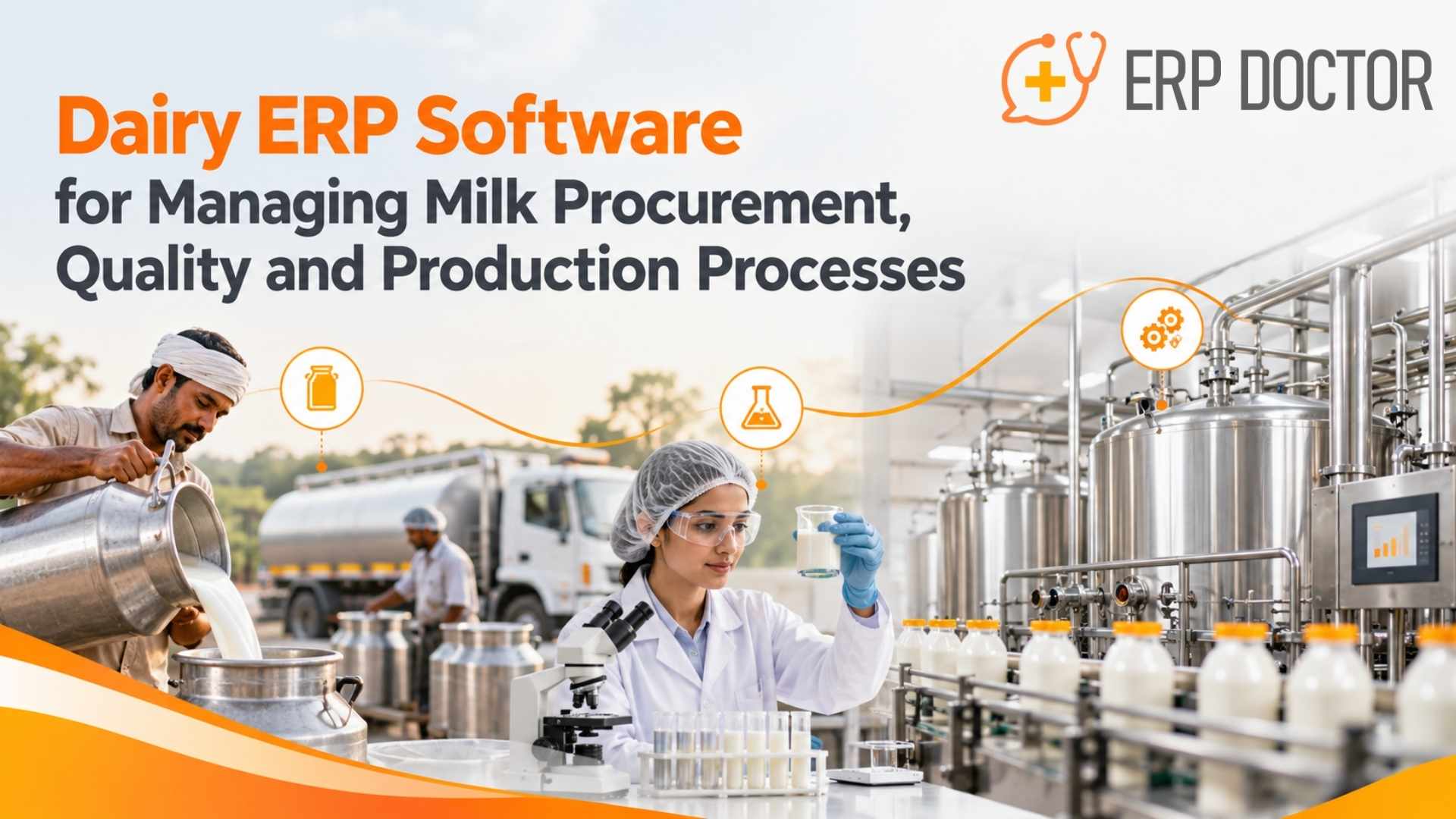
Dairy ERP Software for Managing Milk Procurement, Quality and Production Processes
Quick Answer
Dairy ERP software connects milk procurement, quality testing, inventory, production planning, batch traceability and financial reporting within a coordinated business system. It helps dairy businesses track milk collection, reconcile supplier quantities, monitor quality results, manage perishable stock and improve visibility across processing operations. The right system should reflect the dairy’s procurement model, product range, plant capacity, distribution requirements and compliance obligations. Before implementation, businesses should evaluate process fit, integrations, reporting needs, data readiness and measurable operational outcomes.
Dairy Operations That Require Better ERP Control
Dairy businesses manage a continuous flow of raw milk, ingredients, packaging materials, finished products and delivery commitments. These activities are connected, but they often operate across different teams, locations and applications. When procurement records, laboratory results, production schedules and inventory balances are not aligned, managers may struggle to identify discrepancies or respond quickly to operational changes.
The complexity varies by business model. A milk collection operation may need accurate farmer-level procurement records and collection-centre reconciliation. A dairy processing plant may prioritise production planning, batch genealogy, quality checks and packaging control. A business selling milk, curd, paneer, butter, ghee or other dairy products must also manage different processing requirements, storage conditions and shelf lives.
A dairy ERP system provides a shared operational framework for recording and connecting these activities. Its value depends on whether it supports actual workflows rather than simply digitising existing paperwork.
Procurement records and supplier reconciliation
Milk procurement involves quantities collected from farmers, cooperatives, collection centres or other suppliers. Records may include collection time, measured quantity, quality test results, agreed rates, deductions and payment calculations.
If these details are maintained in separate spreadsheets or applications, reconciling procurement against payments can require repeated manual work. A well-configured ERP system can connect supplier records, collection transactions, quality results and settlement calculations, subject to the system’s capabilities and the business’s agreed rules.
Quality information and production decisions
Raw milk quality affects acceptance, processing suitability and product consistency. Quality information must remain connected to the relevant procurement transaction and subsequent processing records. If a test result is recorded separately from the associated milk lot, tracing the material’s movement can become difficult.
ERP workflows should establish how quality results are captured, who reviews exceptions, and how rejected or held material is prevented from moving into an unauthorised process.
Inventory and distribution coordination
Dairy inventory includes raw milk, ingredients, packaging materials, work in progress and finished goods. Each category has different handling and planning requirements. Production teams need material availability information, while warehouse and distribution teams need reliable stock, expiry and dispatch records.
Connecting these records helps managers make decisions using a more consistent view of procurement, production, stock and orders.
| Dairy Operational Area | Process Gap Without ERP | Operational & Financial Impact | Required ERP Control |
|---|---|---|---|
| Milk Procurement & Collection | Manual collection registers, unlinked quality tests, and disconnected rate charts | Supplier payment disputes, reconciliation delays, and farmer dissatisfaction | Unified collection transaction connecting farmer master, test results, and automated rate calculation |
| Milk Quality & Acceptance | Laboratory test results isolated from milk lots and silo storage records | Risk of processing non-conforming milk, product inconsistency, and compliance exposure | Quality gate validation, automated hold/release statuses, and analyzer integration |
| Batch Traceability | Paper logs and silo mixing make tracing raw milk to finished batches slow | Inability to isolate batches during recalls, prolonged investigations, audit failure | Forward and backward batch genealogy linking farm lots, tanks, processing orders, and dispatches |
| Production Planning & Yield | Plans detached from daily milk arrival, component quality (fat/SNF), and shelf life | Unexplained processing losses, unplanned line downtime, and inaccurate product costing | Capacity-aligned production orders, standard BOMs with component mass balance, and loss variance tracking |
| Perishable Inventory & Cold Chain | Aggregate inventory counts without batch expiry, location, or temperature visibility | Spoilage write-offs, expired stock shipped to retail channels, return claims | First-Expiry-First-Out (FEFO) picking rules, shelf-life alerts, and multi-warehouse visibility |
| Compliance & Financial Control | Scattered paper logs, unlinked accounting entries, and delayed reconciliation | Audit penalties under FSSAI regulations, delayed financial close, unverified margins | Role-based access, automated audit trails, integrated general ledger, and standardized compliance reports |
Milk Procurement Management and Collection Reconciliation
Milk procurement control begins when a collection transaction is created. The business needs to know who supplied the milk, where and when it was collected, how much was received, which quality checks were performed and how the transaction will be settled.
A dairy ERP implementation should define these data requirements before configuration begins.
Supplier and collection-centre records
Supplier master data should identify farmers, cooperatives, collection centres and other procurement sources according to the operating model. Relevant information may include supplier identifiers, collection locations, contract terms, applicable rates and payment details.
Standardised records reduce ambiguity when transactions are consolidated across locations. They also make it easier to review supplier histories and investigate unusual variations in collection volumes.
Quantity measurement and rate calculation
The procurement workflow should record the measurement method and the source of the transaction quantity. Where the process uses weight, volume, density or conversion rules, the implementation team should document how each value is captured and calculated.
Rate calculations may depend on contractual terms and quality parameters. The ERP configuration should make the applicable rules transparent and support review of adjustments, deductions and exceptions. Businesses should validate these calculations using representative transactions before production use.
Procurement reconciliation and payment visibility
Procurement reconciliation compares recorded collection transactions with the information used for supplier settlement. Exceptions may include missing test results, duplicate entries, incorrect quantities, disputed rates or transactions assigned to the wrong supplier.
An ERP workflow can help route exceptions for review and preserve a record of approved adjustments. The exact controls depend on configuration, integrations and user permissions.
Management reports should show unresolved discrepancies, collection trends, supplier settlement status and the reasons for material adjustments. This gives procurement and finance teams a clearer basis for investigating differences rather than relying on end-of-period manual reconciliation.
Milk Quality Control and Batch Traceability
Quality management should be integrated with procurement, storage and production records. The objective is not merely to store laboratory results. It is to connect those results with the material, decision and subsequent activity they affect.
Recording quality tests and acceptance decisions
A dairy business may conduct tests at collection, receipt, storage or processing stages. Depending on the product, process and applicable requirements, checks may cover parameters such as temperature, fat content, solids-not-fat, acidity or other specified measures.
The ERP workflow should identify which tests apply, who records or imports the results, which limits govern acceptance, and who can approve exceptions. These parameters must be defined by the business’s quality team and relevant technical requirements; they should not be assumed to be identical across all dairy operations.
Where laboratory instruments or specialised quality systems are used, assess whether the ERP can exchange the required data with them. Integration should be tested for units of measurement, timestamps, sample identifiers, rejected results and error handling.
Linking milk lots to production batches
Traceability requires a reliable relationship between incoming material and the products made from it. Depending on the operation, the business may need to trace milk lots, storage tanks, processing batches, ingredients, packaging lots and finished-goods batches.
A properly designed traceability model records material movements and transformations. It should help authorised staff determine which incoming lots were used in a production batch and which finished goods were associated with that batch.
This information becomes important when a quality issue, customer complaint or recall investigation occurs. The system should make relevant records accessible without requiring teams to reconstruct the history from disconnected files.
Managing non-conforming material
When a quality result falls outside approved criteria, the business needs a defined process for holding, rejecting, re-testing or otherwise dispositioning the affected material.
The ERP configuration should support the appropriate status controls and approval steps. Where physical segregation is required, software records must be supported by corresponding warehouse and plant procedures.
A system alone cannot guarantee food safety. Effective control also depends on validated procedures, trained personnel, suitable equipment and consistent execution.
Dairy Production Planning, Yield and Processing Losses
Dairy production planning must account for incoming milk availability, quality status, processing capacity, product demand, ingredient availability, packaging materials and delivery schedules. These variables influence one another, making coordination across procurement, production and inventory important.
Aligning production with demand and material availability
Production schedules should reflect realistic capacity and available materials. A plan may need to account for processing lines, equipment availability, cleaning requirements, planned maintenance, product changeovers and order priorities.
An ERP system can bring demand, stock and procurement information together to support planning. Advanced scheduling or optimisation may require additional functionality, integrations or specialist production systems. Businesses should verify the capabilities of the proposed solution rather than assume that every ERP includes detailed dairy production scheduling.
Monitoring yield and process losses
Yield reporting compares input material with expected or actual output. The appropriate calculation depends on the product, process and measurement rules.
For example, a processor may need to compare milk input with the expected output of a particular dairy product while accounting for defined ingredients, moisture levels, process losses and measurement tolerances. The calculation should be approved by production and finance teams where it affects operational or financial reporting.
ERP reports can help highlight unusual differences between planned and recorded consumption or output. However, a variance does not automatically identify its cause. Staff may need to investigate measurement accuracy, process conditions, recording errors, material quality or equipment performance.
Production records and accountability
Production transactions should capture the information needed to explain what was planned, what was consumed, what was produced and which exceptions occurred. Depending on the business, this may include batch identifiers, material issues, production quantities, rejected output, rework and authorised adjustments.
Clear records help managers compare performance across products, lines, shifts and facilities. They also establish a more reliable foundation for analysing production costs and improving process consistency.
| Dairy Value Chain Stage | Common Operational Risk | Required Control | Dairy ERP Software Role |
|---|---|---|---|
| Milk Collection & Weighing | Volume discrepancies, inaccurate manual log entries, unrecorded adulteration | Direct weighbridge and analyser interface, automated rate calculation, prompt settlement slip | Hardware integration, automated collection transaction, transparent supplier accounting |
| Silo Storage & Quality Gate | Mixing failed milk with good lots, unmonitored holding temperature and time | Quality approval before silo transfer, automated quarantine hold, CIP cycle tracking | Tank-level inventory management, quality hold enforcement, lot genealogies |
| Pasteurisation & Processing | Component variation (fat/SNF mismatch), excessive production shrinkage | Approved multi-level BOMs, standard recipe execution, mass-balance loss monitoring | Production order issue vs consumption tracking, real-time yield reporting, scrap accountability |
| Packaging & Labelling | Incorrect expiry or batch codes, packaging film waste, overweight packaging | Automated batch and use-by date calculation, packaging line reconciliation | Finished goods batch generation, packaging BOM issue, automated barcode assignments |
| Cold Storage & Warehousing | Expired stock shipped to distributors, slow-moving inventory write-offs | Strict FEFO picking enforcement, cold chain zone tracking, shelf-life alert thresholds | Real-time batch inventory, expiry monitoring reports, automated pick lists prioritizing earliest expiry |
| Distribution & Delivery | Dispatched batch mismatches, route delays, transit temperature breach, billing disputes | Proof of delivery (POD) capture, vehicle temperature records, route-to-order alignment | Integrated sales order-to-dispatch workflow, delivery app integration, prompt invoicing |
Perishable Inventory, Expiry Tracking and Cold-Chain Visibility
Dairy inventory needs more than a total stock balance. Teams must understand the material’s identity, location, status, quantity and remaining usable life.
Raw milk and ingredient inventory
Raw milk may have specific handling and processing windows. Ingredients and packaging materials may have separate storage, lot identification and expiry requirements. Inventory rules should reflect the actual characteristics of each material.
The ERP design should define how receipts, transfers, consumption, returns, quality holds and stock adjustments are recorded. Where temperature records or sensor data are required, confirm whether these will be captured in the ERP, a connected system or an approved operational record.
Expiry dates and stock rotation
For products with defined shelf lives, the business should establish how manufacturing dates, expiry or use-by dates, batch numbers and storage locations are maintained. Where appropriate to the product and process, a first-expiry-first-out (FEFO) approach can help prioritise stock with the earliest expiry date.
FEFO is not simply a report setting. Warehouse procedures, picking rules, staff training and exception handling must support the intended stock-rotation policy.
Reports should help identify stock approaching expiry, blocked inventory, slow-moving products and differences between recorded and physical stock. Managers can then investigate potential losses and take action within the required time.
Connecting warehouse and distribution operations
Finished-goods inventory needs to align with customer orders, picking, dispatch and delivery records. Businesses operating multiple plants or warehouses should assess how the ERP handles transfers, stock ownership, batch selection and location-level visibility.
If the distribution process uses route-planning, transport management, delivery applications or third-party logistics systems, the integration scope should be defined clearly. The objective is to maintain consistent transaction records and reduce avoidable re-entry across systems.
Dairy Compliance Records and Audit Readiness
Dairy businesses operate under requirements that depend on their geography, product categories, processes and applicable regulatory framework. ERP software should support the records and controls the organisation needs, but the software should not be treated as proof of compliance by itself.
For Indian operations, the business should confirm applicable Food Safety and Standards Authority of India (FSSAI) requirements and any other relevant legal, customer or certification obligations with qualified compliance personnel.
Maintaining traceable operational records
A compliance-oriented ERP design should identify which records must be retained, who can create or change them, how corrections are approved and how authorised users retrieve information for review.
Relevant records may include procurement transactions, quality checks, production batches, ingredient lots, inventory movements, cleaning or process records maintained through connected systems, and dispatch information. The final scope should follow the organisation’s documented requirements.
User permissions and change history
Role-based access helps restrict activities according to job responsibilities. Procurement staff may need to record collections, while quality personnel approve quality-related decisions and finance staff review settlement transactions.
The business should also assess whether the solution maintains the audit trail required for relevant transactions and configuration changes. Retention periods, access controls and electronic-record requirements must be validated against applicable rules and internal policies.
Preparing for audits and investigations
Audit readiness improves when records are consistent, searchable and linked to the relevant transaction or batch. Reports should make it possible to investigate a specific supplier payment, incoming lot, production run or finished-goods batch without relying on several unrelated spreadsheets.
The implementation team should test these scenarios before go-live. Demonstrations should use realistic data and include exceptions, corrections and approval steps—not only successful transactions.
ERP Integration Across Procurement, Quality, Production and Finance
A dairy ERP system delivers limited value if critical information remains isolated in other applications. Before implementation, businesses should identify the systems that create, update or consume operational data.
Possible integration points include weighing equipment, milk analysers, laboratory information systems, production machinery, warehouse applications, accounting systems, customer-order platforms, delivery applications and business intelligence tools. Not every dairy business needs every integration.
Defining integration requirements
For each interface, document the data exchanged, system of record, update frequency, error-handling method and responsible owner. Decide how the system should handle duplicate messages, missing identifiers, invalid units, delayed updates and failed transactions.
A demonstration should show what happens when an integration fails and how staff identify and correct the issue. A successful demonstration under ideal conditions is not sufficient evidence of reliable integration.
Consolidating operational and financial information
Procurement quantities, material consumption, production output, inventory movements and sales transactions can affect financial reporting. The implementation should define how operational transactions flow into the relevant accounting processes and how differences are reconciled.
The objective is to improve consistency between operational records and financial results while preserving the approvals and controls required by the business.
How to Evaluate Dairy ERP Software Before Implementation
The right solution depends on the organisation’s scale, processes, existing technology and future plans. A feature checklist is useful, but a process-based evaluation provides stronger evidence of fit.
Assess the actual operating model
Document how milk is collected, tested, accepted, stored, processed, packaged and dispatched. Include the differences between plants, products, procurement channels and business units.
Identify where current workflows rely on spreadsheets, manual calculations, duplicate entry or informal approvals. These are useful starting points for requirements and process redesign.
Use scenario-based demonstrations
Ask vendors to demonstrate representative business scenarios, such as:
- Recording a milk collection transaction and reconciling the related supplier settlement.
- Holding a lot when a quality result requires review.
- Tracing an incoming lot through production to finished goods.
- Investigating a production yield variance.
- Identifying stock approaching expiry and applying the approved stock-rotation rules.
- Reviewing a batch-related complaint using available traceability records.
- Reconciling operational transactions with financial reporting.
- Handling a failed integration or an unauthorised transaction attempt.
The vendor should explain which functions are standard, which require configuration, which depend on add-ons, and which need custom development or external systems.
Evaluate implementation and support
A suitable product can still underperform if implementation scope, responsibilities and data migration are poorly managed. Assess the proposed delivery team’s experience with comparable workflows, the quality of its project plan and its approach to testing, training and post-go-live support.
Confirm the expected responsibilities of the dairy business and the implementation partner. Data ownership, decision-making, process sign-off and user acceptance should be agreed before the project begins.
Check the total cost of ownership
The financial assessment should include software licensing or subscription charges, implementation, integrations, customisation, data migration, infrastructure, training, support and future upgrades where applicable.
Compare these costs against defined business outcomes. Avoid assuming a particular percentage reduction in waste or operating cost unless it is supported by reliable evidence from the organisation’s own baseline or a comparable, documented implementation.
| Evaluation Area | What to Verify in ERP Demonstrations | Why It Matters for Dairy Operations |
|---|---|---|
| Milk Procurement & Rates | Multi-location collection, dynamic fat/SNF rate charts, automated deductions, and supplier settlement slips | Prevents settlement errors, protects supplier trust, and eliminates manual reconciliation across collection centres |
| Quality Gate & Testing | Capturing fat, SNF, acidity, temperature; automated hold status; exception routing for unauthorized releases | Ensures non-conforming or contaminated raw milk is blocked before mixing into processing tanks |
| End-to-End Traceability | Forward/backward batch tracking from farmer lot through storage tanks to finished goods and sales dispatches | Essential for fast recall investigations, customer complaint resolution, and regulatory audit compliance |
| Production Yield & Losses | Input vs output mass balancing, byproduct accounting (e.g. whey, cream), and loss variance reporting | Uncovers hidden shop-floor processing losses, controls cost of goods sold, and improves recipe consistency |
| Perishable Stock & FEFO | Batch expiry tracking, automated FEFO pick lists, expiry threshold warnings, and cold room storage rules | Prevents stock write-offs due to product spoilage and eliminates accidental shipment of expired goods |
| Hardware & System Integration | Integration with milk analyzers, weighbridges, SCADA/PLC, packaging lines, and accounting modules | Eliminates duplicate manual data entry, prevents transposition errors, and ensures real-time operational data |
| Compliance & Audit Trail | Role-based user permissions, immutable audit logs, electronic signatures, and food safety record retention | Guarantees compliance readiness for FSSAI inspections and external food quality audits |
| Total Cost of Ownership | Licensing, implementation fees, customization, plant hardware interfaces, training, and ongoing support | Avoids unexpected budget overruns and ensures investment aligns with measurable operational benefits |
Dairy ERP Implementation Risks and Readiness Requirements
Implementation should start with process and data readiness, not software configuration alone.
- Inconsistent master data: Supplier names, product codes, units of measurement and location records should be reviewed and standardised before migration.
- Unclear process ownership: Procurement, quality, production, inventory and finance teams need named owners who can approve requirements and resolve cross-functional decisions.
- Uncontrolled customisation: Custom features should address a verified business requirement. Excessive changes can increase cost, testing effort and maintenance complexity.
- Incomplete testing: Test scenarios should cover normal transactions, exceptions, reversals, approvals, integrations and reporting. User acceptance testing should involve the people who will operate the system.
- Insufficient training: Users need role-specific training based on real workflows. Training should include error correction, escalation and exception handling, not only routine data entry.
- Weak go-live planning: Define data cutover, opening balances, stock verification, access permissions, support contacts and rollback or contingency procedures where appropriate. Track unresolved issues and establish clear go-live approval criteria.
These controls help the organisation distinguish a software problem from a process, data or training issue and provide a more dependable basis for operational adoption.
Measuring Dairy ERP Outcomes Through Operational KPIs
ERP performance should be measured against a baseline established before implementation. Choose indicators that connect directly to the problems the business wants to solve.
Useful measures may include:
- Procurement reconciliation: time required to resolve differences between collection records and settlement calculations.
- Quality exception handling: time between recording a quality issue and documenting its disposition.
- Traceability response: time required to retrieve the relevant procurement, production and dispatch records for a defined batch.
- Inventory accuracy: difference between system quantities and verified physical stock.
- Expiry-related losses: quantity or value of stock written off because it passed the applicable usable-life limit.
- Production yield variance: difference between expected and recorded output under an approved calculation method.
- Schedule adherence: proportion of production orders completed according to the agreed schedule.
- Reporting effort: staff time required to prepare and reconcile recurring operational reports.
Define each KPI precisely, including the formula, data source, reporting frequency and accountable owner. Compare performance over suitable periods and account for changes in product mix, demand, seasonality and operating conditions. An ERP implementation may improve data visibility, but sustained performance improvement also depends on management action and process discipline.
Frequently Asked Questions About Dairy ERP Software
Evaluate Your Dairy ERP Requirements with ERPDoctor
Dairy operations need coordinated control over milk procurement, quality decisions, production records, inventory and traceability. ERP selection should begin with the workflows and reporting gaps that have the greatest operational impact.
ERPDoctor can discuss your dairy business requirements, existing systems, process priorities and implementation considerations. Use the discussion to clarify the capabilities you need, the integrations to assess and the controls that should be demonstrated before selecting a solution.
Request a Dairy ERP Consultation