

SAP Business One HANA: Performance and Scalability for Growing Businesses
Quick Answer
SAP Business One HANA helps growing businesses handle increasing transaction volumes, users, data, and reporting requirements through an in-memory database platform designed for fast data processing and real-time analytics. Its value is not simply faster ERP performance; it is the ability to maintain operational visibility and support more complex business processes as the organisation grows.
For businesses evaluating whether their current ERP environment can support the next stage of growth, performance and scalability should be considered together. An ERP system may work effectively at a smaller operational scale but become increasingly difficult to manage as transaction volumes, users, locations, integrations, and reporting requirements increase.
This is where SAP Business One HANA can become strategically relevant.
Rather than evaluating an ERP database only on current workload, growing businesses need to consider how efficiently the system can process larger datasets, support concurrent users, deliver operational information, and accommodate increasing business complexity.
Why Business Growth Can Create ERP Performance Problems
Business growth does not automatically create ERP performance problems. The risk increases when the ERP environment is not designed or configured to handle the changing workload that comes with growth.
As organisations expand, several factors place greater demands on their ERP environment.
1. Transaction Volumes
Transaction volumes increase as businesses process more sales orders, invoices, purchase documents, inventory movements, financial transactions, production records, and other operational data.
2. User Concurrency
The number of users can also increase. More employees accessing the ERP system simultaneously means greater concurrency and a larger demand for system resources.
3. Growing Data Volumes
Data volumes grow over time. Customer records, supplier information, inventory history, financial data, sales transactions, purchasing records, and historical operational information can make reporting and analysis more demanding.
4. Operational Process Complexity
Business processes may also become more complex. A company that initially operates from one location may eventually manage multiple warehouses, branches, production facilities, currencies, business units, or distribution channels.
5. Application Integrations
Integrations add another layer of complexity. ERP systems increasingly exchange information with CRM platforms, e-commerce systems, warehouse applications, payroll systems, logistics platforms, banking systems, tax platforms, and other business applications.
The result is a simple business problem: the ERP system has to process more information while users expect faster access to that information.
Performance therefore cannot be evaluated only by asking whether the ERP works today. The more important question is whether the environment can continue supporting business operations as workload and complexity increase.
How SAP Business One HANA Improves ERP Performance
SAP Business One HANA uses SAP HANA as its database platform. SAP HANA is an in-memory database technology designed to process and analyse data efficiently.
For SAP Business One environments, this can support faster processing of operational and analytical workloads. However, performance should not be interpreted as a guarantee that every transaction, report, or customisation will automatically run faster.
Actual performance depends on factors such as system sizing, configuration, workload, customisations, integrations, infrastructure, database design, and implementation quality.
The main performance advantages come from the way SAP HANA processes and analyses data.
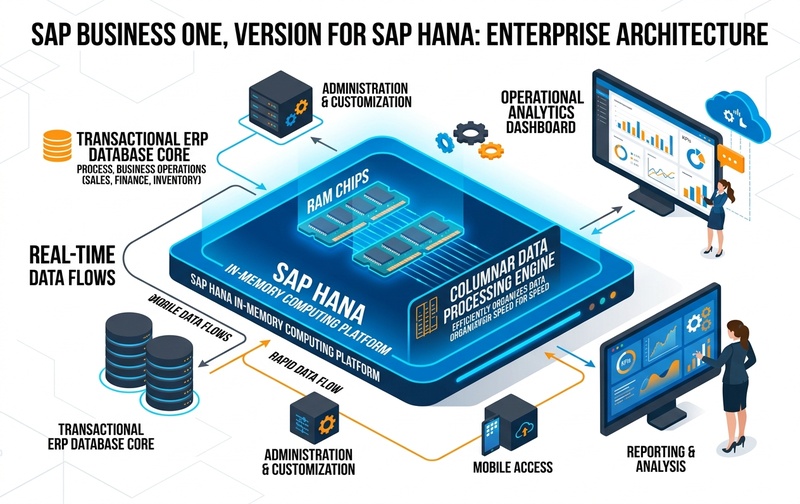
SAP Business One HANA in-memory architecture combines transactional processing and analytical calculation in main memory, reducing query bottlenecks and reporting latency.
In-Memory Data Processing
Traditional database environments rely heavily on disk-based storage and retrieval. SAP HANA uses an in-memory approach in which data is primarily processed in main memory, while persistent storage remains part of the overall architecture.
This architecture can reduce the time required for certain data-intensive processing and analytical operations.
For a growing business, the practical value is not simply technical speed. Faster data processing can help users retrieve information more efficiently when operational decisions depend on current ERP data.
For example, finance teams may need to analyse financial information, operations teams may need inventory visibility, and management may need current sales or purchasing information.
The ability to process larger datasets efficiently becomes increasingly important as the business grows.
Faster Data Analysis
Growth produces more data, but data has limited business value if decision-makers cannot analyse it efficiently.
SAP Business One HANA can support real-time analytical capabilities that allow businesses to work with operational data without treating reporting as a completely separate process.
This can be particularly useful when management needs to analyse sales, inventory, financial, purchasing, or operational information while business activity is still taking place.
Instead of relying only on historical reports, decision-makers can use current ERP information to understand what is happening and respond accordingly.
Real-Time Business Information
Growing organisations need visibility across multiple functions.
A finance leader may need to understand receivables and profitability. An operations leader may need inventory availability. A supply chain team may need purchasing and stock information. A sales leader may need current order and customer information.
SAP Business One HANA can support real-time access to business information across these operational areas.
This does not mean every business decision becomes automatically real-time. Data quality, transaction discipline, integrations, configuration, and reporting design still determine the quality of information available to users.
The advantage is that the underlying platform can support real-time operational and analytical workloads as part of the ERP environment.
Reduced Reporting Delays
Reporting becomes increasingly demanding as businesses grow.
A small organisation may depend on a limited number of standard reports. A larger organisation may require management reporting, financial analysis, inventory analysis, sales analysis, purchasing analysis, production information, and customised business views.
If reporting becomes slow or requires extensive manual data preparation, decision-making can also slow down.
SAP Business One HANA’s analytical capabilities can help businesses work with large volumes of ERP data more efficiently. The objective is not simply to produce reports faster but to reduce the gap between business activity and management visibility.
SAP Business One HANA Scalability for Growing Businesses
Scalability means more than adding additional users.
For an ERP environment, scalability involves the ability to support increasing transaction volumes, data, users, business processes, locations, integrations, and reporting requirements without creating unacceptable operational constraints.
SAP Business One HANA can provide a foundation for organisations that expect these demands to increase.
Consider a business that begins with a relatively straightforward operating model and later expands into multiple locations. The ERP environment may need to handle more users, warehouses, transactions, financial records, and reporting requirements.
Similarly, a manufacturing business may experience increasing production volumes, bills of materials, inventory movements, purchasing activity, and operational reporting requirements.
The appropriate question is therefore not simply:
“Can SAP Business One HANA support our current workload?”
It is:
“Can the proposed SAP Business One HANA environment be appropriately sized and configured for our expected workload and business growth?”
That distinction is important.
Scalability depends on the complete technology environment. Infrastructure capacity, user concurrency, database workload, integrations, custom development, data volume, and system configuration all influence how effectively the ERP environment scales.
Where SAP Business One HANA Performance Matters Most
ERP performance has a direct relationship with day-to-day business operations. The impact becomes more visible when multiple departments depend on the same system for operational information.
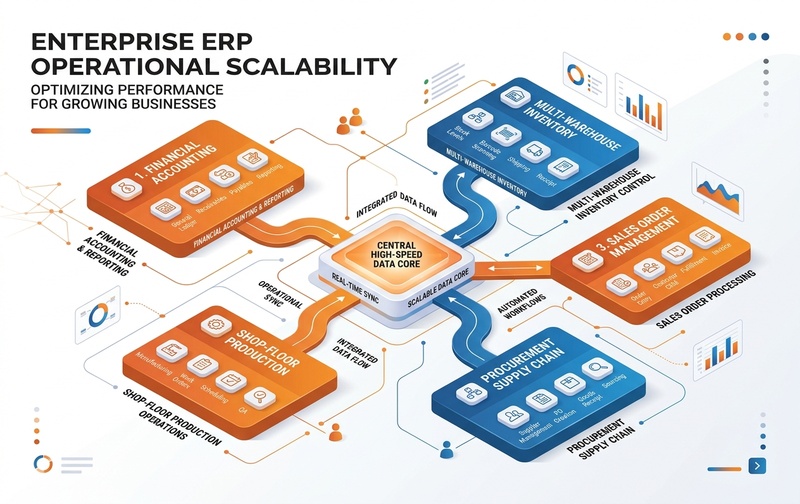
A centralized SAP Business One HANA platform maintains high performance and concurrent user responsiveness across multi-site finance, inventory, production, and supply chain workflows.
Finance and Financial Reporting
Finance teams work with large volumes of transactional information.
As the business grows, financial reporting can involve more transactions, accounts, customers, suppliers, currencies, business units, and historical data.
Efficient data processing can help finance teams analyse financial information and produce management reports without relying excessively on manual data extraction and spreadsheet consolidation.
The objective is greater financial visibility with less delay between transaction processing and analysis.
Inventory and Warehouse Operations
Inventory management becomes more complex as businesses add products, warehouses, locations, suppliers, customers, and transaction volumes.
ERP performance can influence how efficiently users access inventory information and process stock-related transactions.
For organisations managing large product catalogues or multiple warehouses, the ability to work efficiently with current inventory information becomes particularly important.
SAP Business One HANA can provide a platform for processing and analysing this information as the business expands.
Sales and Customer Operations
Sales teams depend on accurate information about customers, orders, inventory availability, pricing, receivables, and sales performance.
As transaction volumes increase, access to current information becomes more important.
A well-configured SAP Business One HANA environment can help connect operational sales data with broader business information, allowing users and management to work from a common ERP data environment.
Purchasing and Supply Chain
Procurement decisions depend heavily on current information.
Purchasing teams may need to evaluate stock levels, open orders, supplier activity, demand, and purchasing history.
As the number of transactions and suppliers increases, efficient processing and reporting become more important.
The value of an ERP platform therefore extends beyond transaction processing. It must also provide sufficient visibility to support purchasing and supply chain decisions.
Production
Manufacturing businesses often have more complex ERP workloads because production processes involve multiple dependencies.
Bills of materials, production orders, inventory consumption, receipts, purchasing, warehouse activity, and costing can all contribute to a growing volume of operational data.
For manufacturers experiencing higher production volumes or expanding product lines, ERP scalability becomes a strategic consideration rather than simply an IT concern.
SAP Business One HANA for Real-Time Reporting and Decision-Making
The business value of ERP performance becomes clearer when connected to decision-making.
Management does not need more data simply because the organisation is growing. It needs timely and reliable information that can support decisions.
Consider a situation where inventory levels are changing rapidly while sales orders and purchasing activity are increasing. A delayed report may provide technically accurate information but still be less useful if the business has already moved to a different operational position.
Real-time ERP information can help reduce this information gap.
With SAP Business One HANA, businesses can use operational data for analysis and reporting while transactions continue to be processed.
This can support management visibility across key operational areas:
However, real-time reporting is only as reliable as the underlying data.
Poor master data, inconsistent processes, incomplete integrations, incorrect configuration, and weak reporting design can reduce the value of even a technically capable database platform.
Therefore, businesses should evaluate ERP architecture, implementation quality, data governance, and reporting requirements together with database technology.
SAP Business One HANA Benefits for Growing Businesses
For a growing business, the benefits of SAP Business One HANA are best understood in terms of operational and management outcomes rather than database technology alone.
High-Volume ERP Data Processing
Provides a strong platform for processing increasing volumes of ERP data without experiencing transactional degradation.
In-Memory Analytics Capabilities
In-memory database technology supports data-intensive processing and instant operational analytics directly within the core platform.
Real-Time Operational Information
Provides continuous, real-time access to operational information for analysis and decision-making across all business functions.
Elimination of Manual Consolidation
Helps businesses reduce dependence on delayed reports or manually consolidated offline spreadsheets that introduce latency.
Support for Complex Reporting Requirements
Supports more demanding multi-entity, multi-currency, and divisional reporting requirements as the organisation becomes larger and more complex.
Scalable Growth Foundation
Provides a scalable foundation for businesses that expect increasing users, transactions, data, integrations, and operational complexity.
The important qualification is that these benefits are not automatic.
A poorly designed implementation can still create performance issues even when the underlying database technology is capable. Businesses should therefore evaluate SAP Business One HANA as part of a complete ERP architecture rather than treating the database choice as the only performance factor.
What to Evaluate Before Choosing SAP Business One HANA
The right ERP platform depends on the organisation’s actual requirements and future growth plans.
Before choosing SAP Business One HANA, businesses should evaluate several factors.
Current Transaction Volume
Review the number and type of transactions currently processed across sales, purchasing, finance, inventory, production, and other business functions.
Current transaction volume provides a baseline for understanding the existing workload.
User and Concurrency Requirements
The number of ERP users matters, but concurrent usage is equally important.
Businesses should consider how many users will access the system simultaneously and which departments will generate the highest workload.
Reporting and Analytics Needs
Identify which reports are operationally critical and which analytical workloads are expected to increase.
Management reporting requirements often change as companies expand, so future reporting needs should be considered during ERP planning.
Integration Requirements
List the systems that need to exchange information with SAP Business One.
CRM, e-commerce, warehouse management, payroll, banking, logistics, tax, and other integrations can contribute significantly to system workload.
Integration architecture should therefore be considered during performance and scalability planning.
Expected Business Growth
ERP selection should not be based solely on current business size.
Consider expected growth across key dimensions:
- Users and concurrent seats
- Transactions and document volume
- Products and SKU catalog depth
- Customers and active accounts
- Suppliers and vendor networks
- Warehouses and distribution points
- Locations, branches, and geographic entities
- Production volumes and manufacturing lines
- Integrations and third-party API throughput
- Reporting requirements and analytical complexity
This provides a more realistic basis for evaluating scalability.
Infrastructure and Deployment Requirements
Infrastructure sizing is a critical component of ERP performance.
Businesses should evaluate expected workloads, memory requirements, storage, network architecture, availability requirements, backup strategy, security, and deployment model.
For cloud or hosted environments, the infrastructure provided by the hosting architecture should also be evaluated against the expected workload.
SAP Business One HANA vs. Staying With a Conventional ERP Environment
The decision to move to SAP Business One HANA should not be based on the assumption that every conventional ERP environment is inadequate.
A business may continue operating effectively on its existing platform if its transaction volumes, reporting requirements, user demands, and growth plans remain within the system’s practical capabilities.
The question changes when the business begins experiencing increasing data volumes, slower analytical workloads, growing concurrency, more complex reporting, or expanding operational requirements.
At that point, continuing with the existing environment may require additional workarounds, manual reporting processes, infrastructure changes, or system optimisation.
SAP Business One HANA becomes relevant when the organisation needs an ERP platform capable of supporting its current requirements while providing a stronger foundation for future data and workload demands.
The decision should therefore be based on measurable business requirements rather than technology preference alone.
| Evaluation Dimension | Conventional ERP Environment | SAP Business One HANA |
|---|---|---|
| Database Processing | Relies primarily on disk-based storage, table indexing, and retrieval mechanisms. | In-memory columnar computing with instantaneous processing of active data sets. |
| Reporting & Analytics | Often requires separate batch extracts, data warehousing, or offline spreadsheet compilation. | Embedded real-time operational analytics and interactive dashboards alongside transactions. |
| High-Volume Concurrency | Prone to database locks, table contention, and degraded response times during peak usage. | High-concurrency parallel processing handles simultaneous users without blocking transactions. |
| Operational Visibility | Information reflects historical end-of-day or scheduled batch status, causing decision latency. | Live operational visibility across sales, inventory, finance, purchasing, and production. |
| Complex Business Scaling | Multi-branch, multi-warehouse expansions often necessitate frequent database tuning or hardware upgrades. | Engineered to scale fluidly with expanding transaction counts, SKUs, entities, and API integrations. |
| Decision-Making Velocity | Dependent on scheduled reporting cycles, creating information gaps for management. | Enables responsive, data-driven decisions based on current operational realities. |
Is SAP Business One HANA the Right Fit for Your Growth Plans?
SAP Business One HANA can be a strong fit for businesses that expect increasing ERP workloads and need faster access to operational and analytical information.
It is particularly relevant when growth is creating pressure across transaction volumes, reporting, users, data, integrations, inventory, finance, production, or multiple business locations.
However, the right choice depends on the organisation’s specific environment.
A proper evaluation should consider current ERP performance, transaction volumes, concurrent users, database workload, reporting requirements, integrations, customisations, infrastructure, expected growth, and implementation requirements.
For this reason, businesses should avoid selecting SAP Business One HANA based solely on the promise of faster performance.
The more useful question is whether the complete SAP Business One HANA solution can be designed and implemented to support the organisation’s operational requirements and growth trajectory.
Conclusion: Building an ERP Foundation for Sustainable Growth
ERP performance becomes increasingly strategic as businesses grow.
More users, transactions, data, locations, integrations, and reporting requirements can place greater demands on the ERP environment. A system that performs adequately at one stage of growth may require a different architecture and capacity as business complexity increases.
SAP Business One HANA provides an in-memory database foundation designed to support efficient data processing, real-time analytics, and growing ERP workloads.
Its value, however, depends on more than the technology itself. Correct sizing, infrastructure, configuration, integrations, customisation, data quality, reporting design, and implementation quality all influence the final outcome.
For businesses considering SAP Business One HANA, the decision should therefore start with the organisation’s current workload and future growth requirements.
The goal is not simply to choose a faster database.
It is to build an ERP environment that can continue supporting operational visibility, informed decision-making, and business growth as requirements become more demanding.
Frequently Asked Questions
How does SAP Business One HANA improve performance?
SAP Business One HANA uses SAP HANA’s in-memory database technology to support efficient data processing and analytics. Actual performance depends on workload, infrastructure, sizing, configuration, integrations, customisations, and implementation quality.
Is SAP Business One HANA suitable for growing businesses?
Yes. SAP Business One HANA can be suitable for growing businesses that expect increasing transaction volumes, users, data, reporting requirements, and operational complexity. The environment should be appropriately sized and configured for the expected workload.
How does SAP Business One HANA support scalability?
SAP Business One HANA can provide a database platform capable of supporting increasing data and analytical workloads. Scalability also depends on infrastructure, user concurrency, integrations, customisations, system configuration, and the organisation’s growth requirements.
What are the benefits of SAP Business One HANA?
Key benefits can include efficient data processing, real-time analytics, improved access to business information, support for data-intensive reporting, and a platform suitable for growing ERP workloads.
Does SAP Business One HANA provide real-time analytics?
SAP Business One HANA supports real-time analytical capabilities using SAP HANA. Businesses can analyse ERP data while operational transactions continue to be processed, subject to appropriate configuration and data quality.
What should businesses consider before choosing SAP Business One HANA?
Businesses should evaluate transaction volumes, concurrent users, data growth, reporting requirements, integrations, customisations, infrastructure, deployment requirements, current ERP performance, and expected future growth.
Does SAP Business One HANA require specific hardware?
The required infrastructure depends on the SAP Business One HANA environment, workload, users, data volume, deployment model, and other technical requirements. Hardware and infrastructure should be sized based on the actual workload rather than using a generic specification.
Evaluate SAP Business One HANA for Your Next Growth Stage
If increasing users, transaction volumes, reporting requirements, integrations, or business complexity are putting greater demands on your ERP environment, the next step is to evaluate whether your current architecture can support your growth plans.
Speak with our Specialist to discuss your business requirements, performance expectations, scalability needs, and SAP Business One HANA deployment options.