
Semiconductor ERP Software: Improving Production Control and Traceability
Quick Answer
ERP software for the semiconductor industry helps manufacturers coordinate procurement, inventory, production planning, quality management, financial control, and supply chain operations through connected business processes. Semiconductor companies can use ERP to improve material visibility, manage production costs, coordinate suppliers, and maintain more consistent operational records. However, ERP is not automatically a replacement for manufacturing execution systems (MES), product lifecycle management (PLM), or specialized equipment-control platforms. The right solution depends on the company’s manufacturing model, traceability requirements, integration architecture, production complexity, and business objectives.
Semiconductor Manufacturing Challenges That Require Better Operational Control
Semiconductor manufacturing depends on precise coordination between materials, production schedules, engineering information, quality requirements, equipment availability, and customer demand. A disruption in one area can affect several connected processes, creating delays, inventory discrepancies, additional costs, and difficulty meeting delivery commitments.
The challenge is not limited to production. Semiconductor businesses must also coordinate supplier purchasing, material availability, inventory valuation, production costs, customer orders, and financial reporting. When these activities operate through disconnected applications or manual spreadsheets, management may struggle to obtain a consistent view of operational performance.
| Operational Area | Semiconductor Process Challenge | Operational & Financial Impact | Required ERP Control |
|---|---|---|---|
| Production Planning | Multi-stage fabrication, testing, and assembly scheduling kept in silos | Schedule changes fail to reach purchasing; capacity conflicts and delivery delays | Demand forecasting, integrated MRP, capacity synchronization, and MES integration |
| Inventory Visibility | Specialized substrates, chemicals, and packaging materials split across locations | Unnecessary purchases, critical cleanroom stockouts, and capital tied in excess stock | Centralized real-time inventory tracking, lot/serial control, and warehouse scanning |
| Quality & Traceability | Scattered inspection logs, supplier batch records, and RMA data | Hours spent tracing root causes; audit vulnerabilities and delayed customer recall responses | End-to-end genealogy connecting raw materials, batches, inspections, and customer shipments |
| Financial Cost Control | Unlinked yield losses, scrap, rework expenses, and consumable costs | Distorted product margins, delayed financial closings, and unaccounted yield degradation | Actual vs. standard job costing, automated scrap postings, and real-time ledger updates |
| Supply Chain Coordination | External foundries, OSAT subcontractors, and multi-tier suppliers operating independently | Lack of WIP visibility across contract manufacturers; unreliable lead-time commitments | Subcontracting purchase orders, external WIP tracking, and partner data integration |
Production Planning Across Complex Manufacturing Stages
Depending on the business model, semiconductor operations may involve wafer fabrication, assembly, packaging, testing, or outsourced manufacturing. Each model has different scheduling, capacity, material, and coordination requirements.
Planning becomes difficult when demand forecasts, procurement information, production schedules, and inventory records are maintained separately. A schedule change may not immediately reach purchasing or finance teams, creating a gap between operational decisions and business records.
ERP can help coordinate demand, procurement, inventory, order management, and financial planning. However, detailed equipment-level scheduling and real-time production execution may require integration with MES or specialized manufacturing applications.
Inventory Visibility and Material Availability
Semiconductor operations may depend on specialized materials, components, chemicals, packaging supplies, and other production inputs. Inaccurate stock records can result in unnecessary purchases, material shortages, production delays, or excess inventory.
Inventory visibility becomes particularly important when materials move between warehouses, production areas, subcontractors, and external manufacturing partners. Business teams need to understand which materials are available, allocated, in transit, reserved, or awaiting inspection.
An appropriately configured ERP system can centralize inventory transactions and procurement records. Where required, lot-level identification, serial tracking, warehouse scanning, and production genealogy must be supported through suitable system capabilities and integrations.
Quality Records and Traceability Requirements
Semiconductor companies may need to trace materials, production batches, process records, inspection results, and customer shipments. The depth of traceability required varies by product, customer agreement, manufacturing process, and applicable quality requirements.
When information is scattered across separate systems, investigating a quality issue can require significant manual effort. Teams may struggle to connect supplier details, material consumption, production records, inspection outcomes, and shipment information.
ERP can provide business-level traceability records and connect purchasing, inventory, quality, production, and shipment transactions. Detailed process history, equipment data, and work-in-progress tracking may still need to be managed in MES, manufacturing data platforms, or other specialized applications.
Core Capabilities of Semiconductor ERP Software
The most appropriate semiconductor ERP solution is not necessarily the system with the longest feature list. Decision-makers should assess whether its capabilities address the company’s actual manufacturing model, operational risks, reporting requirements, and integration needs.
Production Planning and Procurement Coordination
ERP can connect customer demand with material requirements, purchasing activities, inventory availability, and production-related planning. This helps teams identify potential material constraints earlier and coordinate procurement decisions with business priorities.
Manufacturers should assess whether the system supports their planning processes, including demand forecasting, material requirements planning, purchase-order management, supplier records, and order tracking. More advanced production scheduling may require additional manufacturing software.
Inventory Management and Material Traceability
Inventory management should provide reliable visibility into stock quantities, warehouse locations, material movements, reservations, and purchasing transactions.
For semiconductor environments, evaluation should go beyond basic stock balances. Businesses should establish whether the proposed architecture supports the required lot identification, batch tracking, expiry or shelf-life controls where relevant, inspection status, and links between materials and production orders.
If detailed wafer, lot, or work-in-progress genealogy is required, decision-makers should verify exactly which system records that information. A general inventory module should not be assumed to provide complete process-level traceability without configuration or integration.
Quality Management and Inspection Records
Quality processes can involve incoming-material inspection, nonconformance handling, corrective actions, supplier quality records, and the documentation needed to investigate production issues.
ERP may support quality-related workflows and link inspection outcomes with inventory, purchasing, production, and financial transactions. Specialized systems may be necessary for detailed statistical process control, equipment measurements, or advanced process monitoring.
During evaluation, manufacturers should identify the quality records that must be captured, the approval steps required, and how information will be retrieved during an audit or customer investigation.
Financial Management and Production Cost Control
Manufacturing decisions need to be connected to financial information. Procurement costs, material consumption, inventory valuation, production expenses, scrap, and order profitability can all influence business performance.
ERP can consolidate financial transactions and help management evaluate costs across products, departments, facilities, or business units, depending on the system configuration.
The evaluation should confirm how the solution handles the organization’s costing methodology, inventory valuation, production-related expenses, currency requirements, and financial reporting. Actual costing visibility depends on data quality, configuration, integrations, and the accuracy of operational transactions.
Supplier and Supply Chain Coordination
Semiconductor supply chains can involve specialized suppliers, contract manufacturers, logistics providers, and customers operating across different locations. Procurement delays or changes in material availability can affect production commitments.
ERP can help maintain supplier records, purchasing commitments, expected receipts, inventory availability, and financial obligations in a coordinated environment.
Companies should also assess how the solution exchanges information with external partners, whether supplier systems require integration, and how changes to delivery schedules or material availability are communicated to relevant teams.
Semiconductor Inventory Traceability and Work-in-Progress Visibility
Inventory accuracy is only one part of semiconductor traceability. Depending on the operation, manufacturers may need to connect supplier materials, lots, production orders, process steps, inspection results, and finished-product shipments.
A useful evaluation begins by mapping the required traceability path. Management should identify the information that must be recorded at each stage, the system responsible for capturing it, and the records required to investigate a quality or delivery issue.
For example, a company may need to determine which supplier lot was received, where the material was stored, which production order consumed it, what inspection records were associated with it, and which finished products were shipped to a customer. The exact workflow depends on the manufacturing model and the level of genealogy required.
ERP can connect the business transactions associated with these events. MES or other manufacturing systems may capture detailed work-in-progress status, process execution, equipment data, and production events. Integration is essential when management needs a consistent view across both business and manufacturing records.
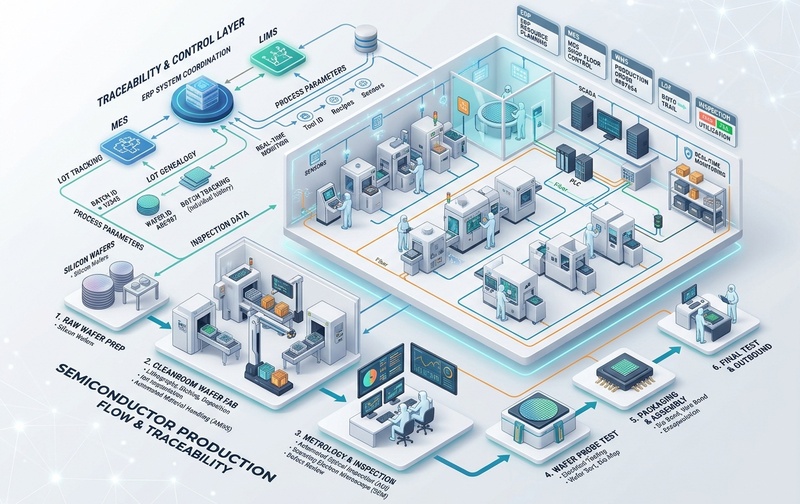
Semiconductor production control and wafer genealogy architecture connecting cleanroom fabrication, inspection, lot tracking, and enterprise resource planning.
Before selecting a solution, verify:
- Whether lot, batch, serial, or other identifiers are supported at the required level.
- How material consumption is associated with production orders or manufacturing lots.
- Whether quality holds and inspection statuses can restrict material use or shipment.
- How production records are connected to inventory and customer orders.
- Whether traceability reports can be retrieved within the organization’s required response time.
- Which capabilities require standard configuration, customization, or third-party software.
These requirements should be demonstrated using realistic business scenarios rather than accepted solely from a product presentation.
ERP, MES, and PLM Integration in Semiconductor Manufacturing
ERP, manufacturing execution systems, and product lifecycle management systems support different but complementary business needs. Understanding these responsibilities is essential when designing a semiconductor manufacturing technology environment.
ERP for Business and Resource Management
ERP generally coordinates business transactions and shared operational information, including purchasing, inventory, financial management, order processing, supplier records, and planning.
Its role is to connect business activities so that departments can work from consistent records and management can evaluate operational and financial performance.
MES for Manufacturing Execution
MES typically supports production execution and shop-floor visibility. Depending on the platform, it may manage work-in-progress, production routing, process steps, equipment interactions, and detailed manufacturing records.
Semiconductor companies requiring detailed production tracking should confirm whether these functions are provided by an MES or another specialized manufacturing platform rather than assuming ERP covers every requirement.
PLM for Product and Engineering Information
PLM systems typically manage product definitions, engineering changes, technical documentation, and related product lifecycle information.
When product structures or engineering changes affect purchasing and manufacturing, controlled information exchange between PLM, ERP, and manufacturing systems can help reduce inconsistencies. The required integration depends on how product data is created, approved, released, and used.
Defining Clear System Responsibilities
An effective integration design establishes which system owns each important data element and transaction. It also defines how updates are transmitted, how errors are handled, and how teams identify discrepancies.
For example, approved engineering information may originate in PLM, production execution records may originate in MES, and purchasing and financial transactions may be managed in ERP. The actual allocation must be agreed upon for each implementation.
| System Domain | Core Responsibilities | Key Data Owned | Integration Hand-Off Points |
|---|---|---|---|
| ERP (Enterprise Resource Planning) | Business transactions, procurement, finance, customer orders, high-level planning | Purchase orders, sales orders, general ledger, inventory valuations, master vendor records | Releases production orders to MES; receives scrap, yield, and completed goods back |
| MES (Manufacturing Execution System) | Shop-floor execution, machine dispatching, wafer/lot genealogy, in-line process control | WIP status, tool recipes, operator logs, wafer inspection measurements, rework histories | Sends actual material consumption, machine hours, and yield data to ERP costing |
| PLM (Product Lifecycle Management) | Engineering specifications, design revisions, CAD files, engineering change orders (ECO) | Approved engineering BOMs, technical drawings, change notices, compliance certifications | Synchronizes released BOM revisions with ERP and MES manufacturing masters |
During solution evaluation, document the required interfaces, data ownership, update frequency, validation rules, error notifications, and recovery procedures. Integration should be tested against real business scenarios, including failed messages, revised orders, rejected materials, and production schedule changes.
Improving Production Cost, Material Planning, and Operational Decisions
Semiconductor manufacturers need reliable information to balance material availability, delivery commitments, production expenses, and changing demand. Disconnected records can delay decisions because managers must reconcile information from multiple sources before acting.
ERP can improve the consistency of business information by connecting purchasing, inventory, orders, and financial transactions. When integrated with appropriate manufacturing systems, it can help decision-makers relate production activity to material consumption, costs, and business outcomes.
Material Planning and Purchasing Decisions
Material planning should reflect expected demand, existing inventory, open purchase orders, supplier lead times, and relevant production requirements. Better coordination can help teams identify shortages and excess stock before they affect operations.
However, planning accuracy depends on reliable master data, realistic lead times, accurate inventory transactions, and appropriate planning parameters. Implementing software without improving these foundations may reproduce existing planning problems in a new system.
Cost Visibility and Scrap Analysis
Manufacturers may need to evaluate material usage, production expenses, scrap, rework, and product-level profitability. ERP can consolidate relevant financial and inventory records, while detailed process measurements may originate in manufacturing systems.
Management should confirm which cost components can be captured, how production variances are calculated, and whether the available reports support the decisions executives need to make. Avoid assuming that a system will automatically identify the root cause of yield loss without the necessary process data and analytical capabilities.
Reporting for Executive Decisions
Leadership teams need consistent information about inventory exposure, purchasing commitments, cost trends, order status, and financial performance. ERP reporting can help bring these records together, subject to the quality and completeness of the underlying data.
Before implementation, define the business questions that reports must answer. Examples include identifying material shortages that threaten delivery, reviewing inventory tied up in slow-moving materials, comparing planned and actual costs, and understanding outstanding supplier commitments.
Selecting ERP for Different Semiconductor Business Models
Semiconductor businesses do not all operate the same way. A solution suitable for one manufacturer may not satisfy the production, integration, or traceability needs of another.
Integrated Device Manufacturers
Integrated device manufacturers may manage multiple stages of semiconductor operations. Their ERP evaluation may involve multi-site procurement, complex inventory flows, financial consolidation, manufacturing integration, and coordination between facilities.
Decision-makers should assess how the solution supports organizational complexity and connects with the systems used for detailed production execution and engineering data.
Fabless Semiconductor Companies
Fabless businesses focus on semiconductor design and typically rely on external partners for fabrication or other manufacturing activities. Their priorities may include purchasing, outsourced production coordination, inventory visibility, supplier management, order commitments, and financial control.
The evaluation should examine how the ERP environment exchanges information with foundries, assembly and test partners, logistics providers, and internal design or product systems.
Foundries and Wafer Fabrication Operations
Foundries require close coordination between capacity, production schedules, material availability, process execution, and customer commitments. Their system architecture may need substantial integration with specialized manufacturing applications.
ERP evaluation should focus on enterprise planning, procurement, finance, inventory, and the interfaces needed to obtain reliable manufacturing status. Detailed process control and equipment-level execution must be assessed separately.
Outsourced Semiconductor Assembly and Test Providers
Outsourced semiconductor assembly and test (OSAT) providers may need to coordinate customer orders, materials, subcontracting, production status, inspection information, and finished-product shipments.
The required capabilities depend on the services provided, customer agreements, and traceability expectations. A scenario-based demonstration should show how the proposed systems connect incoming materials, production activity, quality records, and outbound shipments.
Semiconductor ERP Implementation Risks and Readiness
ERP implementation is a business change initiative, not simply a software installation. Results depend on process design, data quality, stakeholder ownership, integration, testing, training, and the ability to manage operational change.
Incomplete or Inconsistent Master Data
Duplicate supplier records, inaccurate material descriptions, inconsistent units of measure, and unreliable inventory balances can undermine planning and reporting.
Before migration, establish data owners, validation rules, cleanup responsibilities, and reconciliation procedures. Critical data should be checked against agreed business rules before it is loaded into the new environment.
Unclear Integration Requirements
When ERP, MES, PLM, warehouse systems, and external partner applications are involved, incomplete interface requirements can create delays and inconsistent records.
Document data ownership and interface behavior early. Include error handling, security, monitoring, and recovery procedures in the integration design and test plan.
Excessive Customization
Custom development may be necessary when standard capabilities do not meet genuine business requirements. However, unnecessary customization can increase implementation complexity, testing effort, maintenance costs, and upgrade risk.
Classify requirements into standard functionality, configuration, integration, customization, or process change. Require a clear business justification before approving nonstandard development.
Insufficient User Adoption and Testing
Employees need to understand revised workflows, transaction responsibilities, and exception-handling procedures. Training should reflect actual roles and business scenarios rather than relying exclusively on generic demonstrations.
Testing should cover normal transactions as well as exceptions, including material shortages, inspection failures, supplier delays, order changes, integration errors, and financial reconciliation.
Weak Governance and Scope Control
Projects can lose direction when responsibilities, approval authority, scope, and success criteria are unclear.
Assign accountable business owners, establish decision-making processes, and define measurable acceptance criteria. Readiness reviews should confirm that critical processes, data, integrations, reporting, and training are sufficiently prepared for deployment.
Evaluating Whether a Semiconductor ERP Solution Fits Your Business
Executives should compare ERP options against documented requirements rather than choosing solely by brand recognition, feature count, or initial licensing cost.
A structured evaluation should cover the following areas.
- Operational fit: Confirm that purchasing, inventory, financial management, planning, and order processes align with the business model.
- Traceability: Demonstrate the required links between supplier materials, production records, quality events, inventory transactions, and customer shipments.
- Integration: Validate the interfaces needed for MES, PLM, warehouse applications, external manufacturers, and other business systems.
- Reporting: Identify the operational and financial information management needs, then verify that the solution can produce it from reliable data.
- Implementation scope: Separate standard functionality from configuration, integration, customization, and additional software requirements.
- Total cost: Assess licensing or subscription charges, implementation services, data migration, integrations, infrastructure, training, support, and ongoing maintenance.
- Scalability: Evaluate the ability to support expected changes in sites, transaction volumes, users, manufacturing partners, reporting requirements, and business processes.
- Support and governance: Establish responsibility for system administration, security, updates, issue resolution, documentation, and future enhancements.
| Evaluation Area | Key Evaluation Criteria | Verification Goal |
|---|---|---|
| Operational Fit | Confirm that purchasing, inventory, financial management, planning, and order processes align with the business model. | Ensures standard business flows support fab, fabless, or OSAT operations without excessive gaps. |
| Traceability | Demonstrate the required links between supplier materials, production records, quality events, inventory transactions, and customer shipments. | Validates complete genealogy and immediate recall/audit reporting capabilities. |
| Integration | Validate the interfaces needed for MES, PLM, warehouse applications, external manufacturers, and other business systems. | Eliminates duplicate manual entry and coordinates shop-floor execution with enterprise ledgers. |
| Reporting | Identify the operational and financial information management needs, then verify that the solution can produce it from reliable data. | Provides executives with accurate visibility into margins, scrap costs, and delivery commitments. |
| Implementation Scope | Separate standard functionality from configuration, integration, customization, and additional software requirements. | Prevents project delays, unneeded software development, and ballooning consulting budgets. |
| Total Cost | Assess licensing or subscription charges, implementation services, data migration, integrations, infrastructure, training, support, and ongoing maintenance. | Gives a realistic 3- to 5-year total cost of ownership rather than just initial license fees. |
| Scalability | Evaluate the ability to support expected changes in sites, transaction volumes, users, manufacturing partners, reporting requirements, and business processes. | Ensures the software can grow with new cleanroom lines, acquisitions, and multi-country facilities. |
| Support and Governance | Establish responsibility for system administration, security, updates, issue resolution, documentation, and future enhancements. | Secures ongoing operational reliability and SLA adherence after deployment. |
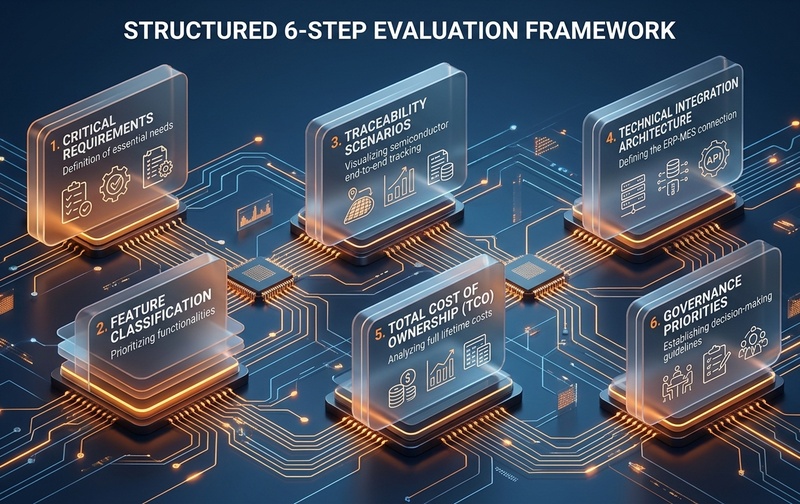
A structured 6-step evaluation roadmap helps semiconductor manufacturers balance business requirements, traceability depth, and total cost of ownership.
Request demonstrations based on representative business scenarios. A useful demonstration should show how the proposed architecture handles a material shortage, a rejected lot, an engineering change, a production-status update, and a customer shipment investigation. Ask the provider to identify which system performs each step and what additional configuration or integration is required.
Why Semiconductor Manufacturers Should Assess ERP Requirements Before Implementation
Semiconductor operations combine specialized production requirements with enterprise-wide responsibilities for procurement, inventory, finance, supplier coordination, and customer commitments. A well-designed ERP environment can help connect these business activities, but its value depends on how well the system fits the company’s operating model.
The decision should begin with operational requirements, not a predetermined list of features. Manufacturers need clarity on traceability depth, production planning, financial controls, integration boundaries, reporting needs, and implementation constraints.
ERP Doctor can discuss ERP requirements, implementation considerations, customization, integration, and support options with businesses evaluating their next steps. The appropriate solution and architecture should be determined through a review of the company’s processes, existing systems, and operational priorities.
Frequently Asked Questions
Evaluate ERP for Your Semiconductor Manufacturing Operations
Semiconductor ERP selection requires a clear understanding of production planning, material traceability, quality controls, financial reporting, system integrations, and implementation priorities.
Request an ERP consultation to discuss your current systems, manufacturing model, operational challenges, and integration requirements. Evaluate which capabilities can be supported through standard ERP functionality and where additional systems, configuration, or customization may be necessary.