

Rising Production Costs? ERP Software for Fertilizer Manufacturing and Operational Control
Quick Answer: How ERP Software Supports Fertilizer Manufacturing Cost Control
ERP Software for Fertilizer Manufacturing helps connect raw material purchasing, inventory, formulations, production consumption, batch movements, costing and finance in one operational environment. This allows manufacturers to compare planned versus actual material usage, identify production and yield variances, monitor inventory costs and investigate where rising manufacturing costs are actually originating.
The core value is not simply having more production data. It is connecting transactions that are often managed separately.
For example, when raw material prices increase, management needs to understand more than the new purchase price. The business also needs to know how that price change affects formulation cost, production orders, inventory valuation, finished-goods cost and product margin.
A properly configured manufacturing ERP creates that connection.
The result is a clearer path from:
That operational chain is particularly important in fertilizer manufacturing, where material prices, formulation requirements, production yield, inventory accuracy and procurement timing can all influence manufacturing economics.
Why Fertilizer Manufacturing Costs Become Difficult to Control
Rising fertilizer production costs rarely originate from one transaction.
They are usually the combined result of changes across procurement, material consumption, production, inventory and finance.
Raw material prices can change before production catches up
Procurement & Cost Variance
When the purchase cost of key materials changes, existing production plans may still be based on earlier assumptions.
If purchasing, inventory and production costing are maintained separately, management may not immediately see how a new procurement price changes expected production cost.
The issue becomes more significant when manufacturers work with multiple suppliers, different purchase quantities, variable lead times or imported materials.
Actual consumption can differ from planned consumption
Shop-Floor Execution & Yield Discrepancy
A formulation or BOM may specify the planned quantity required for a production batch.
Actual shop-floor consumption can differ because of:
The financial impact is difficult to investigate when the planned quantity exists in one system while actual material issues and production results are recorded elsewhere.
Yield variance affects unit economics
Unit Margin & Economics
Suppose a production order is expected to generate a specific finished quantity from a defined material input.
If the actual output is lower, the effective cost per unit may increase even when the material purchase price has not changed.
Management therefore needs visibility into both input variance and output variance.
Inventory inaccuracies create hidden operational costs
Warehouse Discrepancies
A system may show enough material for production while the warehouse physically holds less.
The opposite can also happen: materials are available but not accurately reflected in the system.
These discrepancies can lead to emergency purchases, delayed production, excess safety stock and working-capital pressure.
Procurement decisions can become reactive
Supply Planning & Purchasing Lead Time
When procurement teams do not have reliable visibility into production requirements, existing stock, open purchase orders and lead times, purchasing becomes reactive.
The organization may buy too early, too late or in quantities that do not reflect actual production demand.
For CFOs and operations leaders, the real problem is therefore not simply “high production cost.” It is the inability to trace why cost changed, where it changed and which operational transaction caused the difference.
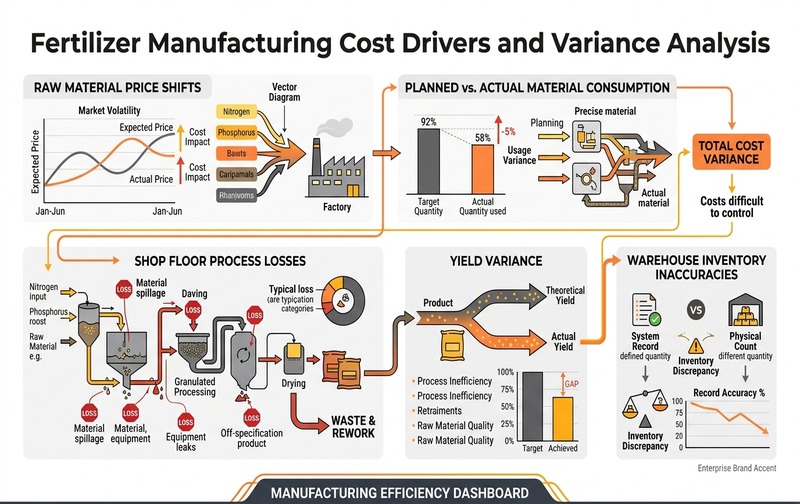
Enterprise infographic detailing root causes of rising fertilizer manufacturing costs, comparing raw material price shifts, planned versus actual consumption, shop-floor process losses, yield variance, and warehouse inventory inaccuracies.
| Cost Variance Driver | Operational Cause | Financial Impact | ERP Operational Control |
|---|---|---|---|
| Raw Material Price Shifts | Supplier price updates, lead-time changes, imported material fluctuations | Production orders executed on outdated procurement estimates | Connected purchasing, inventory valuation, and live batch re-costing |
| Consumption Differences | Process losses, handling losses, material substitutions, rework, scrap | Actual shop-floor consumption exceeds budgeted BOM quantities | Planned vs. actual issue tracking and shop-floor variance reporting |
| Yield Variance | Finished output lower than planned input specifications | Effective unit cost increases despite stable material purchase price | Dual input and output variance analysis across production orders |
| Inventory Inaccuracies | Physical warehouse count diverges from system balances | Emergency rush purchases, production delays, and excess safety stock | Real-time multi-warehouse inventory movements and batch records |
| Reactive Procurement | Purchasing disconnected from live production schedules and stock | Buying too early, too late, or in suboptimal batch sizes | Automated MRP calculating requirements from open orders and lead times |
How ERP Software for Fertilizer Manufacturing Improves Cost Visibility
ERP Software for Fertilizer Manufacturing can create a common transactional structure across purchasing, inventory, production and finance.
This makes cost analysis more useful because management can follow the movement of materials and value through the manufacturing process.
Consider a simplified production cycle:
When these activities are connected, a fertilizer manufacturer can investigate questions such as:
• Did the raw material purchase price increase?
• Was more material consumed than the BOM or formulation required?
• Was finished output lower than planned?
• Did additional material have to be issued?
• Were inventory adjustments recorded?
• Did the finished-product cost change?
• How did the cost movement affect gross margin?
This is more valuable than a standalone dashboard displaying a total production-cost number.
Planned cost versus actual cost
Planned cost provides a reference point based on expected material quantities, production assumptions and the costing method configured in the ERP environment.
Actual production transactions provide the other side of the comparison.
If a production order requires 10,000 kg of defined materials but actual recorded consumption reaches 10,400 kg, management has a variance to investigate.
ERP does not automatically explain the operational reason for that difference. It creates the transaction trail required to identify and investigate it.
The reliability of this analysis depends heavily on accurate BOMs, material issues, receipts, inventory transactions and production reporting.
Controlling Raw Material Consumption and Production Variance
Material consumption is one of the most important areas to monitor when manufacturing cost begins to move unexpectedly.
A Fertilizer Manufacturing ERP can provide a structured way to compare what production should consume against what production actually consumes.
Start with controlled BOMs and formulations
The BOM or formulation defines the expected relationship between raw materials and the manufactured product.
Depending on the production model, the structure may include different components, quantities, stages or versions.
ERP provides the transactional foundation for controlling these structures. However, complex formulation management, recipe versioning or specialized process-manufacturing requirements may require configuration, an industry-specific add-on or integration rather than standard ERP functionality alone.
Compare planned and actual material issues
Once a production order is created, the expected material requirement can be compared with actual warehouse issues.
Management can then investigate situations where:
or
Both conditions can increase manufacturing cost.
The investigation can then move from a financial symptom to an operational cause.
For example, teams can examine whether the variance resulted from an additional material issue, production loss, inaccurate BOM quantity, lower yield, rework or a reporting discrepancy.
This creates stronger accountability around production cost without assuming that every variance represents avoidable wastage.
Managing Fertilizer Formulations, BOMs and Production Planning
A reliable production plan starts with a reliable definition of what must be manufactured and what materials are required.
In fertilizer manufacturing, that makes BOM and formulation control commercially important rather than merely administrative.
Why formulation accuracy matters
If the planned material structure is inaccurate, several downstream processes can also become inaccurate:
This is why BOM governance should be evaluated carefully during ERP implementation.
Manufacturers may need controls around revisions, authorized changes, alternative materials or more complex formulation requirements. Whether those requirements are handled through standard ERP configuration, customization, an add-on or a specialized third-party application should be established during solution design.
Connecting demand with production requirements
Production planning becomes more effective when demand information can be evaluated against:
Instead of planning production in isolation, teams can identify the material consequences of the production schedule.
For example, if demand requires additional finished goods but one critical raw material is below the required quantity, procurement can identify the shortage before the planned production date rather than after production is scheduled.
This connection between demand, inventory, procurement and production is one of the practical reasons manufacturing ERP software can improve operational control.
Improving Batch Tracking and Manufacturing Traceability
Batch traceability provides visibility into which materials moved through production and which finished batches resulted from those transactions.
For fertilizer manufacturers, the exact traceability requirement can vary significantly according to product type, process design, customer requirements and regulatory environment.
ERP selection should therefore begin with the required traceability model rather than assuming every company needs an identical workflow.
What useful batch visibility should provide
Where batch management is applicable, the system should help authorized teams investigate relationships between:
This can support operational investigations involving:
The important distinction is between recording a batch number and maintaining a usable transaction history.
A batch identifier has limited operational value if teams cannot connect it with material receipts, production activity, warehouse movements and subsequent sales.
Quality-management requirements may also extend beyond standard ERP functionality. Inspection workflows, laboratory systems, certificates, specialized quality parameters or regulatory documentation may require configuration, add-ons or third-party integration.
Reducing Inventory-Related Costs With Fertilizer ERP Software
Inventory problems affect more than warehouse efficiency.
They influence production continuity, purchasing behavior, working capital and manufacturing cost.
A Fertilizer ERP Software environment should therefore provide visibility across raw materials, work in progress where applicable, and finished goods.
Stock accuracy affects production decisions
Production planners rely on inventory records to determine whether materials are available.
If recorded stock and physical stock differ, the production plan can be based on incorrect assumptions.
The consequences may include production delays, emergency procurement or unnecessary safety stock.
Multiple warehouses make visibility more important
Fertilizer manufacturers operating multiple storage locations need to understand not only total stock but also where the stock is located.
A material may be available at company level but unavailable at the warehouse serving a specific production requirement.
ERP can provide structured warehouse and inventory movement records so that planners can distinguish between total availability and usable availability at a particular location.
Excess and slow-moving inventory affect working capital
Buying more material than production requires ties up capital.
At the same time, holding insufficient stock can interrupt manufacturing.
Inventory control therefore needs to balance material availability with actual demand and production requirements.
Reorder parameters, inventory reports, stock movement analysis and purchasing information can support that decision, provided master data and transaction discipline are maintained.
Batch or lot visibility can add another dimension where the manufacturer needs to manage material or finished-goods inventory at batch level.
Connecting Procurement With Fertilizer Production Requirements
Procurement should respond to manufacturing requirements rather than operate as a disconnected purchasing function.
A manufacturing ERP environment can connect purchase planning with inventory availability and production demand.
Consider the sequence:
When these relationships are visible, procurement teams can make more informed purchasing decisions.
Managing material availability and lead time
A low stock balance does not automatically mean a material should be purchased immediately.
Teams also need to consider:
- scheduled production;
- open purchase orders;
- expected delivery dates;
- supplier lead times;
- current stock;
- committed stock;
- expected consumption.
Connecting these factors helps reduce both production disruption and uncontrolled purchasing.
Monitoring purchase-price changes
When material prices fluctuate, purchasing history becomes useful for cost investigation.
Management can examine supplier prices and purchasing transactions to understand whether higher manufacturing cost is being driven by procurement conditions rather than production inefficiency.
Supplier-performance analysis may also be relevant, depending on the data captured and the reporting configuration used.
This does not eliminate procurement volatility. It gives decision-makers a better transactional basis for responding to it.
Tracking Fertilizer Manufacturing Costs and Product Profitability
Production costing becomes strategically useful when operational transactions are connected with financial information.
The objective is not simply to calculate a manufacturing cost. It is to understand what contributes to that cost and how it affects product economics.
Depending on ERP design and costing configuration, relevant information can include:
• raw material cost;
• material consumption;
• production transactions;
• inventory valuation;
• finished-product cost;
• cost variance;
• sales value;
• gross margin.
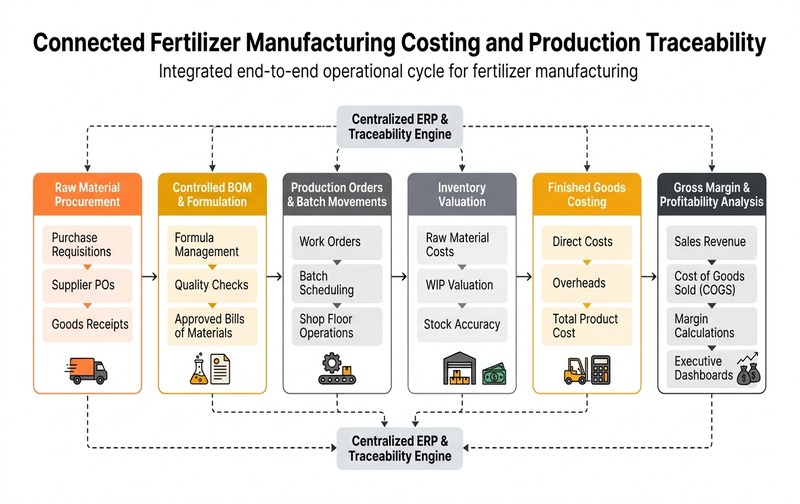
Comprehensive enterprise workflow diagram illustrating connected fertilizer manufacturing operational cycle from raw material procurement and BOM formulation through batch movements, inventory valuation, finished goods costing, and gross margin analysis.
Product profitability depends on transaction quality
A profitability report is only as reliable as the information feeding it.
If material issues are missing, inventory adjustments are inaccurate or production receipts are delayed, product-cost analysis can become misleading.
The same principle applies to master data and costing configuration.
A CFO looking at product profitability therefore needs confidence in the operational transactions behind the financial result.
This is where integrated ERP architecture becomes important: finance is not analyzing an isolated spreadsheet prepared after production. It is using data generated through purchasing, inventory, production and sales processes.
That creates a stronger foundation for investigating why margins differ across products, batches, periods or operating conditions.
How SAP Business One Supports Fertilizer Manufacturing Operations
SAP Business One is an ERP platform designed for small and midsize businesses and can be relevant to growing fertilizer and chemical manufacturers that need tighter integration between operational and financial processes.
Relevant standard SAP Business One capabilities can include areas such as:
• bills of materials and production;
• inventory management;
• purchasing;
• sales;
• financial management;
• warehouse transactions;
• batch and serial number management where applicable;
• reporting and analytics;
• integration capabilities.
For a fertilizer manufacturer, these capabilities can provide the ERP foundation connecting procurement, materials, production, inventory and financial transactions.
Where configuration becomes important
The presence of standard functionality does not mean the software should be deployed with an identical configuration for every manufacturer.
A fertilizer company may require specific configuration around warehouses, item groups, units of measure, BOMs, production processes, costing, approvals or reporting.
Where add-ons may be required
More specialized requirements can extend beyond standard SAP Business One functionality.
Depending on the operating model, this may include advanced formulation management, specialized quality workflows, laboratory processes, industry-specific compliance documentation, advanced planning or other process-manufacturing requirements.
An implementation assessment should determine whether each requirement belongs in:
- standard SAP Business One;
- SAP Business One configuration;
- an industry-specific add-on;
- customization; or
- a third-party integration.
This distinction matters because ERP buyers should evaluate the complete solution architecture rather than assuming the base ERP product automatically covers every fertilizer-specific requirement.
For organizations considering SAP B1 Manufacturing, the evaluation should therefore start with actual fertilizer production workflows and exceptions—not a generic software demonstration.
What to Evaluate Before Choosing Fertilizer Manufacturing ERP Software
ERP selection should focus on whether the proposed system can represent the manufacturer’s actual operating model and produce reliable information for decision-making.
Manufacturing requirements
Production Workflows
Document how production currently works, including production orders, material issues, output reporting, rework, wastage and production exceptions.
The ERP should fit the required process without forcing critical operational activities into uncontrolled spreadsheets.
Formulation and BOM complexity
Recipe Governance
Determine how formulations are structured and how frequently they change.
If the business requires sophisticated recipe management, version control, substitutions or process-specific formulation functions, establish whether these requirements are standard, configured or dependent on an additional solution.
Batch traceability
Forward & Backward Trace
Define the level of backward and forward traceability the business actually needs.
This should include raw material receipt, production usage, finished batches, warehouse movement and customer dispatch where relevant.
Inventory and warehouse structure
Multi-Location Logistics
Map plants, stores, warehouses and inventory-transfer processes.
A company with several production and distribution locations will have different control requirements from a manufacturer operating one plant and warehouse.
Production costing
Costing & Variance
Establish which costs management needs to analyze and how production variance should be reviewed.
Costing design should support management decisions rather than simply satisfy transaction posting requirements.
Procurement
Demand & Purchasing
Evaluate how production requirements translate into purchasing decisions.
The system should allow teams to evaluate demand, available inventory, open purchasing and supplier information before creating new procurement commitments.
Quality processes
Inspections & Approvals
Document inspection points, quality records, approvals and laboratory requirements.
Then determine which processes can be handled by the ERP and which require an add-on or integrated quality application.
Financial integration
Finance & Valuation
Production and inventory transactions should have a defined relationship with financial reporting.
CFOs should understand how inventory valuation, production transactions and sales activity contribute to financial and margin analysis.
Reporting and management visibility
Executive Intelligence
Begin with management questions rather than a list of standard reports.
For example:
This produces a much stronger ERP reporting requirement than simply requesting “production dashboards.”
Integration requirements
Connected Ecosystem
Identify systems that need to exchange data with the ERP, including specialized manufacturing applications, laboratory systems, dealer systems, logistics applications or other business platforms.
Integration scope should be established before implementation rather than discovered after go-live.
Scalability and implementation approach
Long-Term Growth
ERP scalability is not simply a question of adding users.
Management should consider whether the architecture can accommodate additional products, warehouses, plants, transaction volumes, integrations and reporting requirements as operations grow.
Implementation capability is equally important.
The partner should understand how to translate manufacturing requirements into master data, transaction design, controls, reports, integrations and user responsibilities.
| Evaluation Dimension | What to Verify & Questions to Answer | Strategic Value for Cost Control |
|---|---|---|
| Manufacturing & Formulations | BOM revisions, recipe version control, substitution rules, shop-floor issue tracking, rework handling | Prevents uncontrolled material consumption and process loss discrepancies |
| Batch Traceability & Quality | End-to-end forward/backward trace, lab inspection points, certificate of analysis, regulatory filings | Isolates quality issues, prevents scrap, and enables instant compliance audits |
| Inventory & Warehousing | Multi-warehouse stock visibility, usable vs total availability, bin locations, batch shelf life | Eliminates stock discrepancies, emergency purchasing, and tied-up capital |
| Procurement & MRP | Demand calculation against committed stock, open POs, lead times, and supplier price history | Shifts purchasing from reactive guesswork to demand-driven material availability |
| Costing & Financial Integration | Planned vs actual material variance, yield costing, inventory revaluation, product gross margin | Gives CFOs and plant heads auditable transactional proof of cost movements |
| Scalability & Implementation | Partner domain capability, transaction capacity, add-on vs core design, external system integrations | Ensures long-term ERP fit without expensive post-go-live rebuilds |
Conclusion: Turning Production Data Into Better Cost Control
Rising fertilizer manufacturing costs cannot be controlled effectively when procurement, inventory, production and financial information are analyzed separately.
ERP Software for Fertilizer Manufacturing can create a connected transactional foundation that allows management to examine raw material costs, planned versus actual consumption, production variance, inventory movement, procurement requirements, product costing and profitability together.
The objective should not be to select the ERP with the longest feature list.
The stronger question is: Can the system connect the operational data management needs to understand where manufacturing costs originate and why they change?
For some manufacturers, standard ERP functionality may cover a significant part of the requirement. Others may need additional configuration, fertilizer-specific extensions, customization or third-party integrations because formulation complexity, quality processes, warehouse structures and production models differ.
A structured ERP evaluation should therefore begin with the company’s actual manufacturing and costing processes and then determine how the proposed solution will support them.
Frequently Asked Questions
How does ERP software help reduce fertilizer manufacturing costs?
ERP software helps manufacturers identify cost drivers by connecting purchasing, raw material inventory, BOMs or formulations, production consumption, output and financial transactions. Teams can compare planned material requirements with actual consumption and investigate purchase-price, usage or yield variances. ERP itself does not automatically reduce cost; it provides the transactional visibility and controls needed to identify where avoidable cost, inventory inefficiency or production variance may be occurring.
What should ERP software manage in a fertilizer manufacturing company?
ERP for Fertilizer Industry operations should connect the processes that influence production and financial performance, including procurement, raw materials, BOMs or formulations, production orders, material consumption, finished output, batch tracking, warehouse inventory, costing, sales and finance. Requirements differ between manufacturers, so specialized formulation, quality, laboratory or regulatory processes may require configuration, an industry add-on or third-party integration rather than standard ERP functionality.
Can ERP track raw material consumption and production variance?
Yes. A manufacturing ERP can record planned material quantities against production orders and compare them with actual material issues and finished output. This gives production and finance teams a basis for identifying consumption and yield variances. The system can show that a variance exists, but determining its operational cause may require investigation into wastage, rework, incorrect BOM quantities, additional material issues, process conditions or inaccurate production reporting.
How can ERP improve fertilizer inventory and production planning?
ERP can connect production requirements with current inventory, open purchase orders, material demand and finished-goods availability. Planners can identify shortages before releasing or scheduling production and procurement teams can respond to calculated requirements rather than isolated purchase requests. The effectiveness of this planning depends on accurate inventory balances, BOMs, lead times, production data and other master-data settings, making data governance an important part of ERP implementation.
Can ERP software manage fertilizer batch production and traceability?
ERP software can support batch-controlled inventory and production where the selected platform and configuration provide those capabilities. Batch records can help connect material receipts, inventory movements, production transactions, finished batches and subsequent dispatches. Fertilizer manufacturers should define their exact backward and forward traceability requirements during ERP evaluation. Specialized quality, laboratory, formulation or regulatory traceability requirements may require additional configuration, add-ons or integrated systems.
Is SAP Business One suitable for fertilizer manufacturing companies?
SAP Business One can be relevant for growing and mid-market fertilizer manufacturers that need integrated production, inventory, purchasing, sales and financial management. Its suitability depends on the company’s actual manufacturing model. Standard functionality can provide the core ERP foundation, while complex formulation management, specialized quality workflows or other fertilizer-specific requirements may require configuration, customization, add-ons or integrations. A process-fit assessment should therefore precede the implementation decision.
Can SAP Business One help fertilizer manufacturers monitor production costs?
SAP Business One can connect production, material, inventory and financial transactions, providing a foundation for production-cost analysis when the system is appropriately configured. Manufacturers can use BOM, inventory, purchasing and production information to investigate cost movements and variances. However, useful costing depends on accurate master data, inventory transactions, production reporting and the selected costing configuration. The implementation should therefore define the cost questions management needs answered before designing reports.
What should fertilizer manufacturers consider before implementing an ERP system?
Manufacturers should evaluate their production model, formulation and BOM complexity, batch-traceability requirements, warehouses, inventory processes, production costing, procurement, quality workflows, financial integration, reporting requirements and external systems. They should also distinguish requirements covered by standard ERP from those requiring configuration, customization, add-ons or integrations. This process helps management evaluate the complete implementation architecture and cost rather than selecting software based primarily on a generic feature demonstration.
Evaluate ERP for Fertilizer Manufacturing Operations
Rising production costs, material variances, or disconnected data making cost control difficult? SAP Business One can help connect manufacturing, inventory, procurement, and financial processes.
Request an SAP Business One demo to explore better cost and operational control.