

Perpetual ERP Licensing: Costs, Benefits, Risks & Business Fit
ERP licensing is a major financial and operational decision for growing businesses. The choice is not simply between buying software once or paying a recurring subscription. It affects the ERP investment, maintenance obligations, infrastructure requirements, upgrade strategy, scalability, budgeting, and long-term total cost of ownership.
Perpetual ERP licensing remains relevant for businesses that want long-term rights to use a licensed ERP product and are prepared to manage the associated implementation, infrastructure, maintenance, and upgrade requirements. However, a perpetual license is not automatically the lowest-cost option. The right decision depends on how long the ERP will be used, how the system will be deployed, how many users are required, what support is needed, and how the vendor structures maintenance and upgrades.
For CFOs, CIOs, CTOs, IT Heads, business owners, and ERP decision-makers, the better approach is to evaluate the complete commercial model rather than comparing only the initial license price.
Quick Answer: What Is Perpetual ERP Licensing?
Perpetual ERP licensing is a software licensing model in which a business makes an upfront payment for the right to use a specific ERP software license, generally on an ongoing basis according to the vendor’s license terms. Recurring costs may still apply for maintenance, support, upgrades, infrastructure, implementation, customization, and other services.
Unlike a subscription model, where access is generally tied to recurring payments, a perpetual model separates the initial software license purchase from many ongoing services and operating costs.
The important distinction is that a perpetual license is not the same as owning the ERP software itself. The business receives defined usage rights under the applicable licensing agreement.
For an ERP buyer, the real question is therefore not simply whether perpetual licensing is cheaper. The better question is whether its long-term cost, control, deployment model, support requirements, and business fit align with the company’s strategy.
Perpetual ERP Licensing: How the Model Works
Under a traditional perpetual ERP licensing model, the customer pays an upfront license fee for the software rights purchased.
The commercial structure commonly contains several separate components:
Perpetual ERP Commercial Lifecycle Architecture:
➔
Implementation & Setup
➔
Infrastructure & Hosting
➔
Annual Maintenance
➔
Upgrades & Scaled Users
The exact structure differs by ERP vendor, product, deployment method, user model, and contract.
This is why an ERP licensing decision should be evaluated using the complete commercial and operating model, rather than the license price alone.
Perpetual License vs Ownership
One common misunderstanding is that purchasing a perpetual license means the company owns the ERP software.
In most commercial software arrangements, the customer receives a license to use the software rather than ownership of the underlying intellectual property.
The agreement may define:
permitted users
permitted locations
deployment rights
version rights
maintenance terms
support terms
upgrade rights
transfer restrictions
termination conditions
additional licensing requirements
These terms should be reviewed before signing.
What Does a Perpetual ERP License Cost?
There is no universal perpetual ERP license price.
The final investment can depend on the ERP platform, number and type of users, modules, deployment architecture, implementation scope, integrations, customization, geographic requirements, support arrangement, and vendor contract.
For that reason, publishing a single “perpetual ERP cost” can be misleading.
Instead, buyers should separate the cost into three broad categories.
1. Initial ERP Investment
The initial investment may include:
software licenses
implementation services
configuration
data migration
training
customization
integrations
infrastructure or hosting setup
testing and deployment
This is the amount most buyers initially compare.
However, it does not represent the full ERP investment over the system’s lifecycle.
2. Recurring ERP Costs
A perpetual ERP model can still involve recurring expenses.
These may include:
annual maintenance
technical support
hosting
cloud infrastructure
backup
cybersecurity
database administration
managed services
additional users
third-party integrations
regulatory updates
specialist consulting
Therefore, the statement “perpetual ERP has no recurring costs” should not be used as a general rule.
3. Lifecycle Costs
The business should also consider costs that may appear later.
For example:
major upgrades
additional modules
new integrations
infrastructure replacement
system optimization
data migration
new regulatory requirements
additional users
new business locations
customization changes
These costs can materially affect long-term ERP economics.
Perpetual ERP vs Subscription: Cost and Ownership Differences
One of the most important ERP licensing comparisons is perpetual license vs subscription.
The two models can differ in how the business pays for software access and how costs are distributed over time.
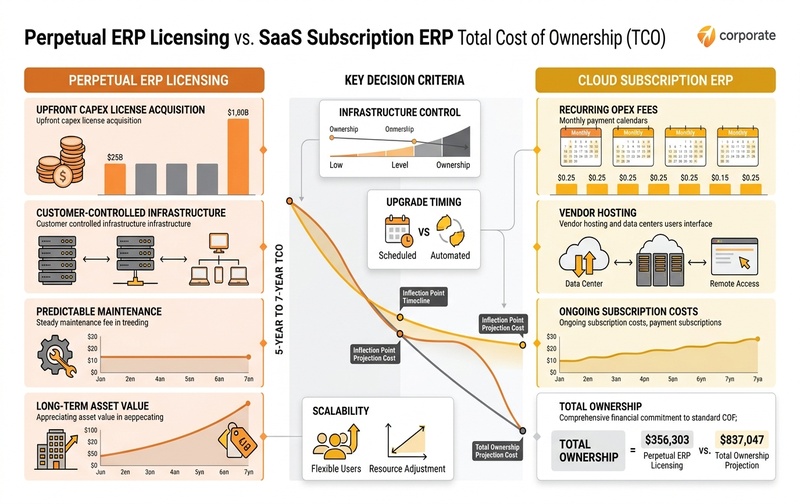
Enterprise infographic comparing perpetual ERP licensing vs SaaS subscription ERP total cost of ownership across Capex, recurring Opex, infrastructure control, upgrade timing, and multi-year TCO inflection.
Neither model is automatically appropriate for every organization.
A business that expects to use an ERP platform for many years may evaluate the economics of an upfront license differently from a company that prioritizes lower initial expenditure, cloud delivery, and operating flexibility.
ERP Total Cost of Ownership: What Buyers Need to Calculate
ERP total cost of ownership (TCO) is the complete cost of acquiring, implementing, operating, maintaining, upgrading, and eventually replacing or migrating from an ERP system over a defined period.
This is particularly important when comparing perpetual ERP licensing with subscription models.
A useful TCO framework can include:
ERP TCO = Initial License + Implementation + Customization + Integration + Infrastructure + Maintenance + Support + Upgrades + Expansion + Administration + Migration/Replacement Costs
The exact formula should be adapted to the ERP deployment and commercial agreement.
Why the Time Horizon Matters
A one-year comparison can produce a very different result from a five-year or seven-year comparison.
For example, consider two hypothetical ERP proposals:
Option A
Option A: higher upfront license investment with separate maintenance.
Option B
Option B: lower initial cost with an ongoing subscription.
The business should calculate the total expected expenditure over the period it realistically expects to operate the system.
Do not assume that one model will always become cheaper after a specific number of years. The result depends on the actual commercial terms and operating requirements.
Example TCO Evaluation
A CFO can create a simple model containing:
This produces a more realistic comparison than looking only at the initial quotation.
Benefits of Perpetual ERP Licensing
Perpetual ERP licensing can offer several advantages when it matches the organization’s operating model.
Long-Term Usage Rights
The primary attraction is the ability to acquire defined long-term usage rights through an upfront license purchase rather than relying entirely on recurring subscription payments.
For businesses with stable ERP requirements and a long expected system lifecycle, this can be an important commercial consideration.
Greater Control Over Deployment
Depending on the ERP and agreement, perpetual licensing may support deployment models where the organization has greater control over its infrastructure and system environment.
This can matter for businesses with:
internal IT teams
specific infrastructure requirements
integration-heavy environments
data-management policies
controlled upgrade schedules
Predictable License Investment
An upfront license can make the software acquisition component easier to identify during initial investment planning.
However, the business should still budget separately for maintenance, support, infrastructure, upgrades, and other recurring costs.
Suitable for Long ERP Lifecycles
Companies expecting to operate the same ERP platform for many years may find a perpetual licensing model worth evaluating.
The key is to compare the complete lifecycle economics rather than assuming longevity automatically creates savings.
Potential for Deployment Flexibility
Some ERP platforms support different deployment approaches around a perpetual license, including customer-managed infrastructure or partner-managed hosting.
The actual options depend on the ERP vendor and licensing agreement.
Risks and Hidden Costs of Perpetual Licensing
The upfront purchase can make perpetual licensing attractive, but it can also hide costs that appear later in the ERP lifecycle.
Higher Initial Capital Requirement
The initial software investment can be significant, particularly when multiple users, modules, integrations, and implementation services are involved.
This can affect cash flow and capital allocation.
Infrastructure Responsibility
For self-managed deployments, the company may need to account for:
server infrastructure
database administration
backup
disaster recovery
cybersecurity
monitoring
patching
IT personnel
These responsibilities can change the actual TCO considerably.
Upgrade Costs
A perpetual license does not necessarily mean every future upgrade is free.
The organization should determine:
- which updates are included
- whether maintenance includes upgrades
- what implementation work is required
- whether customizations must be rebuilt
- whether integrations require modification
- whether additional licenses are required
Maintenance and Support
Annual maintenance or support can represent a significant recurring expense.
The contract should clearly define the services included and excluded.
Scalability Costs
As employee count, business locations, transaction volumes, or functional requirements increase, additional licenses, modules, infrastructure, or implementation services may be required.
A licensing model that works for a 50-user organization may need a different financial assessment at 200 or 500 users.
When Perpetual ERP Licensing Fits a Business
Perpetual ERP licensing may be worth evaluating when a business has a long expected ERP lifecycle and wants to make a substantial upfront software investment.
It can be particularly relevant when the organization:
expects long-term use of the same ERP platform
has an established internal IT function
requires controlled infrastructure
needs substantial ERP customization
wants to evaluate long-term licensing economics
prefers a larger initial investment over indefinite software subscription payments
has predictable user requirements
has clear plans for maintenance and upgrades
However, these factors do not automatically make perpetual licensing the right choice.
A business should also consider subscription or cloud models when:
minimizing upfront expenditure is important
internal infrastructure resources are limited
rapid deployment is a priority
the organization wants managed infrastructure
user requirements change frequently
operating expenditure is preferred over a large upfront investment
The decision should be based on the organization’s financial, operational, technical, and growth requirements.
Perpetual Licensing for SAP Business One and Mid-Market ERP
Perpetual ERP licensing is particularly relevant to organizations evaluating established mid-market ERP platforms such as SAP Business One.
For a company considering SAP Business One or another enterprise ERP platform, licensing should not be evaluated separately from implementation.
The commercial assessment should consider:
required users
user types
modules
financial management requirements
purchasing and sales processes
inventory
production
warehouse management
business intelligence
integrations
industry-specific requirements
customization
deployment environment
support and maintenance
For manufacturing companies, for example, the ERP business case may include production planning, inventory control, purchasing, costing, quality processes, warehouse operations, and financial reporting.
For distributors, the focus may shift toward inventory, purchasing, sales, warehouse management, customer management, and financial control.
The licensing decision should therefore start with the business process requirements and then translate those requirements into the appropriate commercial model.
How CFOs, CIOs and ERP Decision-Makers Should Evaluate Licensing
ERP licensing decisions should involve both finance and technology stakeholders.
A practical evaluation can be divided into six areas.
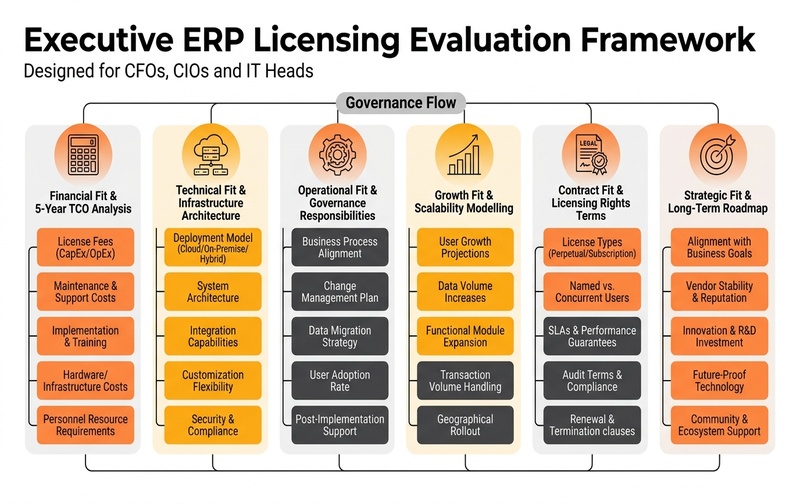
Executive decision framework infographic detailing six ERP licensing evaluation pillars: financial fit and 5-year TCO, technical architecture, operational governance, growth scalability, contract terms, and strategic alignment.
1. Financial Fit
Ask:
- What is the initial investment?
- What are the recurring costs?
- What is the five-year TCO?
- What costs are excluded from the quotation?
- How does user growth affect expenditure?
2. Technical Fit
Evaluate:
- deployment architecture
- database requirements
- integration capability
- security
- backup
- disaster recovery
- scalability
- infrastructure requirements
3. Operational Fit
Determine:
- implementation complexity
- internal IT responsibilities
- support model
- upgrade requirements
- training requirements
- partner availability
4. Growth Fit
Model scenarios for:
- additional users
- new branches
- new legal entities
- increased transaction volume
- new modules
- additional integrations
- international expansion
5. Contract Fit
Review:
- license rights
- user definitions
- maintenance terms
- support terms
- upgrade rights
- renewal conditions
- transfer restrictions
- termination provisions
- additional license pricing
6. Strategic Fit
Finally, consider whether the ERP licensing model supports the company’s broader technology strategy.
The right question is not simply:
“Which license costs less?”
It is:
“Which licensing and deployment model provides the required business capability at an acceptable total cost and level of operational responsibility?”
Perpetual ERP Licensing: A Practical Decision Framework
For management teams comparing perpetual and subscription ERP models, a simple decision matrix can help.
This approach helps management compare licensing models using measurable business criteria rather than assumptions.
Perpetual ERP Licensing vs Subscription: What Should Businesses Choose?
There is no universal answer.
Perpetual ERP licensing can be relevant for organizations seeking long-term usage rights and willing to make a larger initial investment while managing ongoing maintenance and operating responsibilities.
Subscription ERP can be relevant for organizations that prioritize recurring expenditure, managed services, cloud delivery, or lower initial software investment.
The correct comparison should include:
license + implementation + infrastructure + maintenance + support + upgrades + users + integrations + administration + lifecycle costs.
A business should not select a licensing model solely because the first-year price looks lower.
The objective should be to select an ERP model that remains financially and operationally sustainable throughout the expected system lifecycle.
Conclusion: Evaluate TCO, Not Just the License Price
Perpetual ERP licensing remains an important option for businesses evaluating long-term ERP investments. Its value comes from the commercial structure and usage rights it provides, but the financial outcome depends on much more than the initial license.
Maintenance, support, infrastructure, upgrades, customization, additional users, integrations, and internal IT responsibilities can all influence the total cost of ownership.
For this reason, businesses should compare perpetual ERP licensing and subscription ERP using the same business assumptions, time horizon, user requirements, deployment model, and lifecycle costs.
For CFOs, CIOs, CTOs, IT Heads, and business owners, the strongest ERP licensing decision is not necessarily the model with the lowest initial price. It is the model that provides the required capabilities, predictable economics, manageable operational responsibilities, and appropriate long-term business fit.
FAQs About Perpetual ERP Licensing
See the Right ERP Licensing Model in Action
See how different ERP licensing and deployment options can fit your business requirements, user structure, implementation scope, integrations, customization needs, and long-term growth plans.
Book an ERP Demo to explore the right ERP approach for your business before making a major investment.