
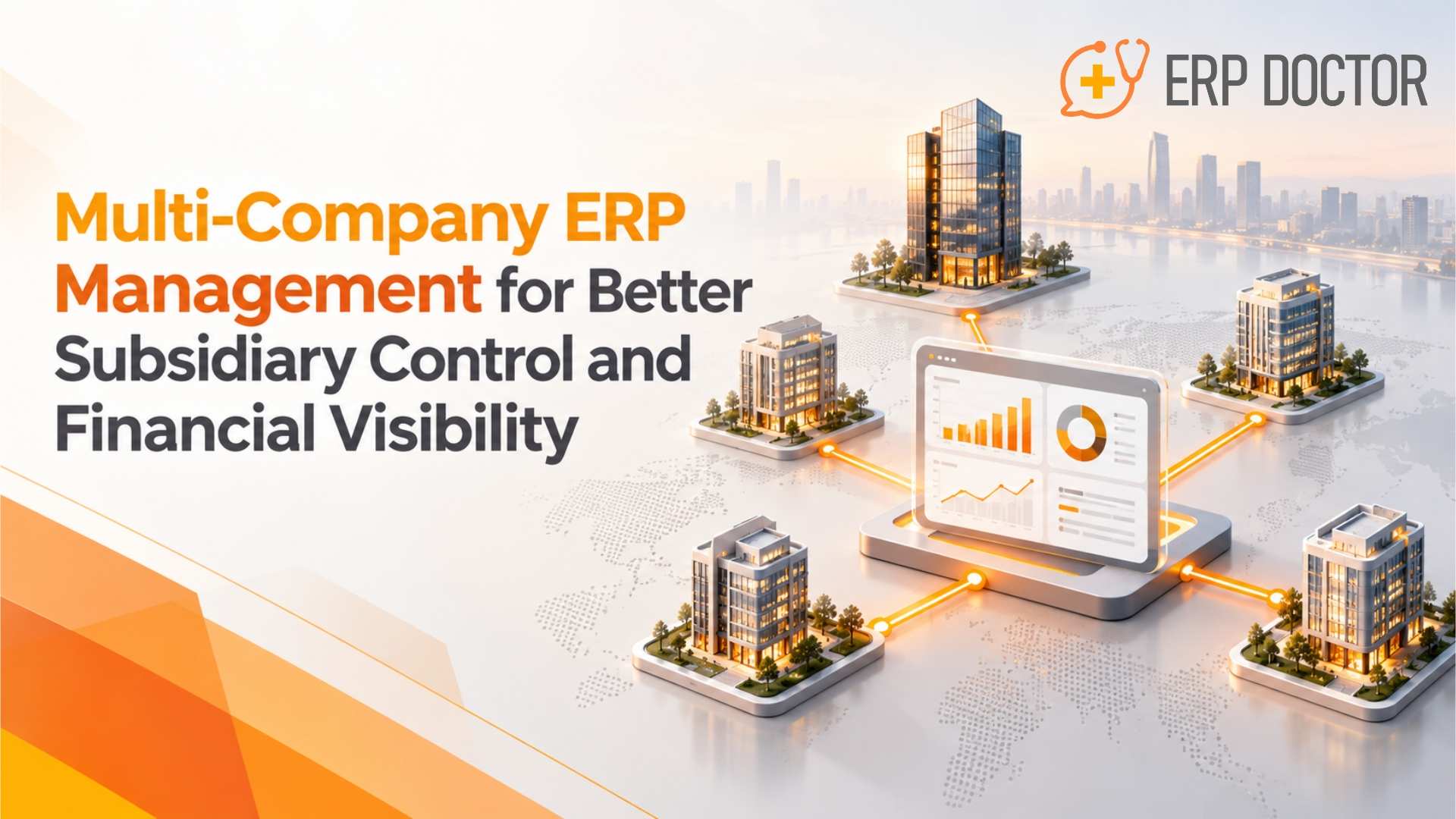
Multi-Company ERP Management for Better Subsidiary Control and Financial Visibility
Quick Answer
Multi-company ERP management helps businesses coordinate financial and operational processes across multiple companies, subsidiaries, and legal entities within a structured system. Depending on the ERP architecture and configuration, it can support entity-level accounting, intercompany transactions, consolidated financial reporting, standardized master data, controlled user access, and group-level visibility. For growing organizations, the objective is to maintain accurate company-level records while giving leadership a reliable view of the entire business group. The right approach depends on the number of entities, ownership structure, currencies, reporting requirements, integrations, and internal controls.
Business Challenges in Managing Multiple Companies and Subsidiaries
Managing multiple companies becomes increasingly complex when each entity maintains separate accounting records, operational processes, reporting formats, and approval procedures. A parent company may need to consolidate financial information from several subsidiaries, while finance teams must still preserve each entity’s individual records and responsibilities.
When these activities rely heavily on spreadsheets, manual reconciliations, and disconnected systems, management can struggle to obtain consistent information at the group level. Finance teams may spend considerable time collecting data, investigating mismatches, and correcting reports before leadership can make decisions.
Common challenges include:
Fragmented financial reporting
Different reporting formats and account structures make company-level results difficult to compare.
Intercompany discrepancies
Transactions between related entities may not match because of timing differences, incorrect references, or inconsistent data.
Limited group-level visibility
Leadership may receive reports at different times, making it difficult to assess performance across the organization.
Duplicate master data
Separate systems can create inconsistent customer, supplier, item, and account records.
Unclear access controls
Users may have access to financial information or transactions outside their responsibilities.
Complex expansion
Adding a new subsidiary can introduce more systems, reporting requirements, and integration work.
These issues are not inevitable consequences of operating multiple companies. They often arise when systems, processes, and governance have not evolved alongside the organizational structure.
A multi-company ERP strategy should therefore address more than software consolidation. It should define how each entity operates, which processes can be standardized, how financial information moves between companies, and how management obtains reliable reporting.
How Multi-Company ERP Management Works
A multi-company ERP environment organizes business information and workflows around the requirements of individual legal entities while supporting appropriate coordination across the wider organization.
The exact capabilities depend on the ERP product, licensing model, deployment architecture, and configuration. Some systems support multiple companies or databases within a coordinated environment. Others require separate instances, additional integration, or dedicated consolidation capabilities.
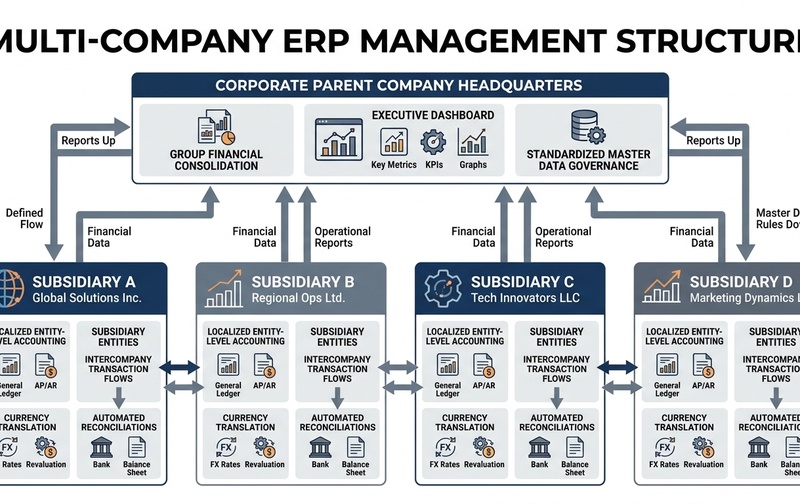
A suitable design typically establishes three operating levels.
1. Entity-level operations
Each company maintains the transactions, financial records, approvals, inventory, and operational information required for its business activities.
2. Shared group standards
The organization defines common policies for areas such as master data, reporting structures, approval workflows, and financial controls where standardization is appropriate.
3. Group-level oversight
Authorized leaders and finance teams access consolidated or aggregated information to evaluate performance, identify exceptions, and support business planning.
This structure helps balance local operational requirements with group-wide consistency. It does not mean every subsidiary must use identical processes. Entities may have different currencies, tax obligations, products, operating models, or statutory reporting requirements.
Before choosing an ERP solution, businesses should confirm whether the required multi-company capabilities are native, configuration-based, integration-dependent, or supported through additional software.
Multi-Company ERP Architecture and Subsidiary Structure
The architecture determines how company records are stored, accessed, processed, and reported. It also affects implementation effort, data governance, system administration, and the cost of future expansion.
A business should evaluate the following architectural considerations before implementation.
Separate company databases or instances
Some organizations maintain separate databases or ERP instances for individual entities. This approach may be appropriate when subsidiaries have different operational requirements, existing system dependencies, or data separation needs.
However, separate environments can increase the work required to synchronize master data, exchange intercompany transactions, maintain integrations, and produce consolidated reports.
Multiple entities within a coordinated ERP environment
Where the selected ERP supports multiple companies within a shared environment, standardized processes and coordinated administration may be easier to implement. The business must still confirm how company boundaries, user permissions, numbering rules, financial periods, and entity-specific configurations are handled.
A shared environment should not be assumed to mean a single database or automatic consolidation. Those capabilities must be verified against the product architecture and licensing terms.
Hybrid ERP architecture
A hybrid approach may combine a central ERP environment with separate systems for particular subsidiaries, specialist applications, or acquired businesses.
This can preserve existing operational requirements while enabling selected information to flow into group reporting. The trade-off is greater integration and governance complexity.
Architecture decision criteria
Before selecting an approach, document:
- The number of current and planned legal entities.
- Required separation of financial and operational records.
- Shared versus entity-specific business processes.
- Currency, tax, and statutory reporting requirements.
- Existing systems and integration dependencies.
- Data access, security, and audit requirements.
- Expected acquisition, expansion, and migration plans.
The preferred architecture is the one that meets the organization’s control and reporting needs without creating unnecessary operational complexity.
Financial Management Across Multiple Legal Entities
Financial management is a central requirement of multi-company ERP implementation. Each legal entity must maintain reliable financial records while the group needs consistent information for performance evaluation and planning.
A well-designed environment should define how chart-of-accounts structures, fiscal periods, financial dimensions, cost centers, approval processes, and reporting rules will operate across entities.
Standardized financial reporting
Where appropriate, a group can establish common account mappings and reporting definitions. This makes it easier to compare revenue, expenses, margins, working capital, and other financial measures across subsidiaries.
Standardization should not eliminate necessary differences in statutory accounts or local reporting. Instead, the organization should document how entity-level accounts map to group reporting categories.
Entity-level financial visibility
Each subsidiary should be able to review its own financial position, subject to the permissions and responsibilities assigned to its users. Parent-company finance teams may require broader access to review group performance and investigate exceptions.
Reports should clearly identify the entity, reporting period, currency, and relevant accounting basis. These details help prevent misleading comparisons between companies.
Multi-currency requirements
Groups operating across countries or currencies should define transaction currency, local reporting currency, group reporting currency, exchange-rate sources, and translation rules.
Currency conversion and foreign-exchange treatment depend on the organization’s accounting policies and applicable standards. The ERP configuration should support those policies rather than assume one conversion rule applies to every situation.
Financial close and reconciliation
A consistent financial close process should establish deadlines, account reconciliation responsibilities, approval requirements, and exception escalation procedures for every entity.
A shared calendar and clearly assigned ownership can help finance teams identify incomplete reconciliations and reporting delays before consolidated results are finalized.
Intercompany Transactions and Reconciliation Controls
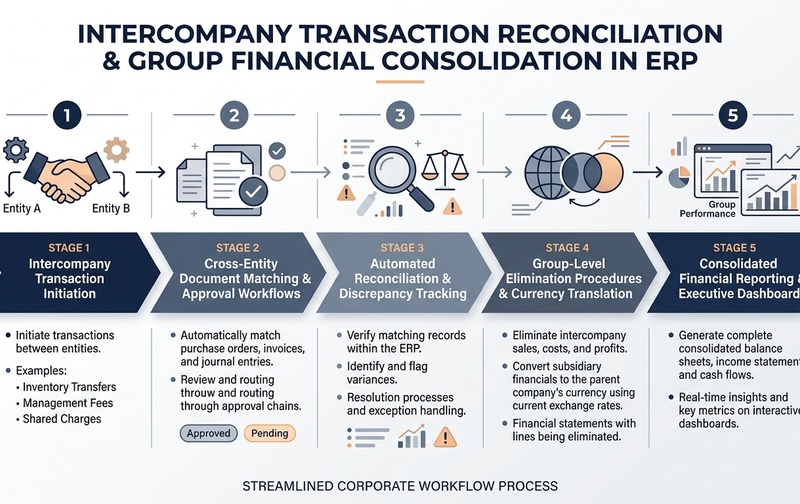
Intercompany transactions occur when related companies exchange goods, services, funds, or other resources. Examples include inventory transfers, management fees, shared-service charges, intercompany loans, and cross-entity expense allocations.
Without defined processes, the two companies involved may record different amounts, use inconsistent transaction references, or recognize transactions in different accounting periods.
A multi-company ERP strategy should establish how these transactions are initiated, approved, recorded, matched, and reconciled.
Standardize intercompany transaction workflows
Define which transaction types are permitted, which entities can transact with one another, and who approves each transaction. Where supported, configured workflows can help generate corresponding entries or documents in the relevant entities.
Businesses should confirm whether this functionality is available natively or requires additional configuration or integration.
Match transactions between entities
Intercompany reconciliation should compare the records of both parties and identify differences in amounts, dates, currencies, quantities, and references.
Exceptions should be assigned to a responsible team member, investigated, corrected, and tracked to closure. Automated matching can reduce repetitive work, but it does not eliminate the need for review and accountability.
Establish group-level elimination procedures
For consolidated financial statements, eligible intercompany balances and transactions may need to be eliminated under the applicable accounting framework.
Recording an intercompany transaction in an ERP system does not automatically guarantee that consolidation eliminations are complete or compliant. The organization must establish the relevant consolidation rules and confirm that its ERP or consolidation solution supports them.
Monitor unresolved exceptions
Useful controls include aging reports for unmatched transactions, reconciliation completion status, approval exceptions, and recurring differences between entities.
These measures help finance leaders identify the causes of discrepancies instead of repeatedly correcting the same issues during each reporting period.
Consolidated Reporting and Group-Level Financial Visibility
Consolidated reporting gives leadership a broader view of the organization by bringing together financial information from multiple entities. It can support analysis of group revenue, profitability, expenses, cash positions, liabilities, and operating performance.
However, consolidated reporting is only reliable when the underlying data, reporting definitions, accounting policies, and consolidation procedures are consistent.
Define the group reporting model
Determine which entities belong in each reporting group and how financial information should be aggregated. Document account mappings, reporting currencies, reporting periods, ownership relationships, and applicable consolidation requirements.
If the organization has multiple levels of subsidiaries, its reporting model should reflect the actual group structure.
Separate operational reports from consolidated statements
Management dashboards and consolidated financial statements serve different purposes. Operational dashboards may combine selected indicators to support decision-making, while formal consolidated statements must follow the organization’s applicable accounting requirements.
The reporting design should make these differences clear and prevent users from treating an operational summary as a finalized statutory or consolidated statement.
Improve reporting consistency
Standard definitions for revenue, cost categories, business units, and performance indicators help leaders compare results across subsidiaries.
Reporting processes should also identify missing data, unusual movements, incomplete close activities, and unresolved intercompany balances.
Give decision-makers appropriate access
Executives may need a group-level view, while subsidiary finance teams may need detailed access to their own records. Permissions should be based on role, responsibility, and legitimate business need.
A consolidated reporting strategy is effective when it provides useful visibility without weakening entity-level accountability or data protection.
Data Governance, User Access, and Audit Controls
Multi-company ERP management requires clear ownership of the information and controls used across the group. A system can centralize information while still producing unreliable results if entities maintain inconsistent records or users follow different procedures.
Establish master data ownership
Identify who can create, update, approve, and deactivate customer, supplier, item, account, and other shared records. Decide which data should be common across the group and which must remain entity-specific.
Where records are shared or synchronized, define matching rules and procedures for resolving duplicates and conflicting values.
Apply role-based access controls
User permissions should reflect job responsibilities and the legal entities a person is authorized to access. Finance, procurement, inventory, and management roles may require different levels of access.
Review sensitive permissions periodically and when employees change roles. Segregation of duties should be considered for activities such as supplier creation, payment approval, journal posting, and master data changes.
Maintain traceability
Audit trails and approval histories can help organizations investigate changes, verify authorization, and understand how transactions were processed. Retention requirements and logging capabilities should be confirmed for the selected system.
Define exception management
Create a documented process for identifying, assigning, escalating, and resolving data and transaction exceptions. Without clear ownership, automated alerts can become another source of unaddressed work.
These governance controls should be designed during implementation rather than treated as optional improvements after the system goes live.
Multi-Company ERP Implementation and Migration Considerations
Implementing ERP across several companies requires coordinated decisions about processes, data, integrations, testing, training, and deployment. A rollout that works for one entity may not automatically meet the needs of every subsidiary.
Assess the current environment
Document each entity’s existing systems, transaction volumes, reporting requirements, customizations, integrations, and operational dependencies. Identify which processes are common and which require justified differences.
This assessment provides the basis for architecture and implementation decisions.
Plan data migration by entity
Create a migration plan for master data, opening balances, outstanding transactions, inventory, and historical records according to the agreed scope.
Data owners should validate mappings and reconcile migrated balances. Migration testing should include representative transactions from each entity, not only a sample from the parent company.
Test cross-company scenarios
Testing should cover normal operations and exceptions. Examples include intercompany purchases, inventory transfers, cross-entity expenses, currency conversion, period-end reconciliation, access restrictions, and consolidated reporting.
Where integrations or automated postings are involved, verify the full transaction flow between systems and entities.
Manage phased deployment carefully
A phased rollout can help reduce implementation risk, but the sequence must account for dependencies between entities. If one subsidiary supplies another, deployment timing may affect inventory, purchasing, invoicing, and reconciliation processes.
Define cutover responsibilities, fallback procedures, support ownership, and go-live acceptance criteria for each entity.
Prepare users and process owners
Finance teams, operational users, and administrators need role-specific training. Users should understand not only which screens to use but also how their transactions affect reporting, controls, and other entities.
A clear ownership model for post-go-live support helps prevent recurring errors from becoming permanent workarounds.
How to Evaluate ERP for a Multi-Company Business
Choosing an ERP solution requires evaluating how well it supports the group’s actual structure and business requirements. A long feature list is not enough; decision-makers should verify capabilities against representative business scenarios.
Use the following criteria during vendor evaluation:
| Evaluation area | What to verify |
|---|---|
| Company structure | How the system supports multiple legal entities and subsidiaries |
| Financial management | Entity-level books, reporting structures, periods, and currency requirements |
| Intercompany processing | Transaction creation, matching, reconciliation, and exception handling |
| Consolidation | Account mapping, currency translation, eliminations, and reporting requirements |
| Data governance | Shared master data, ownership, synchronization, and duplicate management |
| Security | Entity-level access, role permissions, approvals, and audit trails |
| Integrations | Connections to existing finance, banking, tax, operational, and specialist systems |
| Scalability | Effort required to add entities, users, locations, and business processes |
| Implementation | Migration complexity, customization, testing, training, and support |
| Total cost | Licensing, implementation, integrations, infrastructure, support, and future expansion |
Ask vendors to demonstrate realistic workflows using your organization’s scenarios. For example, request a demonstration of an intercompany purchase from initiation through recording, reconciliation, and group reporting.
Also distinguish native functionality from features that require add-ons, third-party software, customization, or manual processes. This distinction is important when estimating implementation timelines, ongoing support requirements, and total cost of ownership.
The final selection should balance operational fit, financial control, implementation risk, scalability, and the organization’s ability to maintain the solution over time.
Frequently Asked Questions
Evaluate ERP Requirements for Your Multi-Company Operations
Managing multiple companies requires more than collecting financial data in one place. Businesses need a clear approach to subsidiary structure, intercompany transactions, data governance, financial reporting, and group-level controls.
ERPDoctor can help your team evaluate the requirements involved in managing multiple entities, identify process and integration considerations, and assess an ERP approach aligned with your operating model.
Request a consultation to evaluate ERP requirements for your multi-company business.