
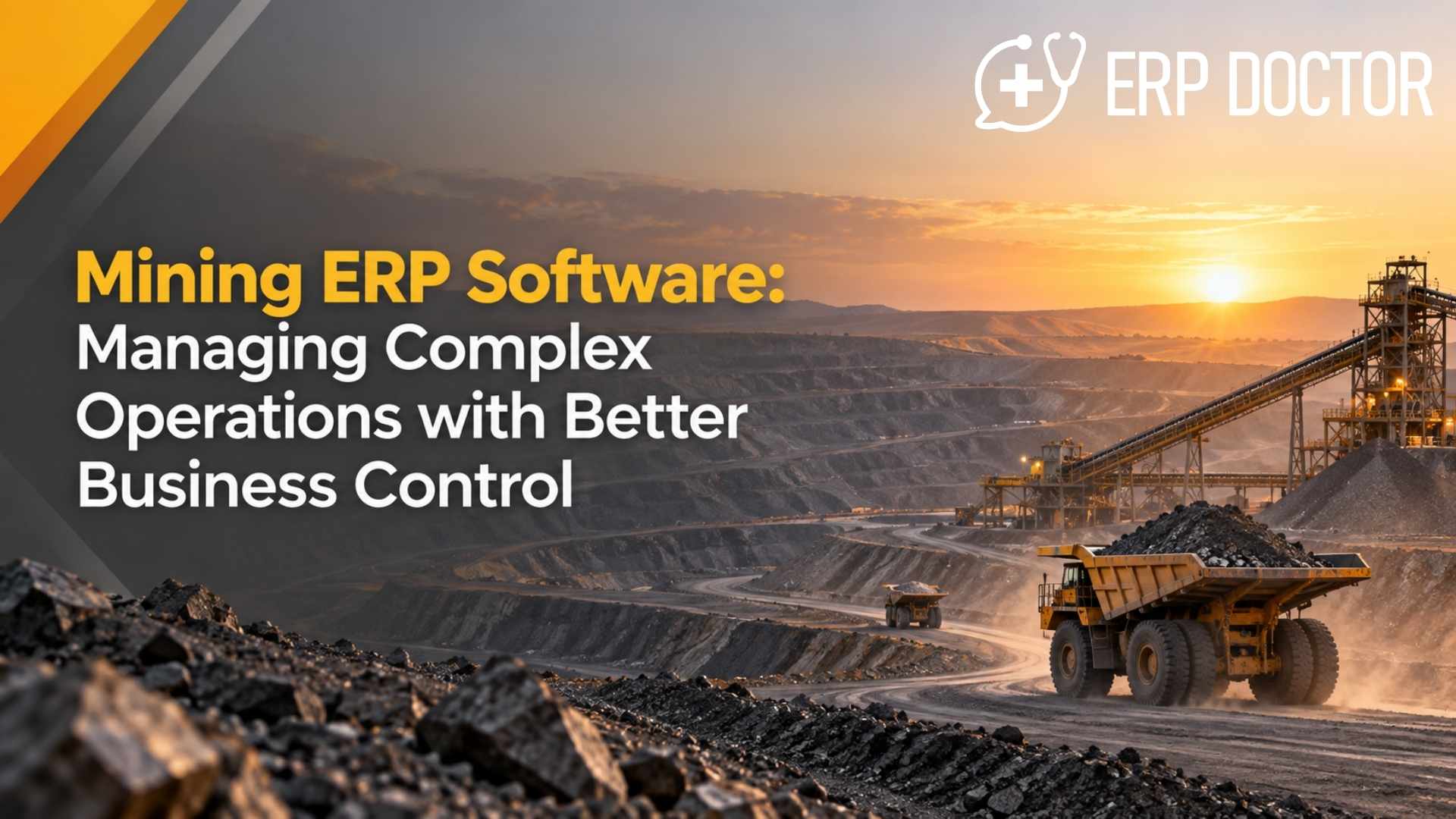
Mining ERP Software: Managing Complex Operations with Better Business Control
Quick Answer: How Does Mining ERP Software Improve Business Control?
Mining ERP Software connects critical mining functions—including production, equipment maintenance, procurement, inventory, contractors, material movement, dispatch, finance and compliance—within a unified business system.
Instead of management relying on spreadsheets, separate applications and delayed site reports, ERP creates a connected operational and financial view.
For mining companies managing multiple sites, high-value assets, large inventories and complex supply chains, this improves visibility over what is happening, what it costs and where management attention is required.
The real value of ERP is therefore not simply process automation.
It is better control over increasingly complex mining operations.
Mining Growth Often Creates a Business Control Problem
Mining businesses rarely operate through one simple process.
Production teams monitor extraction and output. Maintenance teams manage heavy equipment. Stores control spare parts and consumables. Procurement coordinates suppliers. Contractors submit bills against different agreements. Logistics teams manage material movement. Finance needs accurate operational costs. Management needs consolidated information across the entire operation.
As operations expand, these activities become more difficult to coordinate.
A mining company may have strong teams and established processes but still struggle with questions such as:
When answers require several spreadsheets, phone calls, WhatsApp updates or reports from separate systems, management visibility becomes delayed.
That is where the requirement for Mining ERP Software becomes strategic.
What Is Mining ERP Software?
Mining ERP Software is an enterprise management platform designed to connect the operational, financial and administrative processes involved in running mining businesses.
A mining ERP system can bring together areas such as mine production, asset management, maintenance, procurement, MRO inventory, contractor management, logistics, dispatch, costing, finance and compliance.
The objective is not to replace every specialized mining application.
Instead, ERP acts as the business control layer connecting operational activity with financial impact and management reporting.
Connecting Operational Activities to Financial Consequences:
Directly drives mineral inventory levels, stockyard reconciliations, and recovery rates.
Dictates preventive maintenance schedules, component wear, and operating expenditure.
Impacts working capital, MRO stores valuation, and continuous machine availability.
Directly influences project costs, overburden removal expenses, and contract liabilities.
Governs weighment verification, physical inventory drawdown, freight logistics, and revenue billing.
Each activity eventually creates a financial consequence.
An integrated ERP helps management see these relationships through connected data rather than isolated reports.
Why Mining Operations Become Difficult to Control
Complexity itself is not unusual in mining.
The problem begins when operational complexity grows faster than the systems used to control it.
Multiple Mining Sites and Remote Operations
Mine sites may operate far away from corporate offices, warehouses, processing facilities and finance teams.
When each location maintains separate spreadsheets or local systems, information becomes fragmented.
Management may know what happened only after daily, weekly or monthly reports have been consolidated.
A centralized ERP provides a common business system across locations while allowing site-level transactions and responsibilities to remain controlled.
Heavy Dependence on Equipment
Mining businesses depend heavily on excavators, loaders, crushers, trucks, conveyors, drilling equipment and other high-value assets.
Unexpected downtime affects more than maintenance.
It can affect production schedules, contractor utilization, logistics and customer commitments.
Mining ERP Software with asset and maintenance capabilities helps connect equipment history, preventive maintenance, spare consumption and maintenance expenditure with operational reporting.
Large Spare Parts and Consumables Inventories
Mining companies may carry significant inventories of replacement parts, tyres, lubricants, fuel, tools and other consumables.
Without centralized visibility, one location can purchase material that another location already has.
Critical items may also become unavailable because reorder requirements were not identified early enough.
ERP creates greater visibility over stock quantities, consumption, purchase orders, reorder requirements and warehouse movements.
Complex Procurement
Mining procurement can involve equipment, spare parts, contracted services, transportation, consumables and specialized materials.
The problem is not simply creating purchase orders.
Management also needs governance over requisitions, supplier quotations, approvals, receipts, service confirmations and invoices.
A structured ERP workflow helps create a traceable procure-to-pay process.
Contractor-Driven Operations
Contractors may be paid according to hours, equipment utilization, quantity moved, tonnes processed, project milestones or negotiated service rates.
When contractor activity and billing are managed separately, reconciliation becomes difficult.
ERP can connect contracts, service records, approvals, operational quantities and financial settlements.
Limited Cost Visibility
Finance teams may know total expenditure but still struggle to explain exactly where operational cost is increasing.
Mining management usually needs more detailed visibility across:
Equipment Cost
Fuel Cost
Maintenance Cost
Contractor Cost
Site Cost
Material Cost
Logistics Cost
Production Cost
Cost Per Tonne
Mining ERP Software allows operational transactions to be assigned to appropriate cost objects so management can analyze expenditure at a more meaningful level.
From Operational Data to Management Control
One of the biggest differences between basic accounting software and an ERP environment is the connection between operational transactions and business reporting.
Consider equipment maintenance.
A machine breakdown may require spare parts, internal technicians, external services and downtime.
In disconnected systems, each item may appear in a different report.
An integrated mining ERP can connect those transactions to the equipment, maintenance order, cost center and financial account.
Evolution of Management Intelligence:
“How much did maintenance cost?”
“Which equipment is driving maintenance expenditure, how frequently is it failing, and what is the effect on operational performance?”
That transition from transaction recording to business visibility is central to the value of ERP in the mining industry.
7 Core Areas Where Mining ERP Software Improves Control
A mining ERP environment should typically create stronger visibility across these interconnected areas:
1. Production & Material Control
Planned versus actual production, material quantities, stock movements and operational output.
2. Asset & Maintenance Management
Equipment history, breakdowns, preventive maintenance, spare usage and maintenance costs.
3. Inventory & Procurement
Stock visibility, requisitions, approvals, RFQs, purchase orders, receipts and supplier management.
4. Contractor Management
Contracts, service quantities, work confirmations, rates, approvals and billing.
5. Costing & Finance
Operational expenditure, cost centers, production costing, budgets, profitability and financial reporting.
6. Dispatch & Logistics
Material movement, weighment, dispatch documentation, transportation and customer deliveries.
7. Compliance & Reporting
Controlled records, approvals, audit trails, documentation and management reporting.
The greatest value comes when these functions are connected rather than implemented as isolated modules.
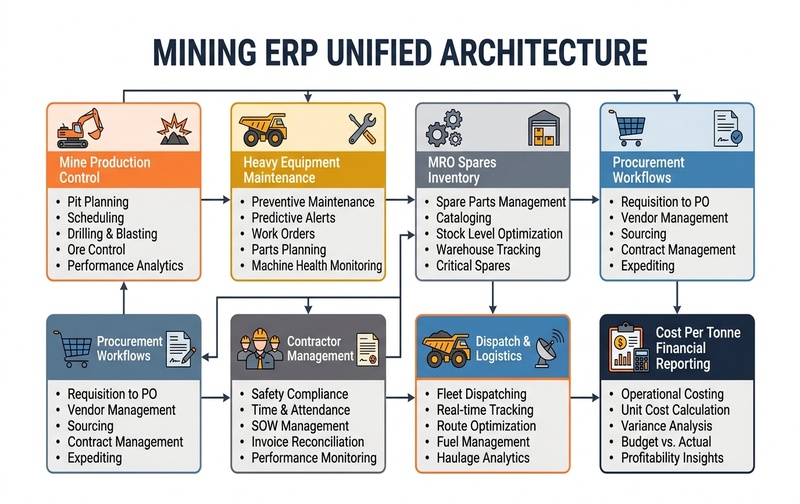
Unified Mining ERP Architecture: Connecting production control, equipment maintenance, MRO inventory, procurement, contractors, logistics, and real-time financial reporting into an integrated business backbone.
Mining Production Control: Plan vs Actual Visibility
Production data is one of the most important inputs to operational decision-making.
However, production figures become much more valuable when they are connected with costs, inventory, equipment and logistics.
Mining ERP Software can help management compare planned activity against actual results by site, shift, material, cost center or other operational dimensions.
Instead of reviewing production separately from financial performance, decision-makers can evaluate questions such as:
- What was produced?
- What resources were consumed?
- Which equipment was used?
- What costs were incurred?
- What material remains available?
- What has already been dispatched?
This gives management a clearer connection between physical production and financial performance.
Equipment Maintenance: Moving from Breakdown Response to Planned Control
Equipment availability can directly influence mining productivity.
Yet maintenance teams often operate through separate maintenance systems, spreadsheets or manual schedules.
ERP-supported maintenance management can create structured equipment masters, service schedules, maintenance orders, spare-part consumption records and cost histories.
Preventive maintenance can be planned according to predefined requirements rather than depending only on breakdown response.
For management, the important benefit is visibility:
Which machines are experiencing repeated problems?
Isolate repeat breakdown patterns to evaluate machine reliability and operator practices.
How much is each asset costing to maintain?
Aggregate labor, parts, and vendor service bills against each individual equipment master.
Which components are being consumed most frequently?
Pinpoint high-wear parts, tyres, and lubricants to negotiate better bulk supplier agreements.
Where are spare shortages likely to create operational risk?
Identify upcoming preventive maintenance cycles against current warehouse availability.
These insights can support better maintenance planning and asset-related decisions.
Mining Inventory: Controlling Spares, Fuel and Consumables
Mining inventory is not simply a warehouse issue.
It directly affects asset uptime, procurement expenditure and working capital.
Holding excessive inventory ties up capital.
Holding insufficient critical inventory can delay maintenance and production.
Mining ERP Software can centralize stock visibility across stores, warehouses and mine locations.
Transactions can track purchasing, goods receipt, transfer, issue, return and consumption.
Management can then evaluate inventory through both operational and financial perspectives.
For example, repeated consumption of a specific component may indicate more than a purchasing requirement.
It may identify an underlying equipment issue.
That is the advantage of connected ERP data.
Procurement Control: From Requisition to Supplier Payment
Unstructured procurement creates multiple risks:
Urgent purchases
Duplicate purchases
Uncontrolled approvals
Limited supplier comparison
Delayed receipts
Invoice mismatches
Mining ERP systems can introduce a controlled procurement workflow beginning with the purchase requirement and continuing through approval, sourcing, purchasing, receiving and invoice processing.
Traceable Procure-to-Pay Workflow:
The purpose is not to add bureaucracy.
It is to create spend visibility, accountability and traceability without depending on manual coordination.
For CFOs and procurement leaders, this creates a stronger basis for analyzing supplier performance, purchasing patterns and cost-saving opportunities.
Cost Per Tonne: Connecting Production with Financial Reality
Production volume alone does not tell management whether mining operations are becoming more efficient.
Cost visibility needs to be connected with output.
The challenge is obtaining reliable inputs.
If fuel, equipment, contractors, maintenance, labour and material costs exist in different systems, calculating operational cost consistently becomes difficult.
ERP can connect financial transactions to relevant sites, equipment, departments or production activities.
This provides a stronger foundation for management analysis.
Instead of waiting for a month-end financial report, decision-makers can work toward more timely visibility into operational cost behavior.
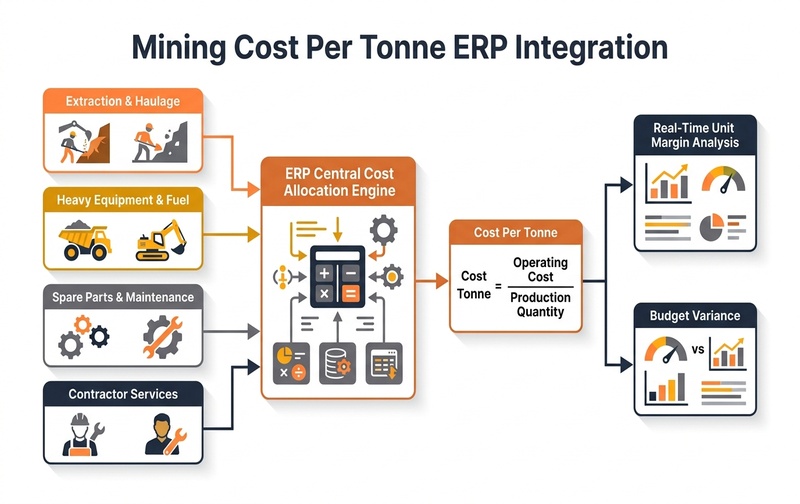
Mining Cost Per Tonne ERP Integration: Operational inputs from extraction, fuel, maintenance, and contractors flow directly into ERP cost centers for real-time unit economics and budget variance tracking.
Contractor Management: Better Control Over External Spend
Mining companies frequently rely on contractors for transportation, equipment operation, excavation, maintenance and specialist services.
The commercial structure can vary significantly:
- Some contractors may charge based on hours.
- Others may charge according to tonnes, trips, equipment utilization or milestones.
If operational records and contractor invoices are disconnected, finance teams may spend considerable time validating claims manually.
ERP can provide a controlled process connecting contract terms, work confirmation, approvals and invoice processing.
This improves financial governance while giving operational teams clearer visibility into contractor performance and expenditure.
Dispatch, Logistics and Material Movement
Producing material is only one part of the mining value chain.
Material must often move between the mine, processing plant, stockyard, weighbridge, transport network and customer.
Errors or delays within this process can create differences between physical quantities, inventory records and financial documents.
Mining ERP Software can connect material availability, dispatch requirements, logistics transactions and billing processes.
Where required, ERP may also integrate with weighbridge, fleet, tracking or specialized operational systems.
The objective should be end-to-end traceability rather than creating another disconnected application.
Finance Should Not Be the Last Team to Know What Happened
In many disconnected environments, finance receives operational information after activities have already occurred.
ERP changes this relationship.
When procurement, inventory, maintenance, production and contractor transactions are captured within connected workflows, finance gains earlier visibility into the financial consequences of operational activity.
This helps CFOs improve:
Budget Monitoring & Variance
Continuous comparison of actual expenditure against site and department budgets.
Cost-Center Analysis
Granular mapping of direct and indirect mining expenses down to specific pits and machines.
Cash-Flow Planning
Accurate forecast of future cash outflows based on approved POs and maintenance schedules.
Vendor Liability Visibility
Immediate tracking of received goods and contractor work confirmations prior to invoice receipt.
Capital Expenditure Control
Real-time tracking of heavy equipment acquisition, major overhauls, and site infrastructure projects.
Site-Level Profitability Analysis
Accurate unit-level gross and net margin calculations per mine site, concession, or mineral grade.
For senior leadership, this means finance becomes more closely connected with operations rather than functioning mainly as a month-end reporting layer.
Real-Time Dashboards Without Reliable ERP Data Are Not Enough
Businesses increasingly want dashboards.
But a dashboard does not automatically create better management information.
If its underlying data comes from inconsistent spreadsheets and disconnected applications, it simply visualizes the same fragmented information more attractively.
ERP improves the foundation.
When departments operate through standardized processes and common master data, dashboards can draw from more consistent business information.
Executives can then monitor operational and financial indicators without repeatedly asking teams to consolidate reports manually.
The Hierarchy of Reliable Business Intelligence:
Not the other way around.
Mining ERP Software vs Disconnected Systems
A disconnected technology environment can still contain excellent individual applications.
The issue is how efficiently information flows between them.
Mining companies may use separate systems for accounting, maintenance, production, inventory, weighbridge operations, HR and reporting.
When these systems are not integrated properly, employees become the integration layer.
They export spreadsheets
Re-enter transactions
Reconcile values
Send reports
Correct inconsistencies
| Operational Dimension | Disconnected Systems & Spreadsheets | Unified Mining ERP Software |
|---|---|---|
| Operational Data Flow | Siloed across departments; manual exports and duplicate data entry. | Unified transactional backbone; automated cross-functional workflows. |
| Cost per Tonne | Delayed month-end estimates calculated via complex manual spreadsheets. | Real-time allocation of fuel, spares, contractors, and production quantities. |
| Equipment Maintenance | Reactive response to breakdowns; maintenance history disconnected from finance. | Preventive maintenance schedules, spare parts reservation, and full lifecycle cost tracking. |
| Inventory Visibility | Site-level stock hoarding, duplicate purchases, and surprise spare part stockouts. | Enterprise-wide multi-warehouse visibility, automated reorder thresholds, and traceable consumption. |
| Contractor Governance | Manual invoice verification prone to billing disputes and unverified work claims. | Contract-tied service entry sheets, milestone approvals, and automated rate verification. |
| Management Reporting | Lagged by days or weeks while teams consolidate conflicting site spreadsheets. | Instant operational and financial dashboards powered by governed single-source-of-truth data. |
ERP reduces this dependency by establishing a common business backbone and integrating specialist applications where necessary.
The goal should not be to force every mining activity into one application.
The goal is to establish one governed business architecture.
What Should Mining Companies Look for in ERP Software?
ERP selection should begin with operational requirements rather than software demonstrations.
The right Mining ERP Software should reflect how the organization actually operates.
A business with one mining site will have different requirements from a diversified company managing several mines, processing facilities and corporate entities.
Executives should evaluate whether the ERP can support production visibility, multi-site operations, asset maintenance, inventory, procurement, contractors, financial management, reporting and required integrations.
Scalability is also important.
An ERP selected only for current requirements can become restrictive as new locations, entities, products or reporting requirements are introduced.
The Strategic Selection Question:
“Which ERP has the most features?”
“Which ERP architecture gives our business the control, integration and scalability required for the next stage of operations?”
Standard ERP vs Mining-Specific Requirements
A common mistake is assuming that an industry ERP must independently perform every mining-specific operational task.
That is rarely necessary.
Core ERP platforms are typically strongest in finance, procurement, inventory, maintenance, projects, costing and enterprise reporting.
Specialized mining applications may remain necessary for technical functions.
The ERP strategy should therefore define:
This architecture-first approach can prevent unnecessary customization and reduce long-term ERP complexity.
Why Excessive ERP Customization Creates Future Problems
Mining operations are complex, so some configuration and industry-specific extensions may be necessary.
But every unique process does not automatically require customization.
Excessive customization can increase implementation effort, testing requirements, upgrade complexity and dependence on specialist support.
Before customizing an ERP, organizations should first ask whether the underlying business process should be standardized.
A strong implementation separates:
Genuine competitive or regulatory requirements from legacy habits that simply developed around older systems.
This distinction can significantly improve long-term ERP maintainability.
A Better Mining ERP Implementation Approach
Successful ERP implementation is not primarily a software installation project.
It is a business transformation initiative.
The process should begin by defining the business outcomes expected from ERP. For example:
Better equipment cost visibility
Improved spare-parts control
Faster procurement approvals
More reliable contractor billing
Stronger site-level costing
Improved production-to-finance visibility
Primary Operational Objective: Substantially Less Spreadsheet Dependency
Once these outcomes are clear, the organization can map current processes, identify system gaps and design the future operating model.
Structured Implementation Lifecycle:
This business-first approach helps prevent ERP projects from becoming technology exercises without measurable operational impact.
Data Quality: The Hidden Mining ERP Challenge
ERP cannot create reliable insights from unreliable master data.
Mining companies may have years of accumulated records involving suppliers, spare parts, assets, equipment codes, warehouses, customers and financial accounts.
Duplicates and inconsistent naming can create problems during migration:
- A spare part might appear under several descriptions.
- The same equipment may have different codes across maintenance and finance.
- Suppliers may appear multiple times across different sites.
Before migration, master data should be reviewed, standardized and assigned clear ownership.
Data governance should continue after go-live.
Otherwise, the new ERP gradually inherits the same problems as the previous environment.
Mining ERP KPIs: What Should Management Measure?
ERP success should be evaluated through business outcomes rather than simply whether the system went live.
Useful performance measures depend on the organization’s priorities but can include:
Production vs Plan
Variance between planned mining yields and actual tons extracted.
Equipment Availability
Overall equipment effectiveness (OEE) and unplanned downtime tracking.
Maintenance Expenditure
Scheduled vs unscheduled maintenance costs per asset category.
Inventory Availability
Critical spares stockout frequency and stores fulfillment cycle time.
Stock Ageing
Identification of obsolete or non-moving consumables and tyres.
Procurement Cycle Time
Elapsed duration from initial site requisition to approved purchase order.
Supplier Performance
On-time, in-full (OTIF) delivery rates and vendor pricing compliance.
Contractor Expenditure
Service billing reconciliation accuracy and contract rate compliance.
Cost Per Tonne
Consolidated operational expenditure normalized across output volumes.
Dispatch Performance
Weighbridge turnaround duration and customer delivery timeliness.
Budget Variance
Monthly site-level operational spending vs budgeted capital allocations.
Reporting Turnaround Time
Days required to close month-end financial and operational reporting.
The most important principle is consistency.
Each KPI should have a clear definition, data source, owner and review process.
ERP then becomes the information foundation supporting management decisions.
When Does a Mining Business Need ERP?
A mining company should consider implementing or upgrading ERP when operational complexity begins reducing management visibility.
Common indicators include:
- Increasing dependence on spreadsheets
- Multiple disconnected applications
- Duplicate data entry across departments
- Slow management reporting
- Inventory inconsistencies between stores and sites
- Poor equipment cost visibility
- Manual procurement approvals
- Difficult contractor reconciliation
- Limited site-level profitability analysis
Another important signal is growth.
Adding another mine, warehouse, processing facility or legal entity to an already fragmented system environment usually increases complexity faster than expected.
Implementing ERP before that complexity becomes unmanageable can create a stronger foundation for expansion.
Cloud ERP or On-Premise ERP for Mining?
There is no universal answer.
Cloud ERP can reduce infrastructure management and make standardized access across locations easier.
On-premise or private environments may remain relevant where organizations require greater infrastructure control, specialized integration architecture or have specific connectivity considerations.
Mining companies operating in remote areas should pay particular attention to network availability and the operational consequences of connectivity limitations.
The decision should therefore consider business continuity, security, integrations, performance, IT resources, deployment strategy and long-term cost—not simply whether cloud or on-premise is more modern.
Building a Business Case for Mining ERP Software
An ERP proposal becomes stronger when it is connected to measurable business problems.
Instead of presenting ERP as a technology upgrade, quantify the operational inefficiencies the organization is trying to address:
These questions help executives connect ERP investment with business outcomes.
Better Business Control Is the Real ERP Outcome
Mining ERP Software should not be evaluated simply by the number of modules implemented.
The real objective is management control.
Executives should be able to understand how production, assets, inventory, procurement, contractors, logistics and finance interact.
Operations Teams
Spend less time manually reconciling spreadsheets and chasing transaction confirmations.
Finance Department
Receives operational data continuously rather than awaiting delayed month-end site summaries.
Procurement Leaders
Gain clear spending visibility, vendor pricing leverage, and streamlined approval controls.
Maintenance Teams
Understand complete equipment history, component failures, and upcoming servicing requirements.
Management should have greater confidence in the information used for decisions.
That is when ERP becomes more than business software.
It becomes the operating backbone connecting mining activity with financial performance.
From Fragmented Mining Operations to One Connected Business System
Mining complexity will not disappear.
Equipment will still require maintenance. Sites will remain geographically distributed. Material will continue moving between operational stages. Contractors will need to be managed. Costs will continue changing. Compliance requirements will still need attention.
The objective of ERP is not to remove these realities.
It is to make them more visible, measurable and controllable.
With the right Mining ERP Software, organizations can connect operational processes with financial information, standardize workflows, improve management visibility and create a stronger technology foundation for future growth.
Planning a Mining ERP Project?
If your mining business is managing production, maintenance, inventory, procurement, contractors and finance through disconnected systems, the first step should not be purchasing ERP software.
Start by identifying where operational complexity is creating control gaps.
A Mining ERP Readiness Assessment can help evaluate your current processes, integration requirements, reporting gaps and ERP priorities before a platform or implementation approach is finalized.
Frequently Asked Questions
Why do mining companies need ERP software?
Mining operations involve complex assets, inventory, sites, contractors and costs. ERP helps connect these processes so management can improve visibility, standardization, financial control and decision-making.
Can mining ERP software manage heavy equipment maintenance?
Yes. ERP platforms with asset-management capabilities can support equipment records, preventive maintenance, maintenance orders, spare consumption, service history and maintenance cost tracking.
Can ERP calculate mining cost per tonne?
ERP can provide the operational and financial data required for cost-per-tonne analysis by connecting production quantities with relevant costs such as maintenance, contractors, fuel, materials and logistics.
Can mining ERP integrate with weighbridge systems?
Yes. Depending on the ERP platform and implementation architecture, ERP can integrate with weighbridge and other specialized mining applications to exchange operational and financial data.
Is cloud ERP suitable for mining companies?
Cloud ERP can be suitable for mining businesses, particularly those requiring centralized access across several locations. Remote-site connectivity, integrations, security and business continuity requirements should be evaluated before deployment.
What should mining companies consider before selecting ERP?
Focus on business processes, mining-specific integrations, asset management, inventory, procurement, costing, multi-site capabilities, scalability, reporting requirements and the ERP partner’s implementation capability.
How long does mining ERP implementation take?
Implementation timelines vary according to company size, number of sites, modules, integrations, data quality, customization and rollout strategy. A detailed process and requirements assessment should be completed before estimating the project.
Turn Mining Complexity into Better Business Control
Book a Mining ERP Demo
See how an integrated ERP environment can connect your mining operations, equipment, inventory, procurement, costing and finance—and identify where better visibility could improve business control.