
Food Safety and Compliance Risks? How ERP Improves Risk Management in the Food & Beverage Industry
Quick Answer
Food and beverage manufacturers face food safety, traceability, quality, inventory, and compliance risks when production, purchasing, warehousing, and financial data are disconnected. ERP software helps centralize operational information, standardize workflows, strengthen batch and expiry tracking, and improve access to quality records. Effective risk management still depends on accurate data, suitable system configuration, employee training, and verified procedures.
Food Safety and Compliance Risks in the Food and Beverage Industry
Food and beverage businesses must maintain control over ingredients, production processes, finished goods, storage conditions, and distribution records. A problem in one stage can affect product quality, customer confidence, delivery commitments, and financial performance.
Managing these risks becomes more difficult when teams rely on spreadsheets, paper records, standalone applications, and manual data entry. Purchasing may hold one version of an ingredient record, warehouse staff may use another, and production teams may record consumption separately. This fragmentation delays the identification of discrepancies and makes it harder to establish a consistent operational picture.
An enterprise resource planning (ERP) system connects key business processes through shared data and configured workflows. For food and beverage manufacturers, the objective is not simply to digitize records. It is to improve the visibility, consistency, and accountability needed to manage operational risks.
Common areas of exposure include:
Food safety
Incomplete inspection records, inconsistent handling procedures, or delayed identification of affected batches.
Traceability
Difficulty connecting ingredient suppliers, production batches, finished products, and customer deliveries.
Quality management
Missed inspections, inconsistent acceptance criteria, and delayed handling of non-conforming materials.
Inventory control
Expired ingredients, inaccurate stock balances, and unsuitable stock rotation.
Compliance documentation
Missing records, inconsistent approvals, and time-consuming evidence collection.
Production planning
Incorrect formulations, material shortages, avoidable waste, and inconsistent production records.
Supplier management
Incomplete supplier documentation, inconsistent quality information, or delayed responses to material issues.
ERP can support controls in these areas, but the outcomes depend on the business processes, system capabilities, integrations, and operating discipline in place.
How ERP Improves Risk Management in Food Manufacturing
ERP improves risk management by connecting information across purchasing, inventory, production, quality, sales, and finance. When relevant records are maintained consistently, authorized employees can investigate discrepancies and make decisions using shared operational data rather than separate departmental reports.
For example, a manufacturer investigating a quality issue may need to identify the ingredient supplier, receipt record, production batch, inspection results, available stock, and customer shipments. An appropriately configured ERP environment can connect these records and reduce the manual effort required to assemble the information.
The main risk-management benefits include:
Centralized operational records
Relevant transaction and master data can be maintained in a shared system, reducing inconsistencies between departments.
Standardized workflows
Configured approval steps, required fields, and transaction rules can help employees follow defined procedures.
Improved exception visibility
Reports and alerts can highlight selected conditions, such as stock approaching expiry, inventory discrepancies, or transactions awaiting approval.
Better accountability
User permissions and transaction histories can help establish who performed or approved particular activities, depending on system configuration.
Faster operational analysis
Managers can review purchasing, production, inventory, and quality information to identify recurring problems and investigate their causes.
These capabilities help businesses move from fragmented recordkeeping toward more consistent operational control. However, ERP does not automatically detect every food safety hazard or guarantee that a product is compliant. Businesses must define the relevant controls and verify that the system supports them correctly.
Batch Traceability and Product Recall Readiness
Batch traceability is a critical requirement for many food and beverage operations. When a supplier reports a potentially affected ingredient or a quality inspection identifies a product concern, the business needs to determine which materials and finished goods may be involved.
Without connected records, staff may have to compare goods-receipt documents, warehouse logs, production sheets, and dispatch records manually. Missing batch references or inconsistent product codes can delay the investigation.
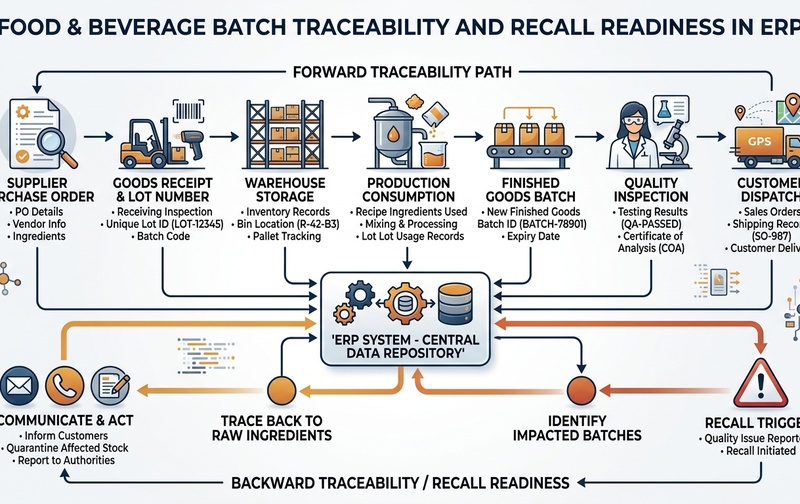
Enterprise infographic illustrating forward and backward batch traceability across purchasing, receipt, warehouse inventory, recipe production, quality release, and customer delivery for recall readiness.
A suitably configured ERP system can help connect:
- Supplier and purchase-order information.
- Goods receipts and ingredient batch numbers.
- Warehouse locations and stock movements.
- Production orders and material consumption.
- Finished-product batch or lot records.
- Quality inspection results and disposition decisions.
- Sales orders, delivery records, and customer information.
These connections can support forward and backward traceability. Backward traceability helps investigate where an ingredient or material originated. Forward traceability helps identify the finished products and deliveries associated with a particular material or batch.
Consider a manufacturer that receives a quality alert concerning an ingredient. If ingredient batch references are recorded consistently and linked to production consumption, the team can investigate which production orders used that ingredient. Connected finished-goods and delivery records can then help identify potentially affected stock and customers.
The actual scope and speed of traceability depend on accurate transaction recording, appropriate lot-control configuration, integration quality, and the completeness of historical data. Businesses should test their traceability process through documented exercises rather than assume that having ERP software alone establishes recall readiness.
Inventory and Expiry Controls for Perishable Products
Perishable ingredients and finished goods introduce risks that affect product quality, stock availability, waste, and profitability. Inaccurate inventory records can cause employees to use unsuitable materials, overlook ageing stock, or purchase additional quantities that are already available.
ERP inventory management can improve visibility into stock quantities, batch identifiers, warehouse locations, and expiry dates when these details are captured and maintained correctly.
Useful controls may include:
Batch-level inventory tracking
Recording stock by lot or batch helps distinguish materials that share a product code but have different histories or expiry dates.
Expiry monitoring
Configured reports or alerts can highlight stock approaching its recorded expiry date, allowing teams to investigate appropriate action.
Stock rotation procedures
First-expiry-first-out (FEFO) processes prioritize stock with the earliest expiry date when operationally appropriate. The system and warehouse procedures must support this method consistently.
Inventory reconciliation
Comparing system balances with physical stock helps identify missing, damaged, incorrectly recorded, or misplaced materials.
Restricted stock handling
Configured status controls can help prevent selected stock from being issued or sold until an authorized decision is recorded.
These controls are particularly relevant to dairy, bakery, frozen food, beverage, and other operations handling materials with defined shelf lives.
ERP data should not replace physical checks or required storage-condition monitoring. Where temperature, humidity, or other environmental conditions are important, businesses may need suitable sensors, warehouse systems, or monitoring applications integrated with ERP. The reliability of the resulting information depends on the connected equipment, interfaces, exception handling, and assigned responsibilities.
Quality Management and Non-Conformance Control
Quality risks can arise during raw-material receipt, production, packaging, storage, and dispatch. If inspection results are recorded inconsistently or corrective actions are not followed through, the same issue may recur across multiple production runs.
ERP can help structure quality-related activities by connecting inspection records to relevant materials, suppliers, production orders, and finished products. Depending on the solution and configuration, businesses may record acceptance criteria, inspection outcomes, deviations, approvals, and stock-disposition decisions.
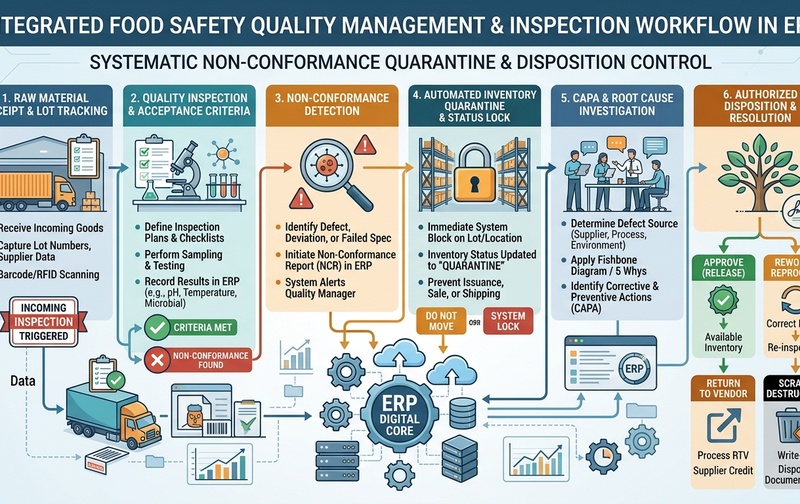
Integrated food safety quality management workflow: Automating receiving inspection, non-conformance detection, inventory quarantine lock, and authorized disposition.
A controlled quality workflow can include:
Connecting these activities to inventory and production records can reduce the risk of quality information remaining isolated from operational decisions.
For example, if an incoming ingredient fails an inspection, the business needs a defined process to determine whether the material can be accepted, returned, reworked, or otherwise handled. ERP can support the documentation and authorized transaction steps, but the disposition decision must follow the company’s approved quality procedures and applicable requirements.
Businesses should also distinguish between basic ERP functionality and specialist quality management capabilities. Advanced sampling plans, laboratory workflows, electronic signatures, or other controls may require dedicated modules, integrations, or additional applications.
Compliance Documentation and Audit Readiness
Food and beverage businesses may need to maintain records related to suppliers, ingredients, production, inspections, sanitation, packaging, distribution, and corrective actions. The applicable requirements vary by jurisdiction, product category, manufacturing activity, and customer obligation.
The difficulty is often not the complete absence of records but the effort required to locate consistent evidence across different departments and systems. Employees may spend significant time reconciling spreadsheets, locating approvals, and confirming which document represents the current version.
ERP can improve documentation practices by linking business transactions to relevant records and applying configured permissions, approval workflows, and change histories. Centralized information can make routine reviews and internal investigations more manageable.
A practical documentation approach should establish:
- Which records must be created and retained.
- Who is responsible for recording and reviewing each item.
- Which approvals are required before a transaction can proceed.
- How changes, corrections, and exceptions are documented.
- How long records must be retained.
- Which users can access, modify, or approve specific information.
- How records are retrieved during an audit or investigation.
ERP should be evaluated against these requirements rather than assumed to satisfy every regulatory obligation automatically. Some records may remain in laboratory systems, document-management platforms, production equipment, or other applications. The business must determine how these records will be connected, retained, and retrieved.
Regulatory requirements should be confirmed against current guidance from the relevant authorities and qualified compliance professionals. System configuration alone is not proof of compliance.
Supplier Risk and Ingredient Quality Management
Supplier-related issues can create operational disruption before ingredients even reach the production line. Inconsistent material specifications, incomplete documentation, delayed deliveries, and recurring quality failures can affect production schedules and finished-product quality.
ERP can bring supplier, purchasing, receipt, inventory, and quality information into a more connected view. This helps purchasing and operations teams investigate supplier performance using recorded transactions rather than relying exclusively on informal communication.
Useful information may include supplier details, purchase history, delivery performance, received quantities, recorded quality issues, and outstanding documentation. Where the process is supported, supplier approval status can also be linked to purchasing controls.
For example, repeated discrepancies between ordered and received quantities may indicate a supplier, process, or data-quality issue that deserves investigation. If quality failures are recorded consistently against receipts and suppliers, managers can review whether corrective action or a supplier reassessment is warranted.
The quality of supplier analysis depends on consistent data entry and agreed performance criteria. Businesses should avoid treating an incomplete ERP report as a definitive supplier score. Relevant evidence may need to be reviewed alongside supplier audits, technical documentation, and other quality-assurance activities.
Production Planning, Formulation, and Waste Reduction
Food and beverage production depends on the availability and suitability of ingredients, packaging materials, equipment, and labor. Inaccurate bills of materials, outdated formulations, incorrect stock balances, or poorly coordinated production plans can cause avoidable interruptions and waste.
ERP can connect demand, inventory availability, purchasing, production orders, and costing information. This gives planners a clearer basis for identifying material shortages, coordinating replenishment, and reviewing planned production against available resources.
Where formulation and recipe management are supported, controlled master data can help establish the required ingredients and quantities for a production run. Version control and approval procedures are important when formulations change, particularly when changes affect specifications, allergens, labelling, or other product characteristics.
ERP can also support the comparison of planned and actual material consumption. Significant variances can prompt investigation into weighing errors, yield differences, spoilage, process losses, or inaccurate records.
However, ERP planning outputs are only as reliable as the underlying data and assumptions. Businesses should validate formulations, units of measure, yield factors, production routing, and inventory balances before relying on the system for operational decisions. Specialist manufacturing execution or recipe-management capabilities may be required for more complex production environments.
ERP Integration and Data Accuracy Across Food Operations
Food safety and compliance information often originates outside the core ERP system. Laboratory applications may hold test results, warehouse systems may manage detailed movements, production equipment may generate process data, and temperature-monitoring devices may capture storage conditions.
If these systems remain disconnected, employees may need to transfer information manually. That creates opportunities for transcription errors, delayed updates, missing references, and conflicting records.
ERP integration can reduce this fragmentation when interfaces are designed around clearly defined business requirements. Common integration areas include warehouse management, laboratory information management, manufacturing execution, barcode scanning, weighing equipment, and environmental monitoring.
A successful integration plan should define which system owns each data field, how records are matched, how often updates occur, and what happens when a transfer fails. It should also include monitoring, exception reporting, access controls, and procedures for correcting failed or incomplete transactions.
For example, a laboratory result may need to be associated with the correct ingredient batch or production order. The integration should validate identifiers and ensure that the result reaches the appropriate workflow. If the data cannot be matched reliably, the exception should be visible to an assigned employee instead of silently disappearing.
Integration does not automatically make data accurate. Master-data standards, testing, reconciliation, and ongoing ownership remain necessary. Businesses should evaluate whether standard ERP functionality is sufficient or whether additional integration development is required.
ERP Customization and Implementation Requirements
Food and beverage manufacturers differ in their products, production methods, packaging processes, quality controls, distribution models, and reporting requirements. A system that supports one business may not cover another company’s workflows without configuration, additional modules, or integration.
Before implementation, decision-makers should document the risks the business needs to control and map them to existing processes. This helps establish whether the required control can be addressed through standard functionality, configuration, an add-on, or a separate connected application.
Key evaluation areas include:
- Batch and lot traceability across receipts, production, and dispatch.
- Expiry-date recording and stock-rotation requirements.
- Quality inspections, non-conformance handling, and approval processes.
- Recipe, formulation, and production-version control.
- Supplier and customer record management.
- Document retention, permissions, and transaction histories.
- Integration with laboratory, warehouse, production, and monitoring systems.
- Operational reporting, exception alerts, and audit evidence retrieval.
Implementation planning should also cover data migration, user acceptance testing, employee training, access permissions, backup and recovery, and post-go-live support.
A structured test plan should use realistic scenarios. These might include identifying products made with a specific ingredient batch, handling stock that fails inspection, investigating an expiry discrepancy, and tracing a finished product to its recorded deliveries. Testing should verify both the expected workflow and the exceptions that could prevent it from working correctly.
The objective is to ensure that the configured system supports the business’s actual control requirements, rather than simply completing a software installation.
Evaluating ERP for Food Safety and Compliance Risk Management
Selecting ERP software should begin with the risks that have the greatest operational, quality, financial, or customer impact. A feature checklist alone may not reveal whether a system can support the complete workflow needed to manage a real incident.
Decision-makers should evaluate potential solutions against practical scenarios and measurable business requirements.
| Evaluation area | What to verify |
|---|---|
| Traceability | Can the business connect ingredient batches to production and recorded deliveries? |
| Inventory and expiry | Can users identify batch-level stock, expiry information, and relevant exceptions? |
| Quality management | Can inspection results, non-conformances, approvals, and disposition decisions be recorded? |
| Compliance records | Can authorized users retrieve the required evidence and transaction history? |
| Production controls | Can the system support approved formulations, production orders, and material-consumption records? |
| Integration | Can relevant external data be matched, transferred, monitored, and reconciled? |
| Reporting | Can managers identify exceptions and investigate their causes? |
| Governance | Are permissions, responsibilities, training, and data ownership clearly defined? |
The evaluation should include the business’s current systems and future requirements. A company with complex laboratory processes may need capabilities beyond a standard ERP configuration, while a smaller manufacturer may prioritize reliable batch tracking, purchasing, inventory, production, and financial visibility.
Total cost should also be considered. Licensing is only one component; implementation, customization, integration, migration, training, infrastructure, support, and ongoing maintenance can affect the overall investment.
The right choice is the system and implementation approach that can support the required controls at an acceptable cost and level of complexity.
Frequently Asked Questions
Evaluate ERP for Food Safety and Compliance
Book an ERP demo with us to assess how ERP can support food traceability, quality control, inventory accuracy, and compliance workflows in your food and beverage operations.