

ERP Software for Heat Treatment Industry: Features, Benefits & Selection Guide
Heat treatment businesses manage far more than furnaces and production schedules. Every customer job can involve material receipt, process specifications, furnace allocation, temperature cycles, inspection, quality documentation, rework, dispatch, billing and customer-specific requirements.
When these activities are managed through spreadsheets, disconnected software or manual records, maintaining visibility across the complete job lifecycle becomes difficult.
ERP software for the heat treatment industry provides a centralized system for connecting production, furnace scheduling, job tracking, quality control, inventory, maintenance, costing, sales and finance. For job heat treaters and thermal-processing companies, the objective is not simply to digitize paperwork. It is to create reliable operational control from job receipt through treatment, certification, dispatch and invoicing.
This guide explains the important ERP features heat treatment companies should evaluate, the business benefits those capabilities can provide, and how decision-makers can select an ERP system that fits their actual operating model.
Quick Answer: What Is ERP Software for the Heat Treatment Industry?
ERP software for the heat treatment industry is a business management system that connects customer jobs, production planning, furnace scheduling, batch and lot traceability, quality records, maintenance, inventory, costing, dispatch and finance within a unified platform.
For a heat treatment company, the right ERP should provide visibility across the complete job lifecycle—from receiving customer material and defining process requirements to furnace processing, inspection, certification, delivery and billing.
The key requirement is therefore not simply having a manufacturing module. The ERP must be capable of representing the way a heat treatment operation actually works.
Why Heat Treatment Companies Need Industry-Specific ERP Control
Heat treatment operations create a combination of production, quality and traceability challenges that conventional business systems may not handle effectively without proper configuration.
A typical customer heat treatment job involves numerous operational parameters that must remain linked throughout the plant:
Customer-Owned Material
Tracking customer-owned components, parts, or lots without treating them as standard inventory assets.
Multi-Part Lots & Recipes
Managing multiple parts or batch lots under specific heat treatment specifications and metallurgic recipes.
Furnace Capability Matching
Aligning process requirements with specific furnace capabilities, working zone dimensions, and atmospheres.
Temperature & Cycle Cycles
Enforcing precise soak times, temperature ramps, quenching cycles, and atmosphere controls.
Inspection & Metallurgical Testing
Recording hardness testing, tensile tests, microstructure analysis, and customer-specific documentation.
Certification & Commercial Terms
Generating process certificates of compliance, meeting dispatch deadlines, and calculating job-specific pricing.
The furnace itself also creates a complex scheduling challenge. Job heat treaters must frequently combine compatible work into furnace loads based on factors such as process requirements, temperature, material compatibility, fixturing, capacity, and delivery priority.
Specialized heat-treatment software currently emphasizes batch-wise jobs, multi-furnace control, process parameters, complete job-to-dispatch traceability and furnace utilization—highlighting how critical these workflows are to the thermal processing industry.
Key Operational Questions Unanswered by Disconnected Systems:
When production planning, quality records and commercial information exist in isolated spreadsheets or paperwork, plant managers struggle to answer fundamental questions:
- Which jobs are waiting? Where are bottlenecks accumulating on the shop floor?
- Which furnace should handle them? Which assets have compatible capacity and temperature capabilities?
- Which customer orders are delayed? Which promised delivery deadlines are at immediate risk?
- Which lots require rework? What is the root cause and status of reprocessed material?
- What did a particular job cost? How much energy, furnace time, consumables, and labor were expended?
- Has the completed job been invoiced? Has delivery generated an immediate commercial billing record?
ERP brings all these critical data points into a single, connected operational framework.
How ERP Software Manages the Heat Treatment Job Lifecycle
A well-designed heat treatment ERP connects the complete process rather than optimizing one department independently. Each stage maintains its relationship with the original customer job card.
End-to-End Heat Treatment Job Lifecycle
➔
➔
➔
➔
➔
➔
➔
➔
➔
➔
➔
➔
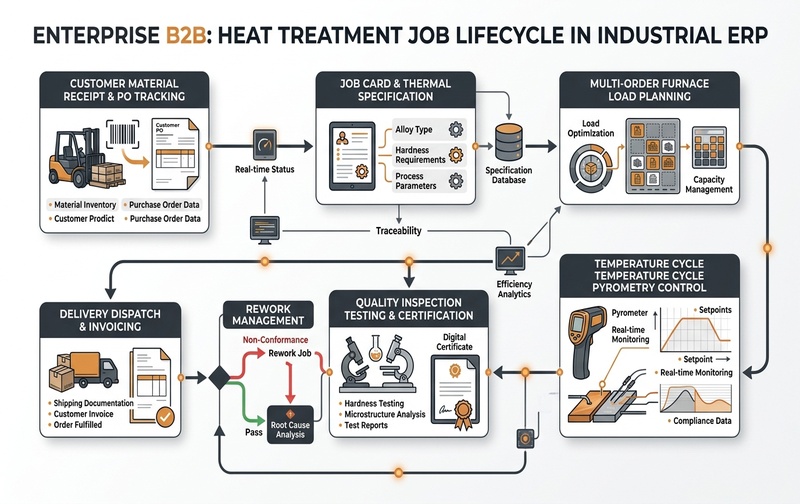
Enterprise infographic illustrating end-to-end heat treatment job lifecycle and batch lot traceability from material receipt and process specification through furnace load planning, pyrometry control, testing, certification, and dispatch.
While the exact workflow varies between companies, every operational stage should retain its data linkage back to the original customer order:
1. Customer Enquiry and Quotation
Sales and engineering teams should capture all technical and commercial requirements at the quotation stage:
- Customer details, account status, and commercial terms
- Part information, part numbers, drawing revisions, and base metal grades
- Quantity, piece weight, total order weight, and packaging specs
- Requested thermal process (e.g., carburizing, hardening, annealing, nitriding, stress relieving)
- Applicable technical specification, hardness range, and case depth targets
- Delivery expectations, expediting requests, and testing/metallurgical certification protocols
Historical pricing, previous identical jobs, and real processing costs can provide immediate operational context when preparing quotations to safeguard profitability.
2. Incoming Material and Job Identification
When components arrive at the receiving dock, the ERP establishes the operational record against which all subsequent plant activities are captured. This includes the customer purchase order, part number, customer lot number, piece count, verified weight, material grade, mill heat or batch reference, process recipe requirements, and committed delivery date. This establishes the unshakeable foundation of batch and lot traceability.
3. Production and Furnace Allocation
Jobs move directly into production planning where planners allocate components to specific furnaces based on thermal cycle recipes, furnace capacity, fixture availability, and delivery commitments.
4. Quality and Testing
Inspection results, pyrometry logs, hardness check values, microstructural micrographs, and deviation reports remain permanently connected with the same job card and batch lot.
5. Dispatch and Billing
After all quality approvals and digital sign-offs are completed, the job moves seamlessly to dispatch, generating certificates of analysis (CoA), packing slips, and automated billing in the commercial finance ledger. The resulting ERP record gives management complete visibility over where each customer job stands in real time.
Heat Treatment Production Planning and Furnace Scheduling with ERP
Production planning is one of the most critical ERP requirements for heat treatment businesses.
Generic manufacturing planning frequently assumes that individual production orders move through machines in a relatively linear sequence. Heat treatment can be fundamentally different because furnaces may process a charge load containing multiple compatible jobs or batch lots from different customers.
A recent industry analysis highlights this distinction: heat-treatment scheduling revolves around furnace charges assembled according to compatible thermal recipes, temperatures, fixturing, quenching methods, and available furnace capacity.
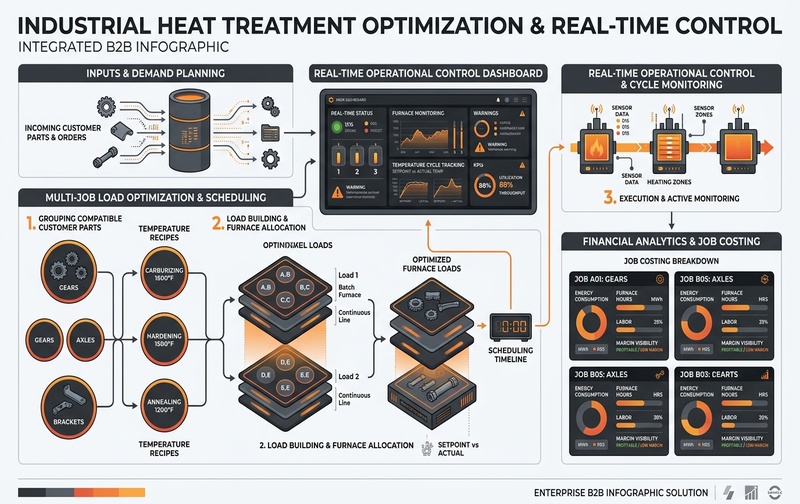
Enterprise diagram showing industrial heat treatment furnace charge assembly, multi-job load optimization by thermal recipe, cycle monitoring, and operational job costing with margin visibility.
ERP configuration therefore needs to account for core technical and operational variables:
Furnace Availability & Type
Managing capacity, dimensions, atmosphere types (vacuum, sealed quench, pit, continuous), and maintenance status.
Thermal Recipe Compatibility
Aligning processing temperatures, soak durations, heating rates, and ramp-down profiles across customer orders.
Material & Quench Chemistry
Grouping compatible steel alloys and ensuring quench media compatibility (oil, polymer, water, inert gas pressure).
Job Priority & Customer Due Dates
Balancing urgent customer turnarounds with maximum furnace load fill rates to eliminate dead space.
Work-In-Progress (WIP) Tracking
Monitoring components staging before pre-heating, post-wash, tempering stages, and non-destructive testing.
Reprocessing & Maintenance Scheduling
Factoring in burnout cycles, planned preventive maintenance, and furnace relining without disrupting delivery queues.
The Strategic Objective of Furnace Planning:
The objective is not simply to produce a rigid schedule. The objective is to create a dynamic scheduling process that helps planners answer: What should be processed next, where should it be processed, and what is delaying completion? Centralized planning visibility reduces avoidable furnace idle time, improves load volume utilization, optimizes energy consumption, and identifies bottlenecks before they cause missed customer deadlines.
Batch, Lot and Customer-Part Traceability Across Heat Treatment Operations
Traceability is one of the strongest reasons for implementing ERP software in heat treatment companies.
A job heat treater receives customer-owned components, processes them according to strict thermal cycles, and returns those exact same components rather than manufacturing finished goods for inventory. The system therefore needs to maintain an unbroken relationship across the entire operational genealogy:
End-to-End Heat Treatment Traceability Chain
➔
➔
➔
➔
➔
➔
➔
➔
➔
Without this connected relationship, employees spend hours searching through paper job sheets, scattered spreadsheets, operator logs, and quality filing cabinets whenever customers audit orders or request test reports.
What Should Heat Treatment ERP Trace?
Depending on operational complexity and industry specifications, an enterprise heat treatment ERP captures:
Customer Part & Drawing Number
Precise identification of customer part numbers, engineering revision levels, and geometry specifications.
Internal Job & Batch Number
Unique tracking IDs linking incoming quantities directly to internal routing and furnace loads.
Customer Heat & Mill Reference
Original steel heat numbers, mill test reports, and raw material chemical compositions.
Weight, Count & Process Route
Exact received piece counts, verified kilograms, and approved operational steps from wash to temper.
Furnace, Charge ID & Operator
Specific equipment ID, charge basket position, shift, date/time stamp, and logged furnace technician.
Inspection, Rework & Dispatch Logs
Hardness test readings, metallurgical micrographs, rework authorizations, and outward delivery notes.
The core principle is traceability continuity: If a job is split into multiple furnace charges, partially completed, rejected during hardness testing, or routed for secondary tempering, the original customer identity remains traceable rather than disappearing into disconnected shop-floor records.
Quality Control and Process Documentation in Heat Treatment ERP
Quality management cannot be separated from production in a thermal processing environment.
A completed furnace cycle does not mean a customer job is ready for dispatch. It may still require surface cleaning, Rockwell or Brinell hardness testing, case depth verification, microstructural examination, metallurgical sign-off, and customer-mandated compliance certification.
ERP provides a structured, gated quality workflow across operational milestones:
- Incoming Verification: Confirming part count, weight, surface condition, and customer test certificates prior to processing.
- Process Parameters Enforcement: Verifying thermal recipe parameters, soak timers, furnace temperature uniformity, and atmosphere setpoints.
- Inspection Checkpoints: Enforcing mandatory hardness testing at defined sample frequencies per lot.
- Acceptance & Nonconformance Logging: Recording test values against specification tolerances; automatically flagging out-of-spec readings.
- Customer-Specific Requirements: Documenting customer testing standards, sample preparation procedures, and reporting formats.
- Certificate Generation & Digital Release: Producing customer-facing Certificates of Conformance (CoC) tied directly to batch data and QA approval.
Regulatory Standards Compliance: AMS2750, Nadcap & CQI-9
Depending on the industries served (aerospace, automotive, defense, medical), heat treatment companies operate within stringent regulatory frameworks such as AMS2750 (pyrometry specification), Nadcap accreditation, and AIAG CQI-9 special process assessments.
Industry software providers specifically address pyrometry calibration, thermocouple replacement lifecycles, System Accuracy Tests (SAT), and Temperature Uniformity Surveys (TUS). ERP should not be treated as an automatic compliance guarantee; rather, the system acts as the operational data governance backbone that supports documentation, calibrations, digital sign-offs, and complete audit readiness.
Managing Rework, Rejections and Nonconformance with Heat Treatment ERP
Rework becomes extremely expensive when businesses can see that it happened but cannot determine why it happened or what it truly cost.
A structured ERP environment ensures that rejected or nonconforming components remain linked to comprehensive operational context rather than being hidden on an isolated spreadsheet:
Root-Cause Rework and Nonconformance Resolution Loop
➔
➔
➔
➔
➔
➔
With connected operational data, decision-makers can systematically analyze and resolve recurring quality issues:
Process Deviation Analysis
Which thermal processes generate the highest volume of rework or secondary tempering?
Asset Concentration Patterns
Are rejections concentrated around specific furnaces, quench tanks, or burner zones?
Shift & Training Consistency
Are certain shifts or machine operators experiencing recurring loading or setup deviations?
Customer Material Quality
Which customer parts or incoming raw material grades create repeated metallurgical deviations?
Capacity Consumption
How much furnace capacity and available production hours are consumed by reprocessing?
Financial Rework Impact
What is the exact financial impact of rework in wasted electricity, natural gas, labor, and delayed orders?
Specialized ERP systems in the heat treatment market emphasize furnace-, shift-, and operator-level rejection analysis, confirming that root-cause quality tracking is a commercially vital ERP requirement.
Heat Treatment Job Costing and Margin Visibility
Production visibility alone does not tell management whether an individual job or customer account is genuinely profitable.
Heat treatment businesses incur significant operating costs across diverse cost drivers that must be accurately allocated to specific jobs rather than averaged across overall plant overhead:
Energy Consumption
Natural gas and electricity consumption tracked per furnace cycle, soak hour, and heating profile.
Furnace & Asset Hours
Depreciation, equipment run-time, and machine hourly rates allocated across combined furnace charges.
Direct & Setup Labour
Loading, fixturing, racking, pyrometry verification, testing, and handling labor hours.
Process Consumables
Atmosphere gases (nitrogen, argon, methanol, ammonia), quench oils, polymer quenchants, and salts.
Maintenance & Subcontracting
Heating element wear, fixture repairs, specialized lab testing, plating, or external surface coating.
Rework & Packaging Scrap
Financial absorption of secondary re-tempering, rust-preventative oiling, packaging, and freight.
Granular Margin Analysis: Quoted Cost vs. Actual Cost vs. Margin
A connected ERP framework links operational cost capture directly with commercial billing data. This allows commercial leaders to systematically evaluate:
Quoted Cost vs. Actual Production Cost vs. Selling Price vs. True Net Margin
This granular visibility immediately identifies customer contracts or part geometries that look attractive on revenue alone, but actually erode profitability once long cycle times, special testing, inefficient load stacking, or repeated rework are fully absorbed. For executive management, this shifts ERP reporting from “How much revenue did we bill this month?” to “Which jobs, alloys, and customer accounts generate healthy margins?”
Equipment Maintenance and Furnace Downtime Management
A single furnace breakdown or heating element failure in a heat treating facility can jeopardize dozens of customer delivery commitments simultaneously.
ERP maintenance capabilities help thermal processing organizations transition from reactive firefighting to systematic asset management:
Equipment Master Records
Centralized tracking of furnace specs, working dimensions, burner types, refractory linings, and control instrumentation.
Preventive Maintenance Schedules
Automated service triggers based on operating hours, thermal cycles completed, or calendar intervals.
Critical Spares Management
Inventory monitoring for heating elements, thermocouples, radiant tubes, retort baskets, and vacuum seals.
Breakdown & Downtime Logging
Tracking Mean Time to Repair (MTTR), Mean Time Between Failures (MTBF), root-cause failure codes, and technician hours.
Inspection & Calibration Surveys
Scheduled logging of pyrometry calibration intervals, SAT (System Accuracy Tests), and TUS uniformity surveys.
Maintenance Cost Accumulation
Direct allocation of spare parts costs, outside contractor services, and repair hours to specific furnace assets.
Connecting maintenance management directly into production scheduling ensures that planners have real-time visibility into when equipment will be taken offline for burnout, relining, or calibration—eliminating scheduling surprises and broken customer promises.
Inventory, Consumables and Customer-Owned Material Control
Inventory management in a heat treatment plant requires rigorous accounting classification: Not everything physically located on the shop floor belongs to the company.
An industry-configured ERP enforces strict classification boundaries across inventory categories:
Customer-Owned Parts (Toll Goods)
Tracked by customer, PO, part number, and weight; segregated completely from company asset valuations.
Company Raw Materials
Alloy stocks, carburizing compounds, fixturing bars, and base metals owned directly by the business.
Process Consumables
Quenching oils, synthetic polymers, inert atmosphere gases, chemical cleaners, and blasting media.
Maintenance Spares
Thermocouples, heating elements, ceramic tubes, seals, fan assemblies, and refractory mortar.
Work-In-Progress (WIP)
Components staged at pre-wash, loading racks, furnace queues, post-wash, or metallurgical inspection bays.
Dispatch & Quarantined Lots
Certified lots staged for shipping and nonconforming material held in physical and digital quarantine.
For job shop treaters, this distinction ensures customer material is never accidentally included on the balance sheet inventory valuation, while consumables and spare parts remain subject to standard reorder points, economic order quantities (EOQ), and consumption tracking. Barcode and QR-code scanning at receiving, charge staging, and dispatch further ensures physical and digital inventory alignment.
Real-Time KPIs for Heat Treatment Management
A useful ERP converts plant-floor transactions into actionable executive insight. Rather than waiting until month-end financial reviews to discover operational losses, plant managers and executives review operational indicators daily:
| KPI | Management Question Answered |
|---|---|
| Furnace Utilization | Are available furnaces being loaded to optimal volume and running effective thermal cycles? |
| Jobs Awaiting Processing | Where is work accumulating across staging queues, pre-heating, or post-wash stations? |
| Delayed Jobs | Which customer delivery commitments are at immediate risk, and what is causing the bottleneck? |
| Turnaround Time (TAT) | How quickly are components moving from dock receipt to final certification and delivery? |
| Rework Rate | How much furnace capacity and energy are consumed repeating thermal cycles or secondary tempering? |
| Rejection Rate | Where are quality losses occurring, and which alloys, recipes, or customers generate scrap? |
| Furnace Downtime | Which thermal assets are causing unplanned outages, and what is the associated lost throughput? |
| On-Time Delivery (OTD) | Are committed customer due dates being achieved across all commercial accounts? |
| Job Profitability | Which customer jobs, thermal processes, and alloys generate healthy net operating margins? |
| Outstanding Receivables | Are completed and delivered heat treatment jobs converting promptly into cash collections? |
The core purpose of ERP analytics is not to produce more static dashboards, but to empower management to identify exceptions early enough to take corrective operational action.
Integrating Heat Treatment ERP with Other Business and Plant Systems
An ERP does not necessarily replace every specialized application already utilized across a modern thermal processing facility. Instead, it serves as the central operational and commercial hub connected with specialized shop-floor systems:
Furnace SCADA & PLC Controls
Interfacing with Honeywell, Eurotherm, or Yokogawa controllers for setpoint downloads and temperature cycle logging.
Pyrometry & Compliance Solutions
Connecting specialized calibration software tracking sensor lifecycles, SAT/TUS survey data, and AMS2750 logs.
Metallurgical Laboratory Systems
Integrating digital hardness testers, spectrometer chemical assays, and case depth imaging directly into job records.
Barcode & Weighing Scales
Capturing verified receiving weights and scanning traveler job cards at charge loading and staging bays.
CRM & Customer Portals
Providing customers with real-time order tracking, estimated delivery dates, and digital certificate downloads.
Financial & Banking Systems
Automating customer invoicing, tax compliance, e-invoicing portals, and electronic payment reconciliations.
Specialist pyrometry systems, for example, manage physical sensors, thermocouple calibration curves, and detailed temperature uniformity survey data. ERP acts as the operational control layer linking these technical records to the customer order, certification, billing, and accounting ledger.
Generic Manufacturing ERP vs Heat-Treatment-Specific ERP
One of the most consequential decisions for leadership is whether to select a dedicated niche heat-treatment software or a proven manufacturing ERP platform configured for thermal processing workflows. Neither approach is universally right for every organization:
| Evaluation Area | Generic Manufacturing ERP | Heat-Treatment-Specific ERP |
|---|---|---|
| Financial Accounting | Usually comprehensive, scalable, and multi-currency | Often basic; may require external accounting bridge |
| Procurement & Purchasing | Extensive supplier management and purchase controls | Basic PO creation; variable procurement depth |
| Standard Inventory Management | Strong multi-warehouse, bin-level, and valuation tools | Focused primarily on shop-floor material tracking |
| CRM & Sales Quoting | Broad pipeline, customer management, and contract pricing | Technical quoting built-in; limited pipeline CRM |
| Furnace & Load Planning | Requires vertical configuration for batch furnace charges | Pre-built around multi-job furnace charge assembly |
| Customer-Owned Part Tracking | Requires process setup to exclude parts from inventory assets | Standard native design for customer material processing |
| Heat Treatment Job Workflows | Configured via custom routing and process checkpoints | Pre-configured for standard thermal processing stages |
| Quality & Certification | Extensive configurable QA modules and audit trails | Pre-formatted hardness and metallurgical test certs |
| Rework & Nonconformance | Highly configurable CAPA and disposition workflows | Pre-defined thermal rework and re-tempering paths |
| Multi-Industry Scalability | High; supports machining, fabrication, or other divisions | Limited; tightly restricted to thermal processing |
| Complex Enterprise Integration | Robust open REST APIs, EDI, and global partner ecosystem | Often proprietary; limited integration capabilities |
A diversified manufacturing group or expanding business typically benefits from the scalability, robust financial governance, and ecosystem of an enterprise platform configured for thermal processes. Conversely, a standalone job shop treater may prioritize out-of-the-box furnace charging templates. The fundamental evaluation question is: Can the selected ERP represent your critical shop-floor processes without forcing users back into offline spreadsheets?
Key Benefits of ERP Software for the Heat Treatment Industry
When appropriately selected and implemented, ERP creates tangible operational value across thermal processing operations:
Better Job Visibility
Production teams and customer service see exactly where each customer job sits in the plant instead of relying on phone calls or shop-floor searches.
Improved Furnace Planning
Planners gain a centralized view of customer demand, load compatibility, furnace capacity, cycle times, and committed due dates.
Stronger Batch Traceability
Customer PO, piece counts, material grade, furnace charge ID, pyrometry logs, inspection records, and dispatch notes remain permanently linked.
Better Quality Visibility
Hardness readings, microstructural test results, rework cycles, and customer rejection trends can be systematically tracked and resolved.
Faster Management Reporting
Executive leaders spend less time consolidating disconnected spreadsheets and more time acting on real-time operational exceptions.
Better Cost Control
Energy, furnace runtime, labor, and rework costs are connected with commercial job cards to reveal true contract-level profitability.
Reduced Manual Dependency
Standardized digital workflows eliminate dependence on the undocumented memories and personal habits of individual technicians.
Stronger Customer Service
Customer service reps provide instant answers regarding order progress, anticipated delivery times, and digital compliance documentation.
How to Select ERP Software for a Heat Treatment Business
ERP selection should begin with operational process requirements—not vendor software demonstrations.
A structured software evaluation framework applies three rigorous tests to every prospective platform:
1. Verify What the ERP Can Actually Handle
Verify whether the system natively or configurably supports: customer-owned components, batch and lot genealogy, furnace/load planning, multiple thermal processes, gated quality checkpoints, rework loops, rejections, job costing, digital certificates of conformance, and multi-plant operations. Never accept a generic “yes”—require the vendor to demonstrate the exact workflow live.
2. Ask How the Process Will Work in Your Business
Pose scenario-based operational questions: How will multiple customer orders be grouped into a single furnace charge? What happens if half a lot fails Rockwell hardness testing? Can rework retain the complete original processing history? Can dispatch see open jobs by promised delivery date? How are customer parts isolated from our inventory balance sheet?
3. Confirm Configuration vs. Custom Development
Establish total clarity between standard core functionality, standard configured functionality, third-party middleware integrations, and custom software development. Documenting these distinctions prior to contract approval avoids unexpected budget expansions, delayed go-live timelines, and costly future upgrade bottlenecks.
ERP Selection Checklist for Heat Treatment Companies
Before committing to an ERP solution, thermal processing executives should evaluate system readiness across seven operational domains:
Production & Planning
- Supports job-based and toll-service manufacturing?
- Provides furnace capacity and volume planning?
- Allows grouping compatible jobs by thermal recipe?
- Tracks real-time WIP across all shop-floor bays?
- Maintains dynamic job scheduling by customer due date?
Batch & Lot Traceability
- Retains customer material identity from receipt to dispatch?
- Supports splitting or merging lots without losing history?
- Enables bidirectional forward and backward traceability?
- Links furnace loads, operators, and pyrometry data to jobs?
Quality & Compliance
- Records hardness, tensile, and microstructural test results?
- Enforces nonconformance isolation and digital holds?
- Retains complete thermal rework and re-tempering history?
- Generates automated customer Certificates of Conformance?
Asset Maintenance
- Automates preventive maintenance based on operating hours?
- Tracks downtime history, MTBF, and MTTR failure codes?
- Manages critical spares (heating elements, thermocouples)?
- Integrates maintenance downtime directly with production planning?
Job Costing & Financials
- Captures energy, furnace run-hours, and labor per job card?
- Compares quoted cost vs. actual processing cost?
- Quantifies the financial cost of rework and scrap?
- Analyzes net margins by customer, alloy, and process type?
Integration & Scalability
- Provides open REST APIs for SCADA and pyrometry systems?
- Supports barcode and QR scanning on rugged mobile devices?
- Scales easily to additional furnaces, lines, and plant locations?
- Accommodates multi-company financial consolidation?
Heat Treatment ERP Implementation: What Should Be Prepared Before Go-Live?
Selecting the right ERP is only the beginning. The quality of implementation preparation determines whether the system becomes the operational source of truth or an administrative burden employees work around.
Prior to commencing configuration, heat treatment businesses should thoroughly document:
Core Master Data
Clean customer records, part master definitions, drawing revision protocols, and base material grades.
Furnace & Asset Masters
Furnace dimensions, temperature operating ranges, atmosphere types, burner configs, and fixturing libraries.
Thermal Process Routes
Approved operational sequences from pre-wash, preheat, soak, quench, post-wash, temper, to final blast.
Quality & Inspection Gates
Required sampling plans, hardness testing methods, case depth test procedures, and certificate layouts.
Commercial Pricing Rules
Pricing structures by weight (per kg), piece pricing, lot minimums, expediting surcharges, and energy indexing.
Roles, Approvals & Integrations
User permissions, digital signature authorities, SCADA data interfaces, and historical data migration scope.
Do Not Model Only the “Perfect” Production Day
A successful ERP blueprint must explicitly design for real-world plant exceptions: urgent customer expedites, partial delivery splits, secondary re-tempering, customer specification amendments, failed hardness inspections, unplanned furnace downtime, and emergency order rerouting. How the ERP accommodates these everyday shop-floor exceptions determines whether plant technicians trust and embrace the system.
When Should a Heat Treatment Company Replace Spreadsheets or Legacy Software?
Spreadsheets and simple accounting software can function adequately when job volumes are low and operational complexity is limited. However, companies reach an operational ceiling where legacy methods fail to provide reliable control.
A thermal processing company should evaluate ERP replacement when experiencing these operational triggers:
- Job status depends on individual memory: Customer service cannot answer where an order is without walking out to the furnace floor.
- Version conflicts across spreadsheets: Production, sales, and quality teams work from competing versions of the schedule.
- Manual, fragmented production planning: Planners spend half their day manually assembling furnace charge spreadsheets.
- Traceability reconstruction takes too long: Customer audits require hours of pulling paper travelers, chart recordings, and lab logs.
- Quality documentation is disconnected: Hardness test readings and furnace charts are filed separately from commercial job cards.
- Rework cannot be systematically analyzed: Reprocessing occurs regularly, but management cannot pinpoint root causes or total cost.
- Reporting requires extensive manual consolidation: Executive KPIs require days of copying and pasting data from disparate systems.
- Delayed customer invoicing: Completed and dispatched customer jobs sit for days before commercial invoices are generated.
- Inconsistent multi-plant or multi-line processes: Different furnaces or satellite plants use conflicting operational methodologies.
- Software bottlenecks inhibit business growth: Legacy systems cannot scale to accommodate higher order volumes or aerospace/automotive standards.
The decision trigger is rarely plant size or headcount alone. The critical question is: Has operational complexity exceeded the level that your existing spreadsheets and legacy software can reliably control?
Building a Business Case for Heat Treatment ERP
An ERP investment should always be justified by measurable operational improvements rather than abstract concepts of digital transformation. Decision-makers should link core operational pain points directly to measurable business outcomes:
| Business Problem | ERP Operational Control | Expected Business Improvement |
|---|---|---|
| Manual furnace scheduling | Centralized planning by recipe, volume, and priority | Higher load utilization and reduced furnace idle time |
| Lost job and lot history | End-to-end customer batch and lot traceability | Rapid audit retrieval and instant customer order status |
| Repeated quality deviations | Integrated rework and nonconformance tracking | Pinpointed root-cause visibility and lower scrap/rework costs |
| Delayed commercial billing | Automated job-dispatch-to-invoice workflows | Faster billing cycles and accelerated cash collection |
| Disconnected spreadsheet reporting | Integrated real-time operational and financial dashboards | Faster executive decisions based on true job margins |
| Unplanned furnace breakdowns | Preventive maintenance and spare-parts scheduling | Minimized unplanned downtime and protected customer delivery dates |
This structured framework provides an unshakeable foundation for evaluating ERP return on investment (ROI) compared to feature checklists alone.
Choosing ERP Software That Fits the Heat Treatment Operation
The most capable ERP for a heat treatment business is not necessarily the system with the longest marketing brochure or generic feature list.
It is the solution capable of creating dependable, repeatable operational control across the processes that define your daily profitability: customer jobs, furnace load optimization, batch and lot traceability, quality inspection, rework control, asset maintenance, actual job costing, dispatch, and finance.
The selection process must always begin with real plant workflows: Map how customer material enters your receiving dock. Understand how furnace loads are planned and prioritized. Document how metallurgical decisions and certifications are released. Identify where traceability breaks down and where job margins leak. Then evaluate whether the proposed ERP creates an integrated operational system around those exact requirements.
For forward-thinking heat treatment organizations, the objective is not simply replacing spreadsheets with another database. It is creating a unified operating platform where production technicians, metallurgists, maintenance teams, customer service, finance, and executive leadership all work from the same reliable operational truth.
Frequently Asked Questions About ERP Software for Heat Treatment Industry
Evaluate Your Heat Treatment ERP Requirements
If your heat treatment business is managing production schedules, traceability, quality records, rework, costing and customer jobs through multiple disconnected systems, an ERP assessment can help identify where better process integration is required.
ERPDoctor can help evaluate your existing workflows, identify ERP requirements and determine which ERP approach fits your operational complexity and growth plans.
Talk to an ERP Expert → Request an ERP Demo