
ERP for Textile Industry: Control Production Inefficiencies, Material Waste and Manufacturing Costs
Quick Answer
ERP for the textile industry helps manufacturers coordinate production planning, yarn and fabric inventory, material consumption, quality control and order costing through connected business processes. By improving operational visibility and transaction accuracy, textile ERP software helps management identify production inefficiencies, control material waste, investigate cost variances and make better manufacturing decisions.
Rather than managing multi-stage spinning, weaving, wet processing, dyeing recipes, and finished fabric dispatch across disconnected spreadsheets and manual logs, an integrated textile ERP provides centralized lot traceability, automated tolerance controls, and real-time variance reporting to protect operating margins.
The Operational Challenges Affecting Textile Manufacturing Performance
Textile manufacturing involves multiple interconnected processes, from raw material procurement and yarn preparation to weaving, dyeing, finishing, inspection and dispatch. Each stage depends on accurate information about material availability, production schedules, process requirements, quality status and order commitments.
When these activities are managed through disconnected applications, spreadsheets or manual records, operational information becomes difficult to coordinate. Production teams may work with outdated schedules, inventory teams may report quantities that differ from actual stock, and finance teams may receive incomplete information about material consumption and production costs.
These problems can affect delivery commitments, working capital and profitability.
For example, a weaving unit may schedule production based on an available yarn quantity that has not been updated after a recent material issue. The production team then discovers that the required material is unavailable or insufficient. This creates a delay while the inventory team checks stock, purchasing reviews replenishment requirements and production revises its schedule.
The immediate problem may appear to be a material shortage. However, the underlying cause could be delayed transaction recording, inaccurate inventory balances or poor coordination between departments.
Common operational challenges include:
- Production schedules that do not reflect actual machine capacity or material availability: Schedulers allocate work without real-time visibility into machine downtime, operator availability, or lot-wise yarn staging.
- Differences between recorded and physical yarn, fabric and accessory inventory: Discrepancies between system ledger balances and actual warehouse cones, rolls, and chemical drums cause stockouts and phantom inventory.
- Excessive material consumption and unexplained production wastage: Unrecorded yarn breaks, loom sizing run-offs, and dye exhaustion variances inflate actual unit costs.
- Delays in tracking work-in-progress across manufacturing stages: Intermediate inventory between spinning, weaving, knitting, and dyeing remains untracked on the factory floor.
- Limited visibility into job-work and outsourced processing activities: Delays, shrinkage, and quality defects at external dye houses and twisting mills remain unmonitored until fabric is delivered.
- Inconsistent quality records and delayed identification of defects: Offline inspection reports result in defective rolls proceeding through expensive finishing before rejection.
- Difficulty calculating order-wise manufacturing costs: Separate accounting logs prevent finance from calculating actual material, labor, and chemical overhead absorption per order.
- Delayed reporting that prevents management from responding quickly: Plant managers only identify cost overruns weeks after finished fabric shipments have completed.
An ERP for textile industry operations connects relevant business information and transactions. This gives management a more consistent view of production performance, inventory movement and manufacturing expenditure.
| Operational Area | Process Gap & Friction | Financial & Operational Impact | Required ERP Control |
|---|---|---|---|
| Raw Material Procurement | Purchasing fiber and yarn based on static spreadsheets without verifying live warehouse stocks or committed production orders. | Working capital trapped in surplus yarn varieties, emergency high-cost spot purchases, and stalled loom beams. | Consolidated material availability MRP, purchase authorization hierarchies, and real-time stock allocation against orders. |
| Production Scheduling & Capacity | Manual scheduling overlooking loom setups, reed changes, spinning frame maintenance, and dye vat capacity. | High machine idle time, frequent order changeover delays, missed customer ship dates, and expedited freight surcharges. | Finite capacity production scheduling, automated machine routing, and real-time WIP milestone updates across departments. |
| Yarn & Fabric Inventory | Unit confusion between kilograms, meters, roll pieces, and cone counts across receiving, processing, and shipping. | Inventory record discrepancies, stock write-downs during audits, ghost stock, and stockout delays during production. | Multi-unit of measure conversions, barcode bin-location tracking, batch-lot tracking, and automated cycle counting. |
| Material Consumption & Loss | Lumping all production losses, selvage trimmings, sizing waste, and chemical run-offs into unmonitored scrap buckets. | Hidden yield depletion, unrecorded yarn waste eroding contract margins, and inability to isolate process root causes. | Standard vs actual material consumption comparisons, segregated scrap accounting, and mandatory tolerance gates. |
| Work-in-Progress (WIP) Tracking | Disconnected tracking between spinning bobbins, grey fabric weaving rolls, and wet finishing batches. | Unexplained lead-time expansion, misplaced semi-finished batches on shop floors, and tied-up working capital. | Stage-wise WIP transaction recording, floor barcode logging, and multi-stage work-order genealogy. |
| Job-Work & Outsourced Processing | Manual dispatch memos for external sizing, twisting, and dyeing with delayed reconciliation of returns and shrinkage. | Material loss at external processors, unresolved shrinkage claims, delayed supplier invoice verification, and late orders. | Job-work order tracking, standard shrinkage tolerance parameters, gate-pass controls, and supplier cost linkage. |
| Quality Control & Rework | Paper-based four-point fabric inspection logs filed after finishing is completed without real-time defect isolation. | Defective fabric shipped to garment exporters, expensive customer debit notes, high rework costs, and rejected lots. | In-line quality checkpoints, automated four-point scoring, quarantine lot holds, and traceable defect root cause analysis. |
| Order Costing & Profitability | Post-mortem cost analysis relying on estimated standard BOM costs rather than actual material, labor, and machine costs. | Inaccurate product pricing, unprofitable export contracts accepted unknowingly, and shrinking operating margins. | Order-wise variance analysis, real-time absorption costing, and direct comparison of planned vs actual expenditure. |
Production Planning Across Multiple Textile Manufacturing Stages
Textile production planning is complicated by the number of processes involved and the dependencies between them. A delay in spinning, weaving, dyeing or finishing can affect subsequent operations and the final delivery schedule.
Planning becomes more difficult when different departments maintain separate production records. The production team may have one schedule, the warehouse may maintain another material availability report, and management may rely on manually consolidated information.
A textile ERP system can help coordinate production requirements with material availability, planned orders, work orders and operational progress.
Aligning production schedules with material availability
Production plans should account for the materials required at each manufacturing stage. Before committing resources to an order, teams need visibility into available stock, expected receipts and outstanding material requirements.
ERP-supported planning can help manufacturers review:
- Raw material availability against production demand.
- Planned production quantities and order priorities.
- Material requirements for different manufacturing stages.
- Pending purchase orders and expected receipts.
- Production progress against planned schedules.
This reduces the risk of releasing production orders without sufficient material information.
Coordinating spinning, weaving and processing activities
Textile manufacturers may operate several production stages within one facility or across multiple locations. Information must move between these stages without creating unnecessary delays.
For example, weaving requirements depend on yarn specifications and availability. Dyeing and finishing requirements depend on fabric quantities, processing instructions and customer specifications.
When production transactions are recorded consistently, teams can identify which orders are awaiting material, which are currently being processed and which are ready for the next operation.
Improving production schedule visibility
Management needs more than a list of planned orders. It needs to understand whether actual production is progressing according to schedule.
An integrated ERP environment can support comparisons between planned and actual production quantities, pending operations and order completion status. These insights help managers identify bottlenecks earlier and review resource allocation.
ERP software does not automatically eliminate machine downtime or production constraints. Its value comes from providing more reliable operational information for planning, coordination and corrective action.
Yarn and Fabric Inventory Discrepancies That Increase Operating Costs
Inventory accuracy is essential for controlling textile manufacturing costs. Yarn, grey fabric, processed fabric, dyes, chemicals, accessories and packing materials must be tracked according to their relevant units, specifications and storage locations.
Manual records can create discrepancies when material receipts, issues, transfers, returns and consumption are not updated promptly.
These differences affect more than stock reporting. They can interrupt production, create unnecessary purchases, increase working capital requirements and make material wastage difficult to identify.

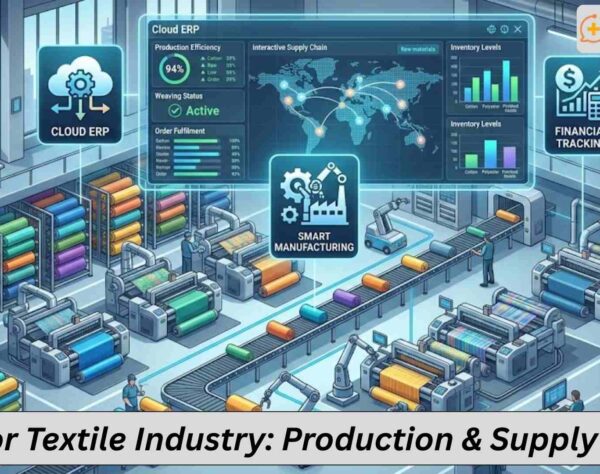
Textile manufacturing ERP workflow diagram illustrating yarn batch traceability, grey fabric tracking, dyeing recipes, and quality inspections.
Managing different textile inventory units
Textile businesses frequently work with different measurement units, including kilograms, metres, rolls, pieces and other product-specific units. Inventory management must account for the units used during purchasing, storage, production and sales.
For example, yarn may be purchased and stored by weight, while production requirements may be calculated using a different operational measure. If unit conversions are not configured and controlled correctly, inventory records can become inconsistent.
An ERP system should support the units of measure, conversion rules and transaction controls required by the manufacturer’s actual processes. These rules must be configured and tested rather than assumed to work automatically for every textile operation.
Improving material movement traceability
Manufacturers need to know where material is stored, when it was received, which order consumed it and whether any quantity remains available.
ERP-supported inventory transactions can improve visibility into:
- Purchase receipts and supplier deliveries.
- Material transfers between warehouses and production locations.
- Issues to production and recorded consumption.
- Returns from manufacturing.
- Finished and semi-finished goods movements.
- Stock adjustments and physical inventory differences.
Consistent transaction recording makes it easier to investigate discrepancies and identify where inventory information became inaccurate.
Reducing excess stock and avoidable purchasing
Inaccurate inventory information can lead to unnecessary purchasing or excessive safety stock. At the same time, insufficient stock can interrupt production and delay customer orders.
By connecting inventory balances with purchasing and production requirements, textile ERP software helps decision-makers evaluate replenishment needs more accurately.
The objective is not simply to reduce inventory. It is to maintain the right materials in the required quantities and at the right time without tying up excessive working capital.
Material Waste and Consumption Variances Across Production
Material waste directly affects manufacturing profitability. However, identifying its causes requires more than recording the total quantity of rejected or unused material.
Textile production may involve losses during cutting, weaving, dyeing, finishing, handling and other process-specific activities. Consumption can also vary because of material quality, machine settings, production specifications and process conditions.
Without consistent production and inventory records, management may struggle to distinguish expected process loss from avoidable wastage.
Comparing planned and actual material consumption
Manufacturers should define expected material requirements for each relevant product, production order or process. Actual material issues and consumption can then be compared with the planned quantities.
For illustration, suppose a production order requires 1,000 kg of yarn according to its approved material plan. Actual recorded consumption is 1,080 kg. The additional 80 kg represents a variance that requires investigation.
It should not automatically be classified as avoidable waste. Management must examine production output, accepted process loss, rejected material, returns, recording accuracy and other relevant factors.
An ERP system can help connect material issues, production output and inventory transactions so that these differences can be investigated using a consistent record.
Material Consumption Variance & Yield Calculation:
Material Variance (%) = [(Actual Material Consumed − Standard Planned Material) ÷ Standard Planned Material] × 100
Production Process Yield (%) = (Accepted Finished Output ÷ Total Material Input) × 100
Identifying recurring wastage patterns
A single production variance may not reveal a systemic problem. Management should review consumption trends across products, production lines, shifts, machines and manufacturing stages.
Useful information includes:
- Planned material quantity compared with actual consumption.
- Accepted production output compared with total input.
- Recorded scrap, rejected material and process loss.
- Material returned to inventory.
- Variances by product, batch or production order.
- Repeated deviations against approved consumption standards.
This information helps production and finance teams identify recurring patterns and prioritise corrective action.
Strengthening accountability through transaction records
Reliable material control depends on recording who issued, transferred, consumed or adjusted inventory and when the transaction occurred.
Appropriate user permissions, approval procedures and audit trails help reduce unauthorised adjustments and improve accountability. These controls should reflect the manufacturer’s operational requirements and internal policies.
Dyeing, Finishing and Job-Work Coordination
Dyeing and finishing introduce additional process dependencies into textile manufacturing. Processing requirements may vary according to fabric type, colour, treatment, customer specification and quality expectations.
When processing is performed externally, manufacturers must also coordinate material dispatch, job-work quantities, expected completion dates, returns and quality inspection.
Disconnected records can make it difficult to determine whether material is with an external processor, awaiting return, undergoing inspection or available for the next production stage.
An ERP system can support the recording and monitoring of relevant transactions, including:
- Material sent for external processing.
- Job-work orders and associated requirements.
- Processing quantities and expected completion dates.
- Material received back from the processor.
- Rejected quantities and quality discrepancies.
- Outstanding balances and related costs.
For internal dyeing and finishing operations, manufacturers can record process-specific production information and link it to relevant inventory and order transactions.
The exact level of process control depends on the ERP configuration, available functionality and any required integration or custom development.
Improved visibility helps management identify pending processing activities, investigate delays and evaluate the cost implications of outsourced operations.
Quality Control and Production Rework Management
Quality issues can increase manufacturing costs through rejected output, reprocessing, additional material consumption and delayed dispatch.
In textile manufacturing, quality requirements may relate to fabric specifications, colour consistency, dimensions, strength, finishing standards and customer-specific acceptance criteria.
If inspection records are maintained separately from production and inventory information, it can be difficult to understand the operational impact of defects.
An integrated ERP environment can help connect quality-related records with production orders, material batches and finished goods transactions.
Recording inspection results and quality status
Manufacturers should define the inspection stages and acceptance criteria relevant to their products. Quality information may include inspection results, rejected quantities, defect classifications and approval status.
Recording this information against the relevant production or material reference improves traceability.
Tracking rework and rejected material
Rework should be visible as a separate operational activity rather than being hidden within total production output.
Management should understand the quantity requiring reprocessing, the additional material consumed, the reason for the defect and the resulting cost impact.
This information supports better quality reviews and helps identify recurring production issues.
Connecting quality performance with business decisions
Quality reporting becomes more useful when it can be reviewed alongside production quantities, customer orders and manufacturing costs.
Decision-makers can evaluate rejection rates, rework frequency, recurring defects and the effect of quality problems on delivery commitments.
An ERP platform provides the transaction and reporting foundation, while effective quality management still depends on clear inspection procedures and accurate data entry.
Manufacturing Cost Variances and Profitability Visibility
Textile manufacturers must understand the actual cost of producing each order, product or batch. However, calculating manufacturing costs becomes difficult when material consumption, production activity, processing charges and other expenses are recorded separately.
A product may appear profitable based on its estimated cost, but actual expenditure may increase because of material wastage, additional processing, rework, purchasing price changes or production inefficiencies.
Without consistent cost information, management may identify the financial impact only after the production cycle is completed.

Comprehensive enterprise workflow showing planned vs actual material consumption, scrap recording, order-wise costing, and margin analysis in textile ERP.
Understanding the components of manufacturing cost
Depending on the manufacturer’s costing method, relevant cost components may include:
- Raw materials and material consumption.
- Direct labour and production-related expenses.
- Machine or production overheads.
- Dyeing, finishing and outsourced processing charges.
- Rework, rejected material and other recorded losses.
- Packaging and other order-related expenses.
The costing model should reflect the company’s production structure and accounting policies. Not every expense should be allocated using the same method.
Comparing planned and actual production costs
Manufacturers should review estimated or planned costs against actual recorded expenditure.
A variance may arise from higher material consumption, changes in input prices, additional processing, lower production output or inaccurate transaction recording.
An ERP system can help bring relevant purchasing, inventory, production and financial transactions into a connected information environment.
This allows finance and production teams to investigate cost differences using shared operational records rather than relying entirely on manually consolidated spreadsheets.
Improving order-wise cost visibility
Order-wise cost analysis helps management understand whether customer orders are meeting expected profitability.
For example, two orders may use similar materials but differ in processing requirements, production quantities, rework levels or delivery conditions. Their actual costs may therefore vary.
Connecting order information with relevant production and financial transactions helps management evaluate these differences before making future pricing and production decisions.
How ERP for Textile Industry Operations Connects Business Processes
The value of an ERP system is not limited to digitising individual departments. Its wider benefit comes from connecting transactions and information across business functions.
When production, inventory, purchasing, sales and finance operate with shared business records, teams can reduce information gaps and improve the consistency of operational reporting.
A textile ERP implementation should evaluate how the system supports the manufacturer’s actual workflows.
| Business Area | Information and Control Requirements | Business Value |
|---|---|---|
| Purchasing | Supplier orders, receipts, purchase costs and pending deliveries | Better purchasing coordination |
| Inventory | Yarn, fabric, chemicals, accessories, locations and stock movements | Improved stock visibility |
| Production | Work orders, planned quantities, material issues and output | Better production coordination |
| Job work | Material dispatch, external processing and returns | Improved process tracking |
| Quality | Inspection results, rejection and rework records | Better quality visibility |
| Sales | Customer orders, delivery commitments and order status | Improved order coordination |
| Finance | Material costs, expenses, transactions and financial reporting | Better cost visibility |
| Management reporting | Production, inventory and financial indicators | More informed decisions |
The implementation must define which processes can be handled through standard ERP functionality, which require configuration and which may need integration or custom development.
Essential Capabilities to Evaluate in Textile ERP Software
Not every ERP solution is designed to handle the operational requirements of every textile business. A manufacturer should evaluate software based on its production model, process complexity, inventory structure and reporting requirements.
Important evaluation areas include:
- 1. Textile-specific inventory management: The system should support the materials, product attributes, storage locations and measurement units used by the business. Evaluate how it handles yarn, grey fabric, processed fabric, dyes, chemicals and finished goods.
- 2. Production planning and monitoring: Assess whether the solution can represent the company’s production stages, planned orders, material requirements and actual production transactions.
- 3. Material consumption control: Review how planned and actual material quantities can be compared, how returns are recorded and how consumption variances are reported.
- 4. Batch and lot traceability: Determine whether the system can track relevant material batches, receipts, production usage and finished goods according to the manufacturer’s traceability requirements.
- 5. Quality and rework records: Evaluate whether inspection status, rejected quantities, rework and related inventory movements can be recorded and reviewed.
- 6. Job-work and outsourced processing: Check how the system handles material sent to external processors, quantities returned, outstanding balances and processing costs.
- 7. Cost and financial reporting: Assess whether purchasing, inventory, production and financial transactions can support the company’s required costing and management reports.
- 8. Integration and customization: Review integration requirements for barcode systems, weighing equipment, production machinery, e-commerce platforms, payroll or other business applications. Confirm the available integration method and any additional development requirements.
The best textile ERP software is the solution that fits the manufacturer’s operational requirements and can be implemented with appropriate process controls, data structures and reporting.
| Evaluation Area | What to Verify | Why It Matters |
|---|---|---|
| Inventory Units & Conversion | Support for dual UoM (kg, meters, rolls, pieces) and automatic conversion rules | Prevents inventory valuation errors and stockout discrepancies during manufacturing |
| Multi-Stage Production Planning | Capability to model spinning, warping, weaving/knitting, wet dyeing, and finishing | Ensures realistic schedules aligned with actual machine capacities and staged raw material |
| Consumption Variance Tracking | Automated comparison of standard recipe/BOM against actual shop-floor issues | Isolates avoidable yarn, chemical, and dye waste from normal acceptable process loss |
| Batch & Lot Traceability | End-to-end genealogy linking raw fiber lot to finished fabric rolls and customer shipments | Enables instant root-cause analysis during customer quality claims or shade variations |
| Job-Work Reconciliations | Dedicated tracking for subcontracted sizing, twisting, dyeing, and shrinkage accounting | Eliminates material leakage at external processors and validates vendor invoices accurately |
| Quality & Rework Control | Configurable inspection checkpoints, defect classifications, and dedicated rework orders | Prevents defective fabric dispatch and accurately captures secondary reprocessing costs |
| Order-Wise Costing & Margin | Real-time roll-up of material, direct labor, machine overhead, and outsourced charges | Reveals actual contract profit margins before order delivery and prevents underpricing |
| Hardware & Machinery Integration | APIs and connectors for barcode/RFID scanners, weighing scales, and loom monitoring | Eliminates delayed manual data entry and provides trustworthy shop-floor transaction logs |
ERP Implementation Considerations for Textile Manufacturers
Selecting software is only one part of an ERP project. Implementation quality determines whether the system reflects actual business operations and provides reliable information.
A manufacturer should evaluate its current processes before configuring the ERP environment.
Map existing production and inventory workflows
Document how materials move from purchasing and receipt through storage, production, processing, inspection and dispatch.
Identify manual records, duplicated data entry, approval gaps and points where departments use different information.
Standardise master data
Product codes, material specifications, units of measure, warehouse details, production resources, supplier information and customer records should be reviewed before migration.
Inconsistent master data can affect inventory accuracy, production transactions and reporting.
Define production and costing requirements
The implementation team should understand the company’s production stages, work-order structure, material consumption rules, job-work processes and costing method.
These requirements should be mapped to standard ERP capabilities before deciding that customization is necessary.
Plan integrations and extensions
Manufacturers may require barcode scanning, weighing scale integration, production data capture or other extensions.
Each integration should have a defined business purpose, data flow, validation process and ownership model.
Test with realistic manufacturing scenarios
Testing should cover normal transactions as well as exceptions, including partial receipts, material returns, production variances, rejected quantities, rework and delayed job-work returns.
This helps identify configuration gaps before the system goes live.
Train users and monitor adoption
Production, inventory, purchasing, finance and management teams need role-based training.
After go-live, management should monitor transaction accuracy, reporting reliability and user adoption. An ERP system cannot provide dependable insights when critical transactions are consistently delayed or omitted.
Manufacturing KPIs Management Should Monitor
An ERP system becomes more valuable when management uses its information to review operational performance regularly.
The most relevant KPIs depend on the manufacturer’s processes, but the following measures provide a practical starting point.
| KPI | What It Measures | Management Purpose |
|---|---|---|
| Production plan adherence | Actual output against planned production | Identify schedule deviations |
| Material consumption variance | Difference between planned and actual consumption | Investigate excess usage |
| Inventory accuracy | Agreement between system records and physical stock | Improve inventory reliability |
| Production cycle time | Time taken to complete a defined production stage or order | Identify process delays |
| Rejection rate | Rejected output against inspected or produced quantity | Monitor quality performance |
| Rework rate | Output requiring additional processing | Identify recurring defects |
| On-time delivery | Orders delivered by the committed date | Review delivery performance |
| Work-in-progress value | Value of goods currently in production | Monitor tied-up resources |
| Order-wise cost variance | Difference between estimated and actual order cost | Evaluate cost control |
KPIs should have clear definitions, consistent data sources and assigned owners. Management should also review trends rather than relying on isolated figures.
For example, a rise in material consumption variance may require a review of production settings, material quality, process loss and transaction accuracy. The KPI identifies an area for investigation; it does not independently establish the cause.
Making the Right ERP Decision for a Textile Manufacturing Business
Textile manufacturers should evaluate ERP investments based on measurable operational requirements rather than software feature lists alone.
A suitable solution should help the business improve coordination between production, inventory, purchasing, quality and finance. It should also provide reliable information for reviewing material consumption, manufacturing costs, production progress and order commitments.
Before selecting a platform, management should establish the business problems that require attention, the processes that need improvement and the reports required to measure results.
The evaluation should also consider implementation scope, data migration, integration requirements, user training, support arrangements and the long-term cost of ownership.
For textile businesses experiencing production delays, material discrepancies, excessive wastage or limited cost visibility, an ERP assessment can help identify the process and system changes required to improve operational control.
Frequently Asked Questions
Improve Textile Manufacturing Control With the Right ERP Solution
Production delays, material discrepancies and unexplained cost variances can affect textile manufacturing performance and profitability. Improving control requires accurate operational data and better coordination between inventory, production, purchasing and finance.
Emerging Alliance helps businesses assess ERP requirements, evaluate SAP Business One capabilities and identify the configuration, integration and customization needed to support manufacturing workflows.
Request an ERP consultation with Emerging Alliance to evaluate your textile manufacturing processes and identify opportunities to improve production visibility, material control and manufacturing cost management.