
ERP for Rubber Manufacturing Industry: Production, Quality & Cost Control Guide
Quick Answer
ERP for the rubber manufacturing industry connects formulation, raw materials, batch production, quality control, inventory, traceability, costing, procurement, sales, and finance within one integrated system.
For rubber manufacturers dealing with variable material costs, complex compounds, production wastage, quality requirements, batch traceability, and margin pressure, manufacturing ERP software can provide better operational visibility and stronger control from raw-material receipt through finished-goods dispatch.
The right ERP should not simply record transactions. It should help management understand what was planned, what actually happened on the shop floor, how much each batch cost, where material losses occurred, and whether every finished product can be traced back to its raw materials.
Rubber Manufacturing Complexity Beyond Standard ERP Requirements
Rubber manufacturing has operational requirements that are significantly different from straightforward trading, distribution, or simple assembly businesses.
Production may involve multiple raw materials, proprietary formulations, mixing processes, curing parameters, moulding or extrusion operations, quality inspections, rework, scrap, and batch-specific costing.
A system that manages only accounting, purchasing, and basic inventory may therefore provide only partial control.
Formula and Compound Complexity
Rubber compounds can involve natural rubber, synthetic rubber, carbon black, oils, chemicals, accelerators, fillers, pigments, and other additives.
Even minor deviations in formulation or mixing can affect:
Product Hardness: Durometer and resilience specifications.
Tensile Properties: Elongation, tear resistance, and tensile strength.
Durability: Wear resistance, weather resistance, and service lifespan.
Appearance: Surface finish, colour consistency, and visual defects.
Cure Performance: Vulcanization rate, scorch time, and rheometer curves.
Customer Specification Compliance: Exact adherence to drawing and engineering parameters.
Final Production Cost: Ingredient variance driving unexpected batch margin shifts.
Manufacturers therefore need controlled formula management rather than informal spreadsheets or employee-dependent knowledge.
Batch-Dependent Production
Rubber production frequently operates through identifiable batches.
Management may need to know:
Which raw-material lots were consumed
Which formulation version was used
Which machine processed the batch
What quantity was produced
What quantity was rejected
Whether rework was included
Which customers received the resulting products
Without batch-level control, investigations can become slow and unreliable.
Raw-Material Price Volatility
Many rubber manufacturers operate with materials whose purchase costs can vary substantially.
If costing is updated slowly or production consumption is inaccurate, management may quote or sell products without understanding the latest manufacturing margin.
Quality Consistency
Quality is not limited to checking the finished product.
Controls may be necessary at incoming material, mixing, processing, final inspection, and dispatch stages.
Disconnected quality records make it difficult to identify trends and determine the source of a failure.
Scrap and Rework
Scrap, rejected output, excess material consumption, and rework directly affect manufacturing profitability.
If these losses are recorded outside the ERP—or not recorded at all—standard product costs can appear healthier than actual margins.
ERP Requirements Across the Rubber Manufacturing Process
An ERP for rubber manufacturing should support the entire operational lifecycle instead of functioning as a finance-only system.
A typical process may look like:
Rubber Manufacturing Operational Lifecycle Flow:
➔
Formulation
➔
Mixing
➔
Production
➔
Quality Inspection
➔
Finished Goods
➔
Dispatch
➔
Financial Costing
Each stage creates information that affects subsequent operations.
For example, a purchasing decision influences material availability. Material availability affects production scheduling. Production consumption affects costing. Quality results affect whether stock can be released. Finished-goods allocation affects customer deliveries.
A well-designed ERP connects these activities rather than requiring teams to reconcile separate spreadsheets and applications.
Manufacturing ERP requirements may differ across businesses producing:
Automotive rubber components
Industrial rubber products
Seals and gaskets
Rubber sheets
Rubber hoses
Moulded components
Extruded products
Engineered rubber products
Customer-specific rubber components
The ERP configuration should therefore reflect actual manufacturing complexity rather than simply the company’s headcount.
Formula, Recipe and Compound Management
Formula management is one of the most important requirements for many rubber manufacturers.
A formulation determines what materials should be consumed and in what proportion. If this information is inaccurate or uncontrolled, both quality and profitability can suffer.
Formula Version Control
Formulations may change because of:
Raw-material substitutions
Customer requirements
Quality improvements
Cost optimization
Regulatory requirements
Supplier changes
The ERP should make it possible to differentiate approved versions and determine which version was used for a specific production batch.
Ingredient Quantities and Tolerances
Manufacturers may need to define expected quantities for each ingredient and compare them with actual shop-floor consumption.
This helps highlight:
- Overconsumption
- Underconsumption
- Incorrect material issues
- Deviations from standard recipes
- Material variance
Alternative Raw Materials
Certain materials may have approved substitutes.
Rather than allowing informal substitutions, businesses should define controlled alternatives with appropriate approvals and costing impact.
Controlled Formula Access
Proprietary formulations can represent important intellectual property.
Access should therefore be controlled according to job responsibilities so that users only see or modify information relevant to their role.
Standard vs. Actual Consumption
One of the biggest benefits of integrating formulas with production is the ability to compare:
Expected Consumption vs. Actual Consumption
The difference can reveal production inefficiency, waste, process deviations, or incorrect master data.
Batch Mixing and Production Control
Once formulations are defined, ERP must connect them to actual production execution.
A production order can specify:
Product
Planned quantity
Formula or BOM
Required raw materials
Machine or work centre
Routing
Planned production date
Labour requirement
Quality requirements
As production progresses, actual information can be captured against that order.
Production Orders
Production orders create a structured link between planning and actual manufacturing.
Rather than issuing materials without a production reference, each consumption transaction can be associated with a specific manufacturing job or batch.
Material Consumption
Actual material issues should be recorded against production so management can identify whether consumption matches expected quantities.
Large deviations may indicate:
- Process losses
- Measurement errors
- Unplanned substitutions
- Incorrect formula quantities
- Scrap
- Operator errors
Output Reporting
Production output should differentiate between:
Accepted quantity
Rejected quantity
Rework quantity
Scrap
Work in progress
This creates a more accurate picture of manufacturing performance.
Planned Production vs. Actual Production
Planned production represents what the organization expected to manufacture using specified resources and materials.
Actual production records what was really consumed, produced, rejected, and completed.
ERP helps management compare these two views and identify variances that would otherwise remain hidden.
Raw Material, Batch and Lot Traceability
Traceability is essential when manufacturers need to investigate quality problems or customer complaints.
A strong ERP environment should support a traceability chain such as:
Full Batch Traceability Chain:
➔
Raw Material
➔
Production Batch
➔
Finished Product
➔
Customer
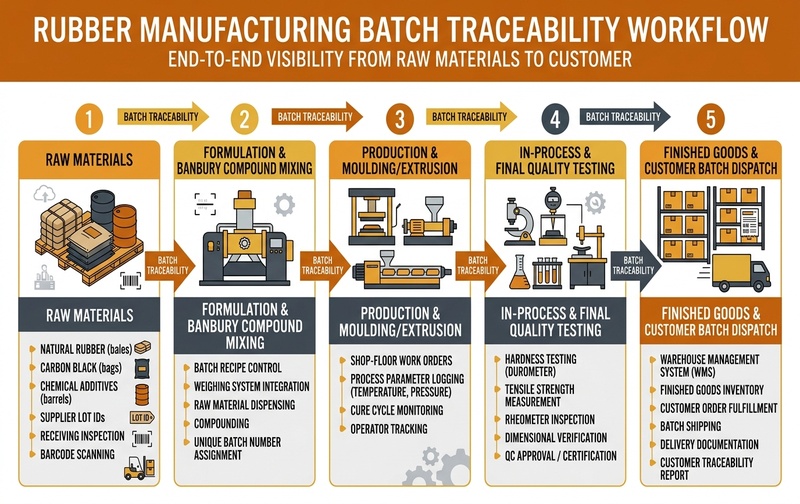
Enterprise infographic detailing rubber manufacturing batch traceability workflow from raw material receiving through Banbury compound mixing, moulding, quality inspection, and customer dispatch.
Backward Traceability
Backward traceability answers:
Which materials were used to manufacture this finished product?
If a customer reports a defect, the business should be able to identify:
- Production batch
- Raw-material batches
- Supplier
- Formula version
- Production date
- Quality results
Forward Traceability
Forward traceability answers:
Where did products manufactured from this material batch go?
This becomes critical when a supplier reports a potential raw-material issue.
Recall Readiness
Instead of searching spreadsheets, production registers, and invoices manually, ERP can provide a structured batch genealogy.
This may significantly reduce the time required to identify affected stock and deliveries.
Customer Complaint Investigation
Linking customer complaints with batch history allows teams to investigate whether issues relate to:
Material quality
Formula deviation
Production conditions
Machine performance
Inspection results
Storage
Delivery
Quality Control Across Rubber Manufacturing
Quality management should be integrated into manufacturing rather than maintained as a separate administrative activity.
Different quality checkpoints may be required throughout the process.
Incoming Material Inspection
Incoming materials can be inspected before release to production.
Relevant checks may include:
- Supplier documentation
- Visual condition
- Material properties
- Batch identification
- Certificate verification
Materials that fail inspection can be placed on hold rather than accidentally released.
In-Process Quality
Quality measurements during manufacturing help identify problems before the entire production batch is completed.
Depending on the product, parameters may include:
Hardness
Dimensions
Specific gravity
Tensile properties
Cure characteristics
Appearance
Thickness
Customer-defined specifications
Final Quality Inspection
Finished goods can be released only after the required quality checks are completed.
This creates stronger control between production completion and dispatch.
Quality Holds and Rejected Batches
ERP workflows should differentiate:
Approved material
Material under inspection
Rejected material
Quarantined material
Rework material
This prevents inventory availability from being overstated.
Inventory, Shelf-Life and Material Control
Rubber manufacturers often manage numerous raw materials with different storage requirements, lead times, batch attributes, and shelf-life conditions.
Inventory may include:
Natural rubber
Synthetic rubber
Carbon black
Oils
Chemicals
Fillers
Accelerators
Additives
Packaging
Work in progress
Finished products
Batch-Wise Inventory
Batch tracking helps management understand exactly what quantities are available from each material lot.
Shelf-Life Tracking
Materials with shelf-life considerations should be monitored so procurement and production teams can prioritize consumption before expiry.
FIFO and FEFO Controls
Depending on business requirements, organizations may use:
- FIFO — First In, First Out
- FEFO — First Expired, First Out
The ERP should support the inventory strategy relevant to the material.
Reorder Planning
Planning should consider:
Current stock
Open purchase orders
Production demand
Safety stock
Lead times
Minimum order quantities
This reduces dependence on manual purchase planning.
Slow-Moving and Obsolete Inventory
ERP reporting can help identify raw materials or finished goods that have remained unused for excessive periods.
This supports better working-capital control.
Scrap, Rework and Regrind Management
Scrap is not simply an operational issue. It is a direct cost.
Rubber manufacturers may need to account for:
- Production scrap
- Rework
- Rejected products
- Recoverable material
- Regrind
- Returned components
- Material reused in subsequent production
Measuring Scrap Cost
Recording only total production output can hide the actual cost of losses.
ERP should help management identify:
Scrap quantity
Scrap value
Product responsible
Production order
Machine
Shift or process
Reason
This makes loss analysis more actionable.
Connecting Wastage to Profitability
Two products with similar selling prices may have very different margins if one consistently generates higher scrap or rework.
Integrated ERP costing helps expose this difference.
Production Planning and Material Requirements
Manufacturing profitability is affected not only by how efficiently production runs but also by how accurately it is planned.
ERP can combine sales demand, stock availability, production requirements, and purchasing information.
Material Requirements Planning
MRP calculates what materials may be required based on factors such as:
Sales orders
Forecasts
Production orders
Existing inventory
Open purchase orders
Lead times
This gives planners a structured basis for procurement.
Avoiding Material Shortages
Without integrated planning, manufacturers may discover shortages only when production is about to begin.
ERP can provide earlier visibility into potential shortages.
Reducing Excessive Stock
Over-purchasing can tie up working capital and increase shelf-life risk.
Production planning should therefore balance availability with inventory efficiency.
Product Costing and Margin Visibility
Costing is particularly challenging when raw-material prices change frequently and actual production consumption differs from standard formulas.
A complete manufacturing cost can include:
Raw Materials + Labour + Machine Cost + Production Overheads + Scrap + Rework
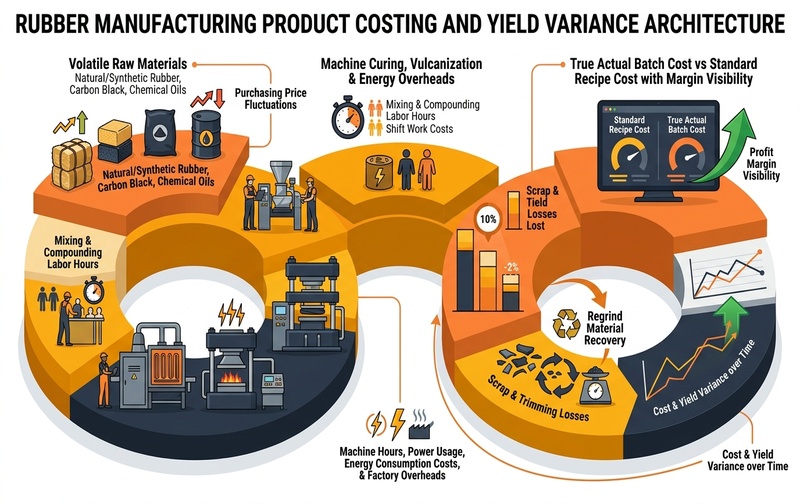
Enterprise diagram illustrating rubber manufacturing product costing architecture, yield variance control, raw material fluctuation tracking, and scrap regrind recovery.
Standard Costing
Standard costing estimates what a product should cost based on expected consumption and predefined rates.
Actual Production Costing
Actual costing uses real consumption and production information to determine what the batch actually cost.
Batch-Level Cost Variance
Comparing standard and actual cost helps identify where profitability was affected.
Possible causes include:
- Material price increases
- Excess consumption
- High scrap
- Lower production yield
- Labour variance
- Machine downtime
Product-Level Profitability
ERP should allow management to compare manufacturing cost with selling price by product or product family.
Customer and Order Margins
When customer-specific pricing or formulations are involved, profitability should ideally be visible at sales-order or customer level.
Why Is Costing Difficult in Rubber Manufacturing?
Rubber manufacturing costs depend on fluctuating material prices, formulation quantities, actual consumption, yield, scrap, rework, labour, and overheads. If these elements are maintained in separate systems, management may not know the true product margin until long after production is completed.
Procurement and Supplier Control
Purchasing decisions have a direct impact on production continuity, material quality, and manufacturing cost.
ERP can support:
Purchase requisitions
Purchase orders
Supplier pricing
Delivery schedules
Supplier batches
Incoming inspection
Approved suppliers
Purchase history
Supplier Performance
Supplier evaluation can consider:
- Delivery performance
- Quality rejection
- Price
- Lead time
- Reliability
This helps procurement teams move beyond purchase price alone.
Material Substitutions
Where alternative raw materials are permitted, they should be controlled and documented rather than decided informally during shortages.
Sales, Dispatch and Customer Specification Management
Rubber manufacturing is often customer-specific.
A single base product may differ according to:
Dimensions
Material grade
Colour
Packaging
Quality requirement
Testing requirement
Customer drawing
Delivery schedule
ERP should therefore connect the sales order with manufacturing requirements.
Order-to-Production Linkage
A confirmed sales order can drive production demand and material planning.
Batch Allocation
Finished batches can be allocated to specific customer orders, improving traceability.
Dispatch Control
Dispatch processes can verify:
- Approved inventory
- Quantity
- Batch
- Packaging
- Customer requirements
- Delivery documentation
Finance Integration and Manufacturing Profitability
One of ERP’s main advantages is the ability to connect manufacturing activity with financial reporting.
Operational transactions can influence:
Inventory valuation
Work in progress
Finished-goods value
Material consumption
Production variance
Accounts payable
Accounts receivable
Cost of goods sold
Profitability
This creates one financial view rather than requiring manual reconciliation between production records and accounting systems.
Executives can therefore analyse not only how much the company produced, but whether that production generated acceptable margins.
Manufacturing KPIs That ERP Should Make Visible
Management should evaluate ERP based partly on the operational questions it can answer.
The value of ERP increases when these metrics are visible without requiring teams to manually combine multiple spreadsheets.
Signs a Rubber Manufacturer Has Outgrown Its Current System
An ERP evaluation may be justified when operational complexity exceeds the capabilities of the current system.
Warning signs include:
Formulas maintained in spreadsheets
Multiple versions of the same production data
Inventory frequently differs from physical stock
Production planning depends on individual employees
Material shortages regularly interrupt manufacturing
Batch traceability requires manual investigation
Quality records remain disconnected from production
Scrap is recorded without financial impact
Product costing requires manual calculation
Management reports arrive too late
Different departments maintain separate systems
Production and finance figures require frequent reconciliation
Customer-specific requirements depend on employee memory
These problems usually indicate a process-control gap rather than simply a reporting problem.
ERP Selection Criteria for Rubber Manufacturing Companies
ERP selection should begin with operational requirements rather than brand comparisons alone.
Manufacturing Functionality
The system should support the organization’s actual production model.
Formula Management
Evaluate whether formulas, recipes, BOMs, versions, and substitutions can be controlled effectively.
Batch Traceability
Confirm whether materials can be traced forward and backward across production.
Quality Management
Determine whether inspection requirements can be integrated into purchasing, production, and finished-goods release.
Inventory Control
Assess batch management, shelf-life tracking, warehouse control, and planning.
Production Planning
The ERP should help align sales demand, inventory, capacity, and purchasing.
Costing
Decision-makers should verify whether the system can provide standard and actual manufacturing costs.
Integration Capability
ERP may need to connect with:
Machines
Barcode systems
Quality equipment
CRM
Warehouse applications
E-commerce
Business intelligence
Third-party logistics
Government or compliance platforms
Reporting and Analytics
Executives should be able to access meaningful operational and financial KPIs without extensive manual preparation.
Scalability
The system should support future requirements such as additional plants, warehouses, users, products, and regions.
Implementation Partner Experience
Software capabilities matter, but implementation design also determines how effectively those capabilities are used.
Industry understanding can help reduce unnecessary customization and improve process design.
Implementation Considerations Before ERP Go-Live
Selecting software is only one part of an ERP program.
Implementation quality depends heavily on process design and master-data accuracy.
Master Data Preparation
Clean and standardize:
- Item codes
- Raw materials
- Finished goods
- Units of measure
- Suppliers
- Customers
- Formulas and BOMs
Incorrect production masters will produce incorrect material planning and costing.
Inventory Cleanup
Opening quantities should be validated before migration.
Routing and Work Centres
Production steps, machines, labour, and capacities should reflect real operations.
Quality Parameters
Inspection requirements should be documented and linked to relevant processes.
User Roles
Access should reflect responsibility and approval requirements.
Data Migration
Historical and opening data should be reconciled before go-live.
Integrations
Third-party systems should be identified early rather than added after implementation.
User Training
Shop-floor, procurement, quality, finance, sales, and management users require role-specific training.
Pilot and Testing
Real-world scenarios should be tested before full deployment.
Common ERP Implementation Mistakes in Rubber Manufacturing
ERP problems often come from implementation choices rather than from the software itself.
Recreating Existing Manual Processes
Digitizing an inefficient process does not necessarily improve it.
Poor Formula Data
Incorrect recipes create problems in planning, material consumption, and costing.
Inaccurate Opening Inventory
Poor inventory data reduces trust in the ERP from the first day.
Excessive Customization
Customization should solve genuine business requirements, not reproduce every historic workaround.
Ignoring Shop-Floor Users
Production operators must be able to record information without excessive complexity.
Weak Quality Integration
Quality control should not remain isolated from inventory and manufacturing.
No Process Ownership
Each major ERP process should have an accountable business owner.
Finance-Only Implementation
Treating ERP as accounting software prevents organizations from realizing manufacturing-control benefits.
Business Benefits of ERP for Rubber Manufacturing
A properly designed manufacturing ERP environment can strengthen multiple areas of business control.
Better Production Visibility
Management can see what is planned, in progress, completed, delayed, or rejected.
Improved Traceability
Batch genealogy becomes easier to investigate.
Lower Material Wastage
Consumption and scrap variance become visible.
Stronger Quality Control
Quality checks can be linked directly to materials and production.
More Accurate Product Costing
Actual consumption and losses can be reflected in manufacturing cost.
Better Inventory Planning
Procurement can work from demand and availability rather than estimates.
Faster Management Reporting
Operational and financial information can be accessed from a common data source.
Improved Margin Visibility
Management can identify products, orders, and customers where costs are rising faster than revenue.
ERP Fit by Rubber Manufacturing Business Type
ERP requirements vary according to operational complexity.
Rubber Component Manufacturers
Key priorities may include customer-specific products, mould management, batch control, quality, and costing.
Automotive Rubber Manufacturers
Traceability, quality documentation, production consistency, and customer requirements may be particularly important.
Industrial Rubber Manufacturers
Manufacturers producing varied industrial products may require flexible formulations, routing, and order-specific manufacturing.
Rubber Extrusion Companies
Production planning, material consumption, continuous processes, scrap, and dimensional quality may be important.
Moulded Rubber Manufacturers
Machine scheduling, tooling, cycle control, rejection tracking, and product costing may require additional attention.
Growing SME Manufacturers
Smaller manufacturers may prioritize integrated finance, inventory, purchasing, production, and basic quality controls.
Multi-Plant Manufacturers
Businesses operating multiple locations may need centralized master data, plant-level planning, intercompany processes, and consolidated reporting.
ERP Implementation Cost Factors for Rubber Manufacturers
There is no single ERP implementation price that applies to every rubber manufacturer.
Cost depends on factors such as:
Number of users
ERP platform
Manufacturing complexity
Number of plants
Warehouses
Formula requirements
Quality processes
Reporting requirements
Data migration
Integrations
Custom development
Training
Infrastructure
Support model
Decision-makers should evaluate total cost against the operational problems the system is expected to solve.
A lower initial software cost can become expensive if the system requires extensive manual work or customization to handle core manufacturing processes.
Building the Business Case for Manufacturing ERP
ERP investment should be connected to measurable business problems.
A useful framework is:
ERP Business Case Value Framework:
➔
Operational Gap
➔
ERP Capability
➔
Expected Improvement
➔
KPI
Examples:
This approach keeps the ERP business case focused on operational outcomes rather than features.
Next Step: Evaluate Your Manufacturing Process Before Selecting ERP
ERP selection should begin with the manufacturing problems that need to be controlled.
Before evaluating software, document how your organization currently manages:
Formulations
Raw materials
Production planning
Batch manufacturing
Quality control
Inventory
Scrap and rework
Traceability
Product costing
Procurement
Customer requirements
Management reporting
This assessment helps determine whether your current systems can support future growth or whether operational complexity now requires a more integrated ERP environment.
For rubber manufacturers considering ERP modernization, a structured process assessment can help identify the highest-priority gaps, define required functionality, reduce unnecessary customization, and create a clearer implementation roadmap.
Frequently Asked Questions About Rubber Manufacturing ERP
Planning an ERP evaluation for your rubber manufacturing operation?
Book an ERP demo to review your production, traceability, quality, inventory, and costing requirements before selecting a solution.