
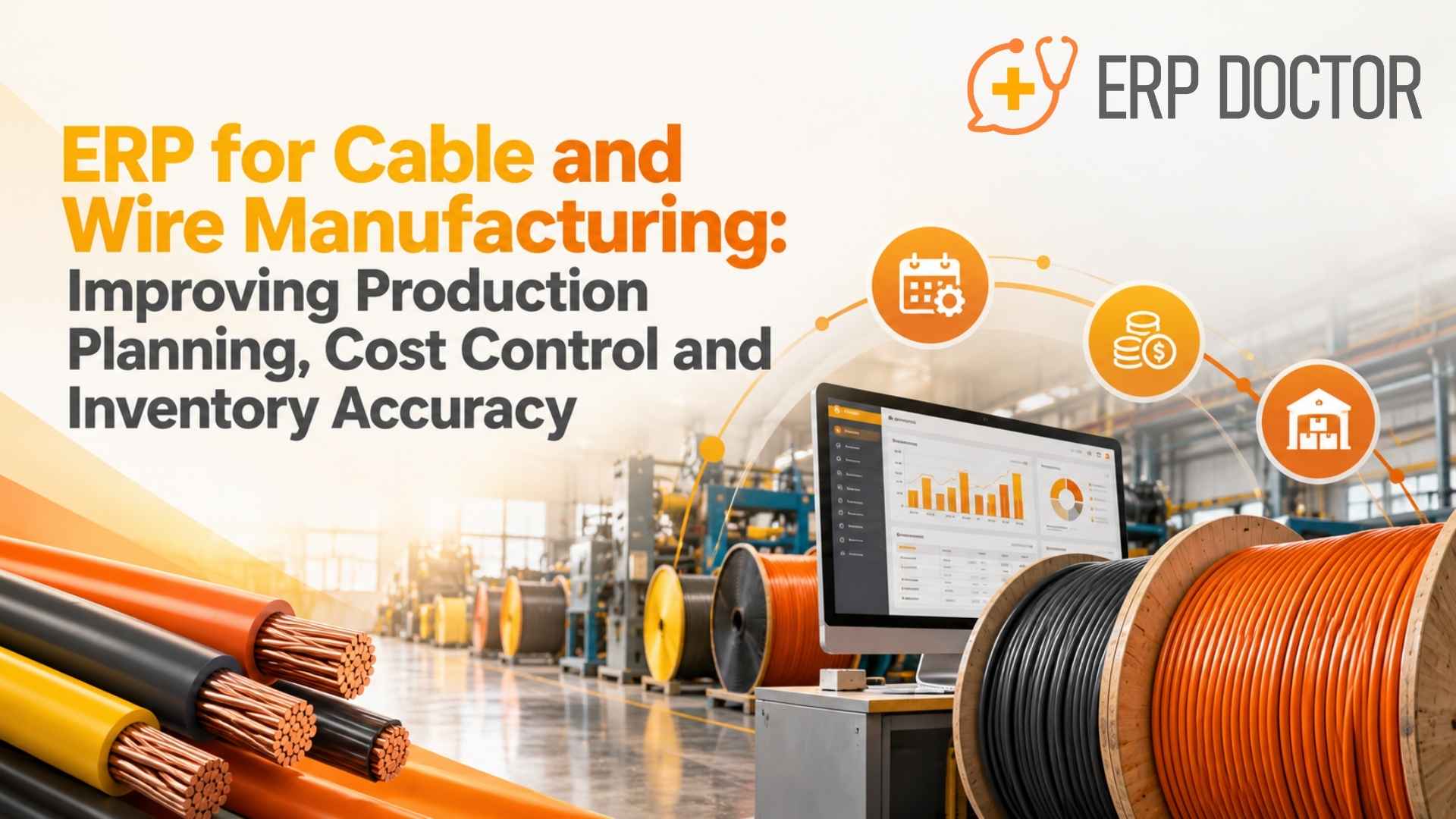
ERP for Cable and Wire Manufacturing: Improving Production Planning, Cost Control and Inventory Accuracy
Quick Answer
ERP for cable and wire manufacturing connects production planning, raw material procurement, inventory management, manufacturing costing, quality control and financial reporting in one business management system. Cable manufacturers can use ERP to coordinate production orders, monitor copper and aluminium consumption, manage work-in-progress, track material availability and identify cost variances. The right ERP configuration depends on product complexity, production processes, traceability requirements, integration needs and business growth plans. Before selecting a solution, manufacturers should evaluate manufacturing functionality, data accuracy, implementation requirements and reporting capabilities to determine whether the system can support their actual operations.
Production Planning Challenges in Cable and Wire Manufacturing
Cable and wire manufacturers must coordinate material availability, production capacity, customer orders, machine schedules and delivery commitments. When these activities are managed through disconnected spreadsheets or separate applications, production teams may struggle to maintain an accurate view of current operations.
Production planning becomes particularly challenging when manufacturers handle multiple cable specifications, conductor sizes, insulation materials, production stages and customer-specific requirements. Changes to one production order can affect material requirements, machine availability, work-in-progress and delivery schedules.
An ERP system can connect sales orders, material planning, purchasing, production orders and inventory records. This provides a more consistent basis for scheduling work and coordinating resources across departments.
Managing production schedules and order priorities
Manufacturers need to understand which orders must be completed first, which materials are available and whether the required production resources are ready. Without coordinated planning, teams may schedule work before confirming material availability or machine capacity.
ERP-supported planning can help production managers review outstanding orders, planned production quantities, material requirements and progress against schedules. The effectiveness of this process depends on accurate production data, realistic planning rules and timely transaction updates.
Coordinating multiple manufacturing stages
Depending on the product, cable manufacturing may involve wire drawing, stranding, conductor preparation, insulation, cabling, sheathing, testing and packing. Not every manufacturer performs every stage internally.
When production involves multiple operations, managers need visibility into the status of work orders, material consumption and quantities awaiting the next process. A properly configured ERP system can support this visibility by recording production transactions and connecting relevant inventory and costing information.
Raw Material Planning and Inventory Control for Copper and Aluminium
Copper, aluminium, insulation compounds, sheathing materials, packaging and other production inputs can represent significant inventory and purchasing commitments. Inaccurate stock records or poorly coordinated procurement can create production delays, excess inventory and avoidable working-capital pressure.
ERP supports material planning by connecting demand, inventory balances, purchasing activities and production requirements. Manufacturers can use this information to identify material shortages, review replenishment needs and coordinate procurement with production schedules.

Improving material availability
When a production order requires a particular conductor size or insulation specification, the planning team must determine whether sufficient suitable material is available. General stock quantities alone may not provide enough information if materials differ by grade, specification, batch or intended use.
ERP can help maintain structured item masters, inventory records, reservations and material requirements. Depending on the configuration, it can also support lot-level tracking and more detailed material allocation.
Controlling inventory accuracy
Inventory discrepancies can occur when material issues, returns, scrap, transfers or finished-goods receipts are not recorded consistently. These differences affect purchasing decisions and production planning.
Manufacturers should establish clear procedures for recording material movements, reconciling physical stock and investigating variances. ERP provides a common transaction record, but inventory accuracy still depends on disciplined processes and reliable data.
Balancing availability with working capital
Holding excessive raw material inventory can tie up cash, while insufficient stock can interrupt production. ERP-based reporting can help purchasing and finance teams review stock levels, consumption patterns, outstanding purchase orders and planned production demand.
Replenishment parameters should reflect actual supplier lead times, demand variability, storage constraints and business priorities rather than relying on generic minimum-stock assumptions.
Manufacturing Cost Control, Scrap and Yield Management
Manufacturing profitability depends on understanding the resources consumed to produce each order. Material prices, production quantities, scrap, rework, labour, machine costs and overhead allocation can all influence the final manufacturing cost.
When production and financial records are disconnected, managers may struggle to explain differences between planned and actual costs. An ERP system can connect relevant production transactions with inventory valuation and financial reporting, subject to the product’s costing functionality and configuration.

Monitoring material consumption and scrap
Consider an illustrative production order that plans to consume 1,000 kilograms of conductor material. Actual consumption is 1,040 kilograms, and the additional 40 kilograms must be investigated.
Possible explanations include process scrap, measurement differences, production adjustments or recording errors. The additional consumption should not automatically be classified as waste without reviewing the underlying transactions.
ERP-supported production records can help teams compare planned and actual consumption, record scrap and investigate material variances. Reliable analysis requires consistent units of measurement, accurate bills of materials and clear rules for recording production losses.
Understanding product and order profitability
A cable order may appear commercially attractive based on its selling price, but its profitability can change when raw material prices fluctuate or actual production consumption differs from the estimate.
Manufacturers should evaluate whether their ERP configuration supports the costing methods, cost components and reporting detail required by the business. Finance and production teams should be able to reconcile material movements, production costs and relevant financial entries.
Improving cost visibility for management
Useful management reports may include material consumption variance, scrap quantities, work-in-progress, production order costs, inventory valuation and gross margin by order or product category.
These reports help decision-makers investigate exceptions and prioritize corrective action. They do not automatically establish the cause of a variance; operational context and accurate transaction data remain essential.
Quality Control and Traceability Across Production
Cable manufacturers may need to document material specifications, production parameters, inspection results and product testing, depending on the products they manufacture and the markets they serve.
Traceability requirements differ by product, customer contract and applicable standard. Manufacturers should identify which records must be maintained and how quickly they need to retrieve them when investigating a quality issue.
An ERP system can support traceability by connecting item records, supplier information, inventory transactions, production orders and finished-goods records. More advanced requirements may need quality-management functionality, specialized testing systems or third-party integrations.
Connecting material records with finished products
When a quality issue is reported, the manufacturer may need to identify the affected finished-goods batch, relevant production order and source materials. The ability to follow these relationships depends on how lot numbers, batches and production transactions are recorded.
Manufacturers should evaluate traceability using realistic scenarios rather than relying only on a vendor demonstration. For example, ask the implementation team to show how a finished cable lot can be traced back to its relevant production and material records.
Recording inspection and testing information
Electrical and mechanical testing requirements vary across cable types and applicable standards. Manufacturers should determine whether the proposed ERP solution can record the required inspection information directly or whether integration with a laboratory information system, testing application or quality platform is necessary.
A solution should be evaluated against actual testing and documentation requirements rather than assumed to provide every specialized capability as standard.
Connecting Procurement, Production, Inventory and Finance
Operational problems often arise when departments rely on different versions of business data. Purchasing may work from one material requirement estimate, production may maintain a separate schedule, and finance may reconcile inventory movements after the fact.
An integrated ERP environment can connect purchasing, inventory, production and accounting transactions. This reduces dependence on manual re-entry and provides a more consistent basis for reporting.
Improving coordination between departments
When sales orders and production requirements are connected, teams can review demand against material availability and production capacity. Purchasing can use relevant planning information to coordinate supplier orders, while inventory teams record receipts and issues against the appropriate transactions.
Finance can use the resulting records to review inventory valuation, production costs and business performance, subject to the system’s accounting and costing configuration.
Strengthening management reporting
Business leaders need reports that explain more than total sales or stock value. Useful operational indicators may include production schedule adherence, material consumption variance, inventory turnover, order fulfilment, scrap levels and work-in-progress.
Each indicator should have a clearly defined calculation, reporting period and accountable owner. Consistent definitions help management compare performance across products, production lines and reporting periods.
ERP Requirements for Different Cable Manufacturing Operations
Cable and wire manufacturers do not all have the same requirements. A company producing standard electrical wires may need a different process configuration from a manufacturer handling complex industrial cables, specialized insulation or customer-specific specifications.
ERP selection should therefore begin with the actual production model rather than a generic list of manufacturing software features.
Power cable and electrical wire manufacturing
Manufacturers in these segments may need detailed material specifications, production-stage visibility, inventory control and documentation appropriate to their products. The evaluation should consider how the system handles product variants, bills of materials, production orders and quality records.
Industrial and control cable manufacturing
Operations involving multiple conductor arrangements, shielding, insulation layers or customer-specific specifications may require careful product configuration and production documentation. The business should determine how product structures, revisions, material substitutions and order-specific requirements will be maintained. Specialized configuration tools may be needed when standard ERP functionality does not cover the complete process.
Manufacturers with multiple production sites
Businesses operating across several facilities should assess site-level inventory, inter-warehouse transfers, production planning, reporting consolidation and access controls. The ERP design must establish how data is shared across locations and which transactions require site-specific authorization. Multi-site requirements should be tested using actual business scenarios before implementation.
How to Evaluate ERP Software for a Cable Manufacturing Business
ERP selection should be based on operational fit, financial requirements, integration needs and the organization’s capacity to implement and maintain the solution.
A software demonstration should use representative business processes instead of relying exclusively on prepared slides or standard feature lists.
| Evaluation area | What to verify |
|---|---|
| Manufacturing functionality and configuration | Ask vendors to demonstrate how the solution handles bills of materials, production orders, material issues, production receipts, scrap recording and costing. Confirm which capabilities are standard, which require configuration and which depend on additional software. |
| Inventory and traceability requirements | Test the handling of different material specifications, units of measurement, warehouse locations, batches and inventory adjustments where applicable. Verify whether the proposed system supports the traceability level required by the business. |
| Reporting and financial integration | Review how production transactions affect inventory valuation, work-in-progress and financial reporting. Ask how the system handles cost variances and whether managers can access the reports needed for operational decisions. |
| Integration and scalability | Identify existing systems that must exchange information with ERP, including customer applications, production equipment, testing systems, barcode solutions and reporting tools. Confirm data ownership, integration responsibilities, error handling and ongoing maintenance. Growth plans should also inform the evaluation of users, locations, transaction volumes and future process requirements. |
| Implementation capability and support | Evaluate the implementation partner’s experience with comparable manufacturing processes, migration methodology, testing procedures, training and post-go-live support. A suitable partner should explain project assumptions, responsibilities, dependencies and risks clearly. The lowest initial quotation may not represent the lowest overall cost if significant customization, integration or ongoing maintenance is required. |
ERP Implementation Risks and Data Readiness
ERP implementation involves more than installing software. The project must align business processes, data, system configuration, reporting and user responsibilities.
Cable manufacturers should identify implementation risks before committing to a detailed project schedule.
Master data and opening balances
Item masters, bills of materials, units of measurement, supplier records, warehouse details, costing data and opening inventory balances must be reviewed before migration.
Duplicate items, inconsistent descriptions and incorrect units can affect planning and reporting. Data owners should validate critical records and approve migration results before the system is used for live operations.
Process design and customization
The project team should distinguish essential business requirements from preferences that can be addressed through standard processes. Excessive customization can increase testing complexity, implementation costs and future maintenance requirements.
Each customization should have a documented business purpose, an agreed acceptance criterion and an identified owner.
Integration testing and user readiness
Integrations should be tested for successful transactions, rejected records, duplicate submissions and recovery from failures. Users should practise realistic purchasing, production, inventory and finance scenarios before go-live.
Post-implementation reviews should monitor data accuracy, unresolved issues, reporting reliability and adoption. These controls help determine whether the system is supporting the intended business processes.
Frequently Asked Questions About Cable Manufacturing ERP
Evaluate ERP for Your Cable Manufacturing Operations
Production delays, inaccurate material records, unexplained cost variances and limited operational visibility can make it difficult for cable manufacturers to manage growth while maintaining control over margins and delivery commitments.
The right ERP solution should fit the manufacturer’s production processes, inventory requirements, costing model and reporting needs. A structured evaluation can identify which capabilities are available as standard, where configuration is required and which integrations or customizations may be necessary.
Emerging Alliance can help businesses evaluate ERP requirements and implementation considerations for their operations. Discuss your manufacturing workflows, inventory challenges, costing requirements and integration needs with the team to determine the appropriate next step.
Request a Cable Manufacturing ERP Consultation to evaluate your requirements and discuss a suitable ERP approach for your business.