

ERP for Airlines: Controlling Operational Costs Across Finance, Fleet & Maintenance
Quick Answer
ERP for airlines connects financial management, procurement, inventory, assets, workforce data and operational information within a centralized business environment. Instead of managing costs across disconnected spreadsheets and systems, airline management can gain better visibility into maintenance spending, inventory, procurement, workforce costs, budgets and vendor performance. ERP does not necessarily replace specialized airline systems such as PSS, flight operations or MRO platforms; it can integrate with them to give finance, operations and leadership teams a more complete view of airline performance.
Why Airline Cost Control Is Difficult Without an Integrated ERP
Airlines operate with multiple cost-intensive processes running simultaneously. Aircraft maintenance, spare parts, procurement, fuel-related expenses, workforce costs, vendor payments, financial accounting and operational planning all generate data that management needs to monitor.
The challenge is not simply the amount of data. It is whether decision-makers can connect that data quickly enough to understand where costs are increasing and why.
When financial and operational information sits across disconnected systems, spreadsheets and manual processes, several problems can emerge:
- Limited visibility into operational spending
- Delayed financial reporting
- Difficulty tracking procurement costs
- Excess inventory and slow-moving spare parts
- Poor visibility into maintenance-related expenditure
- Manual reconciliation between operational and financial data
- Difficulty comparing budgets with actual costs
- Inconsistent vendor and purchasing information
- Delayed management decisions
For an airline, these gaps can make cost control reactive rather than proactive.
An integrated airline ERP system can provide a central business layer for financial, procurement, inventory, asset and workforce information while exchanging data with specialized aviation applications.
The objective is not to force every airline process into one application. It is to create a connected environment in which management can understand the financial impact of operational activity.
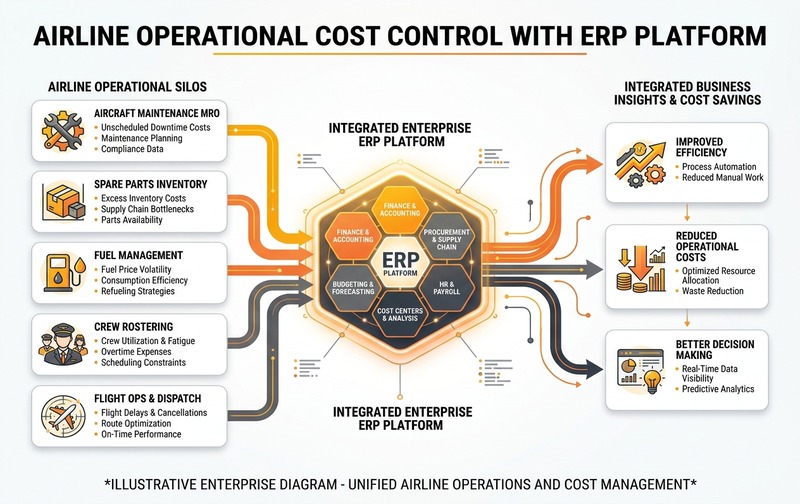
Enterprise architecture diagram illustrating airline operational cost control with an integrated ERP platform connecting MRO, inventory, fuel, crew rostering, and flight ops to finance and procurement.
How ERP for Airlines Reduces Operational Costs
The strongest value of ERP for airlines comes from connecting business processes that directly influence expenditure.
Rather than presenting ERP as a collection of features, airlines should evaluate it according to the specific cost areas it can help control.
Finance and Cost Accounting
Airline cost control starts with financial visibility.
An ERP system can centralize accounting, accounts payable, accounts receivable, budgeting, cost centers and management reporting. This gives finance teams a structured view of where money is being spent and how actual expenditure compares with budgets.
For airline management, the important question is not simply whether transactions are recorded correctly. It is whether financial information can be connected to departments, assets, vendors, projects and operational activities.
A connected financial environment can help management monitor:
- Actual versus budgeted expenditure
- Department-level costs
- Vendor payments
- Purchase commitments
- Expense categories
- Cost-center performance
- Cash-flow requirements
- Financial reporting timelines
This creates a stronger foundation for identifying cost variances before they become larger financial problems.
Aircraft Maintenance and MRO Cost Control
Maintenance is one of the areas where operational activity can have a significant financial impact.
However, airlines should distinguish between an ERP platform and specialized MRO software.
An ERP does not automatically replace an aviation MRO system. Instead, it can provide the financial, procurement, inventory and asset-management layer around maintenance operations and integrate with specialized systems where required.
For example, maintenance-related information can feed into ERP processes for:
- Spare-parts purchasing
- Inventory valuation
- Vendor management
- Purchase orders
- Maintenance-related expenditure
- Asset costs
- Accounts payable
- Budget monitoring
This helps management understand not only what maintenance activity occurred, but also its financial consequences.
That distinction is important when evaluating ERP for airline maintenance management.
Inventory and Spare Parts Optimization
Aircraft and maintenance operations depend on the availability of critical parts and materials.
Holding excessive inventory can tie up working capital. Holding too little can create procurement delays, operational disruption or emergency purchasing.
An ERP system can improve inventory visibility by connecting purchasing, warehouse activity, stock movements, valuation and financial records.
Airlines can use centralized inventory information to monitor:
- Stock levels
- Inventory valuation
- Reorder requirements
- Slow-moving items
- Purchase history
- Supplier performance
- Material consumption
- Warehouse transactions
The objective is not simply to maintain more inventory visibility. It is to support better decisions about what should be purchased, when it should be purchased and how much should be held.
Procurement and Vendor Cost Management
Procurement decisions directly influence airline operating expenditure.
Disconnected purchasing processes can make it difficult to determine whether departments are purchasing consistently, whether vendors are meeting expectations, or whether prices and purchasing conditions are changing.
An airline ERP system can connect purchase requests, purchase orders, goods receipts, invoices and supplier records.
This creates a more controlled procurement cycle:
➔
Purchase Request
➔
Approval
➔
Purchase Order
➔
Receipt
➔
Invoice
➔
Payment
With the process connected, finance and procurement teams can gain better visibility into committed and actual expenditure.
Management can also evaluate supplier performance using factors such as:
- Purchase prices
- Delivery performance
- Order frequency
- Payment terms
- Purchase volumes
- Invoice discrepancies
- Supplier concentration
This turns procurement data into a cost-control mechanism rather than simply a transaction-processing function.
Crew and Workforce Cost Management
Workforce expenditure is another important cost area for airlines.
ERP should not automatically be positioned as a replacement for specialized crew scheduling or rostering systems. Instead, the ERP environment can support the financial and workforce-related information surrounding those systems.
Depending on the solution architecture and integrations, organizations can connect information relating to:
- Employee costs
- Payroll
- Overtime
- Travel and expenses
- Department budgets
- Workforce-related procurement
- Cost centers
This allows management to connect workforce expenditure with financial planning and departmental performance.
The result is better visibility into the cost implications of workforce decisions without incorrectly suggesting that ERP replaces specialized crew-operations software.
Fuel and Operating Expense Visibility
Fuel is a major airline operating cost, but an ERP article should avoid making unsupported claims that ERP itself optimizes flight routes or fuel consumption.
Those functions may belong to specialized flight operations, fuel management or planning systems.
The ERP contribution is the financial and enterprise-management layer.
Fuel-related information can be connected with accounting, budgeting, vendor management, purchasing and cost reporting. This allows management to evaluate expenditure alongside other operating costs and identify significant variances.
The value comes from connecting operational information with financial visibility, not from claiming that ERP independently controls aircraft fuel consumption.
Real-Time Management Reporting
Cost control becomes difficult when management reports arrive after the underlying problem has already developed.
ERP can centralize transactional information and provide management reporting across finance, purchasing, inventory, assets and other business functions.
Depending on the implementation, management dashboards can provide visibility into indicators such as:
- Budget versus actual expenditure
- Purchase commitments
- Inventory value
- Supplier costs
- Maintenance-related expenditure
- Accounts payable
- Departmental expenses
- Operational cost trends
This supports faster decision-making because management can analyze connected information rather than manually consolidate data from multiple sources.
ERP vs Airline-Specific Operational Systems
This is one of the most important distinctions missing from many articles about ERP for airlines.
An ERP system is not necessarily the same thing as an airline’s Passenger Service System (PSS), flight operations platform, crew management application or MRO system.
These systems can serve different purposes.
| System | Primary purpose |
|---|---|
| ERP | Finance, procurement, inventory, assets, workforce and enterprise management |
| PSS/CRS | Passenger, reservation and ticketing processes |
| Flight Operations System | Flight planning and operational control |
| MRO System | Aircraft maintenance and maintenance planning |
| Crew Management System | Crew scheduling, rostering and related operations |
| CRM | Customer and commercial relationship management |
| ERP integrations | Connect business and financial information across these environments |
For this reason, the strongest airline ERP software strategy is often an integrated architecture rather than an attempt to replace every specialized aviation application.
This distinction also makes the article more useful for CIOs, CTOs, CFOs and airline operations leaders evaluating ERP investments.
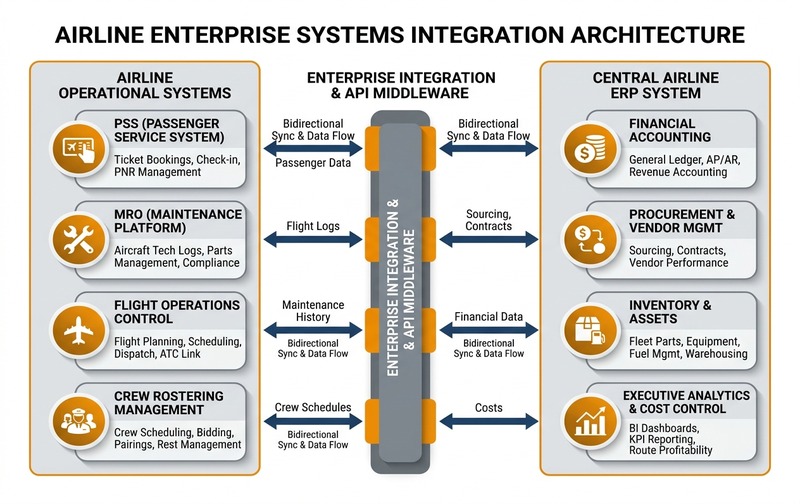
Integration framework diagram showing bidirectional data flow between specialized airline operational systems (PSS, MRO, Flight Ops, Crew Rostering) and the central Enterprise ERP core.
What Should Airlines Look for in an ERP System?
Airlines should evaluate ERP based on business requirements rather than simply comparing feature lists.
The evaluation should consider:
Financial and Cost Management
Can the platform provide centralized accounting, budgeting, cost-center management and management reporting?
Procurement and Supplier Management
Can purchasing workflows connect requisitions, approvals, purchase orders, receipts, invoices and supplier information?
Inventory and Asset Management
Can the system provide accurate visibility into inventory, assets, valuation and transactions?
Integration Capability
Can the ERP exchange data with existing PSS, MRO, flight operations, crew, CRM, HR and other specialized systems?
Reporting and Analytics
Can management obtain reliable information without manually consolidating multiple spreadsheets?
Scalability
Can the architecture support additional aircraft, locations, business units, currencies, subsidiaries or operational requirements?
Data Governance
Can the organization maintain consistent master data across customers, suppliers, materials, assets, accounts and other critical records?
Implementation and Support
Does the implementation partner understand the organization’s existing systems, integration requirements, data migration needs and post-go-live support requirements?
These questions are more useful than asking whether an ERP has a long list of modules.
How to Measure the ROI of Airline ERP
Airline ERP ROI should be evaluated through measurable operational and financial improvements rather than generic claims such as “ERP can reduce costs by X%.”
Actual results depend on the airline’s starting point, processes, technology landscape, implementation quality and adoption.
Useful KPIs include:
- Inventory carrying cost
- Inventory turnover
- Slow-moving inventory
- Purchase-price variance
- Procurement cycle time
- Purchase order processing time
- Invoice processing time
- Budget variance
- Month-end closing time
- Maintenance-related expenditure
- Vendor performance
- Manual transaction volume
- Data reconciliation effort
- Reporting turnaround time
For example, if finance teams currently spend significant time consolidating procurement, inventory and operational information manually, reducing that effort can become a measurable ERP benefit.
Likewise, better inventory visibility can help management identify excess or slow-moving stock and make more informed working-capital decisions.
The correct approach is to establish a baseline before implementation and compare the same KPIs after deployment.
When Should an Airline Upgrade or Replace Its ERP?
An airline may need to reconsider its ERP environment when existing systems create persistent operational or financial limitations.
Common warning signs include:
- Multiple disconnected financial systems
- Heavy dependence on spreadsheets
- Repeated manual reconciliation
- Poor inventory visibility
- Slow financial closing
- Limited management reporting
- Duplicate master data
- Difficult integrations with operational systems
- Increasing customization costs
- Lack of scalability
- Limited support for new business requirements
The decision should not automatically be “replace the ERP.”
Depending on the environment, the better strategy may be modernization, integration, migration, customization or phased replacement.
A proper assessment should first identify the current architecture and determine where the actual business constraints exist.
Key Implementation Considerations for Airline ERP
ERP implementation in an airline environment requires more than software configuration.
The implementation team should first map the existing technology landscape and determine how the ERP will interact with specialized systems.
Important areas include:
- System integration: Identify data flows between ERP, PSS, MRO, flight operations, crew, CRM, HR and other systems.
- Master data: Establish ownership and governance for suppliers, materials, assets, customers, accounts and other critical records.
- Data migration: Determine which historical and master data must move into the new environment and how it will be validated.
- Workflow design: Map approval processes for procurement, expenses, invoices, budgets and other financial activities.
- Reporting: Define the KPIs management needs before designing dashboards and reports.
- Testing: Validate integrations, financial transactions, workflows and data before production deployment.
- User adoption: Train finance, procurement, inventory, operations and other affected teams according to their actual responsibilities.
- Post-go-live support: Establish a structured process for resolving issues, optimizing workflows and managing future requirements.
A phased implementation can also be considered when an airline has a complex technology landscape and cannot realistically replace multiple systems simultaneously.
Conclusion: Build a More Connected Airline Cost-Control Environment
The value of ERP for airlines is not simply the ability to automate individual administrative processes.
The larger opportunity is to connect financial, procurement, inventory, asset and workforce information with the specialized systems already supporting airline operations.
For airline leadership, this creates a clearer path from operational activity to financial impact.
Instead of asking only whether an ERP system can reduce costs, organizations should evaluate where cost visibility is currently breaking down, which processes remain manual, where data is fragmented and how existing aviation systems can integrate with the enterprise management layer.
That is the foundation for a more measurable and sustainable ERP investment.
Frequently Asked Questions About ERP for Airlines
See How ERP for Airlines Can Improve Cost Control
Evaluate how ERP can connect finance, fleet, inventory and maintenance to reduce manual work, improve cost visibility and strengthen operational control.
Request a demo of ERP for Airlines to see how a connected ERP environment can support better cost management and decision-making.