
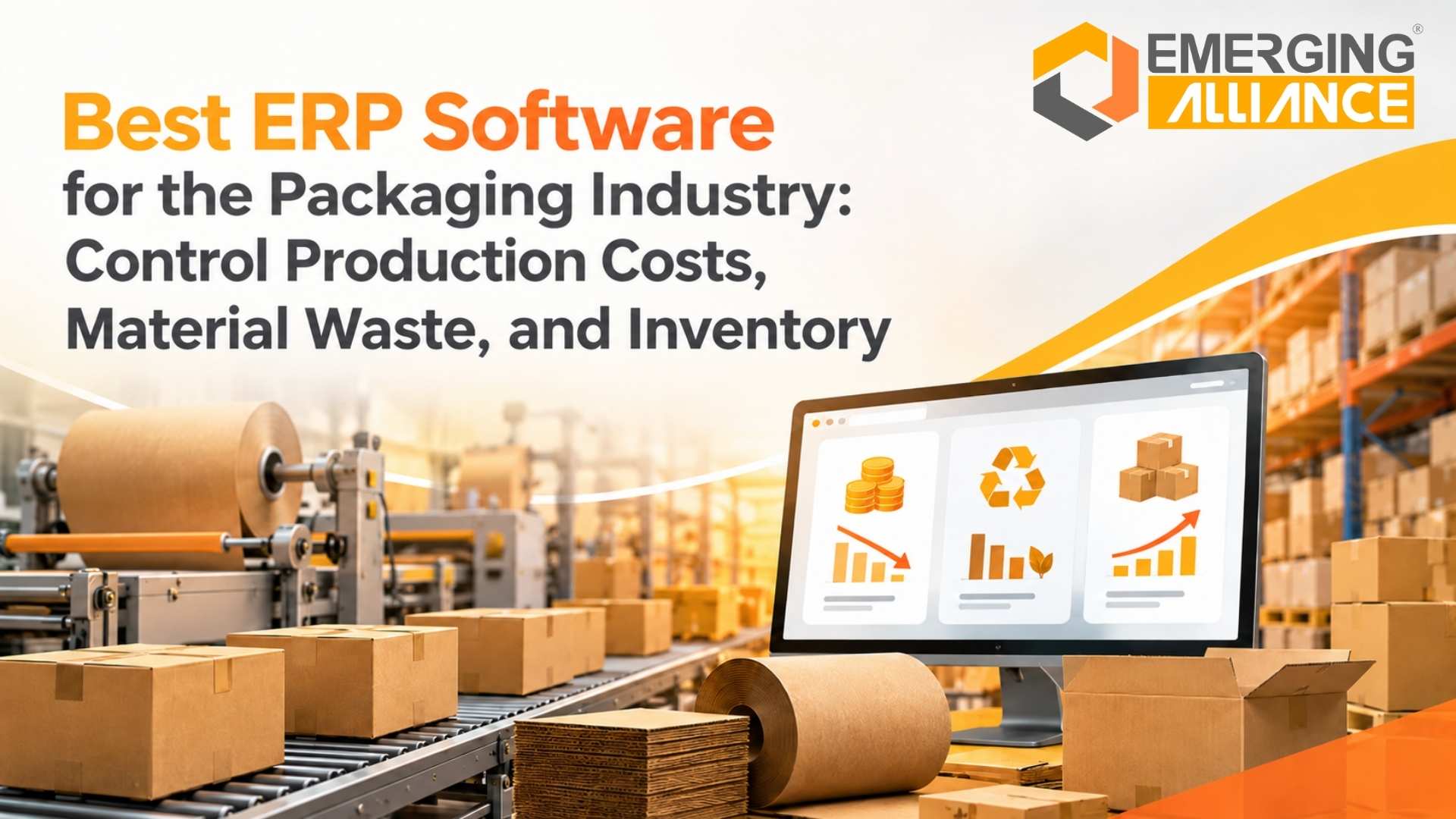
Best ERP Software for the Packaging Industry: Control Production Costs, Material Waste, and Inventory
Quick Answer
The best ERP software for the packaging industry connects production planning, material procurement, inventory, quality control, order management, and financial reporting in one system. Packaging manufacturers should evaluate each ERP against their production processes, material consumption, waste tracking, job costing, traceability, integrations, and reporting requirements. The right solution depends on operational complexity, business size, and implementation priorities.
Packaging Manufacturing Challenges That Require Better Operational Control
Packaging manufacturers operate in an environment where material costs, production schedules, customer specifications, and delivery commitments directly affect profitability. Managing these activities through disconnected spreadsheets and applications can make it difficult to understand actual production performance.
A packaging business may handle paperboard, corrugated sheets, plastic films, labels, inks, adhesives, and other consumables. Each material has its own purchasing requirements, storage conditions, consumption rates, and cost implications. When material usage is not recorded accurately, production teams may struggle to explain differences between planned and actual consumption.
Production planning also becomes more complicated when manufacturers manage multiple customer orders, machine capacities, print specifications, changeovers, and delivery deadlines. A delay in one production stage can affect downstream operations and customer commitments.
Common operational challenges include:
- Inaccurate inventory records: Differences between system quantities and physical stock affect purchasing and production decisions.
- Material waste and scrap: Unrecorded losses make it difficult to calculate actual material consumption and identify avoidable costs.
- Unreliable production schedules: Manual planning can create machine conflicts, idle time, and delayed orders.
- Limited job-cost visibility: Estimates may not reflect actual material, labour, machine, and overhead costs.
- Quality inconsistencies: Incomplete inspection records make it harder to investigate defects and customer complaints.
- Disconnected financial reporting: Production expenses, inventory movements, and sales data may not provide a consistent view of margins.
| Operational Area | Packaging Manufacturing Challenge | Operational & Financial Impact | Required ERP Control |
|---|---|---|---|
| Inventory Accuracy | Differences between system quantities and physical stock | Compromised purchasing decisions and production standstills | Multi-warehouse real-time tracking and cycle counting |
| Material Consumption | Unrecorded losses in setup, trim waste, and scrap | Inability to calculate actual consumption and uncover avoidable costs | Structured BOMs, scrap reason codes, and issue tracking |
| Production Scheduling | Manual planning across machines, dies, and print plates | Machine conflicts, excessive changeovers, idle time, and delayed jobs | Capacity-aware scheduling linked to material availability |
| Job Costing | Estimates based on static spreadsheets without actuals | Unknown job profitability, under-recovery of overheads, and margin leak | Actual vs. planned cost variance analysis by order |
| Quality Management | Incomplete inspection records across substrates and prints | Difficult defect investigations, rework costs, and customer rejections | Traceable inspection checkpoints and non-conformance logs |
| Financial Visibility | Disconnected production expenses, stock movements, and billing | Delayed month-end closing and inconsistent gross margin reporting | Integrated General Ledger with live inventory and production postings |
ERP software can help address these problems by connecting operational transactions and making business information available across departments. However, the system must be configured around the manufacturer’s real workflows. Simply purchasing an ERP product does not guarantee better efficiency or lower costs.
Essential ERP Capabilities for Packaging Production and Inventory Management
Packaging manufacturers should evaluate ERP software based on how well it supports their actual production and commercial requirements. A long list of features is less useful than evidence that the system can handle everyday transactions accurately.
Production planning and scheduling
Production planning should account for incoming orders, material availability, production capacity, machine constraints, and required completion dates. The system should help planners identify resource conflicts and understand the effect of changing priorities.
Manufacturers should verify whether the ERP supports their production model, including make-to-order, make-to-stock, or a combination of both. Businesses with complex production lines may also need detailed scheduling, machine-level planning, and specialist manufacturing integrations.
Bill of materials and material consumption
A bill of materials (BOM) defines the materials and quantities required to produce an item. Packaging products may require multiple substrates, printing materials, coatings, adhesives, and finishing components.
The ERP should support suitable BOM structures, production quantities, material issues, and adjustments. Where specifications change frequently, manufacturers should also assess how revisions are approved and reflected in production orders.
Inventory and procurement management
Inventory management should provide visibility into available stock, committed quantities, incoming supplies, and material requirements. Procurement teams need reliable information to plan replenishment and reduce the risk of shortages.
Evaluate support for multiple warehouses, units of measure, supplier lead times, purchase approvals, stock transfers, and inventory valuation. If materials require lot or batch tracking, confirm that the selected configuration supports the necessary traceability.
Quality management
Quality control can involve incoming material inspection, in-process checks, print verification, dimensional checks, and final product approval. The ERP should help record inspection results, identify affected production orders, and support corrective action workflows where required.
Manufacturers operating under customer-specific quality agreements or industry standards should validate those requirements with the implementation partner before selecting a solution.
Financial management and reporting
An integrated ERP should connect purchasing, inventory, production, sales, and accounting transactions. This allows management to review costs and operational results using consistent business data.
Useful reports include production costs, inventory valuation, purchase-price variances, order profitability, material consumption, and outstanding customer orders. Reporting quality depends on transaction accuracy, configuration, and disciplined data entry.
Production Planning, Material Yield, and Scrap Cost Control
Material consumption is a major area to investigate when evaluating packaging ERP software. Even small differences between planned and actual usage can become significant when repeated across high-volume production orders.
For example, a manufacturer may estimate the paperboard required for a batch of cartons based on the approved product specification. During production, setup adjustments, cutting losses, damaged material, or incorrect settings may increase actual consumption.
If the business records only the finished quantity, management may not understand where the additional material went. An ERP-supported process can compare planned material requirements with actual issues and recorded production losses, provided the relevant transactions are captured.
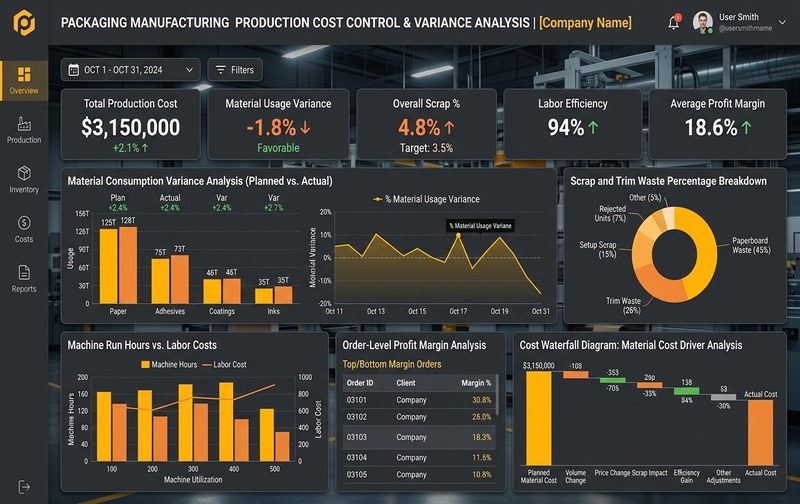
Enterprise ERP production costing and material consumption variance analysis for packaging manufacturers.
Track planned and actual material usage
Production teams should be able to review material requirements against quantities issued and consumed. Variance reports can highlight jobs that use more material than expected.
Investigations should consider several possible causes, including inaccurate specifications, machine setup, material defects, production adjustments, and data-entry errors. A variance does not automatically mean that waste was avoidable.
Record scrap and production losses
Manufacturers should establish clear categories for scrap, rejected output, setup waste, and rework. Recording the quantity, reason, production order, and relevant work centre helps identify recurring problems.
The ERP may require integration with production equipment or a manufacturing execution system (MES) to capture machine-level information automatically. This capability should be confirmed during product evaluation rather than assumed.
Improve schedule reliability
Production schedules are more useful when planners can see material availability and outstanding orders together. When a supplier delivery is delayed, the business can evaluate which orders are affected and whether production priorities should change.
Manufacturers with complex constraints should assess whether standard ERP scheduling is sufficient or whether an advanced planning and scheduling (APS) solution is needed.
Evaluate results using operational measures
Useful measures include material yield, scrap percentage, production order variance, schedule adherence, machine utilisation, and order completion time. Define each measure consistently before comparing results across shifts, machines, or product categories.
An ERP provides a structured basis for analysis; improvement still depends on accurate records, root-cause investigation, and corrective action.
Inventory, Procurement, Quality, and Order Traceability
Packaging manufacturers need to coordinate materials, suppliers, production, and finished goods. Poor visibility at any stage can create unnecessary purchasing, delayed deliveries, and avoidable inventory costs.
An integrated ERP can provide a common record of purchase orders, goods receipts, material issues, production orders, and finished-goods transactions. This reduces the need to reconcile multiple disconnected records manually.
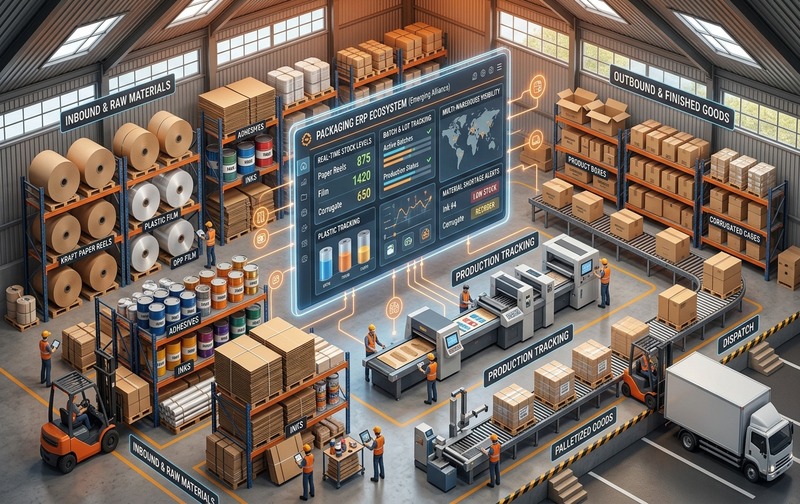
Connected packaging inventory management and order traceability workflow across raw materials, WIP, and finished pallets.
Maintain reliable inventory records
Inventory processes should cover receiving, inspection, put-away, transfers, production issues, returns, and stock adjustments. Cycle counting can help identify discrepancies before they affect important production decisions.
Where materials are managed in different units, such as kilograms, sheets, rolls, or metres, conversion rules must be defined and tested. Incorrect conversions can undermine stock accuracy even when the software is functioning as designed.
Strengthen supplier and procurement control
Procurement teams should be able to compare material requirements with current stock, open purchase orders, supplier lead times, and production demand. Approval workflows can also help enforce purchasing policies and spending limits.
For materials with variable prices or long replenishment times, historical purchasing data can support better supplier reviews and planning decisions.
Connect quality records to production orders
Quality records should be traceable to the relevant supplier batch, material receipt, production order, or finished product where required. This is especially important when customers request an investigation into a defect or a delivery does not meet agreed specifications.
The depth of traceability depends on the ERP product, configuration, and any connected quality or manufacturing applications. Validate the full traceability path with representative transactions.
Improve order visibility
Sales, production, warehouse, and dispatch teams need a consistent view of order status. The system should help staff determine whether an order is awaiting materials, scheduled for production, undergoing inspection, or ready for dispatch.
This visibility supports more informed customer updates and helps management identify delays before they become missed delivery commitments.
How ERP Improves Job Costing and Packaging Manufacturing Margins
A sales order may appear profitable when evaluated using estimated material and production costs. However, the actual margin can differ when material prices change, scrap increases, labour requirements rise, or production takes longer than expected.
ERP software can connect production transactions with financial records to help manufacturers compare estimates with actual costs. The reliability of the analysis depends on how the company defines cost components and records operational activity.
Compare estimated and actual costs
Job costing should account for relevant cost elements, which may include:
- Direct raw materials and consumables.
- Direct labour, where tracked.
- Machine or production time.
- External processing and subcontracting.
- Production overheads and other allocated costs.
Not every ERP calculates all these elements in the same way. Manufacturers should confirm the available costing methods and identify any requirements that need extensions or integration.
Identify the causes of cost variances
A cost variance should lead to investigation rather than an automatic assumption of poor performance. Higher-than-planned costs may result from material price changes, specification revisions, unplanned downtime, scrap, overtime, or incorrect estimates.
Reports should help managers connect the financial variance to the relevant production order and operational records wherever possible.
Evaluate profitability by product and customer
Management may need to compare margins by product type, customer, order, or production category. These views can reveal where quotation assumptions need review and where operational processes require attention.
Before relying on margin reports, confirm that cost allocations, inventory valuation, production quantities, and financial postings are consistent. Incomplete or inconsistent data can produce misleading results even in a fully integrated system.
Comparing ERP Software for Packaging Manufacturers
The best ERP software is the system that fits the company’s requirements, budget, operational complexity, and future plans. Manufacturers should compare products against a consistent evaluation framework rather than selecting a solution based only on brand recognition or the number of advertised features.
| Evaluation area | What packaging manufacturers should verify |
|---|---|
| Production management | Support for production orders, BOMs, scheduling, and material consumption |
| Inventory | Multi-warehouse stock, units of measure, replenishment, and traceability |
| Costing | Actual-versus-planned cost analysis and suitable costing methods |
| Quality | Inspection records, non-conformance handling, and traceability |
| Financial management | Integrated purchasing, inventory, sales, and accounting |
| Integrations | Compatibility with machines, MES, CRM, warehouse, and customer systems |
| Reporting | Role-based dashboards, variance reports, and management analysis |
| Implementation | Data migration, process design, training, testing, and support |
| Scalability | Ability to support additional users, locations, and business processes |
| Total cost | Licensing, implementation, integrations, customisation, hosting, and ongoing support |
Evaluate SAP Business One
SAP Business One is an ERP option for small and midsize businesses that need integrated financial management, purchasing, sales, inventory, and operational processes. Packaging manufacturers should evaluate how its standard capabilities and available extensions fit their production requirements.
The assessment should include BOM management, production orders, material consumption, costing, reporting, and any requirements for machine connectivity or specialised scheduling. The precise capabilities available depend on the version, deployment model, configuration, and add-ons selected.
Evaluate Odoo
Odoo provides a modular business application platform with applications for areas such as inventory, purchasing, sales, accounting, and manufacturing. Its modular approach may suit businesses looking to combine selected operational functions.
Manufacturers should validate the functionality available in the relevant edition, including any requirements for advanced production planning, traceability, integrations, and custom workflows. They should also evaluate the long-term cost and maintainability of customisations.
Evaluate Microsoft Dynamics 365
Microsoft Dynamics 365 includes business applications that can support financial, supply chain, and operational processes. The specific product within the Dynamics 365 portfolio matters because capabilities differ across applications and deployment configurations.
Packaging manufacturers should assess the appropriate product, its manufacturing functionality, integration requirements, implementation scope, and total cost. A demonstration should use the company’s actual workflows rather than generic examples.
Make the comparison process practical
Request a demonstration based on representative business scenarios. For example, ask each vendor to demonstrate how a new order creates material requirements, how production consumption is recorded, how scrap affects costing, and how the finished order appears in financial reporting.
Use the same scenarios, data, and evaluation criteria across shortlisted products. This makes it easier to compare functional fit, additional development, operational usability, and implementation risk.
ERP Implementation Requirements for Packaging Companies
ERP implementation involves more than installing software. The business must define its processes, prepare its data, configure the system, test transactions, and train employees.
A clear implementation scope helps prevent projects from expanding without proper evaluation. It also allows management to understand which requirements can be handled through standard functionality and which may need customisation or integration.
Define business requirements
Document current workflows for quotations, purchasing, inventory, production planning, quality, dispatch, and financial reporting. Identify manual work, duplicated data entry, control gaps, and reporting limitations.
Separate essential requirements from optional improvements. This helps the project team prioritise capabilities that address the most significant operational problems.
Prepare master and transactional data
Migration planning should cover item codes, BOMs, units of measure, warehouse records, supplier information, customer details, opening balances, and other required records.
Clean and validate the data before migration. Duplicate items, outdated specifications, and inconsistent units can create problems after go-live if they are transferred without review.
Validate integrations and customisations
Packaging operations may rely on printing systems, barcode applications, production equipment, e-commerce platforms, logistics services, or customer-specific systems.
Document the purpose, data flow, ownership, and failure-handling process for every integration. Customisations should be tested against realistic workflows and assessed for their ongoing maintenance implications.
Test before go-live
Testing should cover normal transactions and exceptions, such as material shortages, rejected batches, production changes, returns, and order cancellations.
Users should verify that operational records, stock balances, cost calculations, approvals, and accounting entries behave as expected. Training should be role-specific so employees understand both the system steps and the controls they must follow.
Establish post-implementation support
After go-live, monitor transaction accuracy, unresolved issues, user adoption, reporting consistency, and operational performance. Assign ownership for correcting errors and reviewing system changes.
Implementation timelines vary according to scope, data quality, integrations, customisation, business complexity, and resource availability. A credible timeline should be based on a defined project assessment rather than a universal estimate.
Common Packaging ERP Selection and Implementation Risks
Selecting software without a structured evaluation can lead to expensive changes and poor adoption. Packaging manufacturers should address the following risks before committing to a solution.
- Choosing software based only on price. The initial licence or subscription cost may not reflect implementation, integrations, custom development, training, hosting, and support. Compare the total cost of ownership over an appropriate period.
- Over-customising standard workflows. Excessive customisation can increase testing and maintenance effort. First determine whether a standard process can meet the business requirement without creating unnecessary complexity.
- Ignoring shop-floor requirements. A system that handles accounting and inventory well may still need additional tools for machine-level scheduling, data collection, or production monitoring. Validate these requirements before finalising the scope.
- Migrating inaccurate data. Poor item masters, outdated BOMs, and inconsistent units can undermine planning and costing. Assign data owners and complete validation before migration.
- Failing to involve end users. Production planners, warehouse teams, quality staff, finance users, and managers should participate in requirements gathering and testing. Their involvement helps identify practical gaps early.
- Using reports without defined measures. Different departments may calculate waste, production efficiency, or profitability differently. Define each KPI, its data source, calculation, and owner before using it for management decisions.
Measuring ERP Performance After Implementation
ERP success should be evaluated against measurable business objectives, not simply whether the software has gone live. Establish baseline values before implementation and compare results over an agreed period.
Relevant measures may include:
- Inventory accuracy: How closely recorded stock matches physical quantities.
- Material yield: How much usable output is obtained from the material consumed.
- Scrap rate: The proportion of production output or input classified as scrap under a consistent definition.
- Schedule adherence: The extent to which production completes according to the agreed schedule.
- Order fulfilment: The percentage of orders delivered according to customer commitments.
- Cost variance: The difference between planned and actual production costs.
- Reporting timeliness: How quickly management can access reliable operational and financial information.
- System adoption: Whether employees use the intended processes and record transactions correctly.
Set realistic targets based on historical performance, production conditions, and the scope of the ERP project. Review unexpected results to distinguish software issues from process, training, supplier, or equipment problems.
The purpose of measurement is to identify where the business is improving and where further action is required. Avoid attributing every change to ERP alone, especially when staffing, product mix, material prices, or market conditions have also changed.
Frequently Asked Questions
Explore ERP Solutions for Packaging Manufacturing
Evaluate how ERP can improve production planning, material utilisation, inventory control, and job costing across your packaging operations.
Request a demo to explore solutions aligned with your manufacturing workflows, quality requirements, and business goals.