


Pharmaceutical ERP Software: Uncovering Hidden Profitability Gaps Across Global Markets
Quick Answer
Pharmaceutical ERP software helps manufacturers and exporters identify profitability gaps by connecting sales, finance, purchasing, production and inventory data. With appropriate cost allocation and reporting, SAP Business One can support country-wise margin analysis, product profitability, distributor performance and foreign currency accounting, enabling leadership teams to make better-informed expansion decisions.
The Profitability Blind Spot Behind Global Pharmaceutical Growth
A pharmaceutical manufacturer can achieve record export revenue while experiencing declining margins. New distributors, larger orders and additional international markets may strengthen sales performance without delivering proportionate financial returns.
The difference lies in the cost of generating that revenue.
Exporting medicines involves manufacturing expenditure, packaging, freight, distributor discounts, documentation, payment terms and destination-specific requirements. These costs vary across countries, products and commercial arrangements.
When sales teams track international orders in one system, finance records expenses in another and logistics departments maintain shipment details in spreadsheets, management may struggle to establish the actual contribution of each market.
For CEOs and CFOs, this creates a critical distinction: the highest-revenue market is not necessarily the most profitable market.
Understanding that difference is essential before increasing export volumes, negotiating distributor agreements or committing capital to new markets.
Five Hidden Sources of Profitability Leakage in Pharmaceutical Exports
Profitability gaps rarely originate from a single transaction. They develop when commercial and operational expenses are not consistently connected to the revenue they support.
1. Destination-Specific Export Expenses
Freight, insurance, export documentation, customs-related charges and distribution expenses can vary considerably across international destinations. The costs borne by the exporter also depend on contractual delivery terms.
A country generating attractive sales may become less profitable when the full cost of serving that destination is considered. Without shipment-level expense records and suitable reporting dimensions, finance teams may struggle to identify where margins are being eroded.
2. Inaccurate Product-Level Cost Visibility
High-demand pharmaceutical products do not always generate the strongest financial contribution. Raw material prices, packaging requirements, production yields and inventory valuation can influence product economics.
If management evaluates a product using its selling price and an outdated cost estimate, reported margins may differ from actual performance. Reliable costing and consistent expense allocation are essential when comparing product portfolios.
3. Distributor Discounts and Commercial Allowances
International distributors may operate under different price lists, negotiated discounts, rebates and promotional arrangements.
A distributor generating substantial order volume may contribute less profit than a smaller customer with stronger payment terms and fewer commercial concessions. Credit notes, returns and eligible rebates also need to be reflected in net sales or expenses according to the company’s accounting policies.
Without consolidated records, commercial teams may reward volume rather than financial contribution.
4. Foreign Currency Movements
Exchange rates can change between invoicing, reporting and payment settlement. These movements can affect receivables and create realised or unrealised exchange differences.
CFOs need to distinguish commercial margin deterioration from currency-related financial changes. Otherwise, a market may appear to be underperforming even when its underlying operating contribution remains stable.
5. Unallocated Export Fulfilment Costs
Shipment coordination, additional handling, cold-chain logistics where applicable and order-related administrative activities can increase the cost of international fulfilment.
Some costs can be traced directly to an order, while others require an allocation methodology. If these expenses remain in general cost accounts without appropriate analysis, management may underestimate the cost of serving individual products or customers.
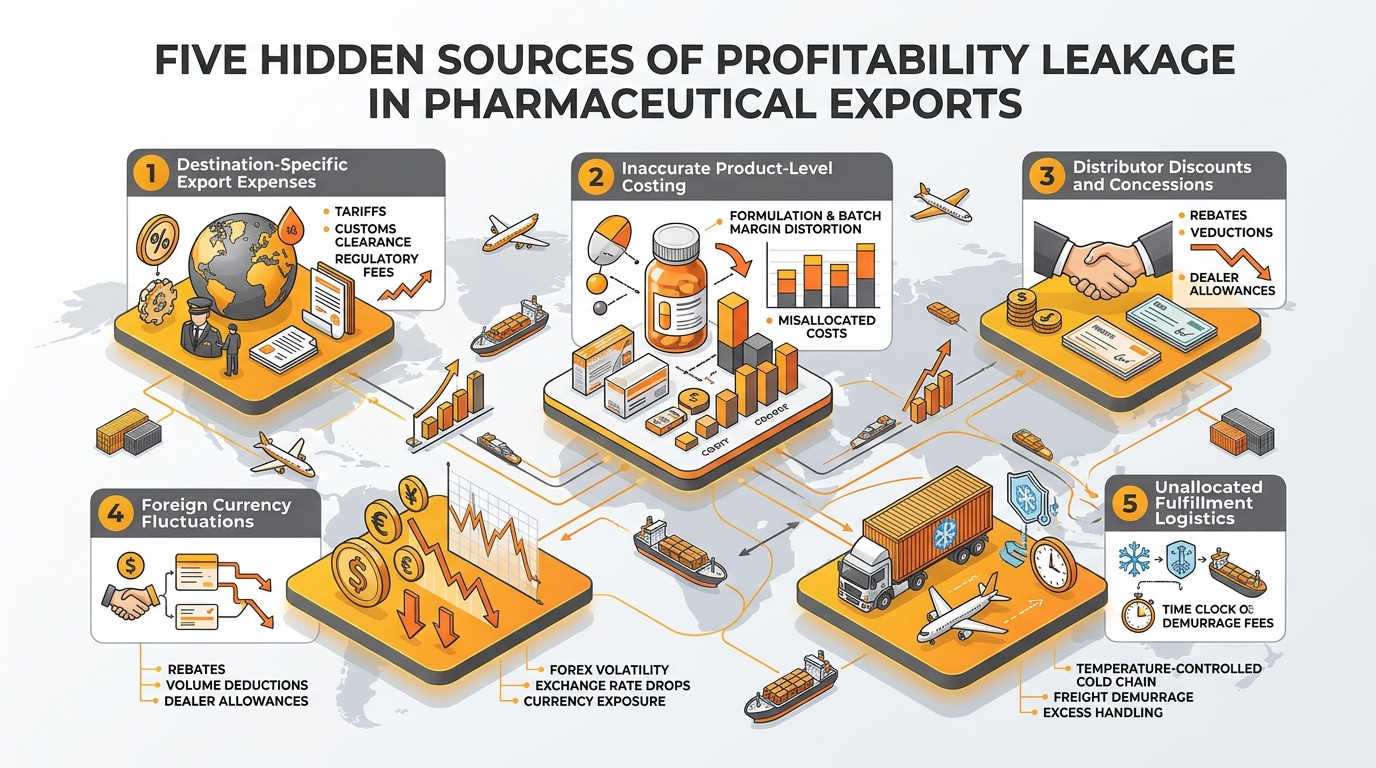
Enterprise analytical infographic illustrating five hidden sources of profitability leakage in pharmaceutical exports including destination-specific freight expenses, inaccurate product-level costing, distributor discounts, foreign currency fluctuations, and unallocated logistics overhead.
The Financial Impact of Revenue-Only Market Analysis
Consider a pharmaceutical exporter supplying two international markets. Both generate identical quarterly revenue, but their cost structures differ.
| Financial measure | Market A | Market B |
|---|---|---|
| Net export revenue | ₹50 lakh | ₹50 lakh |
| Manufacturing and product costs | ₹25 lakh | ₹27 lakh |
| Freight and insurance | ₹5 lakh | ₹8 lakh |
| Distribution expenses | ₹4 lakh | ₹6 lakh |
| Other attributable expenses | ₹3 lakh | ₹4 lakh |
| Total identified costs | ₹37 lakh | ₹45 lakh |
| Contribution after identified costs | ₹13 lakh | ₹5 lakh |
| Contribution after identified costs (%) | 26% | 10% |
Illustrative example only. These hypothetical figures are not industry benchmarks or customer results. The calculation excludes costs not shown and is not a measure of net profit.
Despite identical revenue, Market A generates ₹8 lakh more contribution than Market B. Its contribution percentage is also 16 percentage points higher.
If expansion decisions were based exclusively on sales figures, both markets might receive equal investment. A cost-based comparison provides a more meaningful foundation for prioritising markets and investigating underperformance.
Gross Margin, Contribution and Net Profit
These financial measures serve different purposes:
- Gross margin: Net revenue less the relevant cost of goods sold, expressed as a percentage of net revenue when reported as a margin percentage.
- Contribution margin: Conventionally, net revenue less variable costs. Businesses may also define a management contribution measure that deducts additional attributable expenses.
- Net profit: Revenue less all applicable expenses, including relevant operating, financing and tax expenses.
For consistency, the finance team must define which costs are included in each measure and apply the same methodology across markets. The example uses contribution after identified costs rather than assuming that every identified cost is variable.
Pharmaceutical ERP Software as a Connected Profitability Framework
Pharmaceutical ERP software creates an integrated foundation for analysing financial and operational transactions rather than relying on manually consolidated reports.
An effective framework connects three layers of information:
- Transaction layer: Sales orders, invoices, credit notes, purchase documents, production records and inventory movements establish the underlying business activity.
- Cost and financial layer: Accounting entries, product costs, exchange differences and attributable expenses establish the financial impact of that activity.
- Decision layer: Configured reports compare performance by country, product, distributor and financial period.
The value comes from linking these layers using reliable master data, reporting dimensions and accounting controls. ERP software does not independently eliminate margin leakage; it provides the information needed to investigate it and take corrective action.
SAP Business One Capabilities for Pharmaceutical Export Profitability
SAP Business One is an integrated ERP solution for small and midsized businesses. Its core ERP capabilities provide a foundation for managing financial transactions, commercial activity, purchasing, inventory and management reporting.
For pharmaceutical exporters, the following capabilities are particularly relevant.
| Business requirement | SAP Business One capability | Implementation consideration |
|---|---|---|
| Country-wise financial visibility | General ledger, receivables, payables and financial reporting | Define reporting dimensions and expense allocation |
| Distributor performance | Business partner records, sales documents and pricing | Configure discount approvals and rebate processes |
| Product profitability | Inventory, purchasing and production transaction data | Establish product costing and appropriate expense treatment |
| Foreign currency accounting | Foreign currency transactions and exchange-rate records | Advanced treasury analysis may require separate tools |
| Export expense analysis | Connected transaction and accounting records | Detailed shipment or order costing may require custom reports |
| Executive visibility | Standard and configurable reporting | Build dashboards around agreed financial measures |
Integrated Financial Management
Finance teams can use general ledger records, accounts receivable, accounts payable and financial reports to examine how commercial transactions affect reported performance.
With suitable account structures and cost accounting dimensions, these records can support country-wise and business-segment analysis. Reports must be designed to reconcile with the financial ledger rather than create an independent version of profitability.
Distributor Pricing and Sales Control
SAP Business One connects customer records with sales quotations, orders, deliveries, invoices and credit notes. This creates a transaction history for reviewing realised selling prices and customer activity.
Price lists, discount settings and appropriate approval processes can support commercial control. Specialised distributor rebate arrangements or settlement requirements may require additional functionality.
Purchasing, Inventory and Product Cost Management
Purchasing documents, goods receipts and inventory movements provide information for analysing material costs and product economics. SAP Business One also provides production-related functionality that can support defined manufacturing processes.
Pharmaceutical businesses with complex process manufacturing, quality management or regulated production requirements should separately assess whether specialised add-ons or integrations are necessary.
Multi-Currency Financial Accounting
Foreign currency accounting helps finance teams maintain transaction values and review exchange-rate differences. The accounting treatment depends on transaction circumstances, configuration and applicable accounting requirements.
These capabilities support the financial records needed for currency analysis. They are not a substitute for dedicated treasury forecasting, hedging or currency risk management processes.
Management Reporting and Analytics
Standard reports and configured dashboards can help executives review business performance using connected transaction information. Advanced country-wise contribution, fully allocated order profitability and external logistics analysis may require customised reporting or integration.
The reporting scope should be demonstrated using representative pharmaceutical export transactions before implementation.
Explore SAP Business One for the pharmaceutical industry to understand its broader role in pharmaceutical business operations.
A CFO’s Profitability Measurement Framework for Global Markets
An effective ERP reporting environment should answer distinct management questions rather than present more data without clear financial meaning.
| Performance indicator | Measurement approach | Management purpose |
|---|---|---|
| Country-wise contribution | Net sales less defined attributable costs | Prioritise international markets |
| Product gross margin | Net product sales less associated cost of goods sold | Evaluate product economics |
| Distributor contribution | Net distributor sales less defined customer-related costs | Review commercial agreements |
| Export fulfilment cost ratio | Attributable fulfilment costs divided by net export sales | Monitor logistics efficiency |
| Foreign currency differences | Review realised and unrealised exchange differences separately | Distinguish currency effects from operating performance |
| Receivables ageing | Review unpaid balances by agreed ageing bands | Monitor collection risk and working capital |
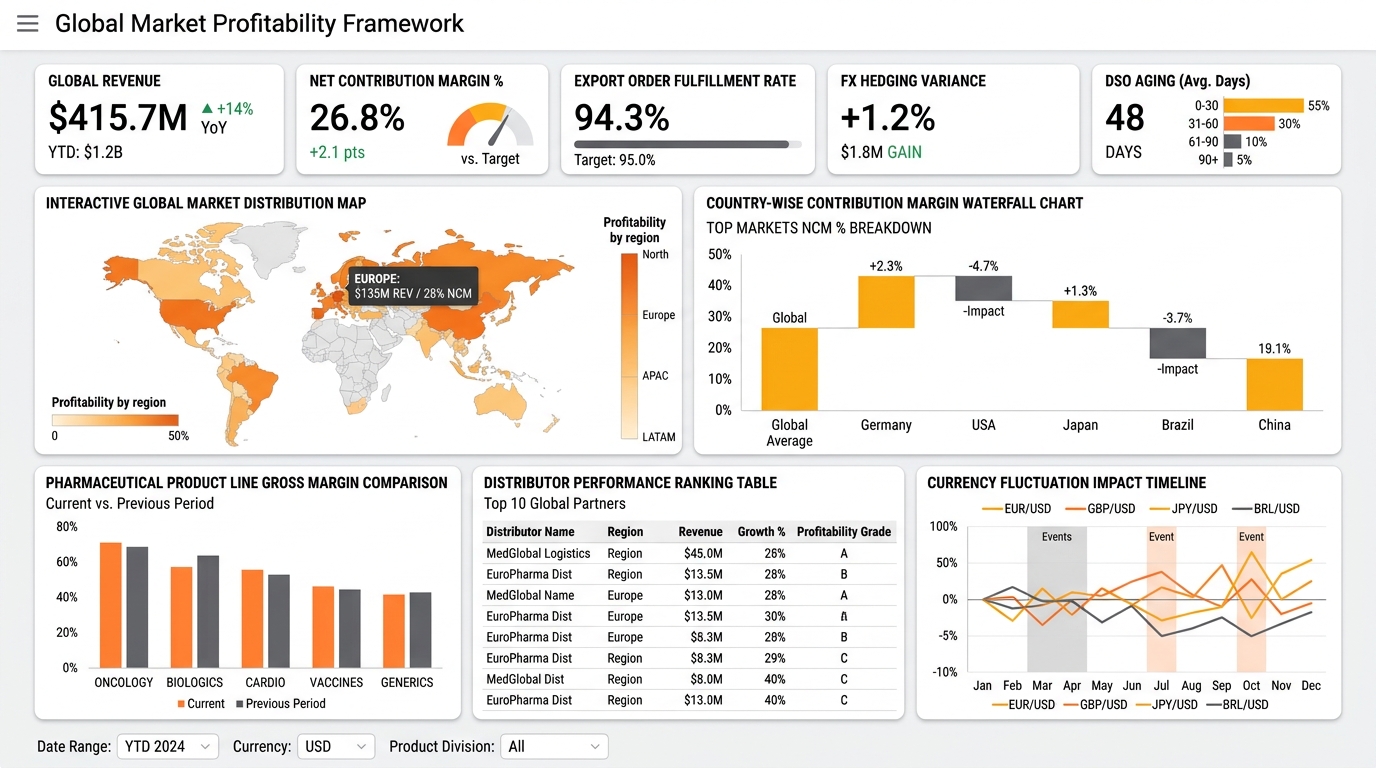
Executive financial dashboard and reporting framework for pharmaceutical CFOs showing country-wise contribution margins, product gross margins, distributor performance, export fulfilment ratios, currency impact, and receivables ageing.
These indicators should use consistent reporting periods, exchange-rate policies and expense classifications. Shared expenses need documented allocation drivers, such as shipment weight, order value or handling activity, where those drivers reasonably reflect cost consumption.
A monthly review can begin with a market-level comparison, followed by drill-down analysis of products, distributors and transactions that explain significant variances. Finance should also reconcile total reported costs with the relevant ledger accounts.
This approach makes profitability reporting useful for management decisions rather than simply adding another dashboard to the reporting environment.
Strategic Business Decisions Supported by Better Margin Visibility
Market Expansion and Capital Allocation
CEOs can evaluate whether a destination’s financial contribution justifies additional inventory, distribution investment or market-entry expenditure. Historical performance can inform expansion assumptions, but forecasts should also consider demand, market access requirements and working capital needs.
Distributor Negotiations and Pricing Reviews
Commercial leaders can identify agreements where high sales volumes are offset by excessive discounts, expensive fulfilment or unfavourable payment conditions. This provides a stronger basis for reviewing pricing, order thresholds and contract terms.
Product Portfolio and Operational Efficiency
COOs and finance teams can investigate products affected by rising material expenditure, packaging costs or inefficient shipment arrangements. Product-level analysis helps distinguish pricing problems from operational cost issues.
Cash Flow and Financial Risk
Profitability alone does not establish whether a market generates healthy cash flow. Long collection periods can increase working capital requirements even when reported contribution is positive.
Combining margin analysis with receivables aging and payment terms helps CFOs evaluate the broader financial implications of international sales.
Implementation Safeguards for Reliable Export Profitability Reporting
Selecting an ERP solution is only one part of improving financial control. The accuracy of the resulting reports depends on the quality of the implementation.
Define Reporting Dimensions Before Configuration
Agree on the country, product group, distributor, shipment and business-unit information required for management reporting. Distinguish the distributor’s billing country from the actual destination market where relevant.
Establish Cost Allocation and Accounting Policies
Identify which costs can be traced directly to a product, order or shipment and which require an allocation rule. Document the treatment of discounts, returns, freight, currency differences and shared expenses to prevent omissions or double counting.
Validate Historical Data and Integrations
Review product master data, customer records, open receivables, inventory balances and available shipment expenses before migration. Where logistics, quality or manufacturing applications remain in use, define how relevant data will be integrated and reconciled.
Test Reports Against Actual Transactions
Use representative export orders involving discounts, different currencies, freight invoices and credit notes. Validate whether the calculated market and product contributions agree with finance-approved expectations and reconcile with underlying accounting records.
Confirm Pharmaceutical-Specific Requirements
Financial integration does not automatically establish regulatory compliance. Assess batch traceability, expiry management, quality workflows, validation obligations and market-specific documentation requirements separately. Confirm the standard, configured and extended capabilities required for each process.
Assign Ownership and Train Users
Define who maintains pricing agreements, records shipment expenses, reviews exchange rates and approves cost allocation rules. Train users in the processes that affect financial reporting, and establish periodic controls for incomplete or incorrectly classified transactions.
Moving from Export Revenue Growth to Sustainable Profitability
An integrated ERP environment becomes worth evaluating when finance teams cannot reliably explain margin differences, monthly reporting depends heavily on spreadsheets or international transaction volumes exceed existing reporting capacity.
However, an ERP implementation should follow a clear business case. Some businesses may first need stronger accounting structures, better master data or improved cost allocation. Others require a connected system to support their expanding distributor networks and operational complexity.
Our experts can help pharmaceutical manufacturers evaluate SAP Business One against their export processes, financial reporting requirements and integration needs. Our implementation approach identifies which capabilities are available as standard, which require configuration and which need additional solutions.
The objective goes beyond consolidating business information. It is to establish a reliable financial foundation that helps decision-makers evaluate product profitability, distributor performance and market opportunities before making further investment decisions.
Frequently Asked Questions
Gain Control Over Global Pharmaceutical Profitability with SAP Business One
Your international sales figures tell you how much you sell. Your profitability reports should tell you which markets are worth growing.
Discover we can help you connect financial and operational data, evaluate export costs and develop a reporting framework aligned with your pharmaceutical business requirements.
Book Your Personalised SAP Business One Demo with Us.