
SAP Business One Partner Solutions for Manufacturing Challenges
SAP Business One Partner expertise for manufacturing efficiency, visibility, and growth
Manufacturers rarely experience production, inventory, procurement, sales, and finance problems independently. A material shortage can affect production schedules, customer delivery commitments, purchasing decisions, inventory costs, and cash flow at the same time. An SAP Business One Partner helps manufacturers connect these processes through an integrated ERP environment while providing the implementation expertise needed to configure workflows, migrate data, manage integrations, train users, and improve operational control.
How Can an SAP Business One Partner Help Manufacturers?
A SAP Business One Partner helps manufacturers connect production, MRP, inventory, procurement, warehouse, sales, and finance processes within SAP Business One.
The partner’s role goes beyond ERP installation. It includes process mapping, system configuration, data migration, integration planning, testing, role-based training, reporting design, go-live support, and continuous optimization.
For manufacturers dealing with spreadsheets, disconnected systems, unreliable inventory information, production delays, or fragmented reporting, the combination of SAP Business One and the right implementation partner can create a more controlled operational environment.
Why Manufacturing Challenges Become ERP Challenges
Manufacturing operations depend on interconnected decisions.
Customer demand influences material requirements. Material availability affects production schedules. Production changes inventory. Inventory affects customer commitments. Purchasing affects working capital. Operational transactions ultimately affect finance.
When those processes operate through disconnected applications, spreadsheets, emails, or manually maintained records, management loses visibility across the complete business cycle.
Common warning signs include:
- production schedules maintained outside the ERP;
- repeated spreadsheet consolidation;
- duplicate data entry between departments;
- unreliable inventory balances;
- last-minute material shortages;
- reactive purchasing;
- delayed management reporting;
- inconsistent bills of materials;
- customer commitments made without operational visibility; and
- finance teams reconciling information from multiple systems.
The underlying problem is usually not one department.
It is the absence of a connected operating model.
Manufacturing Problems SAP Business One Can Help Address
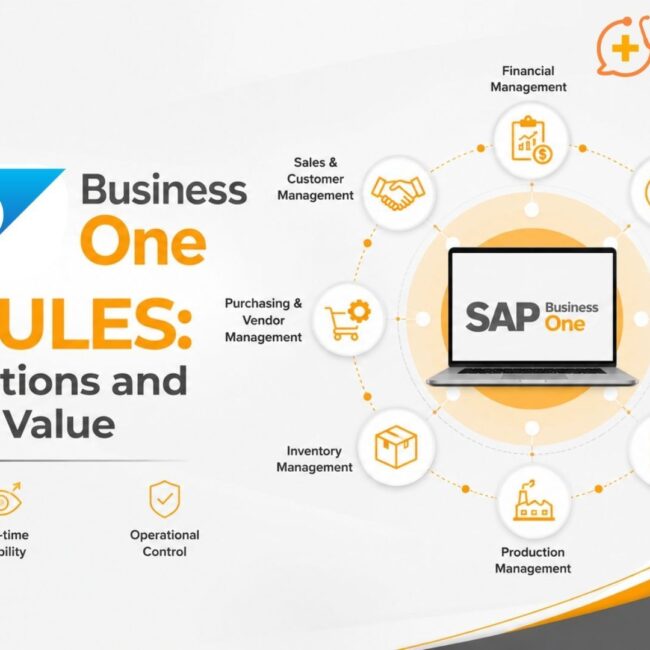
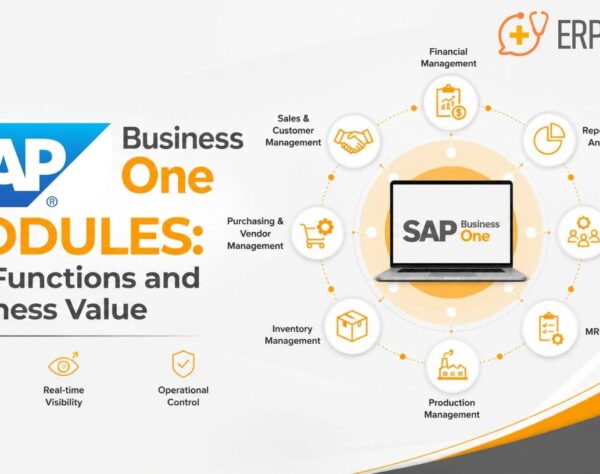
SAP Business One provides integrated ERP capabilities covering areas such as production, material requirements planning, purchasing, inventory, sales, customer management, and finance.
For manufacturing businesses, the value comes from connecting these functions rather than using each module independently.
Production Planning and Material Requirements
Business problem: Production planners identify component shortages too late.
SAP Business One includes production functionality supporting bills of materials and production orders. Its Material Requirements Planning functionality evaluates relevant demand, supply, inventory, production orders, purchase orders, forecasts, and planning parameters to calculate material requirements.
This gives planners a more structured basis for deciding:
- what materials may be required;
- when they may be required;
- whether inventory is already available;
- whether procurement may be necessary; and
- whether production orders should be considered.
The important distinction is that MRP improves planning visibility. Manufacturers requiring advanced finite scheduling, detailed machine-level planning, MES functionality, or specialized shop-floor control may require additional solutions or integrations.
Inventory and Warehouse Control
Business problem: The ERP shows inventory, but operations cannot confidently determine whether it is actually available.
Inventory management must provide more than a total stock quantity.
Manufacturers may need visibility into:
- warehouse location;
- available quantity;
- committed quantity;
- stock movements;
- inventory valuation;
- batch information;
- serial information; and
- production-related material movements.
SAP Business One supports structured inventory processes and batch or serial number management where required.
Better inventory information can support purchasing, production planning, warehouse operations, customer commitments, and working-capital control.
Procurement Aligned With Manufacturing Demand
Business problem: Purchasing teams react to urgent shortages rather than planned requirements.
When procurement, inventory, and manufacturing information are disconnected, buyers may purchase too late, over-purchase, or lack visibility into upcoming material requirements.
Connecting purchasing information with inventory and production-related requirements gives procurement teams stronger context when evaluating:
- supplier requirements;
- purchase orders;
- incoming materials;
- existing stock; and
- future production needs.
The objective is not simply faster purchasing.
It is more disciplined purchasing based on actual operational requirements.
Sales Connected With Operational Reality
Business problem: Sales promises a delivery date without knowing whether operations can support it.
Customer information becomes more useful when it is connected with quotations, sales orders, inventory, delivery activity, and other relevant ERP information.
This creates stronger coordination between sales and manufacturing.
Instead of treating customer commitments as a sales-only decision, the organization can evaluate them within a broader operational context.
Finance Connected With Manufacturing Transactions
Business problem: Finance receives operational information too late.
Manufacturing economics are created throughout day-to-day operations.
Purchasing, inventory transactions, production activity, deliveries, sales, and other business events affect the financial picture.
An integrated ERP environment helps reduce the need for finance teams to reconstruct business activity manually from disconnected systems.
For CFOs and business owners, the objective is stronger visibility into operational and financial information within the same controlled environment.
Reporting Built Around Management Decisions
Business problem: Management reports arrive after the problem has already occurred.
Reporting should begin with executive questions rather than dashboard design.
For example:
- What production exceptions require management attention?
- Which materials could affect upcoming production?
- What inventory positions require review?
- Which purchase commitments matter to finance?
- Which customer orders face delivery risk?
- What cost or margin indicators should management monitor?
A capable SAP Business One consulting partner should translate these questions into reporting requirements rather than simply increasing the number of reports available.
How Connected Manufacturing Workflows Change Operations
Consider a customer order.
In a fragmented environment, the order may be:
- entered by sales;
- copied into a production spreadsheet;
- emailed to purchasing;
- manually checked against inventory;
- communicated to the warehouse;
- re-entered or reconciled by finance.
Every manual handoff creates another opportunity for delay or inconsistency.
Within an integrated ERP model, related transactions can operate from shared business information.
The customer order contributes to demand visibility. Material requirements can influence procurement. Inventory affects production readiness. Production transactions affect stock. Delivery supports invoicing, and relevant transactions feed financial information.
The value is not simply automation.
The value is maintaining a more consistent operational record across departments.
Where the SAP Business One Partner Adds Value
SAP Business One provides the ERP platform.
The implementation partner determines how effectively that platform is translated into the manufacturer’s operating environment.
A weak implementation can reproduce existing problems inside new software.
A disciplined implementation should improve the way processes, data, users, integrations, and controls work together.
1. Manufacturing Process Discovery
Implementation should begin by understanding the business before configuring the system.
Discovery should cover areas such as:
- order-to-delivery;
- production planning;
- bills of materials;
- material requirements;
- purchasing;
- goods receipts;
- inventory movements;
- warehouse processes;
- customer commitments;
- financial controls;
- approvals;
- reporting;
- integrations; and
- future growth requirements.
The objective should not be to reproduce every legacy workflow.
The objective should be to identify what should be standardized, configured, integrated, redesigned, or retired.
2. Configuration Before Customization
Manufacturers often have legitimate process differences.
However, every difference does not justify custom development.
A stronger implementation approach normally follows this order:
Standardize the process → Configure SAP Business One → Identify genuine functional gaps → Evaluate extensions or integrations
This helps prevent unnecessary technical complexity and can make the ERP easier to maintain over time.
3. Master Data and Data Migration
Poor data can undermine an otherwise well-designed ERP implementation.
Manufacturers should establish ownership and validation rules for important records such as:
- items;
- customers;
- suppliers;
- warehouses;
- bills of materials;
- opening balances; and
- other required master or transactional information.
Before migration, duplicated, incomplete, outdated, or inconsistent information should be identified.
A partner should define:
- migration scope;
- data ownership;
- cleansing responsibilities;
- validation procedures;
- reconciliation;
- migration testing; and
- final cutover responsibilities.
Moving bad data into a new ERP does not create better information.
4. Integration Architecture
Manufacturers may continue using specialist applications alongside SAP Business One.
Examples can include production technologies, e-commerce applications, external logistics platforms, specialized manufacturing systems, or other business applications.
Integration requirements should answer four questions:
What data moves?
Which system owns that data?
How frequently should it move?
What happens when the integration fails?
Without this discipline, integration can simply create another layer of disconnected information.
5. Testing and User Adoption
ERP testing should reflect complete business scenarios.
Testing only individual transactions may miss problems that appear when one department’s activity affects another.
A realistic scenario could follow:
Sales Order → Material Planning → Purchasing → Goods Receipt → Production → Inventory → Delivery → Finance
Training should also be role-based.
Production planners, warehouse users, sales teams, finance teams, purchasing users, and executives need different levels of system knowledge.
Users should understand not only what transaction to enter but also how their actions affect downstream processes.
6. Go-Live and Continuous Improvement
ERP implementation does not end at go-live.
After stabilization, manufacturers commonly identify opportunities involving:
- reporting;
- workflow adjustments;
- additional training;
- process automation;
- integrations;
- master-data governance; and
- management dashboards.
Post-go-live optimization should therefore be treated as part of ERP governance rather than an emergency support function.
Manufacturing Visibility: More Than Dashboards
One of the most common ERP objectives is improved visibility.
However, visibility does not begin with dashboards.
It begins with transaction accuracy.
Leadership may want visibility into:
- production status;
- material requirements;
- inventory availability;
- purchasing commitments;
- sales orders;
- delivery commitments;
- receivables;
- operational costs;
- margins; and
- other management KPIs.
But a dashboard cannot correct inaccurate transactions, inconsistent master data, or delayed postings.
Reliable management visibility depends on:
Process discipline + Data quality + Transaction accuracy + Reporting design
The partner’s responsibility is to help connect these elements.
The executive question should eventually move from:
“Who has the latest spreadsheet?”
to:
“Which current operational exceptions require management action?”
SAP Business One and Manufacturing Growth
Growth adds complexity.
A manufacturer may add:
- products;
- suppliers;
- customers;
- warehouses;
- users;
- transactions;
- approval requirements;
- reporting requirements;
- integrations; or
- operating locations.
Processes that depended on experienced individuals may become increasingly difficult to control as transaction volumes increase.
SAP Business One can provide a structured ERP foundation, but scalability should always be evaluated against the manufacturer’s actual growth roadmap.
Leadership should consider:
- expected transaction volumes;
- number of users;
- warehouse complexity;
- production requirements;
- number of locations;
- integration requirements;
- reporting complexity; and
- future business models.
No ERP should be assumed to provide unlimited scalability.
The implementation partner should evaluate future requirements during solution design rather than focusing only on today’s problem.
How to Evaluate an SAP Business One Partner for Manufacturing
Choosing a SAP Business One Partner is also choosing how implementation risk will be managed.
Executives should evaluate the partner using questions such as these.
Manufacturing Expertise
Can the partner discuss:
- BOMs;
- MRP;
- production orders;
- inventory;
- purchasing;
- warehouse processes;
- costing;
- traceability; and
- delivery commitments
in operational terms?
Discovery Approach
Does the implementation begin with business-process discovery, or does the conversation immediately move to software features?
Module Integration
Can the partner explain how production, inventory, purchasing, sales, and finance processes affect one another?
Implementation Governance
Are the following clearly defined?
- project phases;
- responsibilities;
- milestones;
- testing;
- data migration;
- scope control;
- change management;
- training; and
- go-live readiness.
Data Migration
Who owns cleansing?
Who approves migrated data?
How will balances and master data be reconciled?
Customization Discipline
Does the partner investigate standard functionality and process improvement before proposing custom development?
Integration Capability
Can the partner clearly define system ownership, data flows, failure handling, and support responsibilities?
Training
Will training reflect actual user roles and business scenarios?
Reporting
Can the partner convert executive KPIs into meaningful ERP reporting requirements?
Post-Go-Live Support
How will stabilization, incidents, enhancements, and future optimization requests be handled?
A useful evaluation signal is the quality of the questions the partner asks.
If most questions concern only licenses and software features, the discovery process may be too shallow.
A manufacturing-focused implementation partner should also ask about production bottlenecks, inventory accuracy, data ownership, reporting delays, integration dependencies, user responsibilities, financial controls, and future growth.
Measuring the Business Impact of SAP Business One
ERP ROI should be evaluated against business problems rather than software ownership.
Before implementation, establish baseline measurements.
Depending on the manufacturer’s objectives, useful KPIs may include:
- inventory accuracy;
- material shortage frequency;
- management reporting time;
- manual reconciliation effort;
- production schedule adherence;
- purchase-planning visibility;
- transaction processing time;
- manual data-entry volume;
- order-to-delivery performance;
- reporting delays;
- working-capital indicators; and
- selected cost or margin measures.
The purpose is not to create an unrealistic ROI promise.
It is to determine whether the new ERP environment is improving the operational problems that justified the investment.
When Should a Manufacturer Consider SAP Business One?
SAP Business One may be worth evaluating when operational growth is creating problems such as:
- disconnected applications;
- increasing spreadsheet dependence;
- unreliable inventory visibility;
- repeated data entry;
- delayed production information;
- reactive purchasing;
- fragmented financial reporting;
- poor cross-department coordination; or
- excessive dependence on individual employees.
The ERP selection decision should still be based on process complexity, business requirements, transaction volumes, integrations, reporting needs, and future growth plans.
Why Consider Emerging Alliance for SAP Business One?
Manufacturing ERP evaluation should begin with the business process rather than a predetermined software configuration.
Emerging Alliance can work with manufacturers to evaluate:
- production and MRP requirements;
- inventory processes;
- purchasing workflows;
- warehouse operations;
- financial controls;
- sales-to-delivery processes;
- reporting requirements;
- integration dependencies;
- data quality; and
- future growth requirements.
The objective is to determine where SAP Business One fits, what should remain standardized, which gaps require additional capabilities, and what implementation approach makes operational sense.
Manufacturing ERP Discussion
If spreadsheets, material shortages, unreliable inventory information, fragmented reporting, or disconnected systems are creating operational problems, the next step is to map the process before selecting functionality.
Conclusion
Manufacturing problems become harder to control when production, inventory, procurement, sales, warehouse operations, and finance depend on disconnected information.
SAP Business One can provide an integrated ERP foundation for many of these processes. SAP documentation confirms support for manufacturing capabilities including production orders, production BOMs, MRP, inventory planning, and batch or serial management.
The larger implementation challenge is ensuring that processes, data, integrations, reporting, and users work together correctly.
That is where the SAP Business One Partner becomes strategically important.
A capable partner should not simply implement software. The partner should help create a controlled ERP environment that supports reliable information, stronger manufacturing coordination, and future growth.
Frequently Asked Questions
What does an SAP Business One Partner do for a manufacturer?
An SAP Business One Partner evaluates manufacturing processes, configures the ERP, manages data migration and necessary integrations, coordinates testing and training, supports go-live, and helps optimize the environment after implementation.
Which SAP Business One capabilities are useful for manufacturing?
Relevant capabilities can include production orders, bills of materials, MRP, purchasing, inventory and warehouse processes, financial management, reporting, sales, CRM, and batch or serial management where required.
How does SAP Business One MRP support manufacturing?
SAP Business One MRP evaluates demand, existing inventory, supply information, production orders, purchase orders, forecasts, BOM structures, and relevant planning parameters to calculate material requirements and generate planning recommendations.
Can SAP Business One manage bills of materials?
Yes. SAP Business One supports production bills of materials used with production processes and MRP. The required BOM design should reflect the manufacturer’s actual products, components, resources, and production requirements.
Does SAP Business One support batch and serial tracking?
Yes. SAP Business One supports batch and serial number management. The appropriate configuration depends on the manufacturer’s inventory, traceability, product, customer, and regulatory requirements.
Can SAP Business One integrate with other manufacturing systems?
Yes, where suitable integration options are available. Manufacturers should first define which system owns each data set, which information must be exchanged, how frequently it moves, and how integration failures will be handled.
Should manufacturers customize SAP Business One?
Customization should not be the first option. A stronger approach is to standardize processes where practical, use standard configuration where it meets the requirement, and introduce extensions or integrations only when a justified business gap remains.
What should executives check before selecting an SAP Business One Partner?
Executives should evaluate manufacturing knowledge, discovery methodology, implementation governance, data migration discipline, integration capability, customization approach, testing, role-based training, reporting expertise, post-go-live support, and understanding of business KPIs.
Ready to Evaluate SAP Business One for Manufacturing?
Request a Demo with Emerging Alliance to discuss your production, inventory, procurement, reporting, and ERP integration requirements.