
SAP S/4HANA vs Oracle NetSuite: Key ERP Differences for 2026
Quick Answer
SAP S/4HANA and Oracle NetSuite both support finance, procurement, inventory, supply chain, and enterprise operations, but they are designed for different levels of business complexity. SAP S/4HANA is generally better suited to organizations requiring deep operational control, complex manufacturing, and enterprise-scale processes. NetSuite is often attractive to cloud-first, growing organizations seeking standardized ERP and multi-entity management with comparatively lower IT complexity.
The right choice depends less on which ERP has more features and more on which platform fits your operating model, industry requirements, growth plans, integration landscape, and ability to manage implementation complexity.
SAP S/4HANA vs Oracle NetSuite at a Glance
For executives comparing enterprise platforms, the biggest mistake is starting with hundreds of individual features.
First determine the fundamental fit.
| Comparison Area | SAP S/4HANA | Oracle NetSuite |
|---|---|---|
| Typical fit | Complex mid-market and large enterprises | Growing and mid-market businesses, including multi-entity organizations |
| Deployment | Public Cloud and Private Cloud options | Cloud SaaS |
| Financial management | Advanced enterprise finance | Strong cloud financial management |
| Manufacturing | Deep capabilities for complex operations | Strong capabilities for many standard manufacturing requirements |
| Supply chain | Extensive enterprise capabilities | Integrated supply chain functionality |
| Multi-entity operations | Strong | Strong through NetSuite OneWorld |
| Customization | Varies significantly by deployment model | SuiteCloud platform and ecosystem |
| Implementation complexity | Can range from standardized to highly complex | Generally more standardized |
| IT requirements | Can be significant for complex environments | Typically lower infrastructure burden |
| Best-fit consideration | Process depth and enterprise complexity | Cloud standardization and scalable growth |
SAP describes S/4HANA Cloud Public Edition as a ready-to-run cloud ERP built around preconfigured processes and industry best practices, while its Private Edition is designed to provide greater enterprise depth and extensibility.
NetSuite, meanwhile, positions its platform as a cloud ERP covering financials and broader back-office processes, with OneWorld supporting multi-subsidiary and multinational operations.
The key takeaway is simple:
Do not choose between SAP S/4HANA and NetSuite by counting features. Choose based on the complexity those features need to manage.
SAP S/4HANA vs Oracle NetSuite: The Fundamental Difference
SAP S/4HANA and Oracle NetSuite overlap across many ERP functions, but they approach the ERP problem from different directions.
SAP S/4HANA
SAP S/4HANA is built for organizations that may need to coordinate finance, procurement, production, warehousing, supply chain, asset management, sales, and other business processes within a highly integrated ERP environment.
Its relevance becomes particularly strong when a business has:
- Complex manufacturing processes
- Multiple production plants
- Advanced supply-chain requirements
- Large transaction volumes
- Detailed product costing
- Complex organizational structures
- Industry-specific requirements
- Extensive enterprise integrations
- Strong governance and control requirements
SAP also offers different deployment approaches.
SAP S/4HANA Cloud Public Edition emphasizes standardization and predefined best practices, whereas Private Edition provides greater flexibility for organizations with more complex requirements. SAP’s documentation also identifies finance, manufacturing, procurement, supply chain, warehouse management, transportation, asset management, and related business areas within the platform.
Oracle NetSuite
Oracle NetSuite was developed around the cloud SaaS model and provides an integrated environment covering areas such as:
Procurement
Inventory
Order management
CRM
Manufacturing
Projects
Reporting
Multi-subsidiary management
Ecommerce and related applications
For growing businesses, the appeal is frequently the ability to operate these functions within one cloud platform without managing a traditional ERP infrastructure.
NetSuite OneWorld is particularly relevant to companies operating multiple subsidiaries, legal entities, currencies, taxation environments, and countries.
Why This Difference Matters
A company with 500 employees can sometimes have more ERP complexity than one with 5,000.
Employee count or revenue alone should therefore not determine the decision.
The more useful question is: How difficult are the processes the ERP must control?
A multinational manufacturer managing complex production planning, plant operations, quality, warehousing, global procurement, product costing, and regulatory requirements has fundamentally different ERP needs from a fast-growing services or distribution company focused mainly on finance, orders, inventory, projects, and subsidiaries.
That distinction should guide the entire SAP S/4HANA vs Oracle NetSuite evaluation.
Deployment and ERP Architecture
Deployment is one of the most important differences because it influences customization, upgrades, implementation, integration, IT responsibility, and long-term cost.
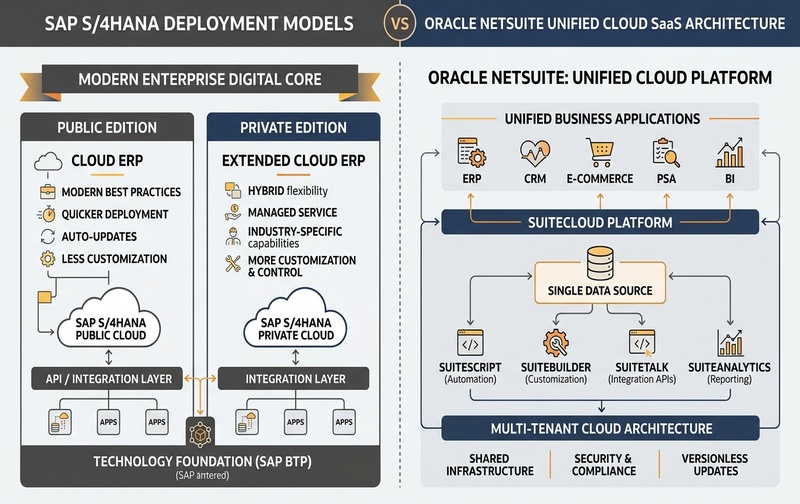
Figure 1: Architectural comparison between SAP S/4HANA Cloud (Public & Private Editions) and Oracle NetSuite unified multi-tenant SaaS architecture.
SAP S/4HANA Cloud Public Edition
Public Edition follows a more standardized cloud ERP approach. It is designed around:
- Preconfigured processes
- Industry best practices
- Cloud delivery
- Standardization
- Regular innovation
- Fit-to-standard implementation
This can work well for organizations prepared to redesign processes around standardized ERP practices rather than recreating every historical process.
SAP S/4HANA Cloud Private Edition
Private Edition is more relevant when an organization needs greater flexibility and process depth. It may be considered when businesses have:
- Complex existing SAP environments
- Extensive integration requirements
- Significant process differentiation
- Industry-specific requirements
- Larger transformation programs
- Greater need for extensibility
SAP describes Cloud ERP Private as an offering for businesses requiring the depth of its established ERP capabilities with an extensible platform.
Oracle NetSuite Cloud
NetSuite follows a cloud SaaS model.
The platform can reduce the need for companies to manage their own core ERP infrastructure and provides a standardized cloud foundation for financial and operational applications.
For organizations prioritizing rapid cloud adoption and avoiding heavy infrastructure management, this architecture can be attractive.
The Decision
The deployment question is therefore not simply: Cloud or cloud?
Instead ask: How much process standardization can the business accept, and how much enterprise flexibility does it genuinely require?
That question often reveals more than a feature comparison.
Core ERP Capabilities: SAP S/4HANA vs Oracle NetSuite
Both systems cover major ERP processes. The difference becomes clearer when businesses evaluate the depth and complexity required within each process.
Financial Management
Both platforms provide financial capabilities covering core accounting processes. Organizations comparing them should assess:
Accounts payable
Accounts receivable
Cash management
Asset accounting
Financial consolidation
Multi-currency operations
Intercompany processing
Revenue recognition
Budgeting and planning
Compliance
Financial reporting
SAP S/4HANA becomes particularly relevant when finance must integrate deeply with complex manufacturing, product costing, procurement, assets, supply chain, and enterprise-wide operational processes.
NetSuite is attractive when businesses want financial management connected with orders, inventory, subsidiaries, CRM, projects, and other cloud processes.
The CFO should evaluate financial complexity, not simply accounting functionality.
Procurement
Both platforms can help move procurement away from spreadsheets, emails, and disconnected approvals. Decision-makers should compare:
Purchase orders
Supplier management
Approval workflows
Contract requirements
Spend controls
Goods receipts
Invoice matching
Procurement reporting
For organizations with complex strategic sourcing and enterprise procurement requirements, the surrounding SAP ecosystem can provide considerable depth.
For organizations seeking integrated procure-to-pay processes within a cloud business platform, NetSuite can provide a more streamlined model.
Inventory and Warehouse Management
The key requirements include:
Multiple locations
Lot and serial tracking
Replenishment
Goods movements
Stock transfers
Warehouse processes
Inventory costing
Traceability
Demand visibility
The deciding factor again becomes complexity.
A regional distributor operating several warehouses has different requirements from a multinational manufacturer running highly automated distribution centers connected to production plants.
Supply Chain Management
Supply-chain requirements can substantially change the ERP decision. Organizations should assess:
Supply planning
Procurement
Production integration
Logistics
Transportation
Warehouse operations
Supplier coordination
Inventory optimization
End-to-end visibility
SAP S/4HANA generally becomes more compelling as supply-chain complexity increases.
Manufacturing
Manufacturing is one area where businesses should avoid overly simplistic ERP comparisons. Evaluate:
Work orders
MRP
Routings
Production planning
Capacity requirements
Material availability
Shop-floor processes
Production costing
Quality
Traceability
Subcontracting
Multi-plant operations
NetSuite supports manufacturing concepts including BOMs, manufacturing routings, work orders, demand planning, quality, WIP, and related capabilities.
However, organizations with very complex production models should evaluate whether those capabilities provide sufficient depth before making a selection.
Manufacturing fit should be validated process by process, not based on the existence of a manufacturing module.
Scalability and Global Business Management
ERP scalability is frequently misunderstood.
It does not simply mean that a system can add more users.
True ERP scalability means the platform continues to support the organization as business complexity increases. That may include:
Multi-Entity Operations
Can the system support additional:
- Companies
- Business units
- Subsidiaries
- Plants
- Warehouses
- Legal entities?
Multi-Country Operations
Expansion creates requirements around:
- Currencies
- Languages
- Tax structures
- Accounting standards
- Local reporting
- Consolidation
- Intercompany transactions
NetSuite OneWorld is specifically designed around multi-subsidiary and multinational management, including currencies, taxation and consolidated visibility. SAP also supports sophisticated multinational and enterprise operating models.
Transaction Growth
The ERP architecture needs to handle increasing:
- Orders
- Inventory movements
- Financial transactions
- Production volumes
- Suppliers
- Customers
- Reporting demands
Complexity Growth
This is often more important than transaction growth.
Ask: Will our growth create more volume—or fundamentally more complex processes?
A rapidly expanding but standardized organization may have very different ERP requirements from an enterprise growing through acquisitions, manufacturing plants, countries, product lines, and regulatory environments.
Customization, Integration and Extensibility
ERP customization can solve legitimate business problems. It can also create technical debt.
Before comparing customization capabilities, divide requirements into three categories:
➔
➔
Only the third category should automatically trigger a customization discussion.
SAP S/4HANA
SAP’s extensibility approach varies between Public and Private Cloud. Organizations should assess:
Non-SAP systems
APIs
SAP Business Technology Platform
Industry applications
Legacy integrations
Custom applications
Data integration
Businesses moving toward Public Cloud should pay particular attention to fit-to-standard principles. Organizations requiring greater process flexibility may find Private Edition more appropriate.
Oracle NetSuite
NetSuite provides its SuiteCloud platform and related development, workflow and integration capabilities. Companies should evaluate:
SuiteFlow
SuiteTalk
APIs
SuiteApps
Integration platforms
Custom records
Custom workflows
Five Questions Before Customizing Either ERP
The best ERP is rarely the system that allows the most customization.
It is the system that requires the least unnecessary customization to support the right operating model.
Reporting, Analytics, Automation and AI
Reporting requirements have moved beyond producing monthly financial statements.
Executives increasingly expect ERP data to support faster operational decisions.
Compare Real-Time Reporting
Look at whether decision-makers can easily understand:
Margin
Cash
Inventory
Procurement
Production
Supply chain
Orders
Working capital
Compare Analytics
Evaluate:
- Operational dashboards
- Financial analytics
- Drill-down capability
- Predictive insight
- Planning
- Exception management
- Self-service reporting
Compare Automation
ERP automation should remove repetitive work across areas such as:
Invoice processing
Procurement
Financial close
Data entry
Reconciliations
Reporting
Exception handling
Evaluate AI by Business Outcome
Both ERP ecosystems continue to expand AI capabilities, but buyers should avoid selecting a core ERP based on an AI feature demonstration.
Instead ask:
AI cannot compensate for weak master data, poor process design, or an ERP that does not fit the business.
User Experience and ERP Adoption
ERP selection does not end when software is purchased.
It ends when people consistently use the system correctly.
Compare UX Dimensions:
Navigation
Dashboards
Mobile accessibility
Workflow simplicity
Training requirements
Learning curve
Process consistency
NetSuite’s standardized SaaS environment may make administration and process consistency attractive for organizations seeking lower IT complexity.
SAP environments can support sophisticated role-based enterprise processes, but more complex implementations also require disciplined training and change management.
A simpler interface does not automatically guarantee successful adoption.
Employees resist ERP when:
Therefore: ERP adoption is primarily an operating-model issue supported by technology—not simply a user-interface issue.
Implementation Complexity and Time to Value
A common ERP buying mistake is asking: Which ERP can go live faster?
A better question is: Which ERP can deliver the required business capability with acceptable implementation risk?
Implementation scope usually includes:
Process Design
Document the future-state process rather than simply reproducing current processes.
Data Migration
Evaluate: Customer data, Supplier data, Items, BOMs, Assets, Inventory, Financial balances, Open transactions.
Poor master data can derail either ERP implementation.
Integrations
Document every connection to: CRM, Ecommerce, Banking, Payroll, Manufacturing systems, Warehouse systems, Supplier platforms, Customer platforms, Analytics tools.
Customization
Every customization should have a business case.
Testing
Testing must cover complete end-to-end processes—not isolated transactions.
User Training
Training should be role-specific and based on real business scenarios.
Change Management
Employees need to understand not only how processes change but why they change.
SAP S/4HANA implementations can become significant transformation programs when enterprise scope, manufacturing, integrations and process complexity are extensive.
NetSuite projects may be comparatively standardized, but poorly controlled scope, excessive customization or weak data migration can still create implementation risk.
Implementation speed should never be evaluated separately from scope.
SAP S/4HANA vs Oracle NetSuite Cost and Total Cost of Ownership
ERP cost comparisons frequently fail because buyers focus on software licensing while ignoring the rest of the investment.
A more useful calculation is:
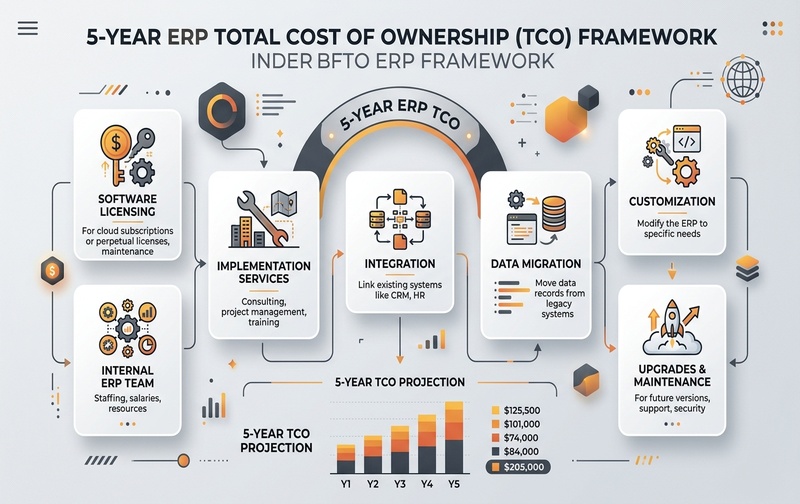
Figure 2: 5-Year ERP Total Cost of Ownership (TCO) evaluation framework covering initial implementation, integrations, customization, data migration, and internal support overhead.
Software Licensing or Subscription
Pricing depends on factors such as: User requirements, Products selected, Modules, Deployment, Countries, Contract structure.
Avoid relying on generic online ERP price tables for final budgeting.
Implementation Services
Implementation cost may include: Discovery, Process mapping, Configuration, Project management, Development, Testing, Migration, Training, Deployment.
Integration
Integration cost can become substantial when ERP must connect with multiple business-critical applications.
Customization
Heavy customization increases both initial and long-term cost.
Internal ERP Team
Consider the resources needed for: Administration, Support, Security, Reporting, Integrations, Enhancements, Master data.
Upgrades and Change
Evaluate whether future product changes require significant internal effort.
The Right Cost Question
Do not ask: “Which ERP is cheaper?”
Ask: “Which ERP delivers the required operating capability at the lowest sustainable total cost?”
A cheaper ERP that requires workarounds, disconnected tools, or later replacement can become the more expensive decision.
Industry Fit: Where Each ERP Is Strongest
Industry fit matters because two businesses with the same revenue can require completely different ERP capabilities.
SAP S/4HANA May Be Stronger For
SAP S/4HANA deserves serious consideration where businesses operate environments such as:
Automotive
Engineering
Pharmaceuticals
Chemicals
Industrial products
Large-scale distribution
Asset-intensive operations
Complex global supply chains
The strongest case exists when operational depth matters as much as finance.
Oracle NetSuite May Be Stronger For
NetSuite deserves consideration for businesses such as:
Software and SaaS businesses
Wholesale distributors
Ecommerce companies
Growing multi-entity businesses
Cloud-first organizations
Businesses seeking unified financial and operational management
These are not absolute boundaries. A manufacturer may use NetSuite successfully, while a services organization may have valid reasons to select SAP.
Industry name alone should never decide ERP fit. The underlying processes should.
SAP S/4HANA vs Oracle NetSuite by Business Requirement
For decision-makers, the following matrix provides a more useful starting point than a simple features checklist.
| Business Requirement | Platform to Evaluate Closely |
|---|---|
| Highly complex manufacturing | SAP S/4HANA |
| Complex global supply chain | SAP S/4HANA |
| Large multinational enterprise processes | SAP S/4HANA |
| Existing strategic SAP ecosystem | SAP S/4HANA |
| Highly specialized business processes | SAP S/4HANA Private Edition |
| Standardized SAP cloud transformation | SAP S/4HANA Public Edition |
| Cloud-first growing organization | Oracle NetSuite |
| Integrated mid-market cloud ERP | Oracle NetSuite |
| Multi-subsidiary financial management | Oracle NetSuite |
| Rapid international expansion with standardized processes | Oracle NetSuite |
| Lower infrastructure administration requirements | Oracle NetSuite |
| Advanced enterprise operational complexity | SAP S/4HANA |
This matrix should create a shortlist—not make the final decision.
The next step should be validating critical processes through demonstrations and solution workshops using your own business scenarios.
When SAP S/4HANA Is the Better Choice
SAP S/4HANA should move higher on the shortlist when several of the following conditions exist:
Your Processes Are Complex
You operate: Multiple plants, Complex manufacturing, Advanced planning, Sophisticated procurement, Extensive warehouse operations, Complex product costing.
Your Supply Chain Is Strategic
Supply chain is not simply an inventory function but a core competitive capability.
You Operate at Significant Global Scale
Multiple countries, legal entities, regulatory environments and enterprise structures require deep control.
You Already Have a Significant SAP Landscape
Existing SAP skills, applications, data and processes can materially influence transformation economics.
Your Industry Requires Process Depth
Some organizations need a level of operational control that goes beyond standardized ERP.
You Need Long-Term Enterprise Process Depth
ERP will become the digital core for highly integrated operations rather than primarily a financial and administrative platform.
In these environments, the additional implementation discipline required by SAP may be justified by the complexity it needs to manage.
When Oracle NetSuite Is the Better Choice
NetSuite should move higher on the shortlist when your priorities are different:
You Want a Cloud-First ERP
The organization wants to minimize infrastructure management and operate on a SaaS foundation.
Your Business Processes Can Be Standardized
You do not require highly specialized enterprise processes across every function.
You Are Scaling Across Subsidiaries
Multi-entity financial and operational management is becoming increasingly important.
You Want a Unified Business Platform
Bringing finance, orders, inventory, CRM, projects and other functions closer together may reduce application fragmentation.
You Have Limited Internal ERP Resources
A standardized SaaS operating model may be attractive where the business does not want extensive ERP infrastructure responsibilities.
Speed and Simplicity Matter
The organization values time to value and standardized processes more than highly specialized configuration.
For these businesses, implementing the deeper complexity of an enterprise platform can sometimes create unnecessary cost without corresponding business value.
CFO, CIO and COO Decision Framework
ERP selection should not be owned solely by IT or finance.
Different executives need to evaluate different dimensions.
CFO: Financial Control and Economics
The CFO should ask:
- What is the five-year TCO?
- How strong is multi-entity consolidation?
- Can we improve financial close?
- How are compliance and controls managed?
- Can we improve working-capital visibility?
- What reporting becomes available?
- How much implementation risk exists?
The CFO’s question is: Does the ERP improve control while creating measurable economic value?
CIO: Architecture and Technology
The CIO should evaluate:
- Cloud architecture
- Security
- Integration
- Data
- Extensibility
- Customization
- Technical debt
- Upgrade model
- Internal skills
- Long-term roadmap
The CIO’s question is: Can we operate and evolve this ERP without creating another technology problem?
COO: Operational Capability
The COO should focus on:
- Procurement
- Inventory
- Production
- Quality
- Supply chain
- Warehousing
- Planning
- Process visibility
- Operational controls
The COO’s question is: Can the ERP run our real business processes at the scale and complexity we expect tomorrow?
When CFO, CIO and COO answers point toward the same platform, the ERP decision becomes far more defensible.
SAP S/4HANA or Oracle NetSuite: Final ERP Selection Checklist
Before selecting either platform, answer these ten questions.
1. How complex are our operations?
Map processes before evaluating software.
2. Which SAP S/4HANA deployment are we actually evaluating?
Public and Private Cloud should not be treated as identical choices.
3. How complex are our manufacturing requirements?
Test real BOM, routing, planning, production and costing scenarios.
4. How global will the business become?
Consider future entities, currencies, regulations and countries—not only today’s structure.
5. Which processes genuinely differentiate us?
Protect differentiation, but avoid customizing processes that provide no competitive value.
6. Which integrations are business-critical?
Document every major application and data flow.
7. What is the five-year total cost?
Include far more than licensing.
8. What ERP capabilities does our internal team have?
The system needs to be manageable after consultants leave.
9. How quickly do we need measurable value?
Balance speed against operational completeness.
10. What will our business look like five years from now?
ERP should support the destination—not merely today’s problems.
If your team cannot answer these questions clearly, it is too early to select either platform.
Final Verdict: SAP S/4HANA vs Oracle NetSuite
There is no universal winner in the SAP S/4HANA vs Oracle NetSuite comparison.
SAP S/4HANA is generally the stronger candidate when complex manufacturing, sophisticated supply chains, enterprise-scale processes, industry depth, or extensive global operations drive the ERP decision.
Oracle NetSuite is generally the stronger candidate when cloud-first operations, standardized processes, multi-entity growth, unified business management, and lower infrastructure complexity are higher priorities.
The most important point is that ERP selection should not begin with a product demonstration.
It should begin with your business.
Recommended Evaluation Flow:
➔
➔
➔
➔
➔
➔
Only then should SAP S/4HANA and Oracle NetSuite be scored against the same requirements.
For CEOs, CFOs, CIOs and COOs, that approach creates a much stronger ERP decision than comparing hundreds of features that may never be used.
Frequently Asked Questions
Is SAP S/4HANA better than Oracle NetSuite?
Neither ERP is universally better. SAP S/4HANA generally fits more complex enterprise operations, while NetSuite can be a strong choice for cloud-first growing businesses with more standardized requirements.
What is the main difference between SAP S/4HANA and NetSuite?
The main difference is operational depth and deployment approach. SAP supports highly complex enterprise processes, while NetSuite emphasizes an integrated SaaS ERP model for scalable cloud operations.
Is NetSuite suitable for large enterprises?
Yes, NetSuite can support substantial multi-entity organizations. Suitability depends on process complexity, industry requirements, transaction volumes, integrations and customization needs.
Which is better for manufacturing: SAP S/4HANA or NetSuite?
SAP S/4HANA is generally stronger for highly complex manufacturing. NetSuite can suit manufacturers whose production, planning, routing and inventory requirements fit its capabilities.
Which ERP is better for growing businesses?
NetSuite may suit businesses seeking standardized cloud ERP and rapid multi-entity growth. SAP S/4HANA may be preferable when growth also creates significant operational complexity.
Is SAP S/4HANA more expensive than NetSuite?
Not necessarily in every case. Total cost depends on deployment, users, modules, implementation scope, customization, integrations, support and internal resources.
How long does SAP S/4HANA implementation take compared with NetSuite?
Implementation time depends heavily on scope. Complex SAP transformations can require more effort, while standardized NetSuite projects may be faster, but either can be delayed by poor data, integrations or scope control.
Can NetSuite replace SAP S/4HANA?
In some organizations, yes. In businesses requiring very deep manufacturing, supply-chain or enterprise-specific processes, replacing SAP S/4HANA with NetSuite requires detailed process-level validation before any decision.
Ready to Compare ERP Fit Before You Invest?
ERP selection should answer one question:
Which system can support your business without forcing you to pay for unnecessary complexity—or outgrow the platform later?
Emerging Alliance helps organizations evaluate ERP requirements across finance, operations, manufacturing, supply chain, integrations and long-term scalability before implementation decisions are made.
Request an ERP Fit Assessment and identify which ERP approach aligns with your current processes, future growth and transformation priorities.