


ERP for Shipbuilding Industry: Managing Project Costs, Procurement, and Production Risks
Quick Answer
ERP for the shipbuilding industry helps shipyards coordinate project budgets, procurement, inventory, production schedules, and financial reporting through connected business processes. When operational information is fragmented across spreadsheets and separate systems, decision-makers may struggle to identify cost overruns, material shortages, purchasing delays, and schedule risks before they affect vessel delivery. Shipbuilding ERP software can improve visibility by connecting relevant operational and financial information, establishing consistent workflows, and supporting more informed project decisions. The right solution depends on the shipyard’s project complexity, existing applications, reporting requirements, and integration needs.
Why Shipbuilding Operations Need Stronger ERP Control
Shipbuilding involves long project cycles, complex material requirements, multiple suppliers, engineering changes, and production activities that must remain coordinated. Each vessel may involve different specifications, budgets, procurement plans, resource requirements, and delivery commitments.
These dependencies make operational control difficult when teams maintain separate records. Project managers may track schedules in spreadsheets, procurement teams may work from purchase-order reports, warehouse teams may update inventory separately, and finance teams may rely on periodic cost summaries.
Although each department may have useful information, disconnected records can prevent management from understanding the overall project position. A purchase order might appear complete while the required material remains unavailable. Production may report progress without reflecting the latest engineering change. Finance may identify a budget variance only after expenditure has accumulated.
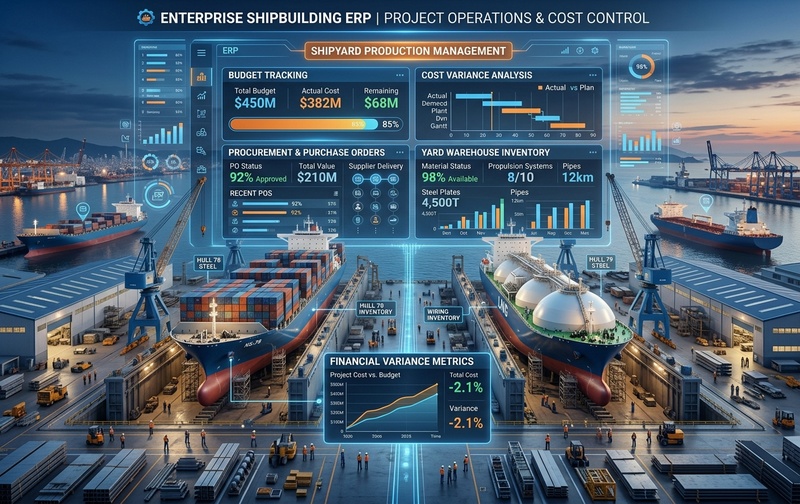
An ERP system can help address these gaps by connecting financial and operational processes. Instead of evaluating project performance through isolated reports, management can use a more consistent view of purchasing, inventory movements, commitments, actual expenditure, and relevant production information.
The objective is not simply to digitize existing paperwork. It is to establish reliable information flows that help decision-makers identify exceptions, assign responsibility, and respond before operational problems escalate.
| Operational Area | Process Gap | Vessel Project Risk | ERP Control Needed |
|---|---|---|---|
| Project Costing | Fragmented commitments and late invoice postings | Cost overruns identified after budget depletion | WBS cost baselines & real-time commitment tracking |
| Procurement | Purchase orders untracked against milestone dates | Out-of-sequence deliveries & idle shipyard labor | Connected PO tracking with confirmed delivery dates |
| Yard Inventory | Delayed receipt postings and unrecorded material issues | Shortages of critical components during dry dock assembly | Project-tagged inventory & multi-warehouse bin tracking |
| Engineering Revisions | Design revisions not synced with purchasing or yard teams | Procurement of obsolete parts & expensive structural rework | Integrated change control (ECO) and revision-controlled BOMs |
| Production Control | Shop-floor progress tracked in isolated spreadsheets | Schedule slippages across block assembly & outfitting | Unified work-order tracking tied to labor and materials |
Project Cost Gaps Can Reduce Shipbuilding Profitability
Shipbuilding projects often involve substantial material purchases, subcontracting, labour, equipment, and other project-specific expenditure. Even when a contract has an approved budget, the final financial outcome depends on how effectively these costs are monitored throughout execution.
Cost visibility becomes difficult when purchase commitments, supplier invoices, material consumption, and project budgets are maintained in different records. Managers may see the original estimate without having a complete picture of committed expenditure or the latest actual costs.
This creates several risks:
- Late identification of cost overruns: If project expenses are reviewed only at periodic intervals, adverse trends may continue before management receives a clear warning.
- Incomplete cost allocation: Materials or services may be recorded against incorrect projects, cost centres, or work packages, making project comparisons less reliable.
- Unclear committed expenditure: Approved purchase orders may represent future financial obligations that are not yet reflected in posted invoices.
- Difficult variance analysis: Finance teams may spend considerable time reconciling transactions before they can explain why actual expenditure differs from the budget.
ERP software for shipbuilders can help establish more consistent project-cost records by connecting purchasing, inventory, and financial transactions with the relevant project structures where the solution supports those workflows.
Management can then review budgeted costs, purchase commitments, recorded expenditure, and outstanding requirements using defined reporting processes. The level of detail depends on system configuration, available data, and integration design.
The business benefit is improved decision support. Leaders can investigate emerging variances, question unexpected purchasing patterns, and assess the financial implications of project changes while decisions remain possible.
Procurement Delays Can Disrupt Vessel Schedules
Shipbuilding depends on the timely availability of materials, equipment, components, and subcontracted services. A delayed delivery can affect more than the purchasing department: it may interrupt a production activity, require schedule changes, or leave other resources waiting.
Procurement risks increase when purchase requests, supplier quotations, approvals, order confirmations, and expected delivery dates are tracked in separate systems.
A procurement team may know that an order has been placed but lack a reliable view of whether the material is required immediately, whether its delivery date has changed, or whether the delay threatens a scheduled production activity.
Common warning signs include:
- Purchase orders without confirmed delivery dates.
- Supplier commitments that are not updated when circumstances change.
- Repeated emergency purchases for previously planned requirements.
- Duplicate or conflicting requests from different departments.
- Limited visibility into approvals and outstanding purchasing actions.
Shipyard ERP software can connect purchasing information with inventory, finance, and project records. Where configured appropriately, users can review purchase requests, approval status, order quantities, expected receipts, and supplier-related information within a consistent process.
This does not eliminate supplier delays. It helps the business recognize and manage them more systematically.
For example, if a critical component has a revised delivery date, procurement and project teams need to understand which requirement is affected, whether alternative stock is available, and what decisions are necessary. A connected ERP workflow can provide the records needed to evaluate these questions.
Decision-makers should also assess whether the proposed system supports the shipyard’s approval structure, supplier processes, purchasing policies, and reporting requirements.
Inventory Inaccuracies Can Affect Material Availability
Shipyards may manage a broad range of materials, including steel, electrical components, mechanical equipment, fittings, consumables, and project-specific parts. Maintaining reliable stock records is essential because material availability influences procurement decisions and production planning.
Inventory problems can occur when receipts are recorded late, material issues are not posted consistently, warehouse locations are inaccurate, or transactions are assigned to the wrong project. Similar problems can arise when teams maintain separate spreadsheets that are not reconciled with the main inventory records.
The consequences are practical and financial:
- A system may show material as available even though it has already been allocated.
- Buyers may order stock that is already held in another yard location.
- Production teams may discover a shortage after work has been scheduled.
- Excess inventory can also tie up working capital without resolving shortages in other materials.
An ERP system can improve inventory control by connecting goods receipts, warehouse transfers, material issues, purchasing transactions, and relevant financial records. Depending on the implementation, it may also support batch or serial tracking, multiple warehouses, defined units of measure, and project-related material allocation.
However, software cannot automatically correct unreliable opening balances or inconsistent transaction practices. Accurate inventory management requires suitable master data, disciplined transaction posting, clear warehouse responsibilities, and regular reconciliation.
Before selecting an ERP solution, shipyard leaders should determine whether it can represent their actual inventory structure, material coding conventions, warehouse processes, and project allocation requirements.
Engineering Changes Create Operational and Financial Risks
Shipbuilding projects may change as technical specifications are refined, customer requirements evolve, or design issues are identified. These changes can affect material quantities, purchasing decisions, production activities, project budgets, and delivery plans.
The risk increases when revised information does not reach every affected team.
For example, an engineering change may make a previously ordered component unsuitable. If procurement continues using an outdated specification, the shipyard may receive material that requires replacement or additional modification. If production teams do not receive the latest approved information, work may need to be repeated.
ERP systems can help maintain a more consistent operational record, but engineering change management often requires integration with specialist design, document-management, or product lifecycle management applications.
Decision-makers should evaluate how a proposed system will handle:
- References to approved specifications and revisions.
- Changes to material requirements and purchasing plans.
- Approval responsibilities and change records.
- Communication between engineering, procurement, production, and finance.
- The financial effect of approved project changes.
The objective is to establish a controlled process for translating approved changes into the business activities they affect. ERP should complement the shipyard’s engineering controls rather than replace specialist engineering functionality without a clear business case.
ERP Capabilities That Support Shipbuilding Project Control
A shipbuilding ERP solution should be assessed against the operational problems the organization needs to solve. A long list of software features is less useful than evidence that the system can support the shipyard’s real workflows.
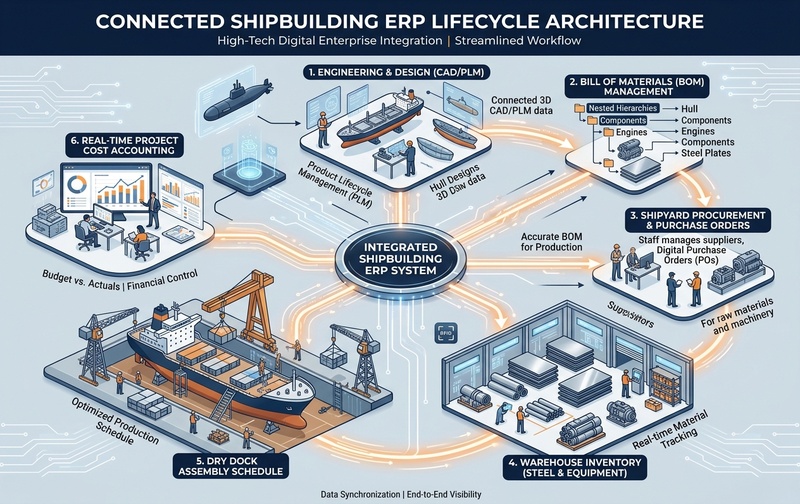
| Shipbuilding Stage | Common Operational Risk | Required Control | ERP Software Role |
|---|---|---|---|
| Engineering & Design | Drawing revisions not communicated to purchasing | BOM revision controls and engineering sign-off | Version-controlled BOM sync with CAD/PLM platforms |
| Project Budgeting | Unrealistic baseline budgets and missing contingency limits | WBS cost baselines tied to procurement commitments | Multi-level cost breakdown structure (WBS) & budget gates |
| Procurement | Unconfirmed delivery dates and emergency re-orders | Milestone-linked PO tracking and supplier confirmation | Purchasing approval workflows and supplier lead-time tracking |
| Yard Warehousing | Stock registered as on-hand but already committed | Project-specific material reservation and bin tracking | Serial/batch traceability and real-time inventory allocation |
| Dry Dock Assembly | Idle work crews waiting on missing materials | Work order scheduling tied to material receipt status | Shop-floor work orders, resource dispatching & variance alerts |
| Commissioning & Delivery | Unreconciled subcontractor invoices and margin erosion | Closed-loop expenditure audit against contract milestones | Final project cost rollup, progress billing, and margin analysis |
Project and Cost Management
The system should support appropriate project structures, budgets, cost allocation, purchasing commitments, and actual expenditure reporting. Management should be able to identify how project costs are developing and investigate material variances.
Procurement and Supplier Coordination
Purchasing workflows should reflect the company’s approval rules, purchasing categories, supplier records, and delivery-monitoring requirements. The system should help users identify outstanding actions and maintain a traceable purchasing history.
Inventory and Material Control
Evaluate stock visibility across relevant warehouses and project allocations. Confirm how the solution records receipts, issues, transfers, adjustments, and other inventory movements. Material planning should use reliable item data and clearly defined processes.
Production and Schedule Visibility
The system should support the operational records required by the shipyard’s production model. Some organizations may need project-level production reporting, work-order controls, or links to specialist planning tools. Confirm which capabilities are native and which require integration or customization.
Financial Management and Reporting
Finance teams need consistent records for supplier invoices, payments, project expenditure, and management reporting. The ERP should support appropriate financial controls and provide a reliable basis for reconciling operational transactions with accounting records.
Management Dashboards and Exception Reporting
Useful reporting highlights actionable problems rather than simply presenting large quantities of data. Examples include overdue purchase orders, material shortages, project-cost variances, outstanding approvals, and incomplete transactions.
The availability of these functions depends on the selected product, licensed modules, configuration, and connected applications. Buyers should validate them against actual business requirements before committing to a solution.
Integrating ERP With Engineering, Production, and Finance Systems
A shipyard may already use specialist applications for computer-aided design, technical documentation, production planning, maintenance, or project scheduling. Replacing every application is not necessarily practical or commercially justified.
The more relevant question is how information moves between these systems and which application is responsible for maintaining each record.
Without a defined integration approach, employees may re-enter the same information in multiple applications. Differences in item codes, project references, supplier records, or transaction status can create reconciliation work and undermine reporting confidence.
An ERP integration assessment should identify:
- Systems and data owners: Determine which application maintains authoritative records for items, suppliers, project structures, technical revisions, and financial transactions.
- Information exchanged: Document the data that must move between systems, how frequently it should be transferred, and which business events trigger an update.
- Validation and exception handling: Establish what happens when records are incomplete, duplicate, rejected, or inconsistent.
- Access and audit controls: Define who can create, approve, change, or view information and how relevant changes are recorded.
- Monitoring and support: Determine how integration failures are detected, investigated, corrected, and escalated.
Integration should be tested using realistic scenarios, including failed transactions, revised requirements, duplicate records, and interrupted connections. Successful transfer of a sample record is not sufficient evidence that the complete business process will operate reliably.
A well-designed integration strategy allows the shipyard to retain suitable specialist tools while improving consistency across purchasing, inventory, project reporting, and finance.
SAP Business One for Shipbuilding-Related Operations
SAP Business One may be worth evaluating for small and midsized shipbuilding businesses or related manufacturers and suppliers whose requirements align with its capabilities. Its suitability depends on the organization’s operational complexity, project controls, production requirements, integration needs, and expected scale.
For relevant businesses, SAP Business One can provide a foundation for financial management, purchasing, inventory, sales, and other supported business processes. Additional configuration, extensions, or integrations may be required to address shipyard-specific workflows.
Before selecting SAP Business One, decision-makers should examine several areas:
- Project cost visibility: Determine whether the available project and financial functions can support the organization’s required cost structures, reporting frequency, and approval processes.
- Material management: Validate item masters, warehouse requirements, stock transactions, and material allocation processes.
- Purchasing controls: Confirm that purchasing approvals, supplier records, order tracking, and financial postings match operational needs.
- Production requirements: Assess the required production planning, work-order, bill-of-material, and material-consumption processes against the product’s actual capabilities and the proposed configuration.
- Engineering integration: Identify whether specialist design or document-management systems must exchange data with the ERP and define how revisions will be controlled.
- Reporting and extensions: Document any dashboards, interfaces, reports, or customized workflows needed to close identified gaps.
Not every shipyard will fit the same ERP model. Businesses with complex vessel engineering, advanced project scheduling, or extensive shipyard-specific functionality may need a broader solution architecture or specialist applications alongside the ERP.
The decision should be based on validated requirements, implementation effort, integration complexity, support arrangements, and total cost of ownership—not on the product name alone.
Customization Should Address Verified Business Gaps
Customization can help an ERP system reflect business processes that are not adequately covered by standard functionality. In shipbuilding, possible requirements include specialized project reports, approval workflows, material allocation rules, or connections to existing operational applications.
However, customization should follow a documented gap assessment.
First, determine whether the requirement can be addressed through standard configuration, reporting, or an existing supported integration. Then evaluate the operational value, implementation cost, maintenance implications, and potential effect on future upgrades.
A poorly controlled customization can introduce dependencies that are difficult to test or maintain. It may also reproduce an inefficient process instead of improving it.
Every proposed change should have a clear business owner, defined acceptance criteria, appropriate testing, and documentation. Where the change affects financial records or inventory transactions, validation and audit requirements should be included in the design.
The aim is to support essential shipyard processes without making the ERP unnecessarily complex.
What Decision-Makers Should Evaluate Before Choosing Shipbuilding ERP Software
Selecting ERP software is an operational and financial decision. Senior leaders should assess whether the proposed system addresses the company’s highest-priority risks and can be implemented within realistic business constraints.
Use the following evaluation areas to structure vendor discussions:
| Evaluation Area | What to Verify | Why It Matters |
|---|---|---|
| 1. Business Requirements | Document existing gaps in cost tracking, procurement, inventory, and yard reporting. Separate critical essentials from optional wants. | Focuses budget on verified operational pain points rather than generic software features. |
| 2. Functional Fit | Require vendors to demonstrate actual shipbuilding workflows and project structures rather than canned standard demos. | Proves software capabilities can handle complex ship construction dependencies. |
| 3. Integration Scope | Define exact data exchanges with CAD, PLM, nesting, and planning tools, including failure recovery protocols. | Prevents costly data silos, duplicate entry, and engineering revision mismatches. |
| 4. Data Quality & Migration | Audit item masters, units of measure, supplier records, WIP balances, and warehouse opening balances. | Avoids carrying legacy discrepancies into the new ERP, securing reliable initial operations. |
| 5. Implementation Ownership | Establish departmental process owners for design sign-offs, data verification, testing, and change management. | Drives internal accountability and smooth shipyard adoption across yard and office staff. |
| 6. Total Cost of Ownership | Calculate licenses, implementation fees, customizations, maintenance, infrastructure, and ongoing support. | Eliminates budget surprises and establishes realistic return-on-investment timelines. |
| 7. Reporting & Governance | Verify real-time exception alerts, audit trails, user permission boundaries, and approval controls. | Ensures management spots cost overruns and delays before they damage delivery targets. |
| 8. Scalability & Support | Assess partner shipyard experience, multi-site scalability, and the vendor’s long-term product roadmap. | Safeguards the investment against obsolescence as the yard handles larger contracts. |
- 1. Business requirements: Document the current problems with cost visibility, procurement, inventory, production coordination, and reporting. Separate essential requirements from optional improvements.
- 2. Functional fit: Ask vendors to demonstrate the relevant workflows using realistic shipbuilding scenarios rather than generic product presentations.
- 3. Integration scope: Identify every required connection, the responsible application, the data exchanged, and the approach to monitoring failures.
- 4. Data quality and migration: Review item masters, supplier records, opening inventory, outstanding orders, project balances, and other information that must be migrated or reconciled.
- 5. Implementation responsibilities: Establish who will own process design, data preparation, testing, training, deployment, and post-go-live support.
- 6. Total cost of ownership: Consider licenses, implementation, integrations, customization, infrastructure, support, training, and future changes. The final cost depends on the agreed scope and operating model.
- 7. Reporting and governance: Confirm how management will monitor exceptions, control access, review approvals, and maintain accountability for key transactions.
- 8. Scalability and support: Evaluate expected business growth, additional locations, changing requirements, partner capabilities, and ongoing system maintenance.
A structured assessment reduces the risk of choosing a system based primarily on price or a feature checklist. It also helps management establish measurable acceptance criteria before implementation begins.
Preparing for a More Controlled ERP Implementation
Even a suitable ERP platform can deliver disappointing results if the implementation begins without clear process ownership, reliable data, or agreed priorities.
Shipyard management should start by documenting the current operating model and identifying where delays, discrepancies, duplicated work, and cost visibility gaps occur. These findings should inform the implementation scope.
The next step is to prioritize business-critical workflows. A company might begin with purchasing, inventory accuracy, financial reporting, and project-cost visibility before introducing more complex integrations. The appropriate sequence depends on the organization’s operational dependencies and risk exposure.
Data preparation deserves particular attention. Duplicate item codes, inconsistent units of measure, incomplete supplier details, and inaccurate opening balances can carry existing problems into the new system. Cleansing, validation, reconciliation, and accountable sign-off should therefore be part of the implementation plan.
Testing should cover complete business scenarios. For example, a material requirement may lead to a purchase request, an approved order, a goods receipt, an inventory update, a supplier invoice, and a financial posting. Testing only individual screens may not reveal failures between these steps.
User training should also reflect each department’s responsibilities. Procurement, warehouse, production, project management, and finance teams need to understand how their transactions affect other parts of the business.
Finally, define how success will be evaluated. Relevant measures may include the timeliness of cost reporting, purchase-order visibility, inventory record accuracy, unresolved integration exceptions, and completion of required approvals. Baseline measurements and agreed targets are necessary before performance changes can be assessed.
Conclusion
Shipbuilding is an inherently complex, multi-year engineering and construction endeavor where disconnected records directly threaten delivery schedules and commercial margins. Deploying a connected ERP solution bridges the critical divide between shipyard operations, procurement commitments, warehouse stock, engineering change orders, and financial accounting.
By establishing verified data ownership, automated approval hierarchies, and real-time variance visibility, shipyards can shift from reactive troubleshooting to proactive project governance. Success requires assessing real workflows, maintaining clean master data, and aligning software capabilities with the shipyard’s specific operating model.
Frequently Asked Questions
Request a Consultation for Shipbuilding ERP Requirements
Disconnected project costs, procurement, inventory, and financial data can limit operational visibility and affect delivery and profitability.
Request a consultation with Emerging Alliance to review your ERP requirements, identify process and integration gaps, and explore suitable SAP solutions based on your business needs.