
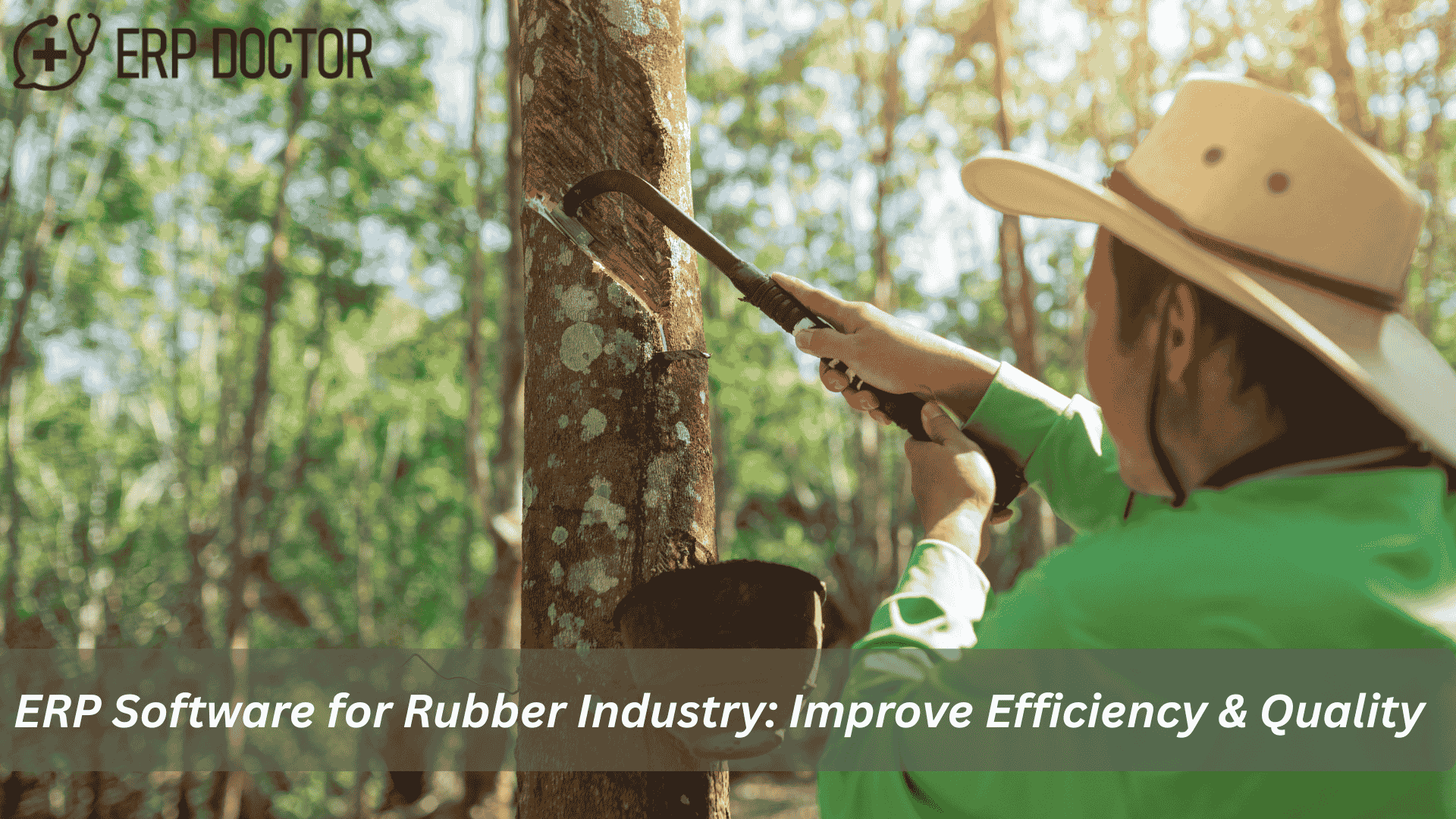
ERP Software for Rubber Industry: Improve Efficiency & Quality
How Manufacturing ERP Software for Rubber Industry Boosts Efficiency, Quality & Traceability
Rubber manufacturers today face competitive pressures, fluctuating raw material costs, and strict quality expectations from global buyers. This is exactly where Manufacturing ERP Software for Rubber Industry becomes a game-changer, helping companies gain complete visibility, streamline daily operations, and improve traceability without complexity.
Understanding Rubber Manufacturing Challenges Today
The rubber manufacturing industry is unique due to its complex production cycles, variable raw materials, and customer-specific specifications. A typical rubber business handles:
- Compounding with precise chemical proportions
- Multiple rubber types (Natural, SBR, NBR, Butyl, Neoprene, Viton, FKM, HNBR)
- Batch mixing results that vary daily
- Strict quality parameters
- Machine-dependent production
- High wastage and scrap tracking
This makes manual coordination impossible as your company grows.
This is where a Rubber ERP software turns into a strategic asset, not just a tool.
Why Modern Rubber Manufacturers Choose ERP for Rubber Manufacturing
A top-notch manufacturing rubber ERP solution is designed to solve core industry demands such as:
- Material accuracy
- Production planning
- Quality assurance
- Traceability
- Regulatory compliance
- Cost control
- Delivery commitments
Whether you are a tyre manufacturer, rubber components supplier, gasket producer, or industrial rubber parts maker, ERP helps synchronize every process into one connected system.
Bold subtopics below cover the operational improvements a Rubber ERP system brings.
Boosting Production Efficiency With ERP Software
Production scheduling becomes simplified with ERP. Manufacturers can automate routing based on machine type, mould availability, and material readiness.
Key improvements include:
- Automated Bill of Materials (BOM) for each compound
- Real-time updates on production status
- Shift-wise job allocation
- Equipment downtime tracking
- Reduced changeover times
- Accurate WIP (Work in Progress) visibility
ERP eliminates guesswork and ensures every order flows smoothly from compounding to curing.
Enhancing Quality Control in ERP for the Rubber Industry
Rubber production quality is sensitive to temperature, curing time, mix ratio, and chemical accuracy. An ERP ensures strict consistency.
Quality control features include:
- Lab testing and QC parameter logging
- Batch sampling with auto-compliance alerts
- Traceability of defects back to raw material or machine
- Recipe-based compound validation
- Automated rejection and rework monitoring
This makes audits simpler and customer confidence stronger.
Streamlining Material Management With Rubber ERP System
Raw materials such as latex, carbon black, chemicals, oils, fillers, pigments, and additives need precise tracking.
ERP enables:
- FEFO (First-Expiry-First-Out) issuing
- Real-time inventory visibility
- Automated low-stock alerts
- Accurate batch-tracking of each material
- Vendor management and pricing comparison
Losses and wastage drop significantly with a connected ERP solution.
Cloud-Based ERP Software for Rubber Industry Advantages
A Cloud Based ERP Software for Rubber Industry ensures you can manage operations from anywhere—ideal for multi-plant setups.
Benefits:
- Lower IT cost
- Faster deployment
- Scalable as the business grows
- Automatic software updates
- Accessible on mobile and web
- Enhanced security
Cloud ERP ensures business continuity even during disruptions.
Key Features of ERP for Rubber Industry
A modern ERP rubber system includes features such as:
- Recipe Management
- Batch Mixing Control
- Compound Standardization
- Machine Load Optimization
- Production Planning & Control
- Quality Inspection
- Scrap Management
- Dispatch & Delivery Management
- Financial Accounting & Costing
- HR & Payroll for factory workforce
Every module is integrated, eliminating data duplication.
Specialized ERP Modules for Different Rubber Types
Rubber manufacturers work with diverse materials. ERP supports specialized workflows for:
- Natural Rubber Manufacturing ERP
- SBR (Styrene Butadiene Rubber) Manufacturing ERP
- Butyl (IIR) Rubber Manufacturing ERP
- Nitrile (NBR) Rubber Manufacturing ERP
- Neoprene Rubber Manufacturing ERP
- Viton (FKM) Rubber Manufacturing ERP
- Hydrogenated Nitrile Rubber Manufacturing ERP
Each variant requires specific compounding parameters and quality checks that ERP handles accurately.
ERP Modules of Manufacturing Industries Relevant to Rubber
Rubber production aligns with common industrial ERP modules:
- Procurement & Supply Chain
- Inventory & Warehouse Management
- Production & Plant Management
- Quality Assurance
- Sales & Distribution
- Financials
- Costing & Budgeting
- Maintenance Management
- CRM for customer communication
ERP brings every department under one digital roof.
Benefits of Manufacturing Rubber ERP Software
Implementing ERP gives manufacturers measurable improvements:
- Higher production speed
- Reduced wastage and scrap
- Consistent product quality
- Lower operational cost
- On-time customer deliveries
- Accurate forecasting
- Improved decision-making
- End-to-end traceability
- Faster order-to-dispatch cycle
These outcomes directly increase profitability
Choosing the Right Rubber ERP Software
When selecting an ERP solution for your rubber business, evaluate:
- Industry-specific functionality
- Ability to handle custom processes
- Cloud readiness
- Mobile access
- Customization flexibility
- Support and training availability
- Integration with machines (Industry 4.0)
Custom ERP solutions are often preferred because rubber workflows differ significantly between companies.
Why Top ERP Systems for the Rubber Industries Stand Out
Top-rated manufacturing ERP software systems share essential strengths:
- Real-time visibility
- Automated production workflows
- Seamless material tracking
- Smart data-driven alerts
- Multi-location support
- Scalability for future growth
The best ERP systems help rubber manufacturers improve efficiency across compounding, mixing, extrusion, moulding, curing, and finishing processes.
Practical Use Cases of ERP for Rubber Top ERP Platforms for the Rubber Industry: Best Solutions to Consider in 2025
Rubber manufacturers require precision, flexibility, and complete traceability to handle complex batches, variable raw materials, and strict customer specifications. As the industry moves toward automation and data-driven manufacturing, ERP systems have become essential for achieving high efficiency, quality consistency, and end-to-end process control.
Below are the most trusted ERP platforms rubber manufacturers are adopting in 2025.
1. SAP Business One
SAP Business One remains one of the top choices for rubber component manufacturers, tyre plants, and industrial rubber goods companies.
Key capabilities include:
- Recipe & formula management for compound mixing
- Batch tracking from raw material to finished product
- Accurate costing and material consumption analytics
- Integrated QC for hardness, tensile, curing time & composition
- Strong production planning for moulding, extrusion & curing
SAP B1’s customizability makes it ideal for rubber companies with complex processes and multiple product lines.
2. Microsoft Dynamics 365
Dynamics 365 is widely used for large and mid-sized rubber manufacturers who want automation, IoT integration, and real-time insights.
Benefits:
- IoT-based machine monitoring (mixers, extruders, curing presses)
- Predictive maintenance for high-load rubber machinery
- AI-driven demand and material forecasting
- Workflow automation for job orders and batch approvals
- Mobile dashboards for plant supervisors
Dynamics 365 is perfect for rubber companies with multiple plants or continuous, high-volume production.
3. Oracle NetSuite
A fully cloud-based ERP ideal for growing rubber businesses looking for scalability and flexibility.
Key features:
- Multi-level BOM for rubber compounding
- Live inventory tracking for chemicals, carbon black, oils & polymers
- Strong procurement automation for vendor management
- Production scheduling with batch consistency monitoring
- Real-time financial consolidation
NetSuite’s cloud architecture makes it suitable for companies expanding globally or managing multiple warehouses.
4. Infor CloudSuite Industrial (CSI)
Infor CSI is popular among rubber manufacturers requiring deep batch control and heavy production automation.
Core strengths:
- Recipe-based compound standardization
- Quality tracking across mixing, extrusion, moulding & curing
- Advanced scheduling for machine load optimization
- Scrap & wastage analysis tools
- Compliance-ready documentation for audits
Infor is ideal for companies handling sensitive compounds or high-consistency rubber products.
5. Odoo ERP
Odoo is a cost-effective ERP solution widely adopted by small and mid-sized rubber manufacturers transitioning from manual systems.
Advantages:
- Configurable modules for compounding, WIP, QC & dispatch
- Real-time material tracking with barcode support
- Easy customization for unique rubber workflows
- Cloud or on-premise deployment options
- Fast implementation with low ownership cost
Odoo is perfect for small component manufacturers, job-order rubber units, and growing factories.
Why These ERPs Stand Out for Rubber Manufacturing
These ERP systems lead the industry because they support essential rubber-specific needs such as:
- Batch and compound traceability
- Precise recipe control
- Machine-wise & mould-wise production planning
- Scrap and rework tracking
- Integration with mixers, extruders, & curing machines
- Quality validation for each production stage
- End-to-end visibility from raw materials to dispatch
With Industry 4.0 adoption rising, these ERPs give rubber manufacturers the tools to reduce wastage, increase output, improve consistency, and scale smarter.
Why ERP Software Is Essential for the Rubber Manufacturing Industry
A powerful ERP software for the rubber manufacturing industry provides complete operational control—from raw material procurement to production, quality checks, and final delivery. With an integrated and modern manufacturing solution, rubber producers can automate workflows, reduce manual errors, and maintain consistent product quality. Real-time data, production tracking, and inventory visibility help manufacturers respond faster to demand changes. The system also improves compliance, ensures better resource utilization, and supports faster decision-making. By adopting advanced rubber manufacturing ERP software, companies achieve higher efficiency, improved traceability, and long-term cost savings.
ERP Doctor offers a powerful and fully integrated ERP software designed specifically for the rubber manufacturing industry, giving businesses complete control—from raw material procurement to production, quality management, and delivery. Our advanced solution helps manufacturers automate operations, reduce errors, and maintain consistent product quality. With real-time data visibility, smart inventory tracking, and seamless process integration, companies can respond quickly to market demands. Emerging Alliance’s ERP also enhances compliance, boosts resource efficiency, and supports faster decision-making. By choosing our cutting-edge rubber manufacturing ERP, businesses achieve higher productivity, complete traceability, and long-term cost savings.
Frequently Asked Questions (FAQs) about Rubber ERP Software
1. What is an ERP Software for Rubber Manufacturing Industry?
ERP Software for the Rubber Manufacturing Industry is a specialized system that integrates procurement, production, inventory, sales, and quality control to streamline end-to-end rubber production processes.
2. How do ERP Modules of Manufacturing Industries help rubber manufacturers?
ERP modules—such as production planning, inventory management, finance, and quality control—help rubber manufacturers improve accuracy, reduce downtime, and maintain complete operational visibility.
3. Why do companies need a Rubber Production ERP System?
A Rubber Production ERP System ensures traceability, standardized quality, automation of shop-floor tasks, and real-time monitoring of raw materials to finished goods.
4. Can a Customized ERP Software support unique rubber manufacturing workflows?
Yes. Customized ERP software can be tailored to specific rubber processes like compounding, vulcanization, moulding, curing cycles, and batch tracking.
5. What are the key benefits of choosing a Rubber ERP Software?
Rubber ERP Software improves production planning, reduces wastage, ensures consistent quality, optimizes machine utilization, and enables real-time decision-making.
6. How does ERP support Production Management in the Rubber Industry?
ERP systems track batch recipes, machine parameters, work orders, labour allocation, and curing timelines to ensure accurate and efficient production management.
7. What makes the Top ERP Systems for the Rubber Industries different?
Top ERP systems offer industry-specific features such as compound formulation, barcode-enabled tracking, quality compliance, and advanced scheduling for rubber production.
8. Is a Rubber Industry ERP suitable for small and medium manufacturers?
Absolutely. Modern ERP solutions are scalable and allow SMEs to automate processes, reduce manual errors, and grow faster with accurate data.
9. How does ERP deliver real-time traceability in rubber manufacturing?
ERP enables end-to-end traceability by tracking raw materials, batches, production stages, and finished goods, ensuring strict quality and compliance.
10. How to choose the best ERP systems for rubber manufacturing?
Look for features like customization options, production planning tools, quality management, scalability, mobile access, and strong support for rubber-specific workflows.