

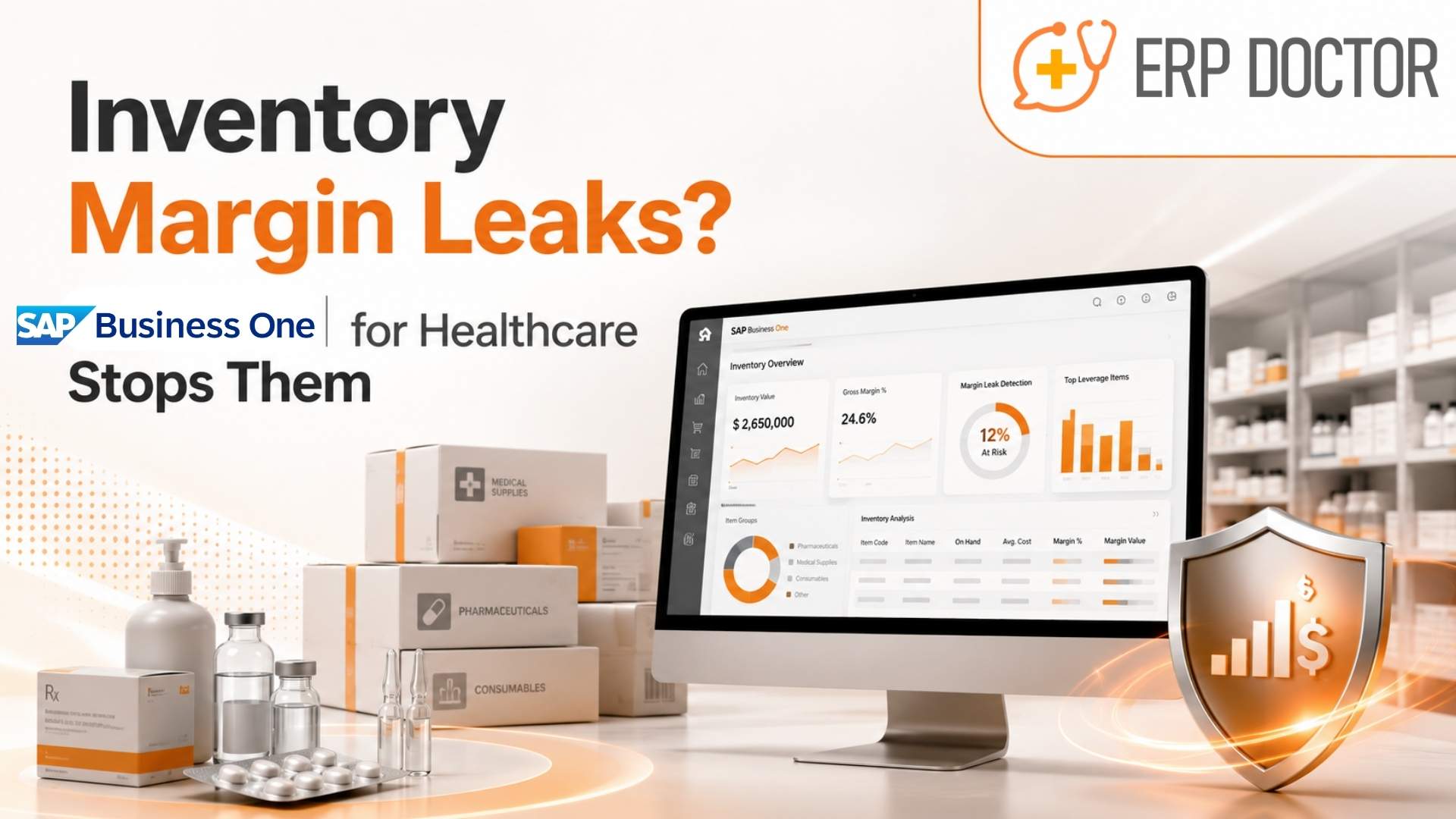
Inventory Margin Leaks? SAP Business One for Healthcare Stops Them
SAP Business One for Healthcare: Expiration Prevention That Saves Thousands Monthly
Healthcare organizations rarely lose profitability because of a lack of demand. More often, margins disappear through expired inventory, inaccurate batch tracking, stock imbalances, and delayed operational decisions. These hidden inefficiencies quietly increase costs while making compliance and patient service more difficult. SAP Business One for Healthcare gives healthcare businesses real-time control over inventory, batch traceability, purchasing, finance, and reporting within a single ERP platform. Instead of reacting to expired stock or missing inventory after the damage is done, leadership gains visibility early enough to prevent losses before they occur.
Why Inventory Margin Leakage Is Growing Across Healthcare Organizations
Inventory leakage is one of the largest hidden costs in healthcare operations. Whether managing pharmaceuticals, medical devices, diagnostics, or healthcare consumables, every expired product represents lost revenue that can never be recovered.
Common causes include:
- Products approaching expiration without proactive alerts
- Overstocking slow-moving inventory
- Poor batch and lot visibility across warehouses
- Manual inventory reconciliation
- Disconnected procurement and finance systems
- Limited forecasting accuracy
These problems don’t stay inside the warehouse.
They affect:
- Cash flow
- Working capital
- Procurement planning
- Regulatory compliance
- Customer satisfaction
- Executive decision-making
Without complete operational visibility, organizations often discover these issues only after monthly financial reviews—when corrective action is already too late.
How SAP Business One for Healthcare Prevents Inventory Loss Before It Happens
The biggest advantage of SAP Business One for Healthcare is that it transforms inventory management from reactive to proactive.
Instead of relying on spreadsheets and manual stock reviews, every inventory movement is tracked in real time across purchasing, warehousing, sales, and finance.
Key capabilities include:
Real-Time Batch Tracking
Every batch remains traceable from procurement through final distribution.
Organizations immediately know:
- Batch location
- Available quantity
- Expiration date
- Movement history
- Customer allocation
This dramatically reduces inventory uncertainty.
Expiration Monitoring
Automated alerts notify teams before products approach expiry.
Rather than writing off inventory, businesses can:
- Prioritize dispatch
- Adjust purchasing
- Reallocate inventory between locations
- Launch promotional movement strategies
Even a small reduction in monthly expirations can generate substantial annual savings.
Why Manual Inventory Management Creates Hidden Business Risk
Manual inventory processes create far more than operational inconvenience. They increase financial exposure, compliance risks, and executive uncertainty.
Typical warning signs include:
- Multiple inventory spreadsheets
- Duplicate data entry
- Inconsistent stock counts
- Limited warehouse visibility
- Delayed reporting
- Difficult month-end reconciliation
As organizations grow, these issues become increasingly expensive.
SAP business one ERP for Healthcare Industry replaces fragmented systems with a unified operational environment where finance, inventory, procurement, and distribution work from the same data.
The result is fewer operational surprises and faster executive decision-making.
If these warning signs sound familiar, a healthcare ERP assessment can often identify the highest-impact opportunities before they become larger financial problems.
Better Batch Traceability Improves Compliance and Patient Safety
Healthcare organizations cannot afford uncertainty around product traceability.
Every regulated product must remain traceable throughout its lifecycle.
SAP Business One healthcare solution supports:
- Batch traceability
- Lot management
- Expiration monitoring
- Product recall readiness
- Audit documentation
- Regulatory reporting
When regulators request historical information, organizations can retrieve complete transaction records quickly instead of searching through disconnected systems.
Compliance becomes part of daily operations rather than a last-minute reporting exercise.
Smarter Purchasing Reduces Overstock and Stockouts
Effective purchasing depends on accurate operational data.
When inventory visibility is limited, purchasing teams often respond by ordering excess stock “just in case.”
This creates:
- Higher inventory carrying costs
- More expired inventory
- Locked working capital
- Warehouse congestion
With SAP Business One for Healthcare, purchasing decisions are based on real-time inventory levels, historical demand, reorder points, and current consumption patterns.
Organizations purchase with greater confidence while maintaining service continuity.
Implementing SAP Business One Successfully Requires More Than Software
Technology alone does not deliver transformation.
Successful Implementing SAP Business One projects begin with understanding operational workflows, regulatory requirements, reporting needs, and future growth plans.
A structured SAP Business One implementation healthcare approach typically includes:
Business Process Assessment
Current operational challenges are documented before system design begins.
Solution Design
ERP workflows are aligned with healthcare-specific inventory, procurement, finance, and compliance requirements.
Data Migration
Historical master data, inventory records, vendors, and customers are transferred accurately.
User Training
Operational teams receive role-specific training to encourage rapid adoption.
Continuous Optimization
Post-go-live improvements ensure the ERP continues supporting business growth as operations evolve.
Organizations that invest in structured implementation generally achieve stronger adoption and faster returns.
Many healthcare businesses discover that a pre-implementation process review identifies inefficiencies that can be resolved even before deployment begins.
SAP Business One for Healthcare vs Traditional Inventory Management
| Traditional Operations | SAP Business One for Healthcare |
| Spreadsheet-based tracking | Real-time inventory visibility |
| Manual batch management | Automated batch traceability |
| Reactive expiry management | Proactive expiration alerts |
| Disconnected departments | Integrated finance, inventory, and procurement |
| Delayed reporting | Real-time executive dashboards |
| Manual compliance records | Automated audit-ready documentation |
As organizations expand, the gap between manual processes and integrated ERP becomes increasingly significant.
How SAP Business One for Healthcare Delivers Measurable Business Outcomes
For CEOs, CIOs, COOs, and Operations Heads, ERP success is measured by business outcomes—not software features.
SAP Business One for Healthcare helps organizations achieve measurable improvements in areas that directly influence profitability and operational resilience.
Expected outcomes include:
- Lower inventory write-offs
- Reduced product expiration losses
- Improved batch visibility
- Faster executive reporting
- Better regulatory readiness
- More accurate purchasing decisions
- Improved working capital utilization
- Higher operational efficiency
These improvements create a stronger operational foundation while supporting sustainable growth.
A concise conclusion that reinforces the business value and leads naturally into your CTA:
Conclusion
Inventory losses rarely happen because of a single operational mistake—they result from limited visibility, disconnected processes, and delayed decisions that compound over time. For healthcare organizations, these inefficiencies affect profitability, compliance, and the ability to maintain consistent service levels.
SAP Business One for Healthcare provides the real-time inventory control, batch traceability, and operational intelligence needed to reduce expiration-related losses, improve decision-making, and strengthen financial performance. By replacing reactive inventory management with proactive business visibility, healthcare leaders can protect margins while building a more scalable and resilient operation.
You can follow this immediately with your CTA section to maintain a strong lead-generation flow.
Frequently Asked Questions
1. How does SAP Business One for Healthcare reduce product expiration losses?
The system continuously tracks expiration dates and inventory movement. Automated alerts help teams prioritize inventory before products expire, significantly reducing write-offs and protecting margins.
2. Is batch traceability available across multiple warehouse locations?
Yes. Batch information remains visible across warehouses, enabling organizations to locate inventory quickly and manage stock transfers efficiently while maintaining full traceability.
3. Can SAP Business One support healthcare compliance requirements?
Yes. The platform maintains detailed audit trails, batch records, inventory history, and transaction documentation that simplify regulatory reporting and internal audits.
4. What makes SAP Business One healthcare solution different from generic ERP software?
Healthcare organizations require stronger batch control, expiration management, regulatory reporting, and inventory traceability. The solution addresses these operational requirements within an integrated ERP environment.
5. How long does SAP Business One implementation healthcare typically take?
Implementation timelines depend on business complexity, number of users, integrations, and data migration requirements. A phased approach often helps reduce operational disruption while improving user adoption.
6. Does SAP Business One improve purchasing decisions?
Yes. Procurement teams gain access to real-time inventory levels, historical consumption, demand trends, and reorder recommendations, helping reduce both overstocking and stock shortages.
7. Can executives monitor inventory performance without waiting for monthly reports?
Absolutely. Interactive dashboards provide real-time visibility into inventory value, batch utilization, expiry exposure, purchasing activity, and financial performance.
8. Is implementing SAP Business One suitable for growing healthcare companies?
Yes. The platform is designed to scale with business growth, allowing organizations to expand operations without replacing their ERP infrastructure as requirements evolve.
9. How does the Healthcare reporting system improve decision-making?
It consolidates operational, financial, procurement, and inventory data into unified reports. Leadership teams can identify trends, monitor KPIs, and respond to operational issues much faster.
10. What should organizations evaluate before implementing SAP Business One?
They should assess existing workflows, inventory accuracy, reporting challenges, compliance requirements, integration needs, and future growth objectives. This preparation leads to a smoother implementation and stronger long-term value.
Reduce expiration losses, improve batch visibility, and gain real-time inventory control with SAP Business One for Healthcare.
Book a free consultation with us to identify hidden inventory leaks and explore the right ERP strategy for your healthcare business.