
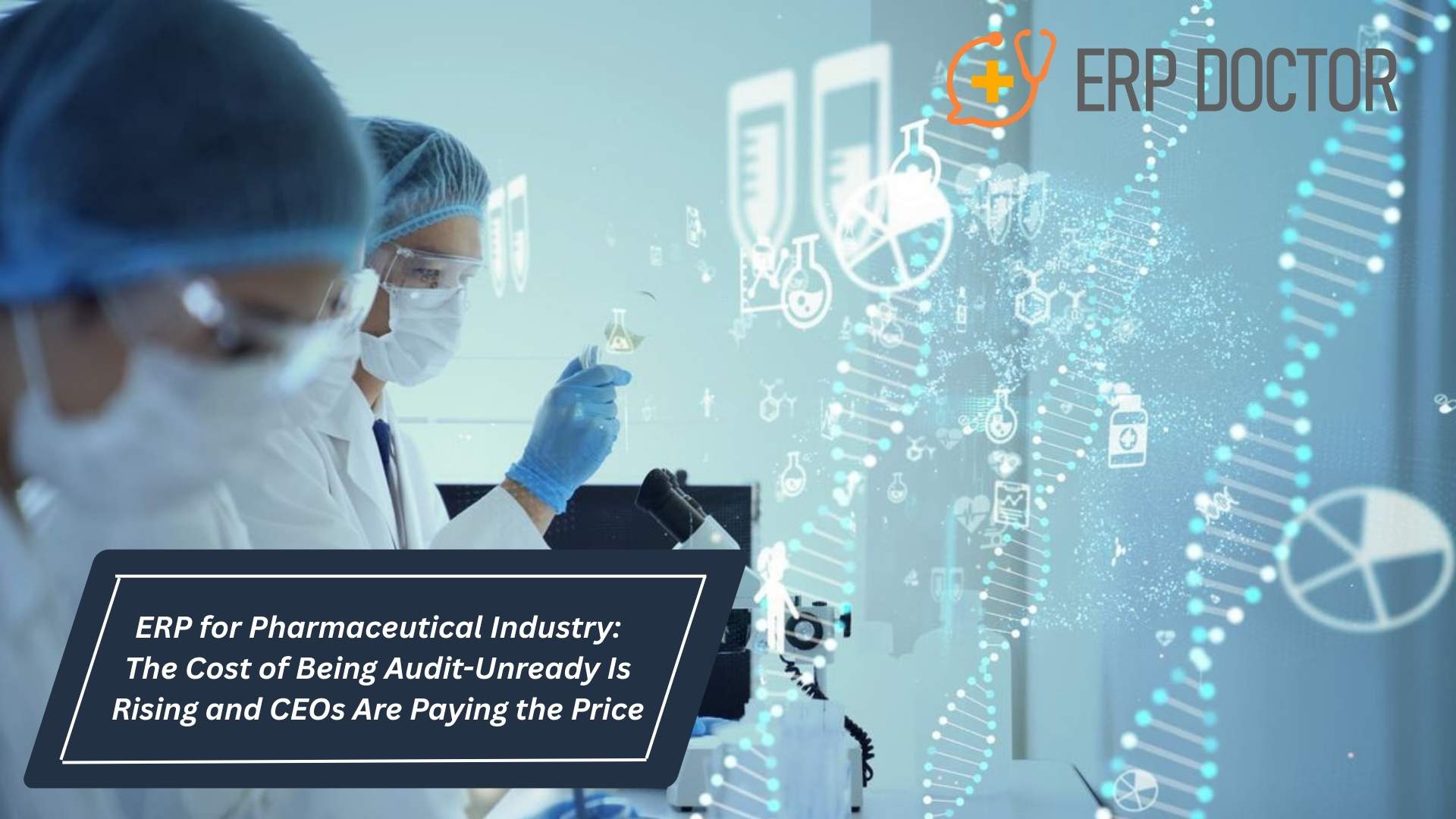
ERP for Pharmaceutical Industry: The Cost of Being Audit-Unready Is Rising and CEOs Are Paying the Price
How ERP for Pharmaceutical Industry Is Becoming a CEO’s First Line of Defense Against Audits, Risk, and Margin Erosion
In the pharmaceutical industry, audits are no longer occasional regulatory hurdles. They are constant, unforgiving, and increasingly expensive when companies are unprepared. From data integrity gaps to traceability failures, the cost of being audit-unready is rising—and CEOs are absorbing the impact through lost revenue, delayed approvals, and reputational damage. This is why ERP for pharmaceutical industry adoption has moved from an IT discussion to a strategic leadership decision. Modern pharmaceutical ERP software is no longer just about process automation; it has become the backbone of audit readiness, operational resilience, and margin protection.
Why ERP for Pharmaceutical Industry Readiness Determines Audit Outcomes
In today’s environment, regulators expect instant access to accurate, validated data across manufacturing, quality, finance, and distribution. Manual systems and disconnected pharmaceutical industry software simply cannot keep up.
An erp software system in pharmaceutical industry centralizes batch records, validation logs, quality events, and financial data into a single source of truth. During inspections, this eliminates delays, data inconsistencies, and compliance risks that often trigger audit observations.
For CEOs, ERP in pharmaceutical industry operations reduces regulatory uncertainty and ensures the organization is always inspection-ready—not just scrambling before an audit.
ERP for Pharmaceutical Industry as a Control Tower for Manufacturing and Quality
Manufacturing and quality failures are among the most expensive audit findings. Pharmaceutical manufacturing ERP platforms integrate production planning, material traceability, and quality control ERP for pharma into one continuous workflow.
With erp systems for pharmaceutical manufacturing, companies gain real-time visibility into deviations, CAPAs, and batch genealogy. Quality management ERP for pharmaceuticals ensures SOP enforcement and documentation integrity, while pharmaceutical manufacturing software reduces dependency on manual records.
This level of control allows leadership to proactively manage risk rather than react to regulatory setbacks.
ERP for Pharmaceutical Industry and the Hidden Cost of Poor Data Integrity
Data integrity violations are now one of the most common regulatory citations. Spreadsheets, legacy pharma manufacturing software, and siloed pharmaceutical ERP systems create gaps that regulators easily detect.
Pharma ERP software ensures controlled access, audit trails, version control, and electronic signatures. Whether it’s pharmaceutical ERP modules for quality, finance, or production, ERP software for pharmaceuticals strengthens data credibility across the enterprise.
For CEOs, this translates into fewer warning letters, faster approvals, and sustained market trust.
Integrated ERP Platforms Strengthening Distribution Control and Financial Governance in Pharma
Audit readiness doesn’t stop at manufacturing. ERP for pharma distribution and sales and distribution ERP for pharma ensure serialized tracking, cold-chain compliance, and recall readiness across the supply chain.
At the same time, financial management ERP for pharmaceutical companies aligns cost structures, pricing controls, and margin analysis. With ERP software for pharma companies, leaders can link operational performance directly to financial outcomes—critical in a margin-sensitive market.
This is where ERP solutions for pharmaceutical industry operations move beyond compliance and actively protect profitability.
Pharmaceutical ERP Systems Driving End-to-End Digital Transformation
Digital maturity is now a regulatory expectation. Cloud ERP for pharmaceutical industry platforms support validation, scalability, and remote audit readiness while reducing infrastructure risk.
Digital transformation ERP for pharma also enables faster erp implementation in pharmaceutical industry environments by standardizing workflows and reducing customization debt. For growing organizations, ERP for pharmaceutical companies supports global expansion without multiplying compliance complexity.
Modern pharmaceutical ERP software is no longer optional—it is foundational.
AI-Enabled Pharma ERP Solutions Delivering Predictive and Intelligent Operations
The next evolution is AI-enabled ERP for pharma. These systems analyze trends across quality events, production delays, and financial leakage to predict risks before they escalate.
AI-driven pharmaceutical ERP systems help leaders identify early warning signals—whether a supplier quality issue, a batch deviation pattern, or margin erosion in distribution channels.
For CEOs, this transforms ERP from a reporting tool into a decision-intelligence platform.
Choosing the Best ERP Software for Pharma and Biotech
Selecting the best ERP for pharmaceutical industry use depends on regulatory scope, scale, and complexity. Leading pharmaceutical ERP solutions offer modular architectures covering pharmaceutical manufacturing ERP, pharmaceutical distribution software, and pharmacy ERP software.
For specialized firms, best ERP for biotech companies and best ERP software for life sciences companies provide flexibility while maintaining compliance rigor. The goal is not just automation—but audit resilience and operational confidence.
CEOs Can’t Afford to Be Audit-Unready Anymore
In the pharmaceutical industry, audit failures now directly impact growth, valuation, and leadership credibility. ERP for pharmaceutical industry adoption has become a CEO-level mandate—protecting compliance, margins, and long-term competitiveness.
Organizations that invest early in ERP software for pharmaceutical industry operations gain more than regulatory readiness. They gain control, visibility, and confidence in an increasingly unforgiving market.
FAQs About ERP for Pharmaceutical Industry
1. Why are ERP systems essential for audit readiness in pharmaceutical operations?
Enterprise platforms centralize regulatory documentation and operational records, allowing pharmaceutical companies to respond to audits faster and with greater accuracy.
2. How do ERP solutions support regulatory compliance across pharma organizations?
Pharma-focused ERP solutions standardize workflows, enforce controls, and maintain secure, time-stamped audit trails aligned with regulatory expectations.
3. Can pharmaceutical ERP platforms improve quality management outcomes?
Yes, integrated quality and compliance modules help reduce deviations, streamline CAPA processes, and lower inspection risks.
4. What role do ERP systems play in pharmaceutical manufacturing and production planning?
ERP platforms align materials, production schedules, and validated processes to ensure efficient manufacturing while meeting compliance requirements.
5. How do ERP platforms help pharma companies control costs and protect margins?
By integrating financial data with manufacturing and supply chain operations, ERP systems provide real-time cost visibility and more accurate forecasting.
6. Are cloud-based ERP systems safe for regulated pharmaceutical environments?
Modern cloud ERP platforms are built with validation support, robust security controls, and compliance with global pharmaceutical regulations.
7. How does ERP improve supply chain visibility in pharmaceutical distribution networks?
ERP systems enable end-to-end tracking, serialization, and batch traceability, ensuring compliance across complex supply chains.
8. Can ERP systems support global expansion for pharmaceutical companies?
Yes, enterprise ERP solutions manage multi-country regulations, currencies, tax structures, and regional distribution requirements.
9. Why are ERP platforms well-suited for both biotech and pharmaceutical companies?
Industry-specific functionality, modular architecture, and scalability make ERP platforms adaptable to evolving biotech and pharma business models.
10. How does artificial intelligence enhance ERP capabilities in pharma operations?
AI-powered ERP systems deliver predictive insights for demand forecasting, quality risk detection, and proactive decision-making.