
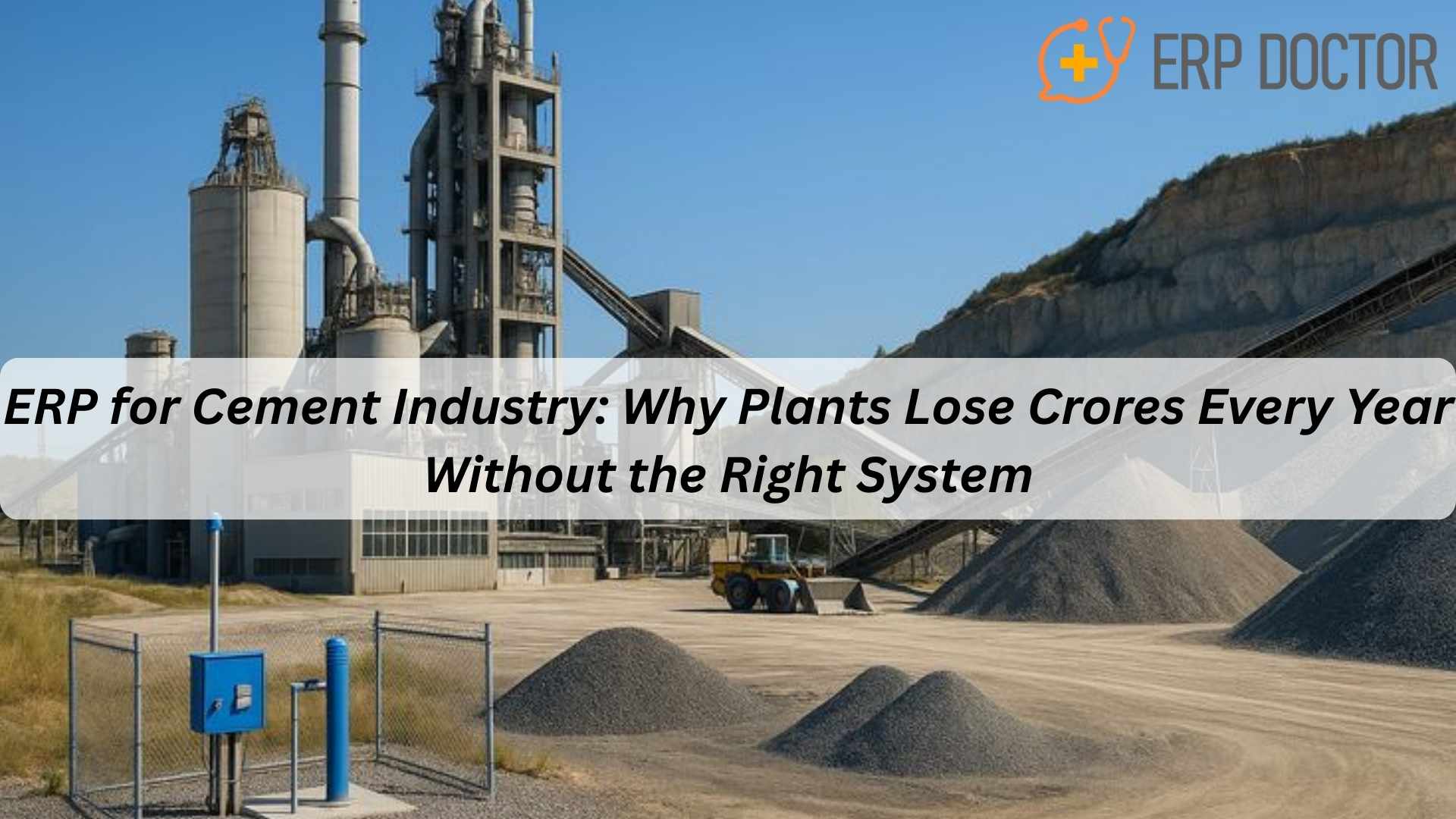
ERP for Cement Industry: Why Plants Lose Crores Every Year Without the Right System
Disconnected systems drain profits—ERP for Cement industry is the fix CEOs choose
Across India, cement manufacturers operate in one of the most capital-intensive and operationally complex environments. From quarry management and clinker production to dispatch, dealer management, and compliance, every step demands precision. Yet many plants still rely on fragmented tools—spreadsheets, legacy applications, and manual coordination. The result is silent value leakage running into crores every year. This is where Enterprise resource planning (ERP) becomes a strategic necessity rather than an IT upgrade. ERP for Cement Industry unifies operations, improves visibility, and helps leadership regain control over margins. This blog explores why cement plants lose money without the right system and how an integrated approach changes the game.
ERP for Cement industry challenges caused by disconnected plant operations
In many cement companies, production, maintenance, procurement, finance, and sales work in silos. Without a unified ERP system for cement plants, data flows slowly and decisions are often reactive.
Common challenges include:
- Cement Production ERP Production plans that don’t align with dispatch realities
- Inventory mismatches between mines, plants, and depots
- Maintenance breakdowns due to lack of predictive insights
- Financial closing delays impacting strategic planning
An integrated ERP software in the cement industry eliminates these silos by creating a single source of truth across departments.
Visibility Gaps in Cement Operations Without an Integrated ERP System
Cement manufacturing is a continuous process. Even a small disruption can cause major financial loss. Without a purpose-built cement manufacturing ERP solution, managers lack real-time visibility into kiln performance, fuel consumption, and output quality.
With cement manufacturing with ERP software, plants can:
Track production KPIs in real time
Monitor raw material usage and wastage
Align production schedules with demand forecasts
This level of transparency directly impacts cost control and throughput.
Cost Leakages in Cement Procurement and Inventory Without ERP Integration
Procurement inefficiencies are another major reason cement plants lose crores annually. Over-stocking spare parts, emergency purchases, and untracked vendor contracts inflate costs.
A centralized ERP solutions for the cement industry framework helps by:
Standardizing procurement workflows
Providing accurate inventory valuation
Linking purchase decisions to production and maintenance needs
This is why many leaders now prefer ERP solutions for cement manufacturing that integrate supply chain and finance seamlessly.
Distribution Losses Beyond the Factory Gate in Cement Supply Chains
Profit erosion doesn’t stop at production. Dispatch delays, billing errors, and dealer disputes often arise from poor coordination between sales and logistics.
Using cement distribution ERP software and cement distribution software, companies can
- Automate order-to-cash cycles
- Improve dispatch planning and route optimization
- Reduce revenue leakage from billing mismatches
A robust cement distribution ERP solution ensures that finished goods translate into realized revenue faster.
Managing Regulatory Complexity in Cement Manufacturing Operations
The Indian cement sector operates under strict regulatory oversight. Manual compliance tracking increases the risk of penalties and reputational damage.
Modern ERP software in the Indian cement industry supports:
- Automated statutory reporting
- Audit-ready financial records
- Standardized processes across multiple plants
This makes implementation for the cement industry not just an efficiency moves, but a governance requirement.
Scalable ERP Architecture for Growing Cement Manufacturing Companies
As cement groups expand capacity or acquire new plants, complexity multiplies. Systems that worked for one unit fail at scale.
A unified ERP for cement manufacturing enables:
- Multi-plant consolidation
- Standard operating procedures across locations
- Faster integration of new business units
This is why fast-growing players invest early in ERP for cement companies rather than patching systems later.
Strategic Decision-Making in Cement Enterprises Powered by Real-Time ERP Data
Ultimately, leadership decisions are only as good as the data behind them. Fragmented tools produce delayed and inconsistent reports.
With cement ERP software and cement industry ERP software, CXOs gain:
- Real-time dashboards
- Accurate cost-to-serve analysis
- Scenario planning based on live operational data
This transforms ERP from a back-office tool into a strategic asset.
ERP as the Digital Transformation Backbone for the Cement Sector
Beyond efficiency, ERP is the backbone of digital transformation. Advanced analytics, automation, and future innovations depend on clean, structured data.
By adopting ERP software for cement and ERP software for manufacturing industry, cement plants lay the groundwork for:
- Predictive maintenance
- Energy optimization
- Data-driven sustainability initiatives
In short, cement industry solutions start with the right ERP foundation.
Cement plants don’t lose crores overnight—it happens gradually through inefficiencies, blind spots, and disconnected systems. A comprehensive Best ERP software for Cement Industry these issues holistically. From production to distribution, compliance to strategy, the right platform turns complexity into control. Cement Industry Management Software For cement manufacturers aiming to protect margins and scale profitably, ERP is no longer optional—it’s essential.
FAQs About ERP for Cement industry
1. How does an ERP system help cement manufacturers improve operational control?
An integrated ERP for Cement Production connects production, finance, and logistics, giving cement manufacturing leaders real-time operational visibility. This unified control reduces manual interventions and improves coordination across departments.
2. Why is ERP essential for cost management in cement manufacturing businesses?
An ERP solution links procurement, inventory, and finance, helping cement manufacturers identify and eliminate hidden cost leakages. It also improves vendor negotiations through accurate consumption and pricing data.
3. Can ERP software support compliance requirements in cement operations?
Yes, ERP systems automate statutory reporting, audits, and documentation for cement manufacturing enterprises. This reduces regulatory risks and ensures timely compliance with industry and government norms.
4. How does ERP improve strategic decision-making for cement industry executives?
ERP platforms provide real-time dashboards and analytics tailored to cement operations. Executives can make faster, data-driven decisions based on accurate plant and financial insights.
5. Is ERP suitable for multi-plant cement manufacturing operations?
Scalable ERP systems support centralized control and standardized processes across multiple cement plants. This ensures consistent performance reporting and operational efficiency across locations.
6. How does ERP streamline distribution and logistics for cement companies?
ERP integrates sales, dispatch, logistics, and billing into a single workflow for cement businesses. This improves order fulfillment accuracy and reduces disputes with dealers and transporters.
7. What role does ERP play in the digital transformation of cement enterprises?
ERP acts as the core data backbone for digital initiatives within cement manufacturing. It enables advanced technologies like automation, predictive analytics, and process optimization.
8. Can ERP help reduce equipment downtime in cement manufacturing plants?
Yes, ERP supports preventive maintenance planning and tracks asset performance across cement facilities. This minimizes unplanned shutdowns and extends equipment life cycles.
9. How long does ERP implementation usually take for cement manufacturing companies?
Implementation timelines vary based on scope and complexity of cement operations. A structured rollout approach ensures smoother adoption and faster return on investment.
10. Why should growing cement manufacturers invest early in an ERP system?
Early ERP adoption helps cement businesses scale operations without process inefficiencies. It creates a strong foundation for future expansion and digital maturity.