
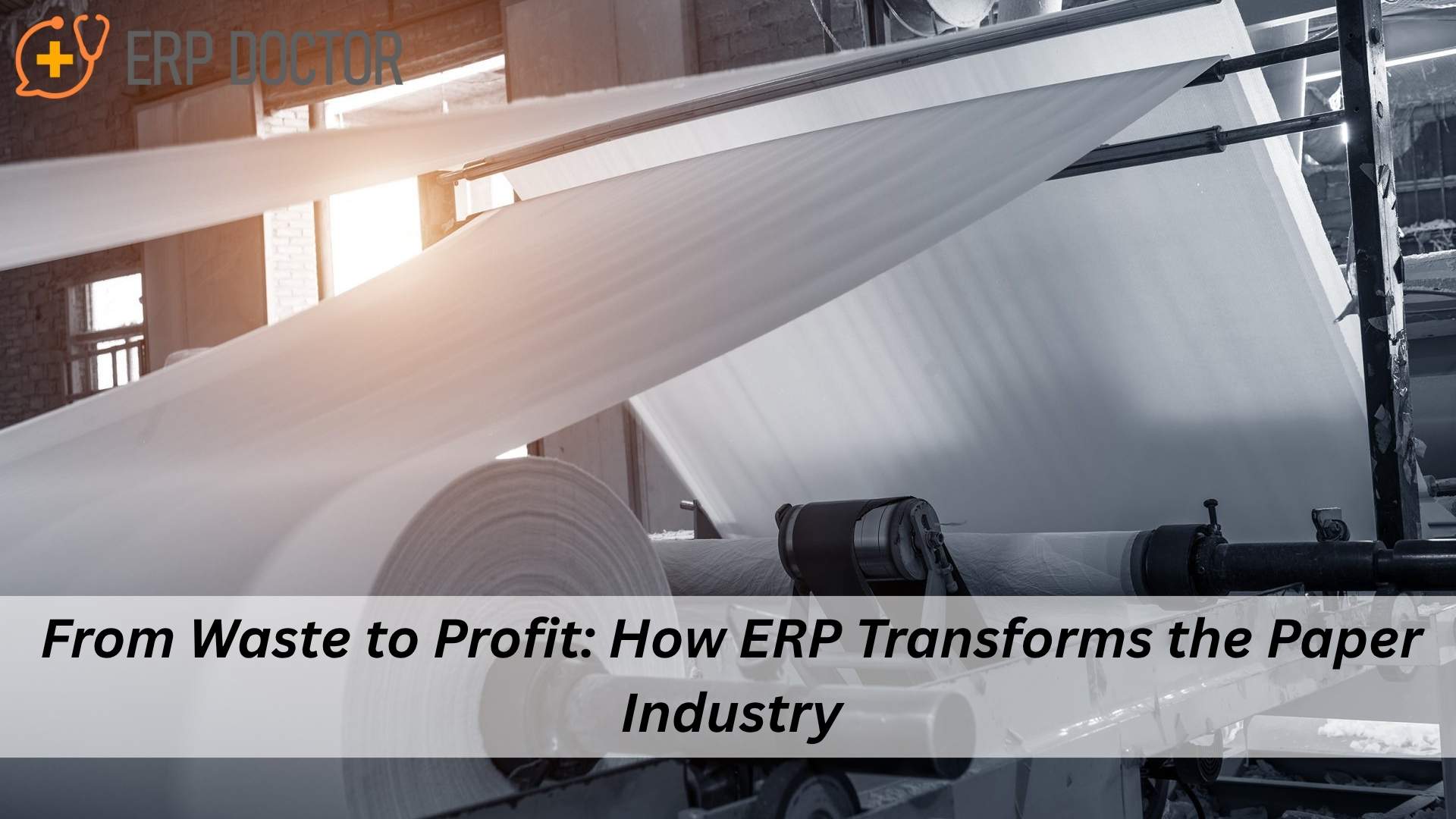
From Waste to Profit: How ERP Transforms the Paper Industry
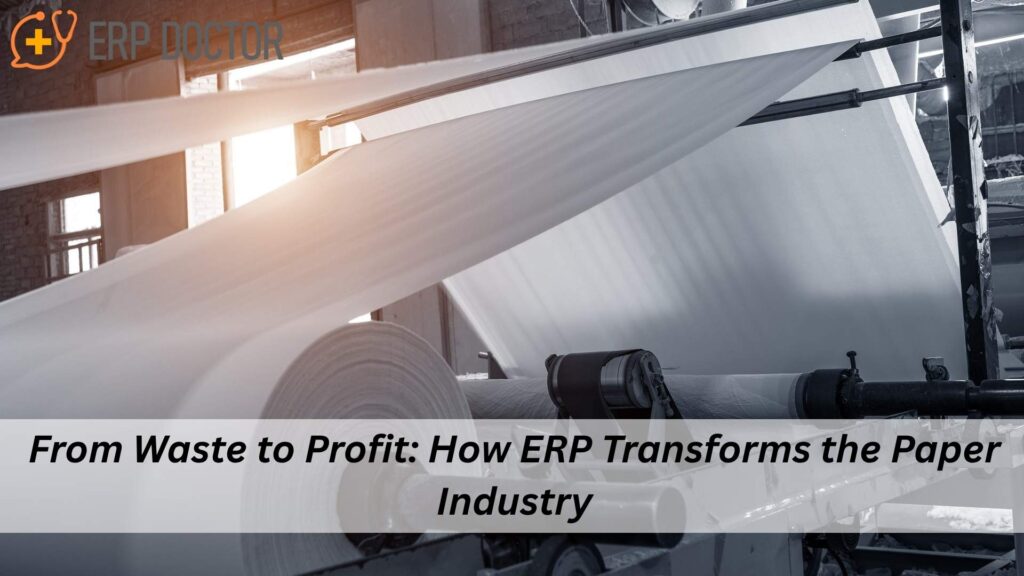
How ERP for Paper Industry Turns Waste into Profit
The paper industry is a high-volume, low-margin business, where even minor inefficiencies can significantly impact profitability. Rising raw material costs, fluctuating energy prices, labor challenges, and strict environmental regulations make operational efficiency more critical than ever. Waste from production defects, scrap, machine downtime, or overproduction can quietly erode revenue and reduce margins. Implementing ERP (Enterprise Resource Planning) for the Paper Industry has become essential for modern paper manufacturers. Specifically, ERP for Paper Industry help mills integrate production, inventory, and customer management into a single platform. By streamlining processes and improving real-time visibility, paper mills can minimize waste, optimize operations, and turn operational efficiency into measurable profit.
Managing Waste Efficiently Through ERP for Paper Manufacturing
Paper manufacturing involves multiple steps: pulping, refining, sheet formation, drying, cutting, coating, rolling, and packaging. Each stage introduces potential waste through
- Trim losses during deckle and cutting
- Overproduction due to inaccurate forecasting
- Material waste from quality inconsistencies
- Machine downtime and process delays
- Excess inventory leading to ageing and scrap
- Poor reel tracking and mismatched specifications
- Even a minor waste percentage can cost millions annually.
Advanced Paper Industry Management System addresses these challenges at every level
1. Optimized Production Planning
ERP for Paper Manufacturing integrates sales forecasts, machine capacity, raw material availability, and production scheduling in real time, ensuring reduced rework and overproduction while lowering trim losses through optimized deckle management. It enables better allocation of resources, improves energy efficiency by optimizing machine usage, and enhances forecasting accuracy, reducing stock-outs and emergency orders. A well-designed production plan increases machine efficiency and minimizes unnecessary consumption of raw materials and energy, directly contributing to higher profitability.
2. Real-Time Quality Tracking
Modern Tissue Paper ERP Software provides advanced quality management tools that monitor GSM, moisture, BF, thickness, brightness, and reel properties throughout the production process. This allows early detection of deviations, reduces rejected rolls, and ensures consistent quality with minimal scrap. In addition, automated reporting supports compliance and audits, while faster root-cause analysis prevents recurring quality issues. These capabilities directly convert saved materials into revenue and enhance overall production reliability.
3. Smart Inventory & Material Management
Accurate control of waste paper, pulp, chemicals, and finished goods is essential for paper manufacturers. Paper ERP systems offer batch and lot traceability, FIFO/FEFO stock control, and minimize waste during conversion processes. They also improve demand planning and replenishment efficiency while providing real-time visibility of inventory across multiple plants. These features eliminate over-stocking, prevent expiry losses, and reduce mismanaged reel inventory, ensuring smooth operations and cost savings.
4. Enhanced Machine Utilization
Machine downtime is one of the most significant hidden waste sources in paper manufacturing. ERP for Paper Industry provides preventive maintenance tools that predict breakdowns, intelligently schedule servicing, and improve overall machine uptime. Additionally, it tracks overall equipment effectiveness (OEE) for informed decision-making and enables condition-based monitoring to extend machine life. By maximizing uptime, mills achieve higher output with fewer resources, boosting operational efficiency.
5. Improved Customer Alignment through CRM
A built-in CRM for Paper Industry helps mills align production with customer expectations more accurately, reducing wrong-size production, return orders, delivery delays, and customer disputes. It also streamlines communication with clients, enabling faster responses, and provides data-driven insights to support personalized offerings and better demand forecasting. These improvements enhance customer satisfaction while directly increasing profit margins and operational efficiency.
Best ERP Systems for the Paper Industry
Below are the top ERP for Paper Manufacturing platforms widely adopted by paper mills worldwide due to their advanced manufacturing capabilities.
- SAP S4HANA for Paper Industry
SAP S4HANA stands out for large paper mills needing deep process integrations. With real-time analytics, advanced planning, machine integration, and strong quality modules, it supports complex workflows like pulp processing, reel tracking, and deckle optimization. Its digital core helps large manufacturers reduce waste, improve accuracy, and maximize productivity. - Microsoft Dynamics 365 for Paper Industry
Dynamics 365 is ideal for medium to large paper manufacturers needing flexibility and scalability. Its strong supply chain modules, production planning tools, and integrated CRM make it a powerful solution. The platform is cloud-based, easy to integrate, and excellent at reducing operational waste through automation and predictive insights. - Oracle NetSuite for Paper ERP Systems
Oracle NetSuite, a fully cloud-native ERP, excels in centralized control for multi-plant operations. It handles batch processing, quality checks, scheduling, and material tracking elegantly. NetSuite is known for improving visibility across the entire manufacturing lifecycle—reducing scrap, standardizing processes, and improving inventory accuracy. - Infor CloudSuite Industrial for Paper Manufacturing
Infor CloudSuite is highly specialized for process manufacturing industries. It offers strong shop-floor control, real-time OEE monitoring, and advanced production scheduling tailored to process-driven operations like paper manufacturing. Its built-in analytics help mills monitor waste patterns and take corrective action faster. - SAP Business One for Paper Industry
For small to mid-sized paper mills, SAP Business One provides an affordable and efficient platform. It supports material planning, reel tracking, basic production scheduling, and quality testing. When combined with industry add-ons, it offers features like conversion management and trim loss tracking—making it ideal for growing manufacturers.
Choosing the Right ERP for Your Paper Mill
Selecting the ideal ERP for Paper Industry depends on your plant size, production complexity, and business goals. While all platforms listed offer waste reduction and efficiency gains, consider these factors:
- Scalability: Ensure the ERP can grow with your operations, supporting additional lines, plants, or product variations.
- Industry Specialization: Choose a system with modules specifically designed for paper manufacturing, such as trim loss management, reel tracking, and pulp processing.
- Integration Capabilities: The ERP should seamlessly connect with existing machinery, MES (Manufacturing Execution Systems), and CRM tools for real-time data flow.
- User-Friendly Interface: Staff adoption improves when the system is intuitive and accessible, reducing training time and errors.
- Analytics & Reporting: Look for dashboards that provide actionable insights on waste, production efficiency, and inventory management to drive continuous improvement.
By carefully evaluating these criteria, paper mills can select an ERP for Paper Manufacturing platform that not only reduces waste but also maximizes operational efficiency and profit potential.
FAQs About ERP for Paper Industry
1. What benefits does Infor CloudSuite ERP offer for paper mills?
Infor CloudSuite ERP monitors machine performance, schedules preventive maintenance, and provides real-time shop-floor insights, maximizing uptime and reducing operational waste.
2. Can SAP S/4HANA ERP help reduce production waste in the Paper Industry?
Yes, SAP S/4HANA integrates production planning, quality checks, and inventory management to minimize scrap, trim losses, and overproduction in paper manufacturing.
3. Why is SAP Business One ideal for quality management in paper manufacturing?
SAP Business One, a leading Paper ERP system, tracks GSM, moisture, thickness, and reel properties, ensuring consistent quality and reducing rejected rolls.
4. How can Microsoft Dynamics 365 ERP improve efficiency in paper production?
Dynamics 365 ERP, part of ERP for Paper Manufacturing, supports predictive maintenance, optimized scheduling, and inventory control, improving material utilization.
5. Is cloud ERP suitable for modern paper mills?
Yes, cloud ERP solutions like Oracle NetSuite and Infor CloudSuite Industrial offer scalability, multi-plant visibility, and real-time analytics for smarter decision-making.
6. What role does ERP play in maintaining consistent paper quality?
Paper Industry Management Systems such as SAP and Dynamics 365 monitor key production parameters in real time, reducing defects and ensuring uniform quality.
7. How does Oracle NetSuite optimize inventory management for paper manufacturers?
Oracle NetSuite, a top Paper ERP system, provides centralized stock management, batch tracking, and automated FIFO/FEFO control, minimizing overstock and scrap.
8. Can ERP reduce machine downtime in paper production?
Yes, Tissue Paper ERP Software like Infor CloudSuite tracks equipment performance, predicts failures, and schedules preventive maintenance to maximize efficiency.
9. Why is ERP important for accurate costing in paper mills?
ERP for Paper Industry, including SAP and NetSuite, tracks material usage, energy consumption, and scrap rates to provide precise costing and support profit analysis.
10. Can Paper ERP systems handle multiple product types effectively?
Yes, systems like SAP Business One and Dynamics 365 manage different GSM, reel sizes, coatings, and grades efficiently, streamlining operations and reducing waste.